The 2021 Magic Quadrant for Master Data Management (MDM) Solutions went public yesterday as reported here.
Quasimodo is the main protagonist of the novel The Hunchback of Notre-Dame. Somehow the plot of vendors in this year’s MDM quadrant looks like (a caricature of) a hunchback. The vendors are in general better in “Ability to Execute” than in “Completeness of Vision”.
So, MDM vendors in general may lack something in market understanding, marketing strategy, product strategy, innovation and more.
This does resonate with me. As also stated in the quadrant some vendors are too invisible in the market buzz. There are heaps of emerging MDM use cases where it is not that easy to find a suitable solution not to say finding one well-fit solution for a range of use cases in a given organization with a given IT landscape.
Semarchy and Riversand have advanced to being leaders
Contentserv, Reltio and Ataccama have moved up as challengers
Syniti and PiLog are new inclusions in the report
Propecta MDO has emerged into the honourable mentions part of the report
The market is probably also heading up. As stated in the report: “From March 2020 — when COVID-19 became a pandemic and global crisis — until December 2020, Gartner had a 28% increase in client inquiries compared with the same period in 2019”.
You can, against a small set of your Personally Identifiable Information, get a free copy of the report at the Semarchy site here.
Stay tuned for more pieces of take away from the quadrant report in the coming days.
Today the 11th January 2021 we should, according to the Gartner publishing schedule, expect a refreshed Gartner Magic Quadrant for Master Data Management (MDM) Solutions.
Historically these quadrants have been delayed possibly due to fighting with vendors objecting to the results herein.
An observation is that the thorough process applied by Gartner makes the results in here a bit behind what is currently happening on the market as touched in the post Why are Analyst Rankings Behind the MDM Market Dynamics? If say the information used in a fresh published quadrant is between a half to a full year old, the latest quadrant to be used in a given tool assessment can be founded on up to 2 years old data.
The last Magic Quadrant for MDM was mentioned in this post.
As touched in the post the two advancing vendors in here were Informatica, who extended their lead, and Semarchy, who became top challenger.
With Informatica it is hard to confirm their position in other analyst reports. Informatica has a dysfunctional relationship with Forrester, so they are not included in their latest MDM reports. Information Difference did not assess Informatica that favourable in their ranking as seen in the post Who is in the MDM Landscape Q2 2020? Will be interesting to see if Gartner keeps having a view on Informatica MDM which is different from most other sources.
Semarchy seems to keep up their momentum from what I hear from the market. Let us see if Gartner reflects that too.
The fastest growing vendor last time was Reltio as reported in the post What has Changed with the Gartner MDM Magic Quadrant? I hope Gartner keeps publishing these revenue estimates, so we can see who has grown the most and who has grown not so much or even shrunk as it happened with IBM and Riversand in the previous check.
Stay tuned for a summary of and link to first free reprints of the refreshed MDM Magic Quadrant.
From time to time, analyst firms publish market reports that include their opinion and ranking of the vendors/solution providers in a specific market, such as Master Data Management (MDM).
Reading such reports, it strikes me that the rankings often do not seem to be in line with what is going in the market, especially when you consider market positioning, demand and technological developments.
One example was touched on in my post “The Latest Constellation Research MDM Shortlist” where the analyst firm in question seemed to take a long time to understand that Oracle had left the MDM market.
Gartner’s Magic Quadrant reports are generally the most popular; their rankings often appear in corporate PowerPoint decks when businesses want to evaluate and select the right MDM solution that fits their needs. And yet, I would argue that Gartner is more conservative in its approach. For example, it took Gartner a long time to abandon the notion that there was a separate customer MDM and product MDM enterprise-level market, as I examined in my post “Who will become Future Leaders in the Gartner Multidomain MDM Magic Quadrant?”
You’ll notice that the magic quadrant from 2017 had a very limited number of market players on it; it excluded several vendors who offer MDM via cloud subscription models who are now recognised as key players and who, in hindsight, should have been included on many shortlists back then.
So, when the next Gartner Magic Quadrant for MDM is published (currently scheduled for the end of November 2020, though I hear it may be pushed to January 2021), I would always recommend you take a look at who is not included as well as those who are, and ask yourself what information has led Gartner to rank the vendors the way they have.
In that sense, Gartner’s thoroughness can often work against them as a lot of the data used in the upcoming report will be from 2019. Also, you should be aware that customer feedback is given by those who made the decision to implement a specific solution; I often hear a number of differing opinions from people across a business when they evaluate MDM solutions.
It’s also interesting to note how analyst firms differ between them. Examples from the world of MDM include a dysfunctional relationship between Forrester and Informatica as well as between Gartner and IBM, and how Forrester, opposed to Gartner, has a much more favourable assessment of a new kind of MDM provider like Reltio.
Disclosure: I recently worked with Reltio on a webinar and a white paper.
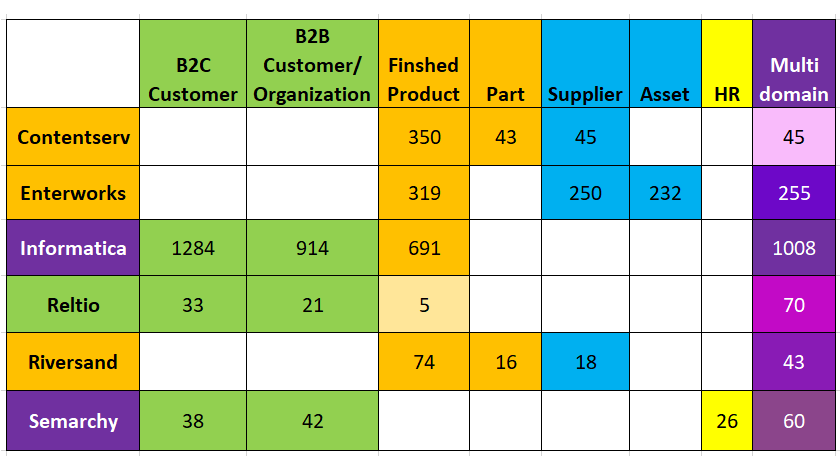
Some of the hard facts presented in the Gartner Magic Quadrant for Master Data Management (MDM) Solutions is how the vendor licenses are distributed between the various master data domains. You can find these figures from the previous quadrant in the post Counting MDM Licenses.
The above figure shows the three domains where the vendor has sold the most licenses and how many customers who are handling multiple domains.
Contentserv is coming from a strong position in the Product Information Management (PIM) market and still have the vast part of licenses attached to product master data.
Enterworks is also coming from the PIM space and are with their ecosystem wide (or interenterprise as Gartner says) approach building up the multidomain grip through encompassing supplier master data.
Informatica is covering all domains with their suite of 360 solutions and have a good portion of customers doing multidomain MDM.
Reltio does cover all domains but are increasingly focusing on the customer domain with their connected customer 360 offering that encompasses all customer data.
Riversand is another vendor coming from the PIM space that is now growing into the multidomain MDM sphere with their new cloud-native platform.
Semarchy is with their Intelligent Data Hub concept going beyond multidomain MDM into handling more kinds of data as reference data and critical application data.
This diversity means that you cannot just use a generic ranking as presented in the magic quadrant when selecting the best fit solution for your intended solution. You must make a tailored selection.
The latest Gartner Magic Quadrant for Master Data Management (MDM) Solutions was published last month.
There was not much movement in the vendors positioning compared to last year. Only, as told in the post The Latest MDM Magic Quadrant, Informatica went further top-right with their suite of 360 solutions and Semarchy went up and above SAP MDG as the top challenger.
Semarchy was also among the ones with the highest revenue growth, so their Intelligent Data Hub approach seems to work pretty well both technically and commercially.
Some years ago Gartner dropped mentioning other MDM vendors than the ones meeting the quadrant criteria. This year a small section of those has returned as Honorable Mentions. These are Magnitude Software, who recently has returned to branding their MDM offering as Kalido, Software AG, PiLog. Unidata, Boomi – the integration-oriented solution from Dell, and the data quality specialist Syncsort – who has acquired Pitney Bowes’ software and data business.
The market overview section was smaller and less informative this year. In here Gartner confirms that digitalization remains the most significant driver for growth in the MDM market and that privacy regulations also continue to drive exploration of MDM initiatives.
You can, against a minimal of personal info, download the report from Semarchy here.
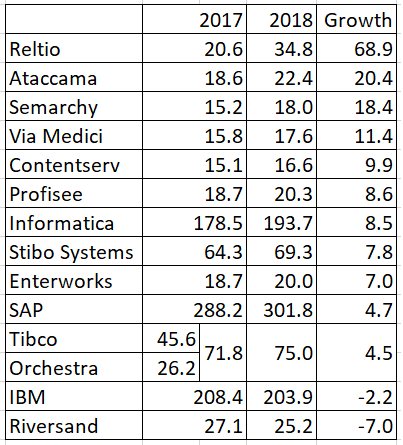
MDM license and maintenance revenue in M USD and growth %. Source: Gartner.
While the change in positions is limited the change in market share is more significant, if we look at the license and maintenance revenue estimates provided by Gartner. The numbers included in the new quadrant published in January 2020 are 2018 estimates. The figure here compares those numbers to the 2017 numbers included in the previous quadrant published in December 2018.
The trend is that the largest providers are not growing as fast as some of the midsize providers, where Reltio, Ataccama and Semarchy are going in the fast lane.
If any of the solution providers have some 2019 updates, please comment here.
With some delay the latest Gartner Magic Quadrant for Master Data Management Solutions has now been published and has began surfacing on the vendor websites.
I will get back with more take away. As a starter, a short look at the movements in the quadrant, where it can be observed that:
Informatica is heading towards the top-right corner
TIBCO Software has defended the second place held by Orchestra Networks following the take over
Semarchy is up in third position following the high jump into the challengers quadrant last year
When selecting a solution for Master Data Management (MDM), Product Information Management (PIM) and Data Quality Management (DQM) buyers and their advisers are using the market reports from the acknowledged analyst firms operating in these markets.
The publication schedule from the analyst firms can be unpredictable.
Information Difference is an exception. There have during the years every year been a Data Quality landscape named Q1 and published shortly after that quarter and an MDM landscape named Q2 and published shortly after that quarter. However, these reports are relying on participation from relevant vendors and not all vendors prioritize this scheme.
Forrester is quite unpredictable both with timing and which market segments (MDM, PIM, DQM) to be covered.
Gartner is a bit steadier. However, for example the MDM solution reports have been coming in varying intervals during the latest years. Let us see when the next ones are published and what news they bring.
In the Master Data Management (MDM) and Product Information Management (PIM) space there are some analyst market reports with vendor rankings used by organizations when doing a tool selection project.
These reports are based on the analyst’s survey at their customers and perhaps other end user organizations as well as the analysts research in corporation with the solution vendor. However, sometimes the latter part does not happen.
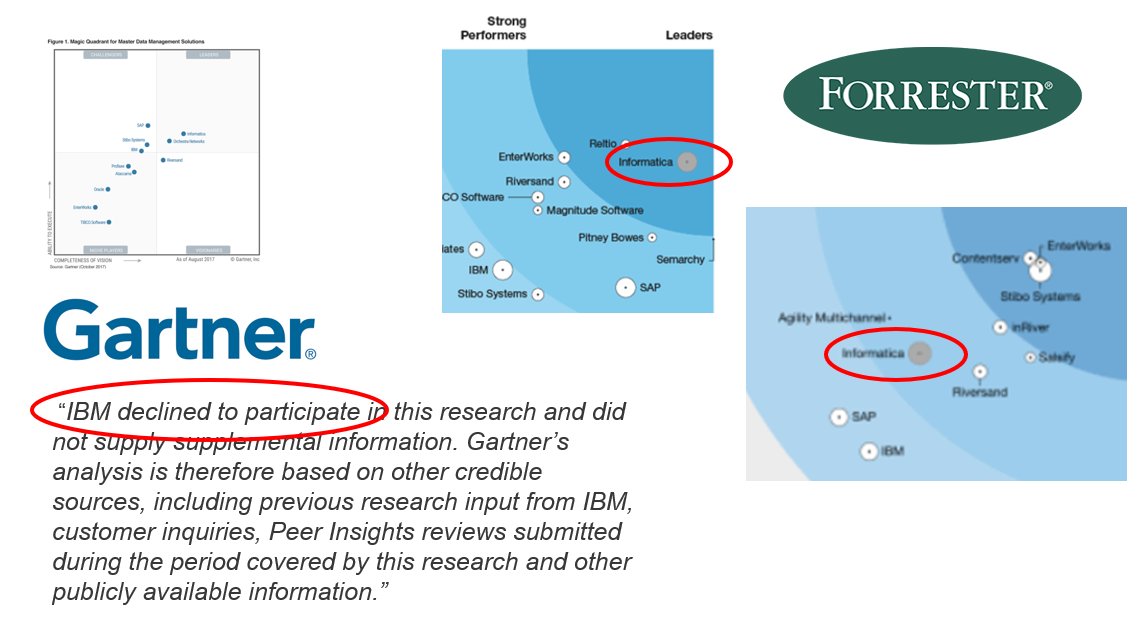
Another example is the Forrester and Informatica dysfunctional relationship. In the Forrester 2019 MDM Wave it is stated that “Informatica declined to participate in our research”. This was also apparent in the Forrester 2018 PIM Wave where Forrester’s placement of Informatica as a Germany-based vendor didn’t reflect movements (and perhaps achievements) since 2012 as told in the post MDM Alternative Facts.
Both Gartner and Forrester have though positioned IBM and Informatica in their plot with the note that the research did not include interaction with the vendor.
This challenge is a bit close to me as I am running a list of MDM / PIM / DQM vendors where there now also is a ranking service based on individual context, scope and requirements. Here I have chosen to include vendor solutions on the three above analyst reports and the list itself as noted in select your solution step 4.



 Bigger picture
 Liliendahl on Data Quality