Agile MDM. Using IT.

MDM (Master Data Management) projects may have a bad name as large IT projects using huge amount of resources, taken a lot of time and ending up with producing very little measurable results.

This phenomenon isn’t new at all in the IT world. There are often two answers to that challenge:

  1. Don’t treat it as an IT project. It’s all about people and culture.
  2. Do it the agile way using IT.

Lean Evolutionary MDMAfter having a lot of fun with option one you will sooner or later realize that the master data pain points still exists and then come to option two.

I have earlier written some agile posts about Lean MDM and Eating the MDM Elephant and the relevance of having MDM technology that supports the agile way has in my eyes only become more and more apparent since then.

What are your experiences? Who is doing agile MDM – using IT? Is it good?

Bookmark and Share

Multi-Domain MDM Uptake

Within Master Data Management (MDM) doing multi-domain MDM has been trending for a couple of years. Yesterday Gartner (the analyst firm) had a chat session on twitter preceding the upcoming Gartner MDM summits around the world.

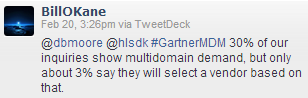
Along the way @BillOKane of @Gartner_inc revealed some numbers about multi-domain MDM from the Gartner camp:

Multi-Domain 1

Multi-Domain 2

So, stating these numbers using the MoSCoW method we have that among companies considering MDM:

  • 3 % sees multi-domain MDM as a MUST have now
  • 10 % thinks they SHOULD have multiple-domain MDM now
  • 17 % regards multi-domain MDM as something they COULD have now
  • 70 % WONT have multi-domain MDM now

Bookmark and Share

Sharing Big Location Reference Data

In the post Location Data Quality for MDM the different ways of handling location master data within many companies was examined.

A typical “as is” picture could be this:

Location1

Location data are handled for different purposes using different kinds of systems. Customer data may be data quality checked by using address validation tools and services, which also serves as prerequisite for better utilization of these data in a Geographical Information System (GIS) and in using internal customer master data in marketing research for example by utilizing demographic classifications for current and prospective customers.

Often additional external location data are used for enrichment and for supplementing internal master data downstream in these specialized systems. It may very well be that the external location reference data used at different points does not agree in terms of precision, timeliness, conformity and other data quality dimensions.

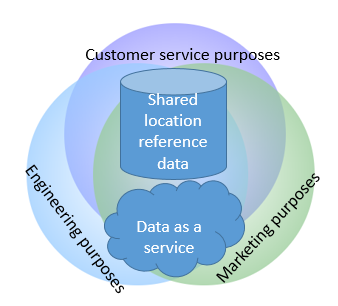
A desired “to be” picture could be this:

Location2

In this set-up everything that can be shared across different purposes are kept as common (big) reference data and/or are accessible within a data-as-a-service environment maintained by third party data providers.

Bookmark and Share

Who needs a data governance tool?

Recently Sunil Soares has released a Research Report being An In-Depth Review of Data Governance Software Tools. Link to the place to download the complimentary report is here.

The report examines what a data governance software tool should do and mentions a range of tools from vendors stretching from:

  • A pure play data governance tool vendor as Collibra
  • A one-stop-shopping vendor within data management as Informatica
  • A none-stop-shopping vendor within everything IT as IBM

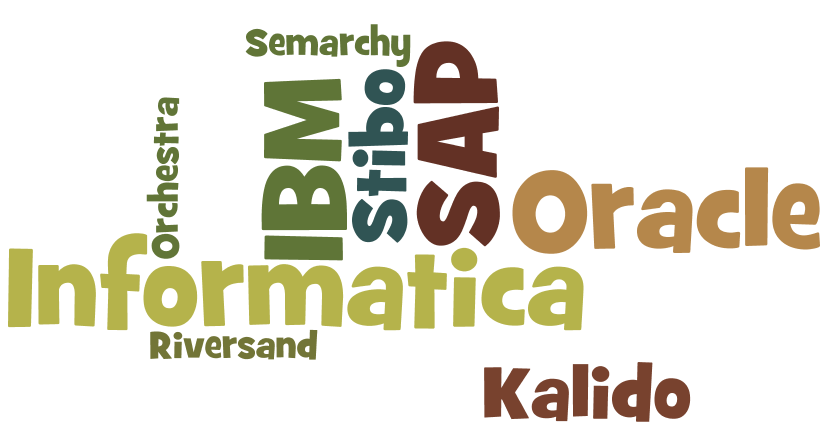
MDMDG 2013 wordleAs touched in the latest post on this blog, how far a tool should go in covering additional disciplines related to the core discipline is an ever-recurring question. Data governance should for example definitely be a part of a Master Data Management (MDM) programme, here using the British English way of spelling programme versus program to emphasise what MDM should be. As data governance is very much about people and processes and not so much about technology, do you need a tool at all? If you do, do you need a separate best-of-breed tool for the data governance part or will it be preferable to have it as an integrated part of the MDM solution?

Bookmark and Share

So, we have four and a half multi-domain MDM vendors

It has been discussed a few times on this blog if Gartner should make a single (multi-domain) Master Data Management quadrant latest in the post MDM for Product Data Quadrant: No challengers. A half visionary.

Well, if Gartner will not Forrester will, as Forrester has just released their MDM wave focusing on multi-platform platforms for MDM. Yep, there is nothing like analyst firms insisting in using their wording as multi-entity, multi-domain or multi-platform MDM within their special visualization as quadrant, landscape, wave and other bulls…. eye stuff to blur things a bit.

If you are a Forrester client or otherwise like to pay money to Forrester, you can get the report here. If you would like to feed one of your eMail addresses into the Informatica marketing machine, you can get the report here.

MDM Brands
This is not the wave. Just some names.

There are only four and half multi-platform MDM vendors in the universe according to Forrester. Three and a half of them are no surprise. Maybe Talend is. I guess one or two more of the Trois acteurs français dans le marché du MDM would like to be there as well.

Bookmark and Share

Where is the Asset?

The pevious post on this blog was called A Master Data Mind Map. In there I tried to map some different examples of master data entities within some known master data domains as party, product, location, financial and calendar.

In the comments and in a following twitter conversation, the placement of the asset entity was questioned.

Asset Master Data

Prash Chan (@MDMGeek) said: “There is another type of asset I came across once, mapped to location domain, largely because the assets were identified by the place where they were installed.”

Jamie Watters (@jamietwatters) said: “Don’t disagree, but think there are other areas of asset data that makes it unique instead of using product or location.  Areas such as engineering, design, construction, maintenance, commissionin make managing asset data pretty unique.”

Indeed, I am actually also on the fence here.

There are certainly often strong relations to a location for an asset. But that is also true for parties as well and some products too as told in the post Product Placement.

Assets can be many things. Gartner (the analyst firm) has the concept of the things domain encompassing products and assets.

Asset may in fact just be its own domain. Property too perhaps as the Real Estate Domain. Services could claim independence from the other products someday. Customer is today often seen as its own domain not belonging to party as examined in the post MDM for Customer Data Quadrant…

Andrew White of Gartner did address these naming issues in a blog post back in 2009 here.

Bookmark and Share

A Master Data Mind Map

A challenge within many disciplines is easily to explain what the discipline is about and that certainly is true for Master Data Management (MDM) too as we often have the question: What is master data?

A good short explanation is:

“The description of the who, what and where in transaction data”.

It could also, with help from Wikipedia, be:

“Information that is key to the operation of a business”.

From Gartner (the analyst firm) we have:

“The consistent and uniform set of identifiers and extended attributes that describes the core entities of the enterprise”.

The latter one I would not try on friends and relatives though.

Examples are often a good way to go. Visualization is great too. So, therefore I have played with a mind map of what master data entities may be:

Master Data

Bookmark and Share

From B2B and B2C to H2H

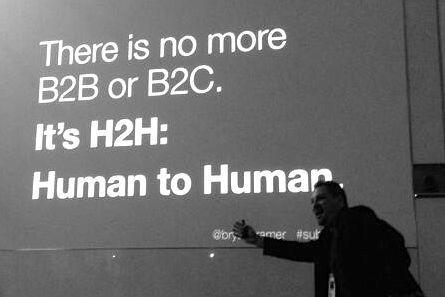
I stumbled upon an article from yesterday by Bryan Kramer called There is no more B2B or B2C: It’s Human to Human, H2H.

H2H

The article is about the implications for marketing caused by the rise of social media which now finally seems to eliminate what we have known as business-to-business (B2B) and more or less merges B2B and business-to-consumer (B2C).

As discussed here on the blog several times starting way back in 2009 in the post Echoes in the Database a problem with B2B indeed is that while business transactions takes place between legal entities a lot of business processes are done between employees related to the selling and buying entities. You may call that employee-to-employee (E2E), people-to-people (P2P) or indeed human-to-human (H2H).

Related to databases, data quality and Master Data Management (MDM) this means we need real world alignment with two kinds of parties:

While B2B and B2C may melt together in the way we do messaging the distinction between B2B and B2C will be there in many other aspects. Even in social media we see it as for example two of the most used social networks being FaceBook and LinkedIn clearly belongs mainly to B2C and B2B respectively for marketing and social selling purposes.

The different possibilities with B2B and B2C in the H2H world was touched in an interview on DataQualityPro last year: What are the Benefits of Social MDM?

Bookmark and Share

Should there be an App for MDM?

MDM may be many different things. For me it’s about Master Data Management and for others it’s about Mobile Device Management.

A recent twitter chat session organized by Gartner (the analyst firm) had the tag #GartnerMDM. It was about Master Data Management but of course there also were questions about Mobile Device Management. Andrew White of Gartner replied:

GartnerMDM

And sure. One of the foremost technology trends being mobile doesn’t have the same attention as other hyped trends like big, social and cloudy within this MDM, but mobile may actually also play a role within master data management.

In my current work with product strategy and product management for a startup within data quality and master data management called iDQ we have been playing with some business cases around an App for this MDM. It has for example been aiming at getting it first time right when NGOs are finding new members on the street and when energy retailers are onboarding new customers on the street.

Have you stumbled upon some business cases for an App for this MDM?

Bookmark and Share

Location Data Quality for MDM

The location domain is after the customer, or rather party, domain and the product domain the most frequent addressed domain for Master Data Management (MDM).

In my recent work I have seen a growing interest in handling location data as part of a MDM program.

Traditionally location data in many organizations have been handled in two main ways:

  • As a part of other domains typically as address attributes for customer and other party entities
  • As a silo for special business processes that involves spatial data using Geographic Information Systems (GIS) as for example in engineering and demographic market research.

Handling location data most often involves using external reference data as location data doesn’t have the same privacy considering as party data, not at least data describing natural personals, tend to have and opposite to product data location data are pretty much the same to everyone.

MDM for the location domain is very much about bringing the two above mentioned ways of working with locations together while consistently exploiting external reference data.

As in all MDM work data quality is the important factor and the usual data quality dimensions are indeed in place here as well. Some challenges are:

  • Uniqueness and precision: Locations comes in hierarchies. As told in the post The Postal Address Hierarchy we when referring to textual addresses have levels as country, region, city or district, thoroughfare (street) or block, building number and unit within a building. Uniqueness may be defined within one of these levels. A discussed in the post Where is the Spot? the precision and use case for coordinates may cause uniqueness issues too.
  • locationTimeliness and accuracy: Though it doesn’t happen too often locations do change names as reported in the post MDM in LED and features on new locations does show up every day. I remember a recent press coverage in the United Kingdom over people who couldn’t get car and other insurances because the address of their newly build house wasn’t in the database at the insurance company.
  • Completeness and conformity: Availability of all “points of interest” in reference data is an issue. The available of all attributes of interest at the desired level is an issue too. The available formats and possible mappings between them is a usual challenge. Addresses in both local and standardized alphabets and script systems using endonyms and exonyms is a problem as told in the posts Where the Streets have Two Names and Where the Streets have one Name but Two Spellings.

Bookmark and Share