MDM in LED

All airports have a tree letter code usually being a mnemonic of the city name or airport name. The airport at Saint Petersburg in Russia thus has the code LED because the code was assigned when the city was called LEningraD. That’s how it is with master data: Names may change but the code of an entity must be kept as it was. And that’s why you usually shouldn’t put meaning into codes.

Europe by Midnight
First sight of Europe 2014.

The Russian MDM (Master Data Management) market has been well described by Dmitry Kovalchuk in a post on the Hub Design Magazine.

This year I had the pleasure of celebrating New Year in Saint Petersburg, a city with great palaces from the time of the czars and czarinas and a growing awareness of Master Data Management including some very interesting start-ups around MDM, where I had the chance to visit TaskData and to revisit the social PIM entrepreneur Actualog.

So from Saint Petersburg: Happy New Year and Merry Christmas.

Bookmark and Share

OMG: Santa is Fake

santa facebook picturesThis blog has earlier had some December blog posts about how Santa Claus deals with data quality (Santa Quality) and master data management (Multi-Domain MDM Santa Style).

As I like to be on the top of the hype curve I was preparing a post about how Santa digs into big data, including social data streams, to be better at finding out who is nice and who is naughty and what they really want for Christmas. But then I suddenly had a light bulb moment saying: Wait, why don’t you take your own medicine and look up who that Santa guy really is?

santa on twitterStarting in social media checking twitter accounts was shocking. All profiles are fake. FaceBook, Linkedin and other social networks all turned out having no real Santa Claus. Going to commercial third party directories and open government data had the same result. No real Santa Claus there. Some address directories had a postal code with a relation like the postcode “H0 H0 H0” in Canada and “SAN TA1” in the UK, but they seem to kind of fake too.

So, shifting from relying on the purpose of use to real world alignment I have concluded that Santa Claus doesn’t exist and therefore he can’t have a data store looking like a toy elephant or any other big data operations going on.

Also I won’t, based on the above instant data quality mash up, register Santa Claus (Inc.) as a prospective customer in my CRM system. Sorry.

Bookmark and Share

Do You Like the Lake?

CapgemeniToday Capgemini as a result of a co-innovation partnership with Pivotal released their take on information management in the big data era in a piece called The Principles of the Business Data Lake.

The business data lake concept is a new try on getting rid of all the excel spreadsheets business people operate because of limitations in today’s enterprise data warehouses and the business intelligence solutions sitting on top of those extracted, transformed and loaded data.

In the business data lake you load raw data including unstructured data sources. Single view and related governance is restricted to master and reference data.

It’s not that you are going to load all the data in the world in your business data lake. You will link internal and external data based on where and when needed.

Thomas Redman has made a famous metaphor in the data quality realm about a polluted lake where the best option to deal with that is to prevent polluted water from streaming into the lake. I guess the rise of big data challenges that take as told some years ago in the post Extreme Data Quality.

In the business data lake we will have polluted data. In that view I think it’s a good thing that master and reference data has a special place in the lake.

What do you think? Do you like the lake – the old and/or the new one?

Bookmark and Share

Trust in External Data is Like Trust in Analysts

The analyst industry is like any other industry. Analysts compete. Mostly analysts do it by presenting what is supposed to be more trustworthy reports than the other ones do including their special visualization method be that a quadrant, landscape, bulls eye or whatever approach . And sometimes they compete by bashing the other ones.

ukraine_fight
MDM market analysts meetup

This week I had a blog post called A Little Bit of Truth vs A Big Load of Trust. The post cites a blog post from Andrew White of Gartner called From MDM to Big Data – From truth to trust. This post again cites an article on SearchDataManagement called Enterprise master data management and big data: A well-matched pair?

Andrew White’s post praises the views of fellow Gartner analyst Ted Friedman in the SearchDataManagement article and bashes the views of the other contributors being Evan Levy, Andy Hayler (Information Difference), Aaron Zornes of the MDM Institute and Kelly O’Neal by saying:

“… presumably since the thinking out there in the cited analyst community has not gotten very far yet.”

Indeed, you have to consider multiple opinions out there when it comes to Master Data Management (MDM), big data and other external data. The same way there are, when it comes to the data, multiple versions of the truth out there and you have, with Andrew White’s words, to: “..manage and govern trust in someone else’s data”.

Bookmark and Share

A Little Bit of Truth vs A Big Load of Trust

The soul of Master Data Management (MDM) is often explained as the search for a single version of the truth. It has always puzzled me that that search in many cases has been about finding the truth as the best data within different data silos inside a given organization.

business partnersBig data, including how MDM and big data can be a good match, has been a well covered subject lately. As discussed in the post Adding 180 Degrees to MDM this has shed the light on how external data may help having better master data by looking at data from outside in.

At Gartner, the analyst firm, they have phrased that movement as a shift from truth to trust for example as told in the post by Andrew White called From MDM to Big Data – From truth to trust.

Don’t get me (and master data) wrong. The truth isn’t out there in a single silver bullet shot. You have to mash up your internal master data with some of the most trustworthy external big reference data. This include commercial directory offerings, open data possibilities, public sector data (made available for private entities) and social networks.

Indeed there are potholes in that path.  Timeliness of directories, completeness of open data, consistency and availability and price tags on public sector data and validity of social network data are common challenges.

Bookmark and Share

The MDM Market Wordle

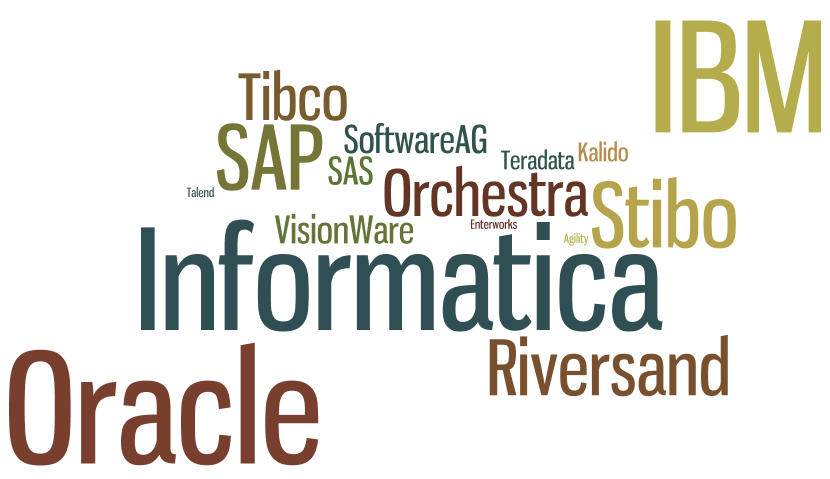
Analyst firms have a lot of fun in making different surveys and rankings of vendors in different markets using their own special visualizing method. For the Master Data Management (MDM) market we have this year had the:

Encouraged by a recent comment on the post What’s New in The Data Quality Magic Quadrant? I have now made my take on the market utilizing the wordle as my special visual approach.

Lazy as I am I haven’t made my own survey but simply taken the brand names from the rankings mentioned above and filled in the name either 1, 2 or 3 times from each report depending on how well the brand was positioned.

So the size of the letters tells something about market positioning according to analyst reports. The size of the words also tells something about the length of the brand name. The placement is according to the wordle principle of course totally random.

And of course I now expect a load of tweets from vendor marketing departments saying that their company is positioned very randomly in the MDM Market Wordle 🙂

MDM Wordle

Bookmark and Share

Third-Party Data and MDM

A recent blog post called Top 14 Master Data Management Misconceptions by William McKnight has as the last misconception this one:

“14. Third-party data is inappropriate for MDM

Third-party data is largely about extending the profile of important subject areas, which are mastered in MDM.  Taking third-party data into organizations has actually kicked off many MDM programs.”

business partnersIndeed, using third-party data, which also could be called big external reference data, is in my eyes a very good solution for a lot of use cases. Some of the most popular exploitations today are:

  • Using a business directory as big reference data for B2B party master data in customer data integration (CDI) and supplier master data management.
  • Using address directories as big reference data for location master data management also related to party master data management for B2C customer data.
  • Using product data directories such as the Global data Synchronization Network (GDSN®) services, the UNSPSC® directory and heaps of industry specific product directories.

The next wave of exploiting external data, which is just kicking off as Social MDM, is digging into social media for sharing data, including:

  • Using professional social networks as LinkedIn in B2B environments where you often find the most timely reference data not at least about contact data related to your business partners’ accounts.
  • Using consumer oriented social networks as Facebook for getting to know your B2C customers better.
  • Using social collaboration as a way to achieve better product master data as told in the post Social PIM.

Bookmark and Share

Social Events and Master Data Management

Recently I changed one of my job titles on LinkedIn resulting in a number of likes, congrats and messages. And thanks for that.

Probably I have a record in a number of CRM systems out there where I am registered as a contact for an account with an attached job title. As a guy working at several places at the same time I am a bit complicated, I have to admit, so I guess many of these records aren’t up to date about where I work carrying what title and having what means of contact.

Complicated or not, I have no doubt about that many CRM implementations will benefit from digging into social networks in order to be up to date and complete as told in the post Social MDM and Complex Sales.

New job (title)As discussed in the post Multi-Facet MDM we may divide master data management into handling these facets:

  • Entities
  • Relations
  • Events

Within party master data management events may be captured during interacting with your (prospective) customers and other business partners, as an update from a third party reference data provider or in an increasing way by monitoring social networks which are often the first to know certain things, not at least when it’s about contacts in Business-to-business (B2B) activities.

Bookmark and Share

MDM for Product Data Quadrant: No challengers. A half visionary.

The Gartner Magic Quadrant for Master Data Management of Product Data Solutions is out. You may have a free look at it for example going through Tibco’s press release on the matter here or directly thanks to IBM here.

MDM Brands
This is not the quadrant. Just some names.

My thoughts are kind of the same as told in the post MDM for Customer Data Quadrant: No challengers. No visionaries. Let’s just have a (Multi-Domain) MDM quadrant.

The quadrant for customer MDM solutions had no challengers and no visionaries. The quadrant for product MDM solutions has a half visionary, as Informatica is positioned as a niche player with its recent Heiler acquisition and just on the right side of the border between niche players and visionaries with what must be the Siperian acquisition from a couple of years ago. This solution has multi-domain capabilities as an important strength.

Bookmark and Share

Getting eMail Addresses Right the First Time

emailChecking if an eMail address will bounce is essential for executing and measuring campaigns, news letter operations and other activities based on sending eMails as explained here on the site Don’t Bounce by BriteVerify.

A good principle within data quality prevention and Master Data Management (MDM) is the first time right approach. There is a 1-10-100 rule saying:

“One dollar spent on prevention will save 10 dollars on correction and 100 dollar on failure costs”.

(Replace dollars with your favorite currency: Euros, pounds, rubles, rupees, whatever.)

This also applies to capturing an eMail address of a (prospect) customer and other business partners. Many business processes today requires communication through eMails in order to save costs and speed up processes. If you register an invalid eMail address or allow self registration of an invalid eMail address you have got yourself some costly scrap and rework or maybe lost an opportunity.

As a natural consequence the instant Data Quality MDM Edition besides ensuring right names and correct postal addresses also checks for valid eMail addresses.

Bookmark and Share