Photo Finish in MDM Vendor Race

With the London Olympics going on we will probably see a lot of winners after a photo finish.

I noticed another photo finish in a recent analyst report called The MDM Landscape Q2 2012 by the Information Difference.

The MDM (Master Data Management) vendors are scored by technology and market strength. If we look at the technology axis – the vertical one, there is a close race.

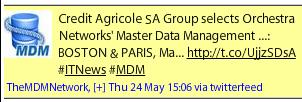
Orchestra shared the victory on twitter:

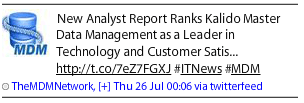
Kalido was also mentioned on twitter:

The linked press release from Kalido has a subtitle telling that Kalido was in front of the megavendors.

As mentioned in the report the vendors are actually not competing in the exact same discipline. Some vendors MDM offerings are part of a larger suite, some vendors focus on a single domain (like product) or industry and some vendors are generalists embracing multi-domain MDM.

This situation is also why another analyst firm, Gartner, have two magic quadrants for MDM vendors: One for customer MDM and one for product MDM.

However the trend is that more and more vendors are going towards multi-domain MDM. I know that for sure as I have been involved in one of the product MDM specialists journeys within multi-domain MDM.

So we could expect an even closer match in the Multi-Domain MDM race in the years to come.

Bookmark and Share

Staying in Doggerland

Currently I’m travelling a lot between my present home in London, United Kingdom and Copenhagen, Denmark where I have most of my family and where the iDQ headquarter is.

When flying between London and Copenhagen you pass the southern North Sea. In the old days (8,000 years ago) this area was a land occupied by human beings. This ancient land is known today as Doggerland.

Sometimes I feel like a citizen of Doggerland not really belonging in the United Kingdom or Denmark.

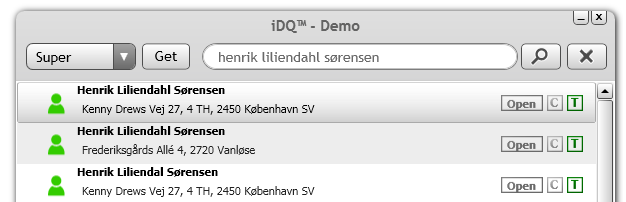
I still have some phone subscriptions in Denmark I use there and my family are using there.  The phone company seems to have a hard time getting a 360 degree customer view as I have two different spellings of my name and two different addresses as seen on the screen when I look up myself in the iDQ service:

Besides having a Customer Relationship Mess (CRM) the phone company has recently shifted their outsourcing partner (from CSC to TCS). This has caused a lot of additional mess, apparently also closing one of my subscriptions due to that they have failed to register my payments. They did however send a chaser they say, but to the oldest of the addresses where I don’t pick up mail anymore.

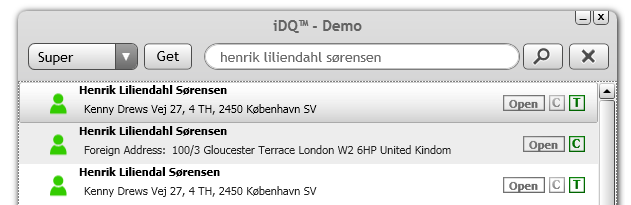
I called to settle the matter and asked if they could correct the address not in use anymore. They couldn’t. The operator did some kind of query into the citizen hub similar to what I can do on iDQ:

However the customer service guy’s screen just showed that I have no address in Denmark in the citizen hub (called CPR), so he couldn’t change the address.

Apparently the phone company have correctly picked up an accurate address in the citizen hub when I got the subscription but failed to update it (along with the other subscriptions) when I moved to another domestic address and now don’t have an adequate business rule when I’m registered at a foreign address.

So now I’m staying in Doggerland.

Bookmark and Share

Olympic Moments

The London 2012 Olympic Games is approaching. You feel that very well in London. For example my usual walking path thru Hyde Park is closed because of the upcoming sport event.

I’m sure these games are going to produce some great moments. Some of the moments I’m remembering from previous games have a touch of data quality technology learning attached.

The Fosbury Flop

In 1968 the American athlete Dick Fosbury introduced a better way of doing the high jump. What I find interesting about the Fosbury Flop is that this technique hasn’t always been possible. In the old days the jumpers landed in a sandpit. If you did the flop then, it would certainly be a flop most probably getting you injured after the first attempt. But after deep foam matting was put in place, the flop has been a good choice.

It’s the same with data quality technology. Some techniques for improvement you have found to be a flop previously may because of new circumstances be a good choice today. The high esteemed scissors jump didn’t prevail forever.

Eddie the Eagle

In 1988, at the winter event, a Brit made a lot of headlines by being totally bad at ski jumping. Eddie the Eagle finished not surprisingly far behind natural born Finnish, Norwegian and Czech ski jumpers coming from a country where the first sign of the white fluffy stuff from above isn’t considered a severe weather condition. But Eddie set a new British record.

It’s the same with data quality technology. Some tools and services are leading in some countries, but have a hard time when challenged internationally.

Sailing under Wrong Flag

In the 2008 games something spectacular happened in the sailing competitions. The Danish 49er boat was in first place but broke the mast when leaving the harbor for the last race. The Croatian team offered their boat. The Danes sailed into the race long after the other boats have started, but managed to get a result just good enough to secure the gold. The other teams might have been confused by the wrong flag.

As told in the post Most Times the Home Team Wins flags are important – in sports, in data quality and other data management disciplines too.

2012

What do you guess will make a difference in this year’s Olympic Games? – And in Data Quality improvement?

Bookmark and Share

Sharing Bigger Data

Yesterday I attended an event called Big Data Forum 2012 held in London.

Big data seems to be yet a buzzing term with many definitions. Anyway, surely it is about datasets that are bigger (and more complex) than before.

The Olympics is Going to be Bigger
One session on the big data forum was about how BBC will use big data in covering the upcoming London Olympics on the BBC website.

James Howard who I know as speckled_jim on Twitter told that the bulk of the content on the BBC Sports website is not produced by BBC. The data is sourced from external data providers and actually also the structure of the content is based on the external sources.

So for the Olympics there will be rich content about all the 10,000 athletes coming from all over the world. The BBC editorial stuff will be linked to this content of course emphasizing on the British athletes.

I guess that other broadcasting bodies and sports websites from all over the world will base the bulk of the content from the same sources and then more or less link targeted own produced content in the same way and with their look and feel.

There are some data quality issues related to sourcing such data Jim told. For example you may have your own guideline for how to spell names in other script systems.

I have noticed exactly that issue in the news from major broadcasters. For example BBC spells the new Egyptian president Mursi while CNN says his name is Morsi.

Bigger Data in Party Master Data Management

The postal validation firm Postcode Anywhere recently had a blog post called Big Data – What’s the Big Deal?

The post has the well known sentiment that you may use your resources better by addressing data quality in “small data” rather than fighting with big data and that getting valid addresses in your party master data is a very good place to start.

I can’t agree more about getting valid addresses.

However I also see some opportunities in sharing bigger datasets for valid addresses. For example:

  • The reference dataset for UK addresses typically based on the Royal Mail Postal Address File (PAF) is not that big. But the reference dataset for addresses from all over the world is bigger and more complex. And along with increasing globalization we need valid addresses from all over the world.
  • Rich address reference data will be more and more available. The UK PAF file is not that big. The AddressBase from Ordnance Survey in the UK is bigger and more complex. So are similar location reference data with more information than basic postal attributes from all over world not at least when addressed together.
  • A valid address based on address reference data only tells you if the address is valid, not if the addressee is (still) on the address. Therefore you often need to combine address reference data with business directories and consumer/citizen reference sources. That means bigger and more complex data as well.

Similar to how BBC is covering the Olympics my guess is that organizations will increasingly share bigger public address, business entity and consumer/citizen reference data and link private master data that you find more accurate (like the spelling example) along with essential data elements that better supports your way of doing business and makes you more competitive.

My recent post Mashing Up Big Reference Data and Internal Master Data describes a solution for linking bigger data within business processes in order to get a valid address and beyond.

Bookmark and Share

Sometimes Big Brother is Confused

Google Maps knows a lot. It knows about addresses and it knows about companies on these addresses.

As with most services it seems that Google Maps gets the reference data from different sources.

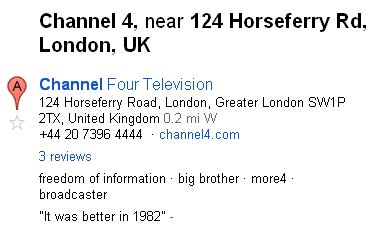
The other day I went to visit “Channel 4”, the British TV channel that hosted the UK “Big Brother” reality show until lately.

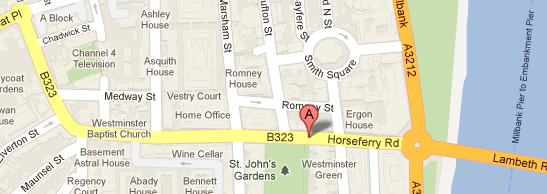
I typed in the address “124 Horseferry Road, London, United Kingdom” and got the point:

However, it seems that there is a large building up to the left called “Channel 4 Television”. Strange. Then I tried with “Channel 4, 124 Horseferry Road, London, United Kingdom”:

Oh, so I will find “Channel Four Television, 124 Horseferry Road” in the “Channel 4 Television” building only 0.2 miles west of “124 Horseferry Rd”:

Bookmark and Share

Most Times the Home Team Wins

This summer is going to be huge if you like sports. The Olympics is coming to London and only 14 days away from now we have the European football (soccer) championship in Poland and Ukraine.

As usual hopes are high for the England soccer team. But statistics doesn’t support the hopes. The England team haven’t really succeeded since the World Cup victory on home ground at Wembley in 1966. That victory was mainly (and now I’m going to be shot in the streets of London) due to a ghost goal.

In business, and in data quality and MDM business too, the home team usually also wins.

Yesterday I noticed a tweet telling that the MDM tool vendor Orchestra Network has been selected as tool vendor by a large bank. The bank is Credit Agricole, a big financial service provider based in France. Orchestra Networks is also based in France. A home win so to say.

In the post The Pond it was told how else dominating American tool vendors may in the first place succeed in expansion to Europe by coming to London, but in fact having a hard time competing in continental Europe due to diversity issues.

European tool vendors going to North America often tries to disguise as a home team. Orchestra Network for example uses Boston & Paris as place of origin in the messaging. Other examples are the leading open source data management tool vendor Talend with dual head quarter in Paris and California, hot Danish MDM vendor Stibo Systems messaging out of Atlanta and the Swedish business intelligence success QlikTech who officially has moved to Pennsylvania.

Bookmark and Share

MDM Summit Europe 2012 Preview

I am looking forward to be at the Master Data Management Summit Europe 2012 next week in London. The conference runs in parallel with the Data Governance Conference Europe 2012.

Data Governance

As I am living within a short walking distance of the venue I won’t have so much time thinking as Jill Dyché had when she recently was on a conference within driving distance, as reported on her blog post After Gartner MDM in which Jill considers MDM and takes the road less traveled. In London Jill will be delivering a key note called: Data Governance, What Your CEO Needs to know.

On the Data Governance tracks there will be a panel discussion called Data Governance in a Regulatory Environment with some good folks: Nicola Askham, Dylan Jones, Ken O’Connor and Gwen Thomas.

Nicola is currently writing an excellent blog post series on the Six Characteristics Of A Successful Data Governance Practitioner. Dylan is the founder of DataQualityPro. Ken was the star on the OCDQblog radio show today discussing Solvency II and Data Quality.

Gwen, being the founder of The Data Governance Institute, is chairing the Data Governance Conference while Aaron Zornes, the founder of The MDM Institute, is chairing the MDM Summit.

Master Data, Social MDM and Reference Data Management

The MDM Institute lately had an “MDM Alert”  with Master Data Management & Data Governance Strategic Planning Assumptions for 2012-13 with the subtitle: Pervasive & Pandemic MDM is in Your Future.

Some of the predictions are about reference data and Social MDM.

Social master data management has been a favorite subject of mine the last couple of years, and I hope to catch up with fellow MDM practitioners and learning how far this has come outside my circles.

Reference Data is a term often used either instead of Master Data or as related to Master Data. Reference data is those data defined and initially maintained outside a single enterprise. Examples from the customer master data realm are a country list, a list of states in a given country or postal code tables for countries around the world.

The trend as I see it is that enterprises seek to benefit from having reference data in more depth than those often modest populated lists mentioned above. In the customer master data realm such big reference data may be core data about:

  • Addresses being every single valid address typically within a given country.
  • Business entities being every single business entity occupying an address in a given country.
  • Consumers (or Citizens) being every single person living on an address in a given country.

There is often no single source of truth for such data.

As I’m working with an international launch of a product called instant Data Quality (iDQ™) I look forward to explore how MDM analysts and practitioners are seeing this field developing.

Bookmark and Share

Broken Links

When passing the results of data cleansing activities back to source systems I have often encountered what one might call broken links, which have called for designing data flows that doesn’t go by book, doesn’t match the first picture of the real world and eventually prompts last minute alternate ways of doing things.

I have had the same experience when passing some real (and not real) world bridges lately.

The Trembling Lady: An Unsound Bridge

When walking around in London a sign on the Albert Bridge caught my eye. The sign instructs troops to break steps when marching over.

In researching the Albert Bridge on Wikipedia I learned that the bridge has an unsound construction that makes it vibrate not at least when a bunch of troops marches across in rhythm. The bridge has therefore got the nickname “The Trembling Lady”.

It’s an old sign. The bridge is an old bridge. But it’s still standing.

The same way we often have to deal with old systems running on unstable databases with unsound data models. That’s life. Though it’s not the way we want to see it, we most break the rhythm of else perfectly cleansed data as discussed in the post Storing a Single Version of the Truth.  

The Øresund Bridge: The Sound Link

The sound between the city of Malmö in Sweden and København (Copenhagen) in Denmark can be crossed by the Øresund Bridge. If looking at a satellite picture you may conclude that the bridge isn’t finished. That’s because a part of the link is in fact an undersea tunnel as told in the post Geocoding from 100 Feet Under.

Your first image about what can be done and what can’t be done isn’t always the way of the world. Dig into some more sources, find some more charts and you may find a way.

However, life isn’t always easy. Sometimes charts and maps can be deceiving.

Wodna: The Sound of Silence.

As reported in the post Troubled Bridge over Water I planned a cycling trip last summer. The route would take us across the Polish river Świna by a bridge I found on Google Maps.

When, after a hard day’s ride in the saddle, we reached the river, the bridge wasn’t there. We had to take a ferry across the river instead.

I maybe should have known. The bridge on the map was named Wodna. That is Polish for (something with) water.

Bookmark and Share

Turning a Blind Eye to Data Quality

The idiom turning a blind eye originates from the sea battle at Copenhagen where Admiral Nelson ignored a signal with permission to withdraw by raising the telescope to his blind eye and say “I really do not see the signal”.

Nelson went on and won the battle.

As a data quality practitioner you are often amazed by how enterprises turns the blind eye to data quality challenges and despite horrible data quality conditions keeps on and wins the battle by growing as a successful business.

The evidence about how poor data quality is costing enterprises huge sums has been out there for a long time. But business success are made over and again despite of bad data. There may be casualties, but the business goals are met anyway. So, the poor data quality is just something that makes the fight harder, not impossible.

I guess we have to change the messaging about data quality improvement away from the doomsday prophesies, which make decision makers turn a blind eye to data quality challenges, and be more specific on maybe smaller but tangible wins where data quality improvement and business efficiency goes hand in hand.        

Bookmark and Share

Search and if you are lucky you will find

This morning I was following the tweet stream from the ongoing Gartner Master Data Management (MDM) conference here in London, when another tweet caught my eyes:

This reminded me about that (error tolerant) search is The Overlooked MDM Feature.

Good search functionality is essential for making the most out of your well managed master data.

Search functionality may be implemented in these main scenarios:

Inside Search

You should be able to quickly find what is inside your master data hub.

The business benefits from having fast error tolerant search as a capacity inside your master data management solution are plenty, including:

  • Better data quality by upstream prevention against duplicate entries as explained in this post.
  • More efficiency by bringing down the time users spends on searching for information about entities in the master data hub.
  • Higher employee satisfaction by eliminating a lot of frustration else coming from not finding what you know must be inside the hub already.

MDM inside search capabilities applies to multiple domains: Party, product and location master data.

Search the outside

You should be able to quickly find what you need to bring inside your master data hub.

Data entry may improve a lot by having fast error tolerant search that explores the cloud for relevant data related to the entry being done. Doing that has two main purposes:

  • Data entry becomes more effective with less cumbersome investigation and fewer keystrokes.
  • Data quality is safeguarded by better real world alignment.

Preferably the inside and the outside search should be the same mash-up.

Searching the outside is applies especially to location and party master data.

Search from the outside

Website search applies especially to product master data and in some cases also to related location master data as described in the post Product Placement.

Your website users should be able to quickly find what you publish from your master data hub be that description of physical products, services or research documents as in the case of Gartner, which is an analyst firm.

As said in the tweet on the top of this post, (good) search makes the life of your coming and current customers much easier. Do I need to emphasize the importance of good customer experience?

Bookmark and Share