instant Single Customer View

Achieving a Single Customer View (SCV) is a core driver for many data quality improvement and Master Data Management (MDM) implementations.

As most data quality practitioners will agree, the best way of securing data quality is getting it right the first time. The same is true about achieving a Single Customer View. Get it right the first time. Have an instant Single Customer View.

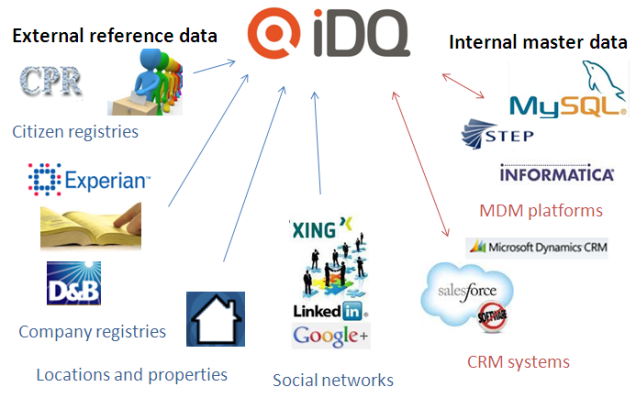
The cloud based solution I’m working with right now does this by:

  • Searching external big reference data sources with information about individuals, companies, locations and properties as well as social networks
  • Searching internal master data with information already known inside the enterprise
  • Inserting really new entities or updating current entities by picking  as much data as possible from external sources
instant Single Customer View

Some essential capabilities in doing this are:

  • Searching is error tolerant so you will find entities even if the spelling is different
  • The receiving data model is real world aligned. This includes:
    • Party information and location information have separate lives as explained in the post called A Place in Time
    • You may have multiple means of contact attached like many phones, email addresses and social identities

How do you achieve a Single Customer View?

Bookmark and Share

Master Data Management in the Utility Sector

Making vertical MDM (Master Data Management) solutions, being MDM solutions prepared for a given industry, seems to become a trend in the MDM realm.

Traditionally many MDM solutions actually are strong in a given industry or a few related industries.

This is also true for the MDM solution I’m working with right now, as this solution has gained traction in the utility sector.

So, what’s special (and not entirely special) about the utility sector?

Here are three of my observations:

Exploiting big external reference data

As examined in the post instant Data Quality at Work the utility sector may gain much in using all the available external reference data available in the party master data domain, including:

  • Consumer/citizen directories
  • Business directories
  • Address directories
  • Property directories

However, if data quality shouldn’t be a joke, this means using the best national data sources available as many of the world-wide data sources is this domain are far from providing the precision, accuracy and timeliness needed in the utility sector.

Location precision

Managing locations is a big thing in the utility sector. The post called Where is the Spot explains how identifying locations isn’t as simple as we may use to think in daily life.

This is indeed also true in the utility sector where the issue also includes managing many different locations for the same customer fulfilling different purposes at the same time.

The products

puzzleThe electricity supply part of the utility sector share a lot of issues with the telco sector when it comes to fixed installations and the products and services are in fact the same in some cases which also as a consequence means that  some organizations belongs to both sectors.

This is also a danger with vertical MDM solutions as there may be several best-of-breed options for a given organization, which eventually will result in choosing more than one platform and thereby introducing the silos which MDM in first place was supposed to eliminate.

Counting on LinkedIn

Let’s say LinkedIn opened a bank. Would you put money into the LinkedIn bank?

I don’t think I would if they used the same technology for accounting as they use for counting members in the LinkedIn groups.

The other day I made a happy tweet telling that the Social MDM LinkedIn group just got 400 members. And now today LinkedIn told me we are only 385 members. First thought: Jesus, 15 members left in a few days. Boring subject. Missing the hype before it even got inflated.

But when I went to the statistics page we were now 400 again:

Count1

Going back to the member list and refreshing it several times showed these results:

count2

And:

Count3

And:

Count4

Well, I guess we are around 400 members. And oh, there’s room for more. Join here.

Bookmark and Share

You probably won’t find the truth (and salsa) inside your firewall

In a Data Roundtable blog post published today and called Big Data in Your Kitchen Phil Simon says:

“CXOs who believe that “data” is simply the content in their own internal databases are increasing being seen as anachronistic. More progressive leaders understand that data is everywhere, including–and especially–external to the enterprise.”

Bringing in external data was also touched recently by Kim Loughead of Informatica in the post Bring The Outside In: Why Integrating External Data Sources Should Be Your Next Data integration Project.

Herein Kim emphasizes that: “Innovation is driven by data and that data largely resides outside your firewall”.

SalsaMy humble work in bringing in the outside revolves around a service called instant Data Quality (iDQ™). This service is about exploiting the increasing choice if external directories holding valuable information about the individuals, companies, addresses and properties we have so much trouble with reflecting in our party master data hubs.

What about you? Are you anachronistic or do you bring in the outside? Or as it will sound in Phil’s Big Data Kitchen: Will you miss salsa tonight?

Bookmark and Share

Who Killed Big Data?

No Bulls
Please, no big data bullsh…

I guess everyone is sick and tired of seeing the term “big data” attached to just about everything larger than 1 kilobyte.

But who is responsible? Who do we hold accountable for overusing the term big data? Who killed big data?

Was it first and foremost the vendors who made the kill? A recent blog post called “Big Data is Dead. What’s Next?” by John De Goes suggest that the vendors are to be blamed for stabbing big data from behind.

Could it be the analysts? I have, as mentioned in the post The Big MDM Trend, seen how Gartner (the analyst firm) have put big data forward in the shouting gallery in order to explain something already explained with other terms.

Big data has often been personalized by the data scientist. So maybe it was a Californian girl called Jill Dyché who caused an extinction of the data scientist and thereby big data. She wrote the blog post called Why I Wouldn’t Have Sex with a Data Scientist.

What do you think? Who killed big data?

Bookmark and Share

Connecting CRM and MDM with Social Network Profiles

As told on DataQualityPro recently in an interview post about the Benefits of Social MDM, doing social MDM (Master Data Management) may still be outside the radar of most MDM implementations. But there are plenty of things happening with connecting CRM (Customer Relationship Management) and social engagement.

While a lot of the talk is about the biggest social networks as FaceBook and LinkedIn, there are also things going around with more local social networks like the German alternative to LinkedIn called Xing.

Xing02

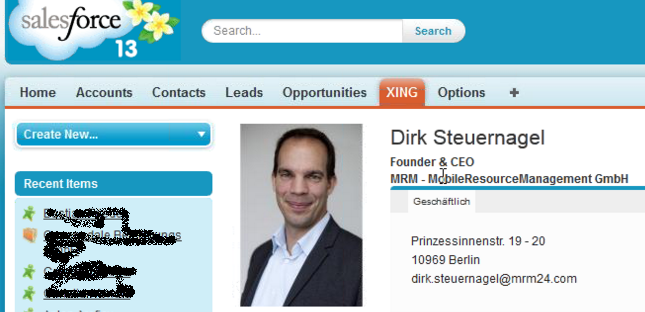
Last week I followed a webinar by Dirk Steuernagel of MRM24. It was about connecting your SalesForce.com contact data with Xing.

As said in the MRM24 blog post called Social CRM – Integration von Business Netzwerken in Salesforce.com:

“Our business contacts are usually found in various internal and external systems and on non-synchronized platforms. It requires a lot of effort and nerves to maintain all of our business contacts at the different locations and keep the relevant information up to date.”

(Translated to English by Google and me).

Xing01

We see a lot of connectors between CRM systems and social networks.

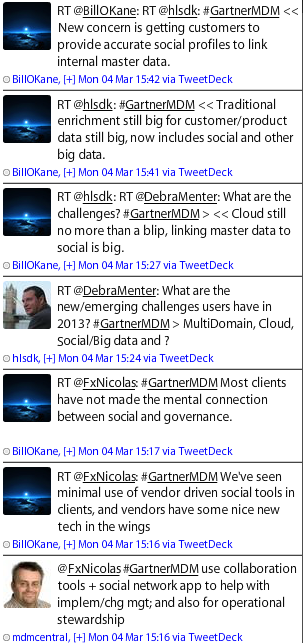
In due time we will also see a lot of connectors between MDM and social networks, which is a natural consequence of the spread of social CRM. This trend was also strongly emphasized on the Gartner (the analyst firm) tweet chat today:

GartnerMDM chat and social MDM

Bookmark and Share

Data Quality Vendors Beware of SEO Agencies

As reported in the post Fighting Identity Fraud with Identity Fraud and experienced with the post 255 Reasons for Data Quality Diversity I have seen several sloppy attempts of link building from SEO agencies working for data quality tool vendors.

The other day it happened again, this time on LinkedIn.

There was a comment in the Master Data Management Interest group:

DataLadder SEO

The comment is now deleted by the author and I do understand why.

I guess a SEO guy was working for Simon at DataLadder and Nathan from somewhere else at the same time and given access to their LinkedIn accounts. However he/she posted a comment to be meant being from Simon logged in as Nathan (who is not working with MDM and data quality).

So, data quality tool and service vendors: You can’t fight identity fraud with identity fraud and you can’t advocate for a single view of customer with a messy view of you as a vendor. Be authentic.

Bookmark and Share

Data Quality Technology for Marketing

TFMAAlso this year I visited the Technology for Marketing and Advertising event in London in order to take part in as many prize drawings as possible. And oh, also to catch up on new developments in applying data quality to marketing.

Translation Management and Social Intelligence

SDL has the slogan: Because Business is Global. I like it. Besides doing translation management SDL also excels in social intelligence. As discussed with the SDL representative on the booth a core competency in doing this is to link social data with master data entities, a subject I touched yesterday on Informatica Perspectives in the post called Social MDM and Future Competitive Analysis.

A proof of that it is a small world is that Informatica is a SDL reference customer for localization as told here.

Utilizing Location Data

Entergate, a survey tool specialist, focused on a new tool called pointSurvey. It’s so new I can’t find any links on their website. The concept is embedding maps into surveys that relate to location data. Using the tool respondents may point out places of interest or draw out routes.

Surely this is a better way to catch locations than typing in postal addresses.

eMail Verification

BriteVerify says on their site:

“At BriteVerify, we take verification seriously – in fact, making sure that you receive the most accurate information possible is pretty much the only thing that matters to us. Well, that and pancakes. Mmmmm… pancakes.”

Somehow I missed the pancakes. But the eMail verification presented by BriteVerify was good.

Bookmark and Share

How to Avoid True Positives in Data Matching

Now, this blog post title might sound silly, as we generally consider true positives to be the cream of data matching as it means that we have found a match between two data records that reflects the same real world entity and it has been confirmed, that this is true and based on that we can eliminate a harmful and costly duplicate in our records.

Why this isn’t still an optimal situation is that the duplicate shouldn’t have entered our data store in the first place. Avoiding duplicates up front is by far the best option.

So, how do you do that?

You may aim for low latency duplicate prevention by catching the duplicates in (near) real-time by having duplicate checks after records have been captured but before they are committed in whatever is the data store for the entities in question. But still, this is actually also about finding true positives and at the same time to be aware of false positives.

Killing Keystrokes
Killing Keystrokes

The best way is to aim for instant data quality. That is, instead of entering data for the (supposed) new records, you are able to pick the data from data stores already available presumably in the cloud through an error tolerant search that covers external data as well as data records already in the internal data store.

This is exactly such a solution I’m working with right now. And oh yes, it is exactly called instant Data Quality.

Bookmark and Share

Beware of False Positives in Data Matching

In a recent blog post by Kristen Gregerson of Satori Software you may learn A Terrible Tale where the identity of two different real world individuals were merged into one golden record with the most horrible result you may imagine associated with a recent special day related to the results of the other kind of matching going around.

datamatching
Join the Data Matching Group on LinkedIn

As reported by Jim Harris some years ago in the post The Very True Fear of False Positives the bad things happening from false positives in data matching is indeed a hindrance for doing data matching

If we do data matching we should be aware that false positives will happen and we should know the probability of that it happens and we should know how to avoid the resulting heartache.

Indeed using a data matching tool is better than relying on simple database indexes and indeed there are differences in how good various data matching tools are at doing the job, not at least doing it under different circumstances as told in the post What is a best-in-class match engine?

Curious about how data matching tools work (differently)? There is an eLearning course available co-authored by yours truly. The course is called Data Parsing, Matching and De-duplication.

Bookmark and Share