What’s New in The Data Quality Magic Quadrant?

The Gartner Magic Quadrant for Data Quality Tools 2013 is out. If you don’t want to pay Gartner’s fee for having a look, you can sign up for a free copy on one of the vendor’s websites for example here at Trillium Software Insights.

So, what’s new this year?

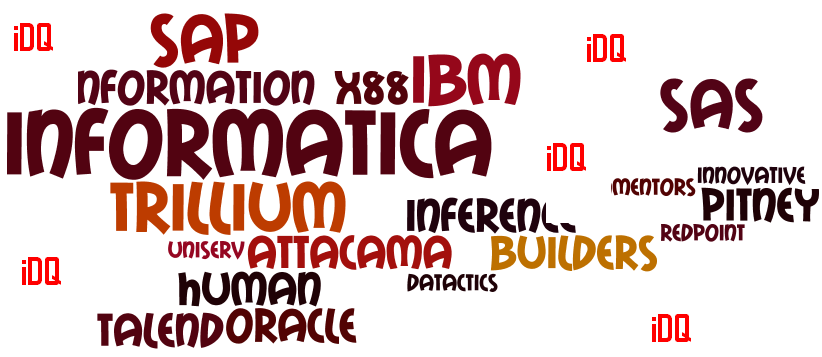
It is pretty much the same picture as last year with X88 as the only new intruder. Else the news is that some vendors “now appear under slightly different names”. And now Ted Friedman is the only author.

The most exciting part, in my eyes, is the words about how the market will develop. Some seen and foreseen trends are:

  • Information governance programs drive the need for data quality tools.
  • Cloud based deployments are gaining traction.
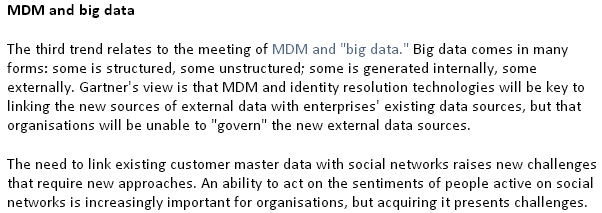
  • Growth expected for embracing less-structured data, not at least social data, by using big data techniques and sources.

That’s good news.
Data Quality Tools

Bookmark and Share

Reaching the Cloud with MDM

As reported in the post The MDM Landscape is Slowly Changing a saying from the Information Difference MDM Landscape 2013 is:

  • “The market is starting to dabble in cloud-based implementations…”

I have spent some part of the last months with a cloud-based Master Data Management implementation in this case using the iDQ™ MDM Edition.

Well, actually it isn’t a full cloud implementation. There is a frontend taking care of user interaction in the cloud and there is a backend taking care of integration on-premise.

I guess many other MDM implementations embracing cloud technology will look like this solution being a hybrid, where some services are based in the cloud and some services are based on-premise.

What about your MDM implementation(s). Is it cloud-based, based on-premise or hybrid?

Hohenzollern Castle in Southern Germany

Bookmark and Share

Double Trouble with Social MDM and Big Data

Yesterday was the first day at the MDM Summit Europe 2013 in London.

One of the workshops I attended was called Master Data Governance for Cloud/Social MDM/Big Data. The workshop was lead by Malcolm Chisholm, one of my favorite thought leaders within data management.

According to Malcolm Chisholm, and I totally agree with that, the rise of social networks and big data will have a tremendous impact on future MDM (Master Data Management) architecture. We are not going to see that these new opportunities and challenges will replace the old way of doing MDM. Integration of social data and other big data will add new elements to the existing component landscape around MDM solutions.

Like it or not, things are going to be more complicated than before.

We will have some different technologies and methodologies handling the old systems of record and the new systems of engagement at the same time, for example relational databases (as we know it today) for master data and columnar databases for big data.

Profiling results from analysis of big data will be added to the current identity resolution centric master data elements handled in current master data solutions. Furthermore, there will be new interfaces for social collaboration around master data maintenance on top of the current interfaces.

So, the question is if taking on the double trouble is worth it. Doing nothing, in this case sticking to small data, is always a popular option. But will the organizations choosing that path exist in the next decade? – or will they be outsmarted by newcomers?

MDM Summit Europe 2013

Bookmark and Share

Data Management in the Cloud

We are seeing more and more data management services offered in the cloud.

dnblogo2As I have had a long time experience with data matching services around the Dun & Bradstreet WorldBase, it was good to see a presentation yesterday in Stockholm featuring D&B Europe’s new cloud based data manager service.

Managing World-Wide B2B Master Data

The D&B WorldBase is a business directory with 225 million business entities from all over the world.

D&B’s Data Manager is a self-service application in the cloud around the WorldBase taking care of:

  • Data matching with comprehensive functionality for manual inspection, approval and master data survivorship
  • Data enrichment embracing a wide range of data attributes
  • Data Maintenance subscription for keeping enriched data up to date

The data matching functionality is built on the good old D&B methodology with confidence codes and matchgrades.

Right for QlikTech

QlikTech is the Swedish firm (pretending to be American) behind the prominent business intelligence solution called QlikView.

At the Stockholm event QlikTech presented how and why they use the D&B Data Manager for ensuring the right data quality in their cloud based B2B CRM solution (SalesForce.com).

As QlikTech is operating all over the world having a consistent world-wide business directory as the reference for party master data is extremely important, and the self-service concept is a perfect match for having the right insight and control into achieving the needed level of data quality in CRM master data.

From there the QlikTech CRM team takes its own medicine using QlikView for self-service business intelligence.

Bookmark and Share

instant Single Customer View

Achieving a Single Customer View (SCV) is a core driver for many data quality improvement and Master Data Management (MDM) implementations.

As most data quality practitioners will agree, the best way of securing data quality is getting it right the first time. The same is true about achieving a Single Customer View. Get it right the first time. Have an instant Single Customer View.

The cloud based solution I’m working with right now does this by:

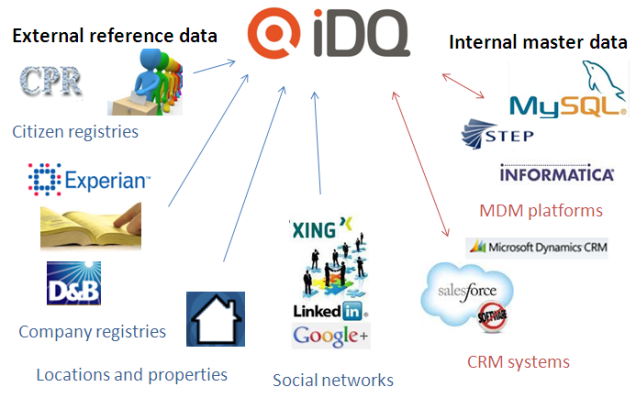
  • Searching external big reference data sources with information about individuals, companies, locations and properties as well as social networks
  • Searching internal master data with information already known inside the enterprise
  • Inserting really new entities or updating current entities by picking  as much data as possible from external sources

instant Single Customer View

Some essential capabilities in doing this are:

  • Searching is error tolerant so you will find entities even if the spelling is different
  • The receiving data model is real world aligned. This includes:
    • Party information and location information have separate lives as explained in the post called A Place in Time
    • You may have multiple means of contact attached like many phones, email addresses and social identities

How do you achieve a Single Customer View?

Bookmark and Share

How to Avoid True Positives in Data Matching

Now, this blog post title might sound silly, as we generally consider true positives to be the cream of data matching as it means that we have found a match between two data records that reflects the same real world entity and it has been confirmed, that this is true and based on that we can eliminate a harmful and costly duplicate in our records.

Why this isn’t still an optimal situation is that the duplicate shouldn’t have entered our data store in the first place. Avoiding duplicates up front is by far the best option.

So, how do you do that?

You may aim for low latency duplicate prevention by catching the duplicates in (near) real-time by having duplicate checks after records have been captured but before they are committed in whatever is the data store for the entities in question. But still, this is actually also about finding true positives and at the same time to be aware of false positives.

Killing Keystrokes
Killing Keystrokes

The best way is to aim for instant data quality. That is, instead of entering data for the (supposed) new records, you are able to pick the data from data stores already available presumably in the cloud through an error tolerant search that covers external data as well as data records already in the internal data store.

This is exactly such a solution I’m working with right now. And oh yes, it is exactly called instant Data Quality.

Bookmark and Share

Defining Social MDM

Social MDM2Social Master Data Management (Social MDM) has been a recurring subject on this blog for a couple of years. But what is Social MDM? What do others say it is?

Here is what Techopedia, Gartner and The MDM Institute thinks:

Techopedia has this definition of Social MDM:

Definition – What does Social Master Data Management (Social MDM) mean?

Social master data management (Social MDM) refers to the processes, policies and concepts used to gather and compile social media data sources – like Facebook, LinkedIn and Twitter – into one master file.

Gartner (the analyst firm) hasn’t to my knowledge used the term Social MDM. In 2011 they though said that this will be one of three main trends in MDM:

Increasing Links Between MDM and Social Networks

By 2015, 15 percent of organizations will have added social media data about their customers to the customer master data attributes they manage in their MDM systems….

In 2012, as reported in the post The Big MDM Trend, Gartner, The Hype Cycle firm, changed the point to be about MDM and Big Data.

The MDM Institute has a Field Report from April 2012 where Aaron Zornes (who is the MDM institute) writes:

Social MDM (Cloud-enablement, Architecture & Integration)

During 2012, cloud-enabled MDM will attract small- and mid-sized businesses as a means to engage in MDM without committing to long-term project and major expense….

By 2014-15, cloud-innate services for data quality and Data Governance will be more prevalent than full Social MDM…

So the MDM institute thinks Social MDM is MDM in the cloud.

What do you think?

Bookmark and Share

Rising Adoption of MDM in the Cloud

When I back in December 2011 had a look into 2012 and what I was going to do, the topics were very well aligned with what Gartner (the analyst firm) have predicted for MDM, being:

What for me turned out to go faster than I thought was the thing about rising adoption of MDM in the Cloud.

I remember from back when CRM in the Cloud started to grow, not at least driven by the success of Salesforce.com, many voices predicted a slow adoption as most people couldn’t believe that companies would put one of their best secrets, the customer database, up in the cloud where everyone may be able to have a look.

iDQ logoRight now I’m working with implementing my first cloud MDM solution. This solution is based on the instant Data Quality service, which now consequently has an MDM edition. We didn’t expected to be this far already, but here we are.

Bookmark and Share

Doing MDM in the Cloud

As reported in the post What to do in 2012 doing Master Data Management (MDM) in the cloud is one of three trends within MDM that according to Gartner (the analyst firm) will shape the MDM market in the coming years.

Doing MDM in the cloud is an obvious choice if all your operational applications are in the cloud already. Such a solution was presented on Informatica Perspectives in the blog post Power the Social Enterprise with a Complete Customer View. The post includes a Video where the situation with multiple instances of SalesForce.com solutions within the same enterprise is supported by a master data backbone in the cloud.

But even if all your operational applications are on premise you may start with lifting some master data management functionality up in the cloud. I am currently working with such a solution.

When onboarding customer (and other party) master data much of the basic information needed is already known in the cloud. Therefore lifting the onboarding functionality up into the cloud makes a lot of sense. This is the premise, so to speak, for the MDM edition of the instant Data Quality (iDQ) solution that we are working on these days.

Cloud services for the other prominent MDM domain being product master data also makes a lot of sense. As told in the post Social PIM a lot of basic product master data may be shared in the cloud embracing the supply chain of manufacturers, distributors, retailers and end users.

In both these cases some of the master data management functionality is handled in the cloud while the data integration stuff takes place where the operational applications resides be that in the cloud and/or on premise.

Bookmark and Share

The Big MDM Trend

Back in 2011 Gartner (the analyst firm) released a document where Gartner Highlights Three Trends That Will shape the Master Data Management Market.

The three things were:

  • Multi-Domain MDM
  • MDM in the Cloud
  • MDM and Social Networks

MDM and Social Networks (also called Social MDM) was described as shown below:

Gartner 3 MDM things 2011

In a 2012 article on Computerweekly called Three trends that will shape the master data management market also by John Radcliffe of Gartner the three trends are repeated however with social MDM now described in the context of MDM and big data:

Gartner 3 MDM things 2012

The slightly different use of terms to describe the trends and what it entails used by Gartner follows the big trend of using the term “big data” by everyone else in the industry as discussed in the post Data Quality vs Big Data, where you see that the use of the term “big data” exploded just after the original Gartner piece on the three trends.

Bookmark and Share