Slicing the MDM Space

Master DataThese days I am attending the Gartner MDM summit in London.

MDM (Master Data Management) initiatives and MDM solutions are not created equal and different ways of slicing the MDM world were put forward on the first day.

Gartner is famous for the magic quadrants and during the customer master data quadrant presentation I heard Bill O’Kane explain why this is a separate quadrant from the product master data quadrant and why there are no challengers and no visionaries.

In another session about MDM milestones Bill O’Kane for this context sliced the MDM world a bit differently based on moving between MDM styles. Here we had:

  • Business-to-consumer (B2C) Customer Data Integration (CDI)
  • Business-to-business (B2B) customer MDM, Product Information Management (PIM) and other domains.

The vendors in general seems to want to do everything MDM.

Stibo Systems, a traditional PIM vendor, presented the case for multidomain MDM based on how things have developed within eCommerce. Stibo even smuggled the term omnidomain MDM into the slides. A marketing gig in the making perhaps.

The megavendors has bought who ever they need to be multidomain.

Some new solutions are born in the multidomain age. Semarchy is an interesting example as they are so the evolutionary way.

Bookmark and Share

Data Entry by Employees

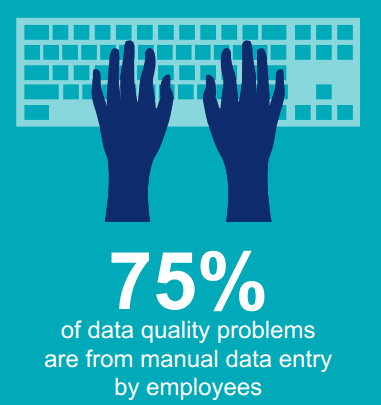
A recent infographic prepared by Trillium Software highlights a fact about data quality I personally have been preaching about a lot:

Trillium 75 percent

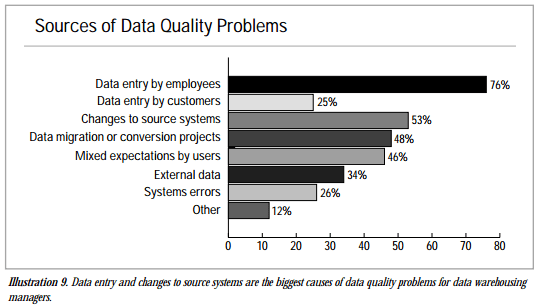
This number is (roughly) sourced from a study by Wayne W. Eckerson of The Data Warehouse Institute made in 2002:

TDWI 76 percent

So, in the fight against bad data quality, a good place to start will be helping data entry personnel doing it right the first time.

One way of achieving that is to cut down on the data being entered. This may be done by picking the data from sources already available out there instead of retyping things and making those annoying flaws.

If we look at the two most prominent master data domains, some ideas will be:

  • In the product domain I have seen my share of product descriptions and specifications being reentered when flowing down in the supply chain of manufacturers, distributors, re-sellers, retailers and end users. Better batch interfaces with data quality controls is one way of coping with that. Social collaboration is another one as told in the post Social PIM.
  • In the customer, or rather party, domain we have seen an uptake of using address validation. That is good. However, it is not good enough as discussed in the post Beyond Address Validation.

Bookmark and Share

Third-Party Data and MDM

A recent blog post called Top 14 Master Data Management Misconceptions by William McKnight has as the last misconception this one:

“14. Third-party data is inappropriate for MDM

Third-party data is largely about extending the profile of important subject areas, which are mastered in MDM.  Taking third-party data into organizations has actually kicked off many MDM programs.”

business partnersIndeed, using third-party data, which also could be called big external reference data, is in my eyes a very good solution for a lot of use cases. Some of the most popular exploitations today are:

  • Using a business directory as big reference data for B2B party master data in customer data integration (CDI) and supplier master data management.
  • Using address directories as big reference data for location master data management also related to party master data management for B2C customer data.
  • Using product data directories such as the Global data Synchronization Network (GDSN®) services, the UNSPSC® directory and heaps of industry specific product directories.

The next wave of exploiting external data, which is just kicking off as Social MDM, is digging into social media for sharing data, including:

  • Using professional social networks as LinkedIn in B2B environments where you often find the most timely reference data not at least about contact data related to your business partners’ accounts.
  • Using consumer oriented social networks as Facebook for getting to know your B2C customers better.
  • Using social collaboration as a way to achieve better product master data as told in the post Social PIM.

Bookmark and Share

Multi-Facet MDM

In MDM (Master Data Management) there is the term Multi-Domain MDM being how we manage respectively parties, products, locations and other entity types and handling master data within a Multi-Channel environment encompassing offline, online and social channels is a huge challenge within MDM today. Yet another multi view of MDM is handling different facets of master data being:

  • Mulit-Facet MDMEntities
  • Relations
  • Events

Entities

Handling entities is the core of master data management. Ensuring that master data are fit for multiple purposes most often by ensuring real world alignment is the basic goal of master data management. Entity resolution is at key discipline in doing that. In the party master data domain doing Customer Data Integration (CDI) is the good old activity aiming at compiling all the customer data silos in the enterprise into a golden copy with golden records. Product Information Management (PIM) is another ancestor in the MDM evolution history predominately focusing at the entities.

Relations

A possible distinction between Master Entity Management and Master Relation Management is discussed in the post Another Facet of MDM: Master Relationship Management.

As we get better and better solutions for handling entities the innovation shifts to handling the relationships between entities. These relations exists for example in Multi-Channel environments by linking entities in the old systems of record with the same real world entities in the new systems of engagement as told in the post Social MDM and Systems of Engagement.

Events

Getting the master data right the first time is crucial.

In product master data management getting to that stage is often done by managing a flow of events where the product data are completed and approved by a team of knowledge workers.

In party master data management a way of ensuring first time right is examined in the post instant Single Customer View. But that is only the start. Party master data has a life cycle with important events as:

Bookmark and Share

Time to Turn Your Product Master Data Management Social?

Yesterday’s post on this blog had the title Time To Turn Your Customer Master Data Management Social? In a true Multi-Domain MDM spirit it is of course also timely to ask if it is time to turn your product master data management social.

Social PIMHere are a few ways to go when thinking social into product master data management:

Making product data lively

Kimmo Kontra had a blog post called With Tiger’s clubs, you’ll golf better – and what it means to Product Information Management. Herein Kimmo examined how stories around products help with selling products. Kimmo concluded that within master data management there is going to be a need for storing and managing stories.

So while traditional product master data management is about having the right hard facts about products consistent across multiple channels, and having the right images and other rich media consistent as well, in the social era you will also need to include the right and consistent stories when the multiple channels embraces social media.

Sharing product data

How do we ensure that we share the same product information, including the same stories, across the ecosystem of product manufacturers, distributors, retailers and end users?

During recent times I have followed a new cloud service called Actualog. Actualog is aiming at doing exactly that with emphasis on the daunting task of sharing product data in an international environment with different measurement systems, languages, alphabets and script systems.

Listening to big data

As discussed in the post Big Data and Multi Domain Master Data Management a prerequisite for getting sense out of analyzing social data (and other big data sources) is, that you not only have a consistent view of the product data related to products that you sell yourself, but also have a consistent view of competing products and how they relate to your products.

Therefore social product master data management requires you to extend the volume of products handled by your product information management solution probably in alternate product hierarchies.

Bookmark and Share

The MDM Landscape is Slowly Changing

This year’s version of the MDM (Master Data Management) Landscape report from Information Difference is out.

The report confirms some trends in MDM offerings also mentioned here on the blog. Some sayings from the Information Difference report are:

  • “The market is starting to dabble in cloud-based implementations…”
  • “There continues to be a demand for MDM offerings to handle reference data….”
  • “ …still very much in their early stages, are support for Big Data…”

Categorizing the vendors into the traditional division of Customer Data Integration (CDI) versus Product Information Management (PIM) support is becoming less relevant as new Multi-Domain offerings are coming out and larger Product Master Data specialists as Hybris and Heiler has been snapped by megavendors. This leaves Stibo as the only remaining large PIM vendor, but Stibo has actually already rebranded themselves as a Multi-Domain player and have been working seriously on that for a couple of years.

MDM 2013You may view the full Information Difference MDM Landscape report here.

Bookmark and Share

Multi-Entity MDM vs Multidomain MDM

puzzleOn the upcoming MDM Summit Europe 2013 in London this April you will be able to learn about Multi-Entity MDM as well as Multi-Domain MDM.

So, what is the difference between Multi-Entity MDM and Multi-Domain MDM?

To my knowledge it is two terms having the same meaning. It is doing the two main preceding disciplines for MDM being Customer Data Integration (CDI) and Product Information Management (PIM) at the same time presumably using the same software brand.

Multi-Entity MDM was probably the first term used and still used by The MDM Institute while Multidomain MDM is used by Gartner (the analyst firm) and most tool vendors today. For example Stibo Systems is focusing on mutidomain recently in this press release about latest achievements.

Talking about Gartner and the vendor crowd Gartner analyst Andrew White wrote a blog post the other day: Round-Up of Master Data Management (MDM) 2012, and looking forward to 2013.

Herein White bashes the vendors by saying:

“Vendor hype related to multidomain …. continued to be far in excess of reality”.

What do you think? Is Andrew White right about that? And what about Multi-Entity MDM, is that any better?

Bookmark and Share

The Letter Å

I have previously written about the letter Æ and the letter Ø. Now it’s time to write about another letter in Scandinavian alphabets that doesn’t belong to the English alphabet: The letter Å which is å in lower case.

When transliterated to the English alphabet Å becomes AA and å becomes aa. When a name begins with Å it becomes Aa. For example the second largest city in Denmark was called Århus being Aarhus in English. Actually the city council by 1st January 2011, as reported here, changed the name of the city to Aarhus.

AarhusThe Master Data Management tool vendor Stibo Systems has it’s headquarter in an Aarhus suburban. As Stibo was founded in 1794 the company has stayed in Århus some of its life.

The term Master Data Management (MDM) wasn’t known in 1794 and IT wasn’t invented then. Stibo is basically a printing company who became a specialist in making catalogues, later electronic catalogues and the software for doing this, which led to being a Product Information Management (PIM) vendor and now a multi-domain MDM solution provider. By the way: å is pronounced as the o in catalogue. Catalåg.

Bookmark and Share

Multi-Domain MDM, Santa Style

How would a Multi-Domain Master Data Management (MDM) solution look like at Santa Claus’s organization?

julemandenI think it may look like this:

Santa’s MDM solution covers all 4 classic domains:

  • Party
  • Product
  • Location
  • Calendar

Party

A main business improvement achieved through Santa’s MDM solution is better Nice or Naughty management. The old CRM system didn’t have a dedicated field for Nice or Naughty assignment, so this information was found in many different fields used during the years including as part of a street address or as a “send Christmas card” check mark. Today Santa handles Nice and Naughty information including historical tracking as a kid may be Nice one year but Naughty the next. This also helps with predictive analysis for future present demand. Ho ho ho.

Party master data management at Santa’s also includes keeping track of all the business partners as manufacturers of toys and other stuff, the shopping malls where Santa has to sit in December and so on. A given legal entity may have different roles in different business processes. For example a reindeer insurance company may also require Santa’s presence at the company’s Christmas tree family party.

Product

Product Information Management (PIM) has always been a complex operation at Santa’s. In Wish List Fulfillment (Wishful) you may have kids wishing for the same thing with different wording. The new MDM solutions flexible hierarchy management features helps a lot when the wishes are matched with specifications obtained by the purchase elves. At Santa’s they increasingly work with the suppliers in sharing complete and timely product descriptions and specifications.

Location

Handling location information relates to different locations where Santa is supposed to live be that at the North Pole, in Greenland, in Lapland or any other believes as discussed in the post Notes about the North Pole.

Also related to knowing where to deliver all the presents Santa has realized that maintaining an address as part of the record for each boy and girl isn’t the best way. Today each boy and girl record has a relation with a start and end date to a location entity where location specific information, including precise chimney positions, are kept.

Calendar

Christmas present delivery timing is crucial for Santa. In some countries Christmas morning the 25th December is the right time for the stuff to be there. In other countries Christmas evening the 24th December is the right time. Add to that doing present delivery across all time zones. Ho ho ho.

The MDM implementation at Santa’s has indeed helped a lot with Santa Quality. But it is an ongoing journey.

Right now Santa is looking for a smart Information management firm to help with defining to what time zone the North Pole belongs.

Anyone out there?

Bookmark and Share

Doing MDM in the Cloud

As reported in the post What to do in 2012 doing Master Data Management (MDM) in the cloud is one of three trends within MDM that according to Gartner (the analyst firm) will shape the MDM market in the coming years.

Doing MDM in the cloud is an obvious choice if all your operational applications are in the cloud already. Such a solution was presented on Informatica Perspectives in the blog post Power the Social Enterprise with a Complete Customer View. The post includes a Video where the situation with multiple instances of SalesForce.com solutions within the same enterprise is supported by a master data backbone in the cloud.

But even if all your operational applications are on premise you may start with lifting some master data management functionality up in the cloud. I am currently working with such a solution.

When onboarding customer (and other party) master data much of the basic information needed is already known in the cloud. Therefore lifting the onboarding functionality up into the cloud makes a lot of sense. This is the premise, so to speak, for the MDM edition of the instant Data Quality (iDQ) solution that we are working on these days.

Cloud services for the other prominent MDM domain being product master data also makes a lot of sense. As told in the post Social PIM a lot of basic product master data may be shared in the cloud embracing the supply chain of manufacturers, distributors, retailers and end users.

In both these cases some of the master data management functionality is handled in the cloud while the data integration stuff takes place where the operational applications resides be that in the cloud and/or on premise.

Bookmark and Share