CDI, PIM, MDM and Beyond

The TLAs (Three Letter Acronyms) in the title of this blog post stands for:

  • Customer Data Integration
  • Product Information Management
  • Master Data Management

CDI and PIM are commonly seen as predecessors to MDM. For example, the MDM Institute was originally called the The Customer Data Integration Institute and still have this website: http://www.tcdii.com/.

Today Multi-Domain MDM is about managing customer, or rather party, master data together with product master data and other master data domains as visualized in the post A Master Data Mind Map. Some of the most frequent other master domains are location master data and asset master data, where the latter one was explored in the post Where is the Asset? A less frequent master data domain is The Calendar MDM Domain.
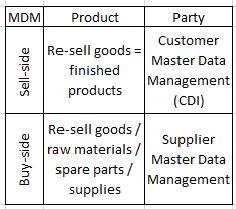
QuadrantYou may argue that PIM (Product Information Management) is not the same as Product MDM. This question was examined in the post PIM, Product MDM and Multi-Domain MDM. In my eyes the benefits of keeping PIM as part of Multi-Domain MDM are bigger than the benefits of separating PIM and MDM. It is about expanding MDM across the sell-side and the buy-side of the business eventually by enabling wide use of customer self-service and supplier self-service.

The external self-service theme will in my eyes be at the centre of where MDM is going in the future. In going down that path there will be consequences for how we see data governance as discussed in the post Data Governance in the Self-Service Age. Another aspect of how MDM is going to be seen from the outside and in is the increased use of third party reference data and the link between big data and MDM as touched in the post Adding 180 Degrees to MDM.

Besides Multi-Domain MDM and the links between MDM and big data a much mentioned future trend in MDM is doing MDM in the cloud. The latter is in my eyes a natural consequence of the external self-service themes and increased use of third party reference data which all together with the general benefits of the SaaS (Software as a Service) and DaaS (Data as a Service) concepts will make MDM morph into something like MDaaS (Master Data as a Service) – an at least nearly ten year old idea by the way, as seen in this BeyeNetwork article by Dan E Linstedt.

Bookmark and Share

The Multi-Domain Data Quality Tool Magic Quadrant 2014 is out

Gartner, the analyst firm, has a different view of the data quality tool market than of the Master Data Management (MDM) market. The MDM market has two qudrants (customer MDM and product MDM) as reported in the post The Second part of the Multi-Domain MDM Magic Quadrant is out. There is only one quadrant for data quality tools.

Well, actually it is difficult to see a quadrant for product data quality tools. Most data quality tools revolves around the customer (or rather party) domain, with data matching and postal address verification as main features.

For the party domain it makes sense to have these capabilities deployed outside the MDM solution in some cases as examined in the post The place for Data Matching in and around MDM. And of course data quality tools are used in heaps of organizations who hasn’t a MDM solution.

For the product domain it is hard to see a separate data quality tool if you have a Product Information Management (PIM) / Product MDM solution. Well, maybe if you are an Informatica fan. Here you may end up with a same branded PIM (Heiler), Product MDM (Siperian) and data quality tool (SSA Name3) environment as a consequence of the matters discussed in the post PIM,  Product MDM and Multi-Domain MDM.

What should a data quality tool do in the product domain then? Address verification would be exotic (and ultimately belongs to the location domain). Data matching is a use case, but not usually something that eliminates main pain points with product data.

Some issues that have been touched on this blog are:

Anyway the first vendor tweets about the data quality tools quadrant 2014 is turning up, and I guess some of the vendors will share the report for free soon.

Magic Quadrant for Data Quality Tools 2014

Update 3rd December: I received 3 emails from Trillium Software today with a link to the report here.

Bookmark and Share

PIM, Product MDM and Multi-Domain MDM

Over on the Informatica Perspectives blog Monica McDonnell of Informatica seems to be determined to separate Product Information Management (PIM) and Product Master Data Management (Product MDM) as we now have the second attempt in the post PIM is not Product MDM Part 2.

I can easily see the reason for this quest for Informatica, as Informatica will very much like to position the Heiler acquisition as an Informatica Multi-Domain MDM aware PIM solution as mentioned in the post MDM Aware MDM Solutions.

There will always be pros and cons for having capabilities delivered in smaller best of breed packages opposed to in larger integrated packages. On the MDM market the vendors pitch their offerings according to how they got there. SAP is using Hybris as an eCommerce focused PIM add-on to SAP. On the other hand Stibo Systems and Riversand have been adding MDM to PIM and now adds Multi-Domain to MDM as reported in the post The second part of the Multi-Domain MDM Magic Quadrant is out.

In the PIM / Product MDM realm we have several other considerations on how to address different disciplines with technology support. An important capability within PIM is Digital Asset Management (DAM) as described in the post Digital Assets and Product MDM. DAM can be a separate application or part of PIM / Product MDM. Technology support for Data Governance could also come separately as reported in the post Data governance tools: The new snake oil?

QuadrantNow, back to PIM versus Product MDM. I’m not sure it is wise to divorce these two. It seems to be a kind of back looking exercise. I would like to marry them as part of looking forward in a multi-domain MDM world. To catch up on Monica’s arguments PIM has been much about the sell-side of things. I think we should be better at integrating the buy-side and the sell-side of Product MDM / PIM as examined in the post An Alternative Multi-Domain MDM Quadrant.

Bookmark and Share

Digital Assets and Product MDM

Digital Asset Management (DAM) solutions are often seen working beside or within product Master Data Management (MDM) solutions.

I guess I might have been some of the first folks working with relating digital assets and enterprise software. That was in the early 90’s when I worked with Wang Laboratories that was a pioneer in handling digital images in the IT world.

Digital assets today are typically stored as files of well-known types as jpg, png and pdf. Within product MDM they are images of products, installation guides, safety handling sheets and so on.

The rise of the multi-channel theme has emphasized the importance of digital asset management capabilities.

Data quality is as ever an imperative. Related to well-known data quality dimensions that for example for product images means:

  • Uniqueness: You want to use the same image in your printed catalogue and on your web shop.
  • Accuracy: The image must show the described product and not something else.
  • Consistency: The images for similar products should have the same style.
carlsberg six pack
A random product image

Many of the leading product MDM solutions were born in the printed catalogue era. Here the product image was the dominant digital asset. Adding eCommerce and mCommerce means that a lot more digital asset types must be handled.

Usually we see digital assets as unstructured, or sometimes semi-structured, data. Therefore we often relate structured keywords in order to control the digital assets.

Digital assets should flow and should be controlled in the eco system of manufacturers, distributors, retailers and end users of the products. Here we have the same issues as with the structured product attributes. Giving the foreseeable steep increase in the volume, velocity and variety of the digital assets used as part of product MDM, we must drastically improve our capability in Sharing Product Master Data.

Bookmark and Share

The second part of the Multi-Domain MDM Magic Quadrant is out

Gartner, the analyst firm, recently released their magic quadrant for Master Data Management (MDM) of customer data solutions 2014 as reported in the post Customer MDM Magic Wordles.

Now the quadrant for Master Data Management of product data solutions 2014 is out too, so we can overlay the two quadrants and see how multi-domain Master Data Management (MDM) solutions are doing in terms of who are performing well with product master data and who are performing well with customer master data.

If we focus on leading vendors with differences in quadrant positioning, Informatica is better positioned with customer master data (leader) than with product master data (visionary and niche with two different products). Stibo Systems and Riversand are positioned very well within product master data (leaders) but not positioned at all with customer master data, though both vendors are naming themselves as multi-domain MDM solution providers and surely have such capabilities. I personally worked on the multi-domain roadmap with one of them some years ago.

MDM Brands
This is not the quadrant. Just some vendor names.


As every year the vendors makes press releases about the quadrant.

Upen Varanasi, CEO of Riversand, has commented in this way: “In this new Digital world, accurate product and other master information is a foundation for our customers’ major business initiatives, which requires a comprehensive, highly scalable and flexible MDM solution with full multi-domain capabilities.” See the full press release from Riversand here.

Mikael Lyngsø, CEO of Stibo Systems says: “Every member of the Stibo Systems’ team remains committed to providing our customers and partners with cutting edge solutions that not only meet their most pressing business issues but also create the most lasting and demonstrable value.” The about the company section has this bold statement: “Stibo Systems is the global leader in multidomain Master Data Management (MDM) solutions.” Read the full press release here.

Rob Karel, vice president, Product Strategy and Product Marketing, MDM, Informatica says: “We continue to deliver a multidomain MDM solution that, in combination with Informatica PIM, delivers end-to-end customer, product and supplier information governance and stewardship. Delivering complete, reliable and consistent product information – across every channel – is the key to a great customer experience.” Informatica also kindly provides a free copy of the report. Get the Magic Quadrant for Master Data Management of Product Data Solutions 2014 here.

Bookmark and Share

Customer Friendly Product Master Data

Data is of high quality if they are fit for the purpose of use. This mantra has been around in the data management realm for many years.

In a recent article by Andy Hayler on CIO about MDM at Harrods there is a good example of a piece of data of such a high quality. It is a product description:

XX 6621/74 BLK VNN SS TOP 969B S

This product description was nicely fit for the purpose of use when Harrods handled their product data in a material master in an ERP system I guess. But when switching from buy-side focus to sell-side focus in a multi-channel world, this product description gives no meaning to the customer.

HarrodsSuch problems with changing purposes of use for product master data is not only a luxury problem at Harrods but a common challenge within retail and distribution. The challenge involve having customer friendly product descriptions, a range of atomized product attributes that varies by product category and having related digital assets that helps the customer.

Organizations around are, as explained by Andy Hayler, tackling this challenge by implementing Master Data Management (MDM) solutions – in this case those ones specialized in Product Information Management (PIM).

MDM is said to be about a single version of the truth. While this in the customer (or rather party) MDM world is much about achieving uniqueness by matching and merging several different representations of the same real world individual or legal entity, the main challenge in product MDM is a bit different. Here completeness is a big issue. This involves gathering several different pieces of the truth from different sources. And a certain level of completeness may be fit for the purpose of use today but not fit enough tomorrow.

So, how can organizations overcome the huge task of gathering so much product data? I think it is much about Sharing Product Master Data.

Bookmark and Share

Buying a PIM Solution at Harrods

Today I attended the Informatica MDM Day for EMEA here in London.

London has a lot of attractions. If you for example want to see a lot of big price tags and go to a public toilet with a very nice odeur the place to go is the famous luxury department store called Harrods.

Harrods

Harrods, represented by Peter Rush, presented their Product Information Management (PIM) journey at the Informatica event. So, how does a luxury PIM implementation look like?

It starts with realising that traditional product master data in retail has mostly been about the buy-side, but today, not at least in light of the multi-channel challenge, you must add the sell-side to product master data, meaning having customer friendly product information.

After setting that scene Harrods went into selecting a PIM solution, meaning eliminating possible vendors one by one until the lucky one was chosen. In this case Heiler (now Informatica). In the last stages evaluated vendors were sent home based on criteria like roadmap, being in Texas and as the last step the price.

Bookmark and Share

Hierarchical Completeness within Product Information Management

Some years ago I wrote a blog post called Hierarchical Completeness. This post also had some excellent comments and David Loshin made a good follow up post called Hierarchy Data Completeness and Semantic Convergence.

HierarchyThe importance of hierarchical completeness, not at least within Product Information Management (PIM), has become close to me again.

It is a numbers game. Often having an advanced PIM solution on board is based by the fact that you have many products to manage. Too many products for a single data steward to control. Add to that today’s challenges of doing multi-channel business and tomorrows challenges of embracing social media engagement. This means a lot more attributes and digital assets per product and perhaps more products to manage as told in the post called Social PIM.

All products aren’t equal. The one size fits all term doesn’t apply to selling shoes or any other range of products. The attributes and assets needed differ per product categorization and so does the performance measures and expectations for each product.

Bookmark and Share

An Alternative Multi-Domain MDM Quadrant

No, this is not an(other) attempt to challenge Gartner, the analyst firm, in making quadrants about vendors in the Master Data Management (MDM) realm.

This an attempt to highlight some capabilities of Multi-Domain MDM solutions here focusing on party and product master data and the sell-side and the buy-side of MDM as discussed some years ago in the post Sell-side vs Buy-side Master Data Quality.

A simple quadrant will look like this:

Quadrant

  • The upper right corner is where MDM started, being with solutions back then called Customer Data Integration (CDI).
  • The Product Information Management (PIM) side is quite diverse and depending on the industry vertical where implemented:
    • Retailers and distributors have their challenges with sometimes high numbers of products that goes in and comes out as the same but with data reflecting different viewing points.
    • Manufacturers have other issues managing raw materials, semi-finished products, finish products and products and services used to facilitate the processes.
    • Everyone have supplies.
  • The supplier master data management has more or less also been part of the PIM space but looks more like customer master data and should be part of a party master data discipline also embracing other party roles as employee.

Also, this quadrant is by the way without other important domains as location (as discussed in the post Bringing the Location to Multi-Domain MDM) and asset (as discussed in the post Where is the Asset?)

Bookmark and Share

Sharing Product Master Data

One of the top challenges in product Master Data Management (MDM) is the sharing of master data attributes and digital assets across the ecosystem of manufacturers, distributors, retailers and end users.

There seems to be a range of solutions emerging in order to cover that land. Three kinds of approaches will be:

  • Supplier engagement within Product Information Management (PIM) solutions.
  • Similar solutions within wider IT offerings.
  • Social PIM.

PIMMaster Data Management (MDM) platforms with strong offerings for the product domain comes with built-in functionality for engaging suppliers in the process of collecting product master data attributes and related materials as product sheets, images and other digital assets.

You may also find similar functionality within the broader software suites as for example the SAP Product Stewardship Network.

A somewhat different approach may be called Social PIM as explained in the post Time to Turn Your Product Master Data Social? Here the collection process is sort of independent of in-house systems. This may, in the long run, help with having your suppliers having to attend many different solutions and also help your customers depending on where you sit in the ecosystem.

What is your experience regarding sharing product master data?

Bookmark and Share