Social Data Quality

A cornerstone in the social sphere around data quality is the site DataQualityPro founded by Dylan Jones.

This week the site had a major facelift. As Dylan explains:

“We’ve moved over to one of the most advanced content hosting sites available to make it easier for you to discover, share and engage with the huge amounts of educational content and resources we now have on the site.”

You may read more about the changes in the post Welcome to the New Look Data Quality Pro.

I remember joining DataQualityPro even before it was a site, as it started as a section of the sister site called DataMigrationPro.

During the years I have learned a lot by being a member of DataQualityPro and as most things social you don’t pay anything for being that. The only difference compared to other services is that there are no paid upgrades. You get the full package when joining.

There are sponsors too of course.

Also here I, as representing the data quality service provider iDQ, have very good experiences with DataQualityPro. Last summer we had a technology briefing on the site with a massive response.

So, if you haven’t seen the new design or you are not a member (or a sponsor) yet, hurry on and visit

DataQualityPro

Bookmark and Share

Putting it Right

Data Governance (DG), Reference Data Management (RDM) and Management Data Management (MDM) are closely related disciplines.

MDM DG RDMConsequently the Data Governance Conference Europe 2013 and the Master Data Management Summit Europe 2013 are co-located and a hot topic this year is Reference Data Management.

The difficulties in putting the sessions on the conference in one right place may be seen by that the session called Establishing Reference Data Governance in the Large Enterprise is part of a MDM track, but is actually mostly about data governance. The session is labeled Product MDM & Reference Data, but will be about governing reference data for multi-domain MDM and the data governance program described was in fact based on a party master data challenge involving reference data for industry classification.

In the session Petter Larsen, Head of Data Governance at Norway’s largest financial services group called DNB, and Thomas T. Thykjaer, Lead MDM Consultant at Capgemini, will connect the dots in the landscape of business vocabularies, data models, the data governance toolbox, data domains and reference data architecture.

I for sure look forward to that Petter and Thomas will put it right.

Bookmark and Share

Data Quality Does Matter!

The title of this blog post is the title of a seminar about data quality and data matching taking place in Copenhagen:

Data Quality Does Matter

The seminar is hosted by Affecto, a data management consultancy firm with strong presence in the Nordic and the Baltic countries, and Informatica, a leading data management tool vendors word-wide.

There will be three sessions on the seminar:

  • First you will learn about steps for working with a data quality platform to improve BI and master data management solutions.
  • Then you will see a walkthrough of the architecture and capabilities of the Informatica Data Quality platform.
  • And finally you shouldn’t miss the session with yours truly on data matching based on a Informatica Perspectives blog post called Five Future Data Matching Trends.

Hope to see you in Copenhagen, København, Köpenhamn, Kopenhagen, Copenhague, Copenaghen, Hafnia or whatever name you use for that place as told in the post about data matching and Diversity in City Names.

Bookmark and Share

What’s so special about your party master data?

My last blog post was called Is Managing Master Data a Differentiating Capability? The post is an introduction to a conference session being a case story about managing master data at Philips.

During my years working with data quality and master data management it has always struck me how different organizations are managing the party master data domain while in fact the issues are almost the same everywhere.

business partnersFirst of all party master data are describing real world entities being the same to everyone. Everyone is gathering data about the same individuals and the same companies being on the same addresses and having the same digital identities. The real world also comes in hierarchies as households, company families and contacts belonging to companies which are the same to everyone. We may call that the external hierarchy.

Based on that everyone has some kind of demand for intended duplicates as a given individual or company may have several accounts for specific purposes and roles. We may call that the internal hierarchy.

A party master data solution will optimally reflect the internal hierarchy while most of the business processes around are supported by CRM-systems, ERP-systems and special solutions for each industry.

Fulfilling reflecting the external hierarchy will be the same to everyone and there is no need for anyone to reinvent the wheel here. There are already plenty of data models, data services and data sources out there.

Right now I’m working on a service called instant Data Quality that is capable of embracing and mashing up external reference data sources for addresses, properties, companies and individuals from all over the world.

The iDQ™ service already fits in at several places as told in the post instant Data Quality and Business Value. I bet it fits your party master data too.

Bookmark and Share

Is Managing Master Data a Differentiating Capability?

If you are a Master Data Management (MDM) fanatic seeing the MDM solution as the centre of the universe and you plan to attend the MDM Summit Europe 2013 then you might as well start to work on your consistency in booing and your accuracy in throwing rotten tomatoes.

In the session called Multi-Entity MDM for the Enterprise Bert Hooyman will shock you by telling that managing master data is not considered a differentiating capability at Royal Philips Electronics.

The solution at Philips is based on the information factory idea and built upon data warehouse technology. Master data and transactional data are treated equally.

saving bulb MDMWhere others may struggle with Multi-Entity / Multidomain MDM the path chosen by Philips already serves multiple business cases for combining party master data and product master data.

I guess the term “a Philips light bulb moment” could have been used too much, so let me just say that I look forward to be enlightened on how to do MDM in an energy saving way.

Bookmark and Share

Hurray! I am on LinkedIn

These days LinkedIn are celebrating passing 200 million profiles.

This is done by sending us members a mail telling about our part in the success.

The mail message is easily sharable on LinkedIn, Twitter and Facebook. What I’ve seen is that you can be among the 1 % most viewed (including yours truly), the 5 % most viewed, the 10 % most viewed and among the first 500,000 members in a given country.

The latter incident includes for example being among the first 500,000 members in Malta.

Malta LinkedIn

I guess that will include every member in Malta as Malta has a population around 450,000, unless of course the Maltese are world champions in creating duplicate profiles.

Bookmark and Share

Happy New Year

Am I too late? Not at all. Today is the last day in the year of the dragon and tomorrow will be the first day in the year of the snake according to the Chinese calendar. It’s the Chinese New Year.

As globalization moves on we are becoming more and more aware of celebrations from different cultures and I guess we will end up having almost every day as a special day.

Next up as I am aware of is the coming Thursday being Valentine’s Day, a day that has gained much in importance during the last decades in many European countries and other places. Not at least taunted by retailers.

In Chinese symbology, snakes are regarded as intelligent, but with a tendency to be somewhat unscrupulous. So I guess Valentine’s day this year will be great (for retailers).

Everything a good reminder of the diversity issues in data quality which is a frequent subject on this blog.

Happy new year and for god’s sake don’t forget Valentine’s Day.

Chinatown_london

Bookmark and Share

Social MDM and Matchback

business partnersIn a discussion in the Social MDM group on LinkedIn the following saying came up:

“Why did 85% of the 1700 CMOs interviewed say they use social media as a communications channel and yet only 14% of them measure the ROI?”

A traditional discipline in measuring ROI from a certain market activity is, as told in the post Matchback and Master Data Management, that you try to figure out from which activity a new (prospect) customer was triggered.

The problem is that the trigger may be in one channel but the customer shows up in another channel.

Measuring the Return on Investment (ROI) in doing social media communication and social CRM also requires matchback and in order to do this you will need social master data management where the old systems of records are linked to the new systems of engagement.

As the social business has some considerations not at least around privacy, the matchback activities may very well be done by adapting Hierarchy Management in Social MDM.

Bookmark and Share

The Data Governance Jigsaw Puzzle

Picture this: You find yourself taking over a challenging Data Governance initiative part way through and the path to complete the implementation is far from clear.

Most learning and best practices for data governance implementation, and a lot of other implementations of whatever, are based on doing the stuff from start to end. But in fact many people are thrown into the journey somewhere along the route without any own history on how the journey began, no clear understanding on why the actual direction was taken and no clue about where the end of the rainbow is supposed to be.

If this isn’t hard enough the good people organizing the Data Governance Conference Europe 2013 (co-located with the MDM Summit) has put the session from Nicola Askham on this tough challenge almost at end of the program. Check it out here.

Last Friday I met Nicola for an after work drink at a secret place in the City of London and I can assure you that Nicola despite all odds is fit for fight and ready to kick y… well, putting the puzzle together.

DG2013

Bookmark and Share

The Greenland Problem in MDM

In a recent comment here on this blog the relevance of Master Data Management (MDM) solutions was questioned because in real business life different business units sees master data very differently though the data describes the same real world entity. And it’s not the first time I hear this argument.

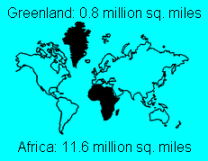
The Greenland ProblemThe issue is similar to the Greenland problem in geography. When using the most common projection for visualizing a round earth on a flat map, the Mercator projection, Greenland has a true shape but will look as being of same size as Africa, though Africa is over 10 times as large as Greenland.

As examined in the post Sharing data is key to a single version of the truth this is similar to the problems in fulfilling multiple uses embracing all business units in an enterprise:

  • If a map shows a limited part of the world the difference doesn’t matter that much. This is similar to fitting the purpose of use in a single business unit.
  • If the map shows the whole world we may have all kind of different projections offering different kind of views on the world having some advantages and disadvantages like when we do enterprise MDM.

Today we have new technology coming to the rescue. If you go into Google Earth the world indeed looks round and you may have any high altitude view of an apparently round world. If you go closer the map tends to be more and more flat.

Google EarthMy guess is that the solutions to fit the multiple uses conundrum within MDM also will be offered from the cloud by having innovative solutions reflecting the real world entities and relate those to a variety of business functions used in different business units offering a range of views that supports multiple purposes of use.

Bookmark and Share