Data Monetization and Data Quality

Traditionally data quality management has revolved around making data fit for purpose in various business processes and thus data quality has contributed indirectly to business outcomes, as the business benefits were measured and harvested by results created in these business processes.

This situation has also made it very hard to create distinct business cases for data quality improvement. Most often data quality improvement and related disciplines and data governance, Master Data Management (MDM) and Product Information Management (PIM) has been part of wider business cases concerning for example Customer Relationship Management (CRM) and eCommerce perhaps under an even wider specific business objective.

In today’s data driven business world and drastic rising top-level appetite for digital transformation we see more and more examples of how data can be used much more directly to create business outcome through new or fundamentally reshaped business services and business models.

WebinarsOne example close to me is how data quality via completeness of product information can lead directly to selling more online as told in the post Where to Buy a Magic Wand?

On the 7th August I will elaborate on these themes in a webinar together with Rado Kotorov. The webinar is hosted by Information Builders and you can learn more and register on the Data Monetization webinar here.


Achieving Business Benefits from Multi-Domain MDM

Multi-Side MDMThe title of this blog post is also the title of my presentation at a Master Data Management (MDM) event that will take place in Berlin the 18th and 19th October 2018.

Here, I will give my perspectives on:

Read more about this MDM event from ThinkLinkers here. Hope to see you in Berlin.

PS: You can watch a YouTube video with testimonials from a previous event here.

Ecosystem Wide Product Information Management

The concept of doing Master Data Management (MDM) not only enterprise wide but ecosystem wide was examined in the post Ecosystem Wide MDM.

As mentioned, product master data is an obvious domain where business outcomes may occur first when stretching your digital transformation to encompass business ecosystems.

The figure below shows the core delegates in the ecosystem wide Product Information Management (PIM) landscape we support at Product Data Lake:

Ecosystem Wide PIM.png

Your enterprise is in the centre. You may have or need an in-house PIM solution where you manipulate and make product information more competitive as elaborated in the post Using Internal and External Product Information to Win.

At Product Data Lake we collaborate with providers of Artificial Intelligence (AI) capabilities and similar technologies in order to improve data quality and analyse product information.

As shown in the top, there may be a relevant data pool with a consensus structure for your industry available, where you exchange some of product information with trading partners. At Product Data Lake we embrace that scenario with our reservoir concept.

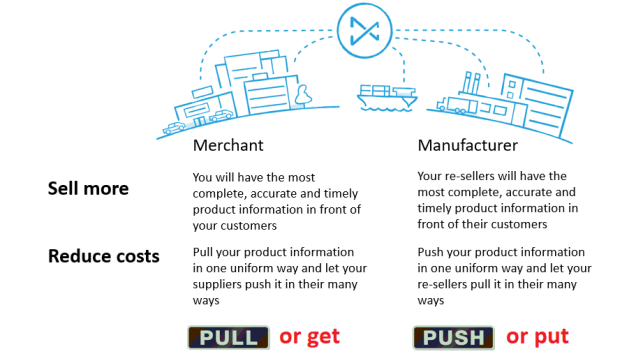
Else, you will need to make partnerships with individual trading partners. At Product Data Lake we make that happen with a win-win approach. This means, that providers can push their product information in a uniform way with the structure and with the taxonomy they have. Receivers can pull the product information in a uniform way with the structure and with the taxonomy they have. This product data syndication concept is outlined in the post Sell more. Reduce costs.

The Emperor´s New Term

Emperor_Clothes“No one dared to admit that he couldn’t see anything, for who would want it to be known that he was either stupid or unfit for his post?”
This is a quote from the story called The Emperors New Clothes by Hans Christian Andersen.

Having been in and around the IT business for nearly 40 years I have seen, and admittedly not seen, a lot. Inflated hype has always been there, and a lot of technologies, companies and gurus did not make it, but came out naked.

What will you say are the emperor’s new clothes within data management today. Here are some suggestions:

  • Social MDM (Social Master Data Management): The idea that master data management will embrace social profiles and social data streams. If not anything else, did GDPR kill that one?
  • Big Data: This term has been killed so many times. But were those always a staged murder?
  • Single source of truth: The vision that we can have one single source that encompasses everything we need to know about a business entity. This has been a long time running question. Will it ever be answered?

What is your suggestion?

Where to Buy a Magic Wand?

Sometimes you may get the impression that sales, including online sales, is driven by extremely smart sales and marketing people targeting simple-minded customers.

Let us look at an example with selling a product online. Below are two approaches:

Magic wand

Bigger picture is available here.

My take is that the data rich approach is much more effective than the alternative (but sadly often used one). Some proof is delivered in the post Ecommerce Su…ffers without Data Quality.

In many industries, the merchant who will cash in on the sale will be the one having the best and most stringent data, because this serves the overwhelming majority of buying power, who do not want to be told what to buy, but what they are buying.

So, pretending to be an extremely smart data management expert, I will argue that you can monetize on product data by having the most complete, timely, consistent, conform and accurate product information in front of your customers. This approach is further explained in the piece about Product Data Lake.

Product Data Lake Behind the Scenes

Product Data Lake is a cloud service for exchanging product information (product data syndication) between manufacturers, distributors and merchants. When telling about the service I usually concentrate on the business benefits and how the service will make you sell more and reduce costs.

However, there will always be one or two persons in the audience who wants to know about the technology behind. And for sure, this is important too.

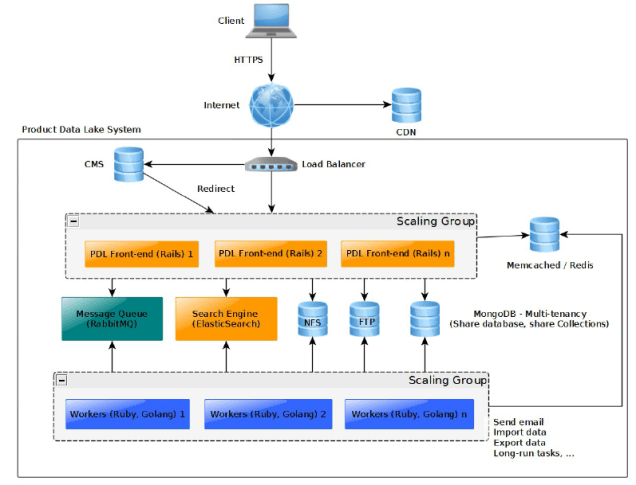
The service is built using some of the newest and best-of-breed technologies available for this purpose today. This includes Amazon Elastic Computing Cloud for hosting the public cloud version, MongoDB for storing data, RabbitMQ for handling data streams and ElasticSearch for finding data.

PDL Architecture

You can dive into the geeky parts in this PDF document: Product Data Lake Architecture.

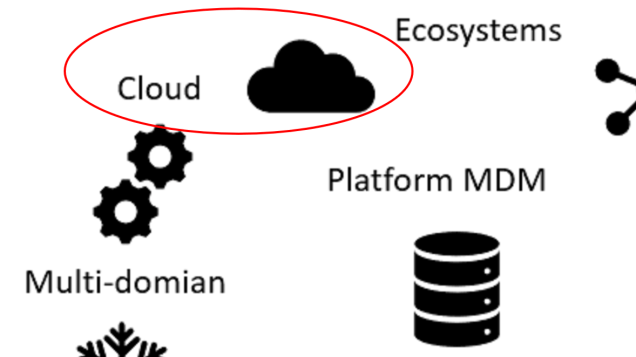
MDM in The Cloud, On-Premise or Both

One of the forms of Master Data Management (MDM) is the rising cloud deployment model as touched in the Disruptive MDM List blog post about 8 Forms of Master Data Management.

If we look at the MDM solution vendors, they may in that sense be divided into three kinds:

  • Cloud only, which are vendors born in the cloud age and who are delivering their service in the cloud only. Reltio is an example of that kind of MDM vendor.
  • Cloud or on-premise, which are vendors that can deliver both in the cloud and on premise, but where it makes most sense that you as a customer chooses the one that fits you the best. An example is Semarchy.
  • Cloud and on-premise. Informatica is the example of an MDM vendor that embraces both deployment models (together with other data management disciplines) at the same time (called hybrid) as told in an article by Kristin Nicole of SiliconANGLE. The title goes like this: Balancing act: Informatica straddles on-prem needs with cloud data at Informatica World 2018

Cloud MDM

Happiness vs Market Strength

When following analyst market reports one thing that always strike me is that the vendors who have charged the most for licenses (being to the right on the market strength axis) seldom are the same as those having the most satisfied customers.

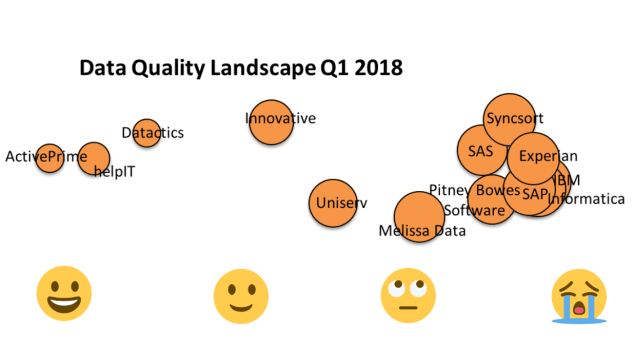
The Data Quality Product Landscape 2018 from Information Difference has no surprises there either.

On the technology vertical axis, the vendors are pretty even, while they stretch out on the horizontal market strength axis.

DQ Landscape 2018

The report states: “The happiest customers based on this survey were those of Datactics followed by ActivePrime”. You will find those to the left.

(Innovative Systems, Experian and Syncsort were the better of the rest it must be said.)

See the full report here.

Even With 20 Entities MDM Can be Hard

This week I attended the Master Data Management Summit Europe 2018 and Data Governance Conference Europe 2018 in London.

Among the recurring sessions year by year on this conference and the sister conferences around the world will be Aaron Zornes presenting the top MDM Vendors as he (that is the MDM Institute) sees it and the top System Integrators as well.

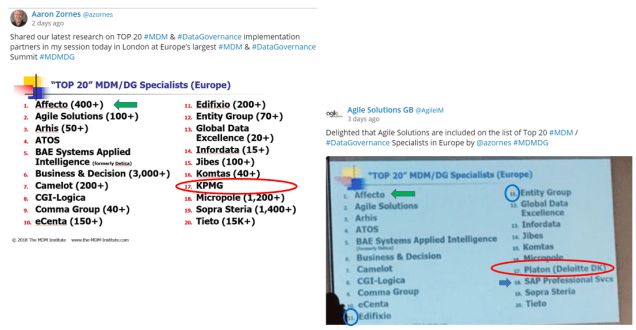
Managing an ongoing list of such entities can be hard and doing it in PowerPoint does not make the task easier as visualized in two different shots captured via Twitter as seen below around the Top 19 to 22 European MDM / DG System Integrators:

20 entities

Bigger picture available here.

Now, the variations between these two versions of the truth and the real world are (at least):

  • Red circles: Is number 17 (in alphabetical order) Deloitte – in Denmark – who bought Platon 5 years ago or is it KPMG.
  • Blue arrow and circles: Is SAP Professional Services in there or not – and if they are, there must be 21 Top 20 players with two number 11: Edifixio and Entity Group
  • Green arrow: Number 1 (in alphabetical order) Affecto has been bought by number 8 CGI during this year.

PS: Recently I started a disruptive list of MDM vendors maintained by the vendors themselves. Perhaps the analysts can be helped by a similar list for System Integrators?

Product Data Lake Version 1.7 is Live

Win-Win

The good thing about providing Software-as-a-Service is that you do not have to ship the software to all your users and the good thing about using Software-as-a-Service is that program updates are immediately available to the users without that an IT department has to schedule, plan, test and go live with a new version of an application.  This is also true for Product Data Lake, the cloud service also being a win-win application by providing business benefits to both manufacturers and merchants of goods.

Using Application Programming Interfaces (APIs)

Already existing means to feed to and consume product information from Product Data Lake include FTP file drops, traditional file upload from your desktop or network drives or actually entering data into Product Data Lake. With version 1.7, that went live this week, you can now also use our APIs for system to system data exchange by both pushing (put) data into the lake and pulling (get) data from the lake.

Get the Overview

Get the full Product Data Lake Overview here (opens a PDF file).

Get