Search and if you are lucky you will find

This morning I was following the tweet stream from the ongoing Gartner Master Data Management (MDM) conference here in London, when another tweet caught my eyes:

This reminded me about that (error tolerant) search is The Overlooked MDM Feature.

Good search functionality is essential for making the most out of your well managed master data.

Search functionality may be implemented in these main scenarios:

Inside Search

You should be able to quickly find what is inside your master data hub.

The business benefits from having fast error tolerant search as a capacity inside your master data management solution are plenty, including:

  • Better data quality by upstream prevention against duplicate entries as explained in this post.
  • More efficiency by bringing down the time users spends on searching for information about entities in the master data hub.
  • Higher employee satisfaction by eliminating a lot of frustration else coming from not finding what you know must be inside the hub already.

MDM inside search capabilities applies to multiple domains: Party, product and location master data.

Search the outside

You should be able to quickly find what you need to bring inside your master data hub.

Data entry may improve a lot by having fast error tolerant search that explores the cloud for relevant data related to the entry being done. Doing that has two main purposes:

  • Data entry becomes more effective with less cumbersome investigation and fewer keystrokes.
  • Data quality is safeguarded by better real world alignment.

Preferably the inside and the outside search should be the same mash-up.

Searching the outside is applies especially to location and party master data.

Search from the outside

Website search applies especially to product master data and in some cases also to related location master data as described in the post Product Placement.

Your website users should be able to quickly find what you publish from your master data hub be that description of physical products, services or research documents as in the case of Gartner, which is an analyst firm.

As said in the tweet on the top of this post, (good) search makes the life of your coming and current customers much easier. Do I need to emphasize the importance of good customer experience?

Bookmark and Share

The Big ABC of Reference Data

Reference Data is a term often used either instead of Master Data or as related to Master Data. Reference data is those data defined and (initially) maintained outside a single organisation. Examples from the party master data realm are a country list, a list of states in a given country or postal code tables for countries around the world.

The trend is that organisations seek to benefit from having reference data in more depth than those often modest populated lists mentioned above.

In the party master data realm such reference data may be core data about:

  • Addresses being every single valid address typically within a given country.
  • Business entities being every single business entity occupying an address in a given country.
  • Consumers (or Citizens) being every single person living on an address in a given country.

There is often no single source of truth for such data. Some of the challenges I have met for each type of data are:

Addresses

The depth (or precision if you like) of an address is a common problem. If the depth of address data is at the level of building numbers on streets (thoroughfares) or blocks, you have issues as described in the blog post called Multi-Occupancy.

Address reference data of course have issues with the common data quality dimensions as:

  • Timeliness, because for example new addresses will exist in the real world but not yet in a given address directory.
  • Accuracy, as you are always amazed when comparing two official sources which should have the same elements, but haven’t.

Business Entities

Business directories have been accessible for many years and are often used when handling business-to-business (B2B) customer master data and supplier master data management. Some hurdles in doing this are:

  • Uniqueness, as your view of what a given business entity is occasionally don’t match the view in the business directory as discussed in the post 3 out of 10
  • Conformity, because for example an apparently simple exercise as assigning an industry vertical can be a complex matter as mentioned in the post What are they doing?

Consumers (or Citizens)

In business-to-consumer (B2C) or other activities involving citizens a huge challenge is identifying the individuals living on this planet as pondered in the post Create Table Homo Sapiens. Some troubles are:

  • Consistency isn’t easy, as governments around the world have found 240 (or so) different solutions to balancing privacy concerns and administrative effectiveness.
  • Completeness, as the rules and traditions not only between countries, but also within different industries, certain activities and various channels, are different.

Big Reference Data as a Service

Even though I have emphasized on some data quality dimensions for each type of data, all dimensions apply to all types of data.

For organisations operating multinational and/or multichannel exploiting the wealth and diversity of external reference data is a daunting task.

This is why I see reference data as a service embracing many sources as a good opportunity for getting data quality right the first time. There is more on this subject in the post Reference Data at Work in the Cloud.

Bookmark and Share

Small Business Owners

A challenge I encounter over and over again within Data Matching and customer Master Data Management is what to do with small business owners.

Examples of small business owners are:

  • Farmers
  • Healthcare professionals with an own clinic
  • Small family driven shop owners
  • Modest membership organisation administrators
  • Local hospitality providers as Basil Fawlty of Fawlty Towers
  • Independent Data Quality consultants as myself

When handling customer master data we often like to divide those into Business-to-consumer (B2C) or Business-to-business (B2B). We may have different source systems, different data models and different data owners and data stewards for each of the two divisions.

But small business owners usually belong to both divisions. In some transactions they act as private persons (B2C) and in some other transactions they act as a business contact (B2B). If you like to know your customer, have a single customer view , engage in social media and all that jazz, you must have a unique view of the person, the business and the household.

In several industries small business owners, the business and the household is a special target group with unique product requirements. This is true for industries as banking, insurance, telco, real estate, law.

So here are plenty of business cases for multi-domain Master Data Management embracing customer master data and product master data.

The capability to handle a single customer view of small business owners is in my experience very poorly fulfilled in Data Quality and Master Data Management solutions around. Here is certainly room for improvement and entrepreneurship.

Bookmark and Share

Indulgent Moderator or Ruthless Terminator?

I am the founder/moderator of two small niche LinkedIn groups in the data quality and Master Data Management (MDM) realm:

As a moderator I feel responsible for keeping the discussions in the group on target.

I guess my challenges in doing so resemble what nearly every other moderator on LinkedIn groups are faced with.

The postings that keep creating trouble are related to:

  • Jobs
  • Promotions

LinkedIn does have a facility to place entries into these two alternative tabs. But people seldom do that voluntary.

Jobs

In fact I’m pleased when a job is posted in one of the groups. But I also know that many people don’t like job postings coming up among the “normal” discussions in the groups.

I’m not so naive that I think recruiters forget to post as a job or don’t know how to do it. Many recruiters don’t respect the rules even if reminded. And some recruiters keep on entering the same job over and over again.

Therefore I have to mark recruiters, who twice “forget”, as subject to indulgent moderation. As said, I like job postings, so until now I haven’t practiced ruthless termination apart from deleting double entries – but that is also a destination of data matching anyway.

Promotions

With the relative small number of members in the groups in question, and recognising that most participants are tool vendors and service providers, I find it refreshing and informative with entries with promotional content, however most pleased when it’s done with limited marketing triviality.     

My indulgence may be explained by that I’m interconnected with tool makers and service providers myself. So these promotions are great ready-made competitor monitoring.

However, my indulgence has its limits when it comes to off topic promotion.

A special case here is outsourcing promotions. I find it peculiar that those people practicing this trade don’t target the message for the group where posted. It shouldn’t be too hard to make an angle with data matching or Multi-Domain MDM for your services. But I find that most out-sourcing people copy-paste their usual stuff.

So, in this area I mostly am the ruthless terminator. And there is seldom any hasta la vista, baby.

Bookmark and Share

Multi-Occupancy

The fact that many people doesn’t live in a single family house but live in a flat sharing the same building number on a street with people living in other flats in the same building is a common challenge in data quality and data matching.

The same challenge also applies to companies sharing the same building number with other companies and not to say when companies and households are in the same building. So this is a common party master data issue.

Address verification and geocoding is seen as important methods for achieving data quality improvement related to the top data quality pain all over being quality of party master data and aiming at getting a single customer view.

Multi-occupancy is a pain in the (you know) getting there.

My pain

I have had some personal experiences living at multi-occupancy addresses lately.

One and a half years ago I was living a painless life in single family house in a Copenhagen suburb.

Then I moved closer to downtown Copenhagen in a flat as mentioned in post Down the Street.

The tradition in Denmark is to send letters and make deliveries and register master data with a common format of units within a building and having separate mailboxes with flat ID and names for each flat. I have received most of my post since then and got all deliveries I’m aware of.

Then I moved to London in a flat. Here the flats in my building have numbers. But the postman delivers the letters in one batch in the street door, and there are no names on the doorbells in front of the door.

So now I sense I don’t get many letters and today I had to order the same stuff trice from amazon.co.uk, because I haven’t received the first two packages despite of their state of the art online accessible package tracking systems that tells me that delivery was successful.

Master data pains unresolved

Address reference data at building number level and related geocodes are becoming commonly available many places around these days.

But having reference data and real world aligned location and related party master data at the unit level is still a challenge most places. Therefore we are still struggling with using address verification and geocoding for single customer view where a given building number has more than a single occupancy.

Bookmark and Share

Reference Data at Work in the Cloud

One of the product development programs I’m involved in is about exploiting rich external reference data and using these data in order to get data quality right the first time and being able to maintain optimal data quality over time.

The product is called instant Data Quality (abbreviated as iDQ ™). I have briefly described the concept in an earlier post called instant Data Quality.

iDQ ™combines two concepts:

  • Software as a Service
  • Data as a Service

While most similar solutions are bundled with one specific data provider the iDQ ™ concept embraces a range data sources. The current scope is around customer master data where iDQ ™ may include Business-to-Business (B2B) directories, Business-to-Consumer (B2C) directories, real estate directories, Postal Address Files and even social media network data from external sources as well as internal master data at the same time all presented in a compact mash-up.

The product has already gained a substantial success in my home country Denmark leading to the formation of a company solely working with development and sales of iDQ ™.

The results iDQ ™ customers gains may seem simple but are the core advantages of better data quality most enterprises are looking for, like said by one of Denmark’s largest companies:

“For DONG Energy iDQ ™ is a simple and easy solution when searching for master data on individual customers. We have 1,000,000 individual customers. They typically relocate a few times during the time they are customers of us. We use iDQ ™ to find these customers so we can send the final accounts to the new address. iDQ ™ also provides better master data because here we have an opportunity to get names and addresses correctly spelled.

iDQ ™ saves time because we can search many databases at the time. Earlier we had to search several different databases before we found the right master data on the customer. ”

Please find more testimonials here.

I hope to be able to link to testimonials in more languages in the future.

Bookmark and Share

What to do in 2012

The time between Christmas and New Year is a good time to think about if you are going to do the right things next year. In doing so, you will have to look back at the current year and see how you can develop from there.

In my professional life as a data quality and master data management practitioner my 2011 to do list included these three main activities:

  • Working with Multi-Domain Master Data Quality
  • Exploiting rich external reference data sources in the cloud
  • Doing downstream data cleansing

In a press release from May 2011 Gartner (the analyst firm) Highlights Three Trends That Will Shape the Master Data Management Market. These are:

  • Growing Demand for Multidomain MDM Software
  • Rising Adoption of MDM in the Cloud
  • Increasing Links Between MDM and Social Networks

It looks like I was working in the right space for the first two things but stayed in the past regarding the third activity being downstream data cleansing.

The third thing to embrace in the future, social MDM we may call it, has been an area of interest for me the last couple of years and actually some downstream data cleansing projects has touched making master data useful for including social media networks in the loop.  

I’m not sure if 2012 will be a breakthrough for social MDM, but I think there will be some exciting opportunities out there for paving the road for social MDM.

Bookmark and Share

The Pond

The term ”The Pond” is often used as an informal term for the Atlantic Ocean, especially the North Atlantic Ocean being the waters that separates North America and Europe.

Within information technology and not at least my focus areas being data quality and master data management there is a lot of exchange going on over the pond as European companies are using North American technology and sometimes vice versa. Also European companies are setting up operations in North America and of course also the other way around.

Some technologies works pretty much the same regardless of in which country it is deployed. A database manager product is an example of that kind of technology. Other pieces of software must be heavily localized. An ERP application belongs to that category. Data quality and master data management tools and implementation practice are indeed also subject to diversity considerations.

When North American companies go to Europe my gut feeling is that an overwhelming part of them chooses to start with a European or EMEA wide head quarter on the British Isles – and that again means mostly in the London area.

The reasons for that may be many. However I guess that the fact that people on the British Isles doesn’t speak a strange language has a lot to say. What many North American companies with a head quarter in London often has to realize then is, that this move only got them half way over the pond.  

Bookmark and Share

Nonprofit Data Quality

One of the industries where I have worked a lot with data quality issues is at nonprofit organizations such as charities and other form of membership based organizations.

A general characteristic of such organizations is that they have databases with as many “customers” as huge global enterprises; however the number of employee records is only a fraction compared to those large companies.

So the emphasis is often not at creating well manned data governance organizational structures but implementing the best automation available in order to have optimal party master data management, where the parties involved are members and other roles played by individuals and companies with a common interest.

Many nonprofit organizations have several different fundraising activities going on at the same time. This means that real world individuals, households, organizations and their contacts are registered through different channels. The challenges of getting a “single view of customer” from the data streams created in these processes are discussed in the post Multi-Purpose Data Quality.

There are many nonprofit organizations working internationally. The often decentralized management structures in nonprofit organizations means that way of doing things will naturally be different between countries where nonprofits are operating. Also the differences in legislation and culture are important. Some examples related to how to exploit master data are examined in the post Feasible Names and Addresses.

When it comes to creating business cases for data quality nonprofits are basically of course not different from any other organization. The main goals are increased fundraising and lowering administration costs. As said, the low number of employees often leads to using technology. The low amount of money available often leads to using agile technology.

Bookmark and Share

Party, Product, Place. Period.

In a recent post here on this blog the Master Data Management domain usually called locations was examined and followed by excellent comments.

Also in the DAMA International LinkedIn group there was a great discussion around the location domain.

The comments touched two subjects:

  • Are locations just geographic locations or can we deal with “digital locations” as eMail addresses, phone numbers, websites, go-to-meeting ID’s, social network ID’s and so as locations as well?
  • How do we model the relations between parties, products and locations?

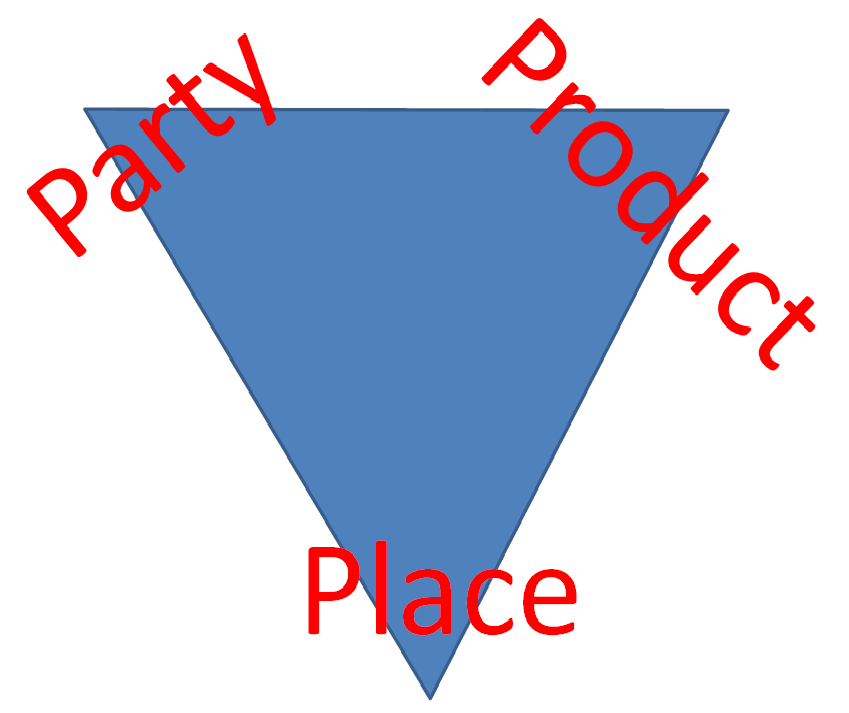
Sometimes I like to use the word places instead of locations as we then have a P-trinity of parties, products and places.

I’m not sure if places have a stronger semantic link to geography than locations have. Anyway, my thoughts on the location domain were merely connected to geography. The digital locations mentioned also in my eyes are more related to parties and not so much products. The same is true for another good old substitute for a location or address being a mailbox (like “Postbox 1234”), which is a valid notion for the destination of a letter or small package, and often seen in database columns else filled with geographic locations.

So, sticking to places being physical, geographic locations: How do we model parties, products and places?

First of all it’s important that we are able to model different concepts within each domain in one single way. A very common situation in many enterprise data landscapes is that different forms of parties exist with different models, like a model for customers, a model for suppliers, a model for employees and other models for other business partner roles.

The association between a party entity and a location entity is in most cases a time dependent relation like this consumer was billed on this address in this period. The relation between the party and the product is the good old basic data model, that we invoiced this and this product on that date. The product and place relation is very industry specific. One example will be that an on-site service contract applies to this address in this period.

Time, often handled as a period, will indeed add a fourth P to the P-trinity of party, product and place.

Bookmark and Share