If you haven’t yet implemented a Master Data Management (MDM) solution you typically holds master data in dedicated solutions for Supply Chain Management (SCM), Enterprise Resource Planning (ERP), Customer Relation Management (CRM) and heaps of other solutions aimed at taking care of some part of your business depending on your particular industry.

In this first stage some master data flows into these solutions from business partners in different ways, flows around between the solutions inside your IT landscape and flows out to business partners directly from the various solutions.
The big pain in this stage is that a given real world entity may be described very different when coming in, when used inside your IT landscape and when presented by you to the outside. Additionally it is hard to measure and improve data quality and there may be several different business processes doing the same thing in an alternative way.
The answer today is to implement a Master Data Management (MDM) solution. When doing that you in some degree may rearrange the way master data flows into your IT landscape, you move the emphasis on master data management from the SCM, ERP, CRM and other solutions to the MDM platform and orchestrate the internal flows differently and you are most often able to present a given real world entity in a consistent way to the outside.
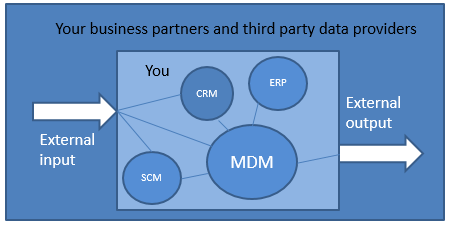
In this second stage you have cured the pain of inconsistent presentation of a given real world entity and as a result of that you are in a much better position to measure and control data quality. But typically you haven’t gained much in operational efficiency.
You need to enter a third stage. MDM 3.0 so to speak. In this stage you extend your MDM solution to your business partners and take much more advantage of third party data providers.
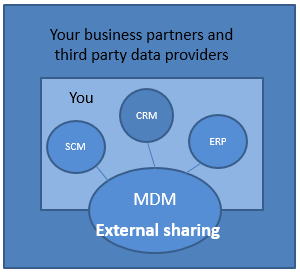
The master data kept by any organization is in a large degree a description of real world entities that also is digitalized by business partners and third party data providers. Therefore there are huge opportunities for reengineering your business processes for master data collection and interactive sharing of master data with mutual benefits for you and your business partners. These opportunities are touched in the post MDM 3.0 Musings.


 An important part of implementing Master Data Management (MDM) is to capture the business rules that exists within the implementing organization and build those rules into the solution. In addition, and maybe even more important, is the quest of crafting new business rules that helps making master data being of more value to the implementing organization.
 There are relationships between entities within the single MDM domains and there are relationships between entities across multiple MDM domains.
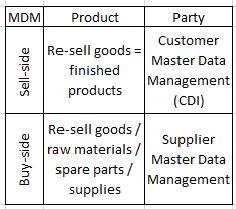 Now, back to PIM versus Product MDM. I’m not sure it is wise to divorce these two. It seems to be a kind of back looking exercise. I would like to marry them as part of looking forward in a multi-domain MDM world. To catch up on Monica’s arguments PIM has been much about the sell-side of things. I think we should be better at integrating the buy-side and the sell-side of Product MDM / PIM as examined in the post
  If we look at customer, or rather party, Master Data Management (MDM) it is much about real world alignment. In party master data management you describe entities as persons and legal entities in the real world and you should have descriptions that reflect the current state (and sometimes historical states) of these entities. Some reflections will be
  One example is in postal services as mentioned in the post