Know Your Foreign Customer

I’m not saying that Customer Master Data Management is easy. But if we compare the capabilities within most companies with handling domestic customer records they are often stellar compared to the capabilities of handling foreign customer records.

It’s not that the knowledge, services and tools doesn’t exist. If you for example are headquartered in the USA, you will typically use best practice and services available there for domestic records. If you are headquartered in France, you will use best practice and services available there for domestic records. Using the best practices and services for foreign (seen from where you are) records is more seldom and if done, it is often done outside enterprise wide data management.

This situation can’t, and will not, continue to exist. With globalization running at full speed and more and more enterprise wide data management programs being launched, we will need best practices and services embracing worldwide customer records.

Also new regulatory compliance will add to this trend. Being effective next year the US Foreign Account Tax Compliance Act (FATCA) will urge both US Companies and Foreign Financial Institutions to better know your foreign customers and other business partners.

In doing that, you have to know about addresses, business directories and consumer/citizen hubs for an often large range of countries as described in the post The Big ABC of Reference Data.

It may seem a daunting task for each enterprise to be able to embrace big reference data for all the countries where you have customers and other business partners.

My guess, well, actually plan, is, that there will be services, based in the cloud, helping with that as indicated in the post Partnerships for the Cloud.

Bookmark and Share

Well Met, Stranger

Finally wordpress.com, the hosted version of WordPress that I am using, has added geography to the stats.

The counter has been running for 14 days now, so I have tried to have a first look into the numbers.

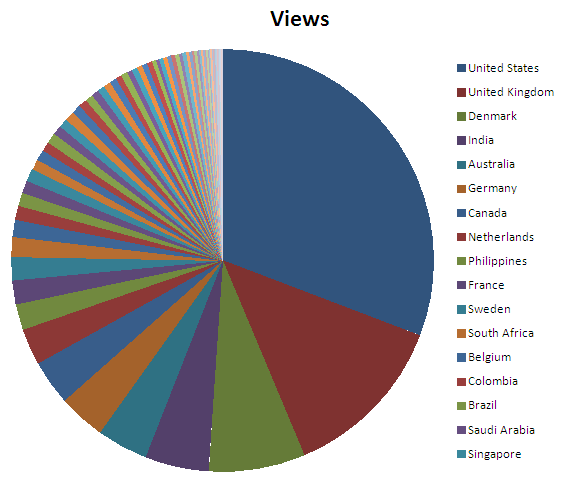
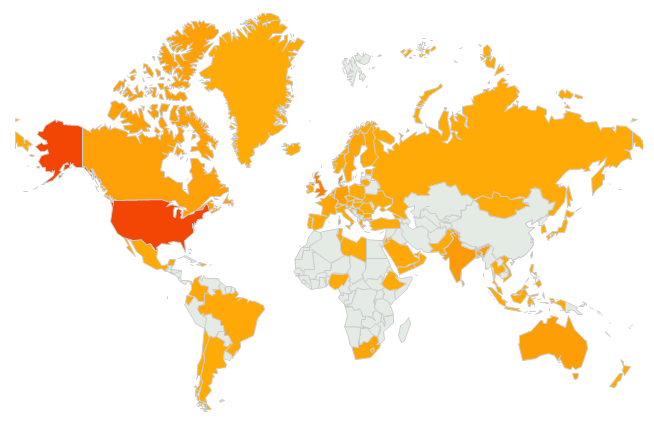
First of all I’m pleased that I during these 14 days have had visitors from 67 different countries around the globe:

Most visitors have been from the United States, followed by my current home country United Kingdom and then my former home country Denmark:

Note: This figure is made by copying the results into excel.

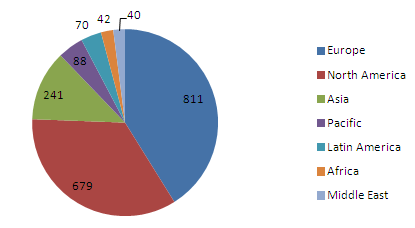
If grouped by regions of the world, it looks like this:

The world has certainly become a small place. Of course your interactions are biased towards your neighborhood, but in blogging as well as in business our success will increasingly become dependent on meeting, understanding and interacting with (maybe not so) strange people of the world.

Bookmark and Share

Your Point, My Comma

Spam mails can be great food for thought.

This morning I had this one in one of my many mailboxes:

So, the amount in question was:

It’s interesting to see how the spammer used points and commas in the large amount of money he wanted to trick me with. Don’t know if he was sloppy or had the problem of showing an amount to a not segmented audience of the world that are:

  • Using point as decimal mark and comma as thousand separator
  • Using comma as decimal mark and point as thousand separator

The use of a sign for decimal mark and thousand separators is indeed divided across the globe as seen on this map:

The blue countries are using point as decimal mark and comma as thousand separator and the green countries are doing the opposite.

Then there may be diversities within a country as in Canada there are always questions about Quebec, where they are following the French custom. India also has its own numerals with 100 groupings besides the English heritage.  

The pattern of a approximately one half world using one standard and approximately another half of the world using an opposite standard is seen in other notations as arranging person names, writing street addresses as well as place names and postal codes as told in the post Having the Right Element to the Left.

Bookmark and Share

Broken Links

When passing the results of data cleansing activities back to source systems I have often encountered what one might call broken links, which have called for designing data flows that doesn’t go by book, doesn’t match the first picture of the real world and eventually prompts last minute alternate ways of doing things.

I have had the same experience when passing some real (and not real) world bridges lately.

The Trembling Lady: An Unsound Bridge

When walking around in London a sign on the Albert Bridge caught my eye. The sign instructs troops to break steps when marching over.

In researching the Albert Bridge on Wikipedia I learned that the bridge has an unsound construction that makes it vibrate not at least when a bunch of troops marches across in rhythm. The bridge has therefore got the nickname “The Trembling Lady”.

It’s an old sign. The bridge is an old bridge. But it’s still standing.

The same way we often have to deal with old systems running on unstable databases with unsound data models. That’s life. Though it’s not the way we want to see it, we most break the rhythm of else perfectly cleansed data as discussed in the post Storing a Single Version of the Truth.  

The Øresund Bridge: The Sound Link

The sound between the city of Malmö in Sweden and København (Copenhagen) in Denmark can be crossed by the Øresund Bridge. If looking at a satellite picture you may conclude that the bridge isn’t finished. That’s because a part of the link is in fact an undersea tunnel as told in the post Geocoding from 100 Feet Under.

Your first image about what can be done and what can’t be done isn’t always the way of the world. Dig into some more sources, find some more charts and you may find a way.

However, life isn’t always easy. Sometimes charts and maps can be deceiving.

Wodna: The Sound of Silence.

As reported in the post Troubled Bridge over Water I planned a cycling trip last summer. The route would take us across the Polish river Świna by a bridge I found on Google Maps.

When, after a hard day’s ride in the saddle, we reached the river, the bridge wasn’t there. We had to take a ferry across the river instead.

I maybe should have known. The bridge on the map was named Wodna. That is Polish for (something with) water.

Bookmark and Share

Inaccurately Accurate

The public administrative practice for keeping track of the citizens within a country is very different between my former country of living being Denmark and my current country of living being the United Kingdom.

In Denmark there is an all-purpose citizen registry where you are registered “once and for all” seconds after you are born as told in the post Citizen ID within Seconds.

In the United Kingdom there are separate registries for different purposes. For example there is a registry dealing with your health care master data and there is a registry, called the electoral roll, dealing with your master data as a voter.

Today I was reading a recent report about data quality within the British electoral roll. The report is called Great Britain’s electoral registers 2011

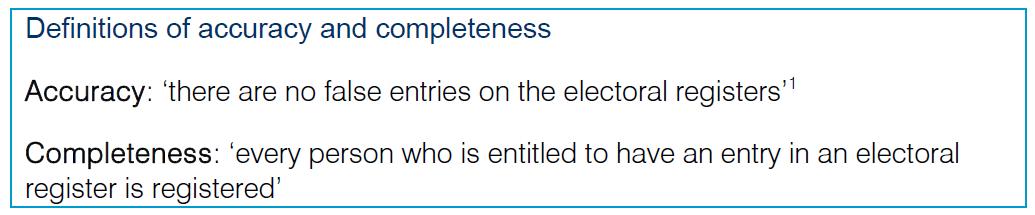
The report revolves around the two data quality dimensions: Accuracy and completeness.

In doing so, these two bespoke definitions are used:

There is a note about accuracy saying:


This is a very interesting precision, so to speak. Having fitness for the purpose of use is indeed the most common approach to data quality.

This does of course create issues when such data are used for other purposes. For example credit risk agencies here in the UK use appearance on the electoral roll as a parameter for their assessment of credit risk related to individuals.

Surely, often there isn’t a single source of the truth as pondered in the post The Big ABC of Reference Data.

However, this mustn’t make us stop in the search for getting high quality data. We just have to realize that we may look in different places in order to mash up a best picture of the real world as explained in the post Reference Data at Work in the Cloud.  

Bookmark and Share

Yin and Yang Data Quality

The old Chinese concept of yin and yang, or simply yīnyáng, is used to describe how polar opposites or seemingly contrary forces are interconnected and interdependent in the natural world. The concept is probably best known materialized as sweet and sour sauce.

Lately we had a debate in the data quality community on social media about if data quality is a journey or a destination, nicely summarized by Jim Harris in the post Quo Vadimus. I guess the prevailing sentiment is that it is kind of both a journey and a destination.

We also have the good old question about if data are of high quality if they are “fit for the purpose of use” or “aligned with the real world”. Sometimes these benchmarks go in opposite directions and we like to fulfill both goals at the same time.

The Data Quality discipline is tormented by belonging to both the business side and the technology side of practice. These sides are often regarded as contrary, but in my experience we get the best sauce by having both sides represented.

And oh yes, do we actually have to call it one of two diametrically different terms being Data Quality or Information Quality. Bon appetit.

Bookmark and Share

Partnerships for the Cloud

Earlier this month Loraine Lawson was so kind to quote me in an article on IT Business Edge called New Partnerships Create Better Customer Data via the Cloud.

The article mentions some cloud services from StrikeIron and Melissadata. These services are currently based on improving North American, being US and Canadian, customer data.

I am involved in similar services that currently are based on improving Danish customer data, which then covers the rest of North America being Greenland.

Improving customer data from all over the world is surely a daunting task that needs partnerships.

The cloud is the same, the reference data isn’t and the rules and traditions aren’t either as governments around the world has found 240 (or so) different solutions to balancing privacy concerns and administrative efficiency.

So, if not partnering, you risk getting solutions that are nationally international.

Bookmark and Share

Fit for repurposing

Reading a blog post by David Loshin called Data Governance and Quality: Data Reuse vs. Data Repurposing I was, perhaps a bit off topic, inspired to pose the question about if data are of high quality if they are:

  • Fit for the purpose of use
  • Fit for repurposing

The first definition has been around for many years and has been adapted by many data quality practitioners. I have however often encountered situations where the reuse of data for other purposes than the original purpose has raised data quality issues with else cleared data. One of my first pieces on my own blog discussed that challenge in a post called Fit for what purpose?

Not at least within master data management where data are maintained for multiple uses, this problem is very common.

Data in a master data hub may either:

  • Be entered directly into the hub where multiple uses is handled
  • Be loaded from other sources where data capture was done

In the latter case the data governance necessary to ensure fitness for multiple uses must stretch to the ingestion in these sources.

Now, if repurposing is seen as a future not yet discovered purpose of use, what can you then do to ensure that data today are fit for future repurposing?

The only answer is probably real world alignment as discussed here on a page called Data Quality 3.0. Make sure your data are reflecting the real world as close as we can when captured and make sure data can be maintained in order to keep that alignment. And make sure this is done and facilitated where data are entered.

Bookmark and Share

Sharing Social Master Data

If a company runs a Customer Relationship Management (CRM) system all employees are supposed to enter their interactions with customers and prospects including adding new accounts and contacts if it’s the first engagement.

With the rise of social networks first engagements are increasingly done in those networks. Furthermore new employees often bring old contacts from former employments with them thus utilizing an established relationship that probably is manifested in one or more already existing social network connections.

As explained in the post Social Master Data Management the term ”Social CRM” has been around for a while. We now see CRM solutions where the account and contact master data primarily is build on extracting those data from social networks.

I have just tried out such a solution called Nimble.

If you are more than a one-man-band company it’s interesting in what degree you are willing (or forced) to share your connections as master data entities for the CRM solution.

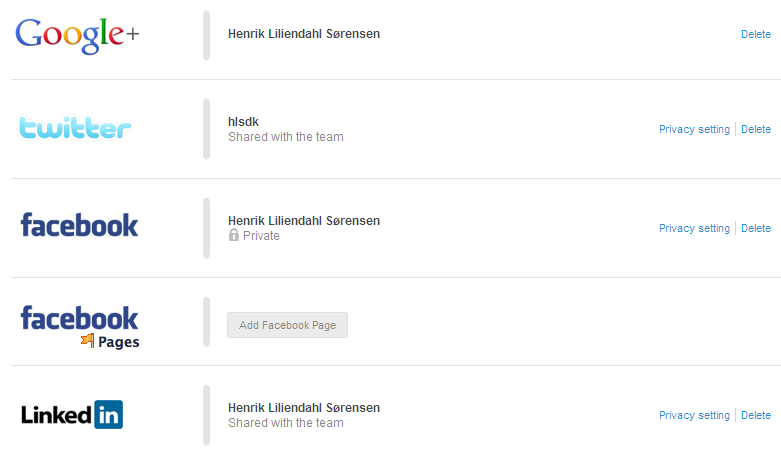
In Nimble you have the choice of differentiate for each network. I would probably freely choose a setup with Twitter and LinkedIn as shared with the team, but Facebook as private:

But that is just how I think based on my way of using social networks.

There is a fundamental data quality versus privacy issue around utilizing employee’s social network connections as master data for CRM and eventually enterprise wide Master Data Management (MDM).

All things equal data quality will be best if everyone contributes within reason. Not at least in sales, but also more or less in other functions, you are hired also because of your relations.

What do you think?

Bookmark and Share

Informatics for adding value to information

Recently the Global Agenda Council on Emerging Technologies within the World Economic Forum has made a list of the top 10 emerging technologies for 2012. According to this list the technology with the greatest potential to provide solutions to global challenges is informatics for adding value to information.

As said in the summary: “The quantity of information now available to individuals and organizations is unprecedented in human history, and the rate of information generation continues to grow exponentially. Yet, the sheer volume of information is in danger of creating more noise than value, and as a result limiting its effective use. Innovations in how information is organized, mined and processed hold the key to filtering out the noise and using the growing wealth of global information to address emerging challenges.”

Big data all over

Surely “big data” is the buzzword within data management these days and looking for extreme data quality will be paramount.

Filtering out the noise and using the growing wealth of global information will help a lot in our endurance to make a better world and to make better business.

In my focus area, being master data management, we also have to filtering out the noise and exploit the growing wealth of information related to what we may call Big Master Data.

Big external reference data

The growth of master data collections is also seen in collections of external reference data.

For example the Dun & Bradstreet Worldbase holding business entities from around the world has lately grown quickly from 100 million entities to over 200 millions entities. Most of the growth has been due to better coverage outside North America and Western Europe, with the BRIC countries coming in fast. A smaller world resulting in bigger data.

Also one of the BRICS, India, is on the way with a huge project for uniquely identifying and holding information about every citizen – that’s over a billion. The project is called Aadhaar.

When we extend such external registries also to social networking services by doing Social MDM, we are dealing with very fast growing number of profiles in Facebook, LinkedIn and other services.

Surely we need informatics for adding the value of big external reference data into our daily master data collections.

Bookmark and Share