Big Trouble with Big Names

An often seen issue in party master data management is handling information about your most active customers, suppliers and other roles of interest. These are often big companies with many faces.

I remember meeting that problem way back in the 80’s when I was designing a solution for the Danish Maritime Authorities.  

In relation to a ship there are three different main roles:

  • The owner of the ship, who has some legal rights and obligations
  • The operator of ship, who has responsibilities regarding the seaworthiness of the ship
  • The employer, who has responsibilities regarding the seamen onboard the ship

Sometimes these roles don’t belong to the same company (or person) for a given ship. That real world reality was modeled all right. But even if it practically is the same company, then the roles are materialized very different for each role. I remember this was certainly the case with the biggest ship-owner in Denmark (and also by far the biggest company in Denmark) being the A.P. Moller – Maersk Group.

We really didn’t make a golden record for that golden company in my time on the project.

Bookmark and Share

Valuable Inaccuracy

These days I’m involved in an activity in which you may say that we by creating data with questionable quality are making better information quality.

The business case is within public transit. In this particular solution passengers are using chip cards when boarding busses, but are not using the cards when alighting. This is a cheaper and smoother solution than the alternative in electronic ticketing, where you have both check-in and check-out. But a major drawback is the missing information about where passengers alighted, which is very useful information in business intelligence.

So what we do is that we where possible assume where the passenger alighted. If the passenger (seen as a chip card) within a given timeframe boarded another bus at a stop point which is on or near a succeeding stop point on the previous route, then we assume alighting was at that stop point though not recorded.

Two real life examples of doing so is where the passenger makes an interchange or where the passenger later on a day goes back from work, school or other regular activity.

An important prerequisite however is that we have good data quality regarding stop point locations, route assignments and other master data and their relations.    

Bookmark and Share

Business Directory Match: Global versus Local

When doing data quality improvement in business-to-business party master data an often used shortcut is matching your portfolio of business customers with a business directory and preferably picking new customers from the directory in the future.

If you are doing business in more than one country you will have some considerations about what business directory to use like engaging with a local business directory for each country or engaging with a single business directory covering all countries in question.

There are pro’s and con’s.

One subject is conformity. I have met this issue a couple of times. A business directory covering many countries will have a standardized way of formatting the different elements like a postal address, whereas a local (national) business directory will use best practice for the particular country.

An example from my home country Denmark:

The Dun & Bradstreet WorldBase is a business directory holding 170 million business entities from all over the world. A Danish street address is formatted like this:

Address Line 1 = Hovedgaden 12 A, 4. th

Observe that Denmark belongs to that half of the earth where house numbers are written after the street name.

In a local business directory (based on the public registry) you will be able to get this format:

Street name = Hovedgaden
Street code = 202 4321
House number = 012A
Floor = 04
Side/door = TH

Here you get an atomized address with metadata for the atomized elements and the unique address coding used in Denmark.

Bookmark and Share

Deduplicating with a Spreadsheet

Say you have a table with a lot of names, postal addresses, phone numbers and e-mail addresses and you want to remove duplicate rows in this table. Duplicates may be spelled exactly the same, but may also be spelled somewhat different, but still describe the same real world individual or company.

You can do the deduplicating with a spreadsheet.

In old times some spreadsheets had a limit of number of rows to be processed like the 64,000 limit in Excel, but today spreadsheets can process a lot of rows.

In this case you may have the following columns:

  • Name (could be given name and surname or a company name)
  • House number
  • Street name
  • Postal code
  • City name
  • Phone number
  • E-mail address

What you do is that first you sort the sheet by name, then postal code and then street name.

Then you browse down all the rows and focus at one row at the time and from there looks up and down if the rows before or after seems to duplicates. If so, you delete all but one row being the same real world entity.

When finished with all the rows sorted by name, postal code and street name you make an alternate sort, because some possible duplicates may not begin with the same letters in the name field.

So what you do is that you sort the sheet by postal code and then street name and then house number.

Then you browse down all the rows and focus at one row at the time and from there looks up and down if the rows before or after seems to duplicates. If so, you delete all but one row being the same real world entity.

When finished with all the rows sorted by postal code, street name and house number you make an alternate sort, because some possible duplicates may not have the proper postal code assigned or the street name may not start with the same letters.

So what you do is that you sort the sheet by city name and then house number and then name.

Then you browse down all the rows and focus at one row at the time and from there looks up and down if the rows before or after seems to duplicates. If so, you delete all but one row being the same real world entity.

When finished with all the rows sorted by postal code, street name and house number you make an alternate sort, because some duplicates may have moved or have different addresses for other reasons .

So what you do is that you sort the sheet by phone number, then by name and then by postal code.

Then you browse down all the rows and focus at one row at the time and from there looks up and down if the rows before or after seems to duplicates. If so, you delete all but one row being the same real world entity.

When finished with all the rows sorted by phone number, name and then by postal code you make an alternate sort, because some duplicates may not have a phone number or may have different phone numbers.

So what you do is that you sort the sheet by e-mail address, then by name and then by postal code.

Then you browse down all the rows and focus at one row at the time and from there looks up and down if the rows before or after seems to duplicates. If so, you delete all but one row being the same real world entity.

You may:

  • If you only have a few rows do this process within a few hours and possibly find all the duplicates
  • If you have a lot of rows do this process within a few years and possibly find some of the duplicates

PS: The better option is of course avoiding having duplicates in the first place. Unfortunately this is not the case in many situations – here is The Top 5 Reasons for Downstream Cleansing.

Bookmark and Share

Script Systems

This Friday my blog post was called Follow Friday diversity. In my hope to reach for more equalized worldwide interaction I wonder if writing in English with roman (latin) characters is enough?

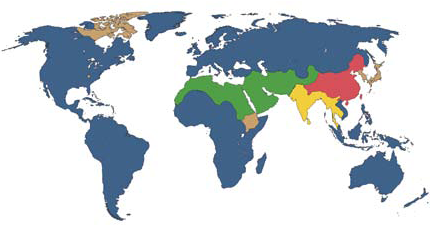
Take a look at the diversity in script systems around the world:

Alphabets

In an alphabet, each letter corresponds to a sound. These are also referred to as phonographic scripts. Examples of Alphabets: Roman (Latin); Cyrillic; Greek

Abjads

Abjads consist exclusively of consonants. Vowels are omitted from most words, because they are obvious for native speakers, and are simply inserted when speaking. In addition, Abjads are normally written from right to left. Examples of Abjads: Hebrew; Arabic

Abugidas

Abugidas are characteristic for scripts in India and Ethiopia. In this style, only the consonants are normally written, and standard vowels are assumed. If a different vowel is required, it is indicated with a special mark. Abugidas form an intermediate level between alphabetic and syllabic scripts. Examples of Abugidas: Hindi (Devanagari); Singhalese

Syllabic Scripts

Like alphabets, syllabic scripts are another type of phonographic script. In a syllabic script, each character stands for a syllable. Examples of Syllabic Scripts: Japanese (Hiragana, Katakana); Cherokee

Symbol Scripts

In symbolic scripts, each character is an ideogram standing for a complete word. Compound terms or concepts are composed of multiple symbols. Symbolic scripts are also called logographic scripts. Examples of Symbolic Scripts: Chinese; Japanese (Kanji)

Source: Worldmatch® Comparing International Data by Omikron Data Quality – full version here.

Bookmark and Share

What is Multi-Domain MDM?

Doing master data management with several different entity types is most often seen as the federated discipline of handling Customer Data Integration (CDI) and Product Information Management (PIM) with the same software brand.

And sure, doing this (including making that software) is a challenge as there are basic differences between the two disciplines as discussed in the post Same Same But Different.

But doing both well at the same time is only a starting point. Making business value from the intersection between the two disciplines is the real challenge.

I learned that 20 years ago when I started a new client relationship (which also was before MDM, CDI and PIM was household TLA’s).

The client’s head quarter was in the southern outskirts of Copenhagen, so on a good summer day I could go there on my bike. They imported else wasted peels from oranges grown in the endless South American citrus plantations to be used for our morning juice and else useless seaweed harvested in the hot waters around the countless Philippine islands.

Along with a few other raw materials the peels and seaweed were made into approximately a hundred different semi-finished products. Based on customer orders these were blended into not much more than a thousand different defined finished products being valuable ingredients for food and pharmaceutical production.

The number of different customers was also modest, as I remember not much more than a thousand different worldwide customers.

So, managing 1,000 different customers buying 1,000 different products shouldn’t be much of a MDM case. Of course customer data management with global diverse entities had its challenges and not at least product information handling with rising regulatory demands in the food and pharmaceutical segment wasn’t a walk over either.

But some big hurdles were sure in the intersection between customer master data and product master data and solving the issues did almost always involve data quality related to core transactions referencing the entities described in the master data.

Bookmark and Share

Follow Friday Diversity

Every Friday on Twitter people are recommending other tweeps to follow using the #FollowFriday (or simply #FF) hashtag.

So do I.

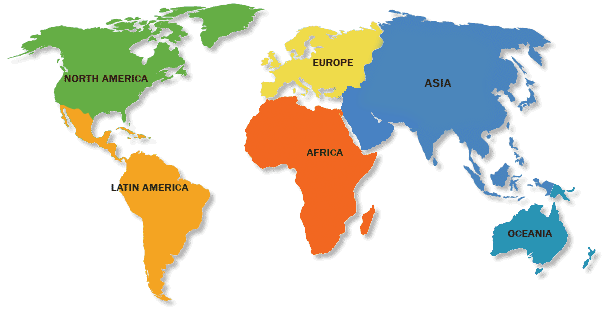
Below please find my follow Friday recommendations grouped by global region:


Canada: @carrni @datamartist @sheezaredhead @andrewsinfotech @aniagl @DQamateur @bivcons @projmgr @DQStudent @datachickUnited States: @GarnieBolling @stevesarsfield @UtopiaInc @bbreidenbach @fionamacd @RobertsPaige @BIMarcom @IDResolution @FirstSanFranMDM @dan_power @merv @NISSSAMSI @jilldyche @howarddresner @GartnerTedF @RobPaller @marc_hurst @dcervo @datamentors @VishAgashe @IBMInitiate @RamonChen @JackieMRoberts @philsimon @Nick_Giuliano @DataInfoCom @juliebhunt  @Futureratti  @dqchronicle  @jonrcrowell @elc  @Experian_QAS @paulboal @im4infomgt @WinstonChen @ocdqblog @KeithMesser @murnane @BrendaSomich @alanmstein @JGoldfed @jaimefitzgerald @tedlouie @bslarkin

Venezuela: @pigbar

Ireland: @daraghobrien @KenOConnorData @MapMyBusiness: United KIngdom: @SteveTuck @VeeMediaFactory @mktginsightguy @Daryl70 @Teresacottam @AnishRaivadera @ExperianQAS_UK @DataQualityPro @SarahBurnett @faropress @jschwa1 @mikeferguson1 @jtonline @Master_OBASHI @Nicola_Askham; France: @DataChannel @mydatanews @jmichel_franco @ydemontcheuil;Switzerland: @alexej_freund @openmethodology; Austria: @omathurin; Germany: @stiebke @dwhp @dakoller @marketingBOERSE; Belgium: @guypardon; Netherlands: @harri00413 @GrahamRhind; Denmark: @jeric40 @eobjects @StiboSystems;Norway @Orvei; Sweeden: @MrPerOlsson @DarioBezzina; Finland: @JoukoSalonen; Lithuania: @googlea; Italy: @Stray__Cat

Algeria: @aboussaidi; South Africa: @MarkGStacey

Pakistan: @monisiqbal; India: @MDMAnswers @twitrvenky @ashwinmaslekar; Indonesia: @VaiaTweets

Australia: @emx5 @vmcburney;New Zeeland: @JohnIMM @Intelligentform

It’s my hope, that I in the future will be able to interact even more diverse.

Bookmark and Share

The Little Match Girl

The short story (or fairy tale) The Little Match Girl (or The Litlle Match Seller) by Hans Christian Andersen is a sad story with a bad ending, so it shouldn’t actually belong here on this blog where I will try to tell success stories about data quality improvement resulting in happy databases.

However, if I look at the industry of making data matching tools (and data matching technology is a large part of data quality tools) I wonder if the future has ever been that bright.

There are many tools for data matching out there.

Some tool vendors have been acquired by big players in the data management realm as:

  • IBM acquired Accential Software
  • SAS Institute acquired DataFlux
  • Informatica acquired Similarity Systems and Identity Systems
  • Microsoft acquired Zoomix
  • SAP acquired Fuzzy Informatik and Business Objects that acquired FirstLogic
  • Experian acquired QAS
  • Tibco acquired Netrics

(the list may not be complete, just what immediately comes to my mind).

The rest of the pack is struggling with selling matches in the cold economic winter.

There is another fairy tale similar to The Little Match Girl called The Star Money collected by the Brothers Grimm. This story has a happy ending. Here the little girl gives here remaining stuff away for free and is rewarded with money falling down from above. Perhaps this is like The Coming of Age of Open Source as told in a recent Talend blog post?

Well, open source is first expected to break the ice in the Frozen Quadrant in 2012.

Bookmark and Share

Quality Data Integration

As late as yesterday I was involved in yet a data quality issue that wasn’t caused by that the truth wasn’t known, but caused by that that truth wasn’t known in all the different databases within an enterprise and of course exactly not (thanks Murphy) by that application that needed that information due to a new requirement. Yep, the column was there alright, but it wasn’t updated, because until yesterday it didn’t need to be.

The data architecture in most enterprises isn’t perfect at all. Through the information technology history of that enterprise many different systems has been deployed ranging from core operational applications, data warehouses and lately also web frontends.

It’s not that we don’t know about how master data management can help, how service oriented architecture (principles) is a must and how important it is to document the data flows within the enterprise. But gee, even for a modest sized organization this is huge and even if we strived to do it right, when we succeeded, the real world has moved.

Well, back to business. What do we do? I think we will:

  • Make a quick fix that solves the business problem to the delight of the business users
  • Perhaps prioritize up that sustainable technical solution we planned some while ago

Have a nice day everyone. I think it is going to be just fine.

Bookmark and Share

instant Data Quality

My last blog post was all about how data quality issues in most cases are being solved by doing data cleansing downstream in the data flow within an enterprise and the reasons for doing that.

However solving the issues upstream wherever possible is of course the better option. Therefore I am very optimistic about a project I’m involved in called instant Data Quality.

The project is about how we can help system users doing data entry by adding some easy to use technology that explores the cloud for relevant data related to the entry being done. Doing that has two main purposes:

  • Data entry becomes more effective. Less cumbersome investigation and fewer keystrokes.
  • Data quality is safeguarded by better real world alignment.

The combination of a more effective business process that also results in better data quality seems to be good – like a sugar-coated vitamin pill. By the way: The vitamin pill metaphor also serves well as vitamin pills should be supplemented by a healthy life style. It’s the same with data management.

Implementing improved data quality by better real world alignment may go beyond the usual goal for data quality being meeting the requirements for the intended purpose of use.  This means that you instantly are getting more by doing less.

Bookmark and Share