Social Events and Master Data Management

Recently I changed one of my job titles on LinkedIn resulting in a number of likes, congrats and messages. And thanks for that.

Probably I have a record in a number of CRM systems out there where I am registered as a contact for an account with an attached job title. As a guy working at several places at the same time I am a bit complicated, I have to admit, so I guess many of these records aren’t up to date about where I work carrying what title and having what means of contact.

Complicated or not, I have no doubt about that many CRM implementations will benefit from digging into social networks in order to be up to date and complete as told in the post Social MDM and Complex Sales.
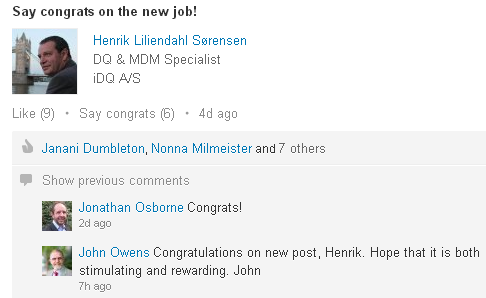
New job (title)As discussed in the post Multi-Facet MDM we may divide master data management into handling these facets:

  • Entities
  • Relations
  • Events

Within party master data management events may be captured during interacting with your (prospective) customers and other business partners, as an update from a third party reference data provider or in an increasing way by monitoring social networks which are often the first to know certain things, not at least when it’s about contacts in Business-to-business (B2B) activities.

Bookmark and Share

Everyday Year 2000 Problems

14 years ago this was busy times for computer professionals, including yours truly, because of the upcoming year 2000 apocalypse. The handling of the problem indeed had elements of hysteria, but all in all it was a joint effort by heaps of IT people in meeting a non-postponable deadline around fixing date fields that were too short.

everyday y2k problemsData entry and data storage fields that are too short, have an inadequate format or are missing are frequent data quality issues. Some everyday issues are:

Too short name fields

Names can be very long. But even a moderate lengthy name as Henrik Liliendahl Sørensen can be a problem here and there. Not at least typing your name on Twitter, where the 20 characters name field corresponds very well to the 140 character message length, forces many of us to shorten our name. I found a remedy here from a fellow Sørensen on a work around in the post Getting around the real name length limit in Twitter. Not sure if I’m prepared to take the risk.

Too short and restricted postal code fields

When working with IT solutions in Denmark you see a lot of postal code fields defined as 4 digits. Works fine with Danish addresses but is a real show stopper when you deal with neighboring Swedish and German 5 digit postal codes and not at least postal codes with letters from the Netherlands and the United Kingdom and most other postal codes from around the world.

Missing placeholder for social identities

The rise of social media has been incredible during the last years. However IT systems are lacking behind in support for this. Most systems haven’t a place where you can fill in a social handle. Recently James Taylor wrote the blog post Getting a handle on social MDM. Herein James describes a work around in a IBM MDM solution. Indeed we need ways to link the old systems of records with the new systems of engagement.

Bookmark and Share

MDM for Product Data Quadrant: No challengers. A half visionary.

The Gartner Magic Quadrant for Master Data Management of Product Data Solutions is out. You may have a free look at it for example going through Tibco’s press release on the matter here or directly thanks to IBM here.

MDM Brands
This is not the quadrant. Just some names.

My thoughts are kind of the same as told in the post MDM for Customer Data Quadrant: No challengers. No visionaries. Let’s just have a (Multi-Domain) MDM quadrant.

The quadrant for customer MDM solutions had no challengers and no visionaries. The quadrant for product MDM solutions has a half visionary, as Informatica is positioned as a niche player with its recent Heiler acquisition and just on the right side of the border between niche players and visionaries with what must be the Siperian acquisition from a couple of years ago. This solution has multi-domain capabilities as an important strength.

Bookmark and Share

What’s Different about MDM in Denmark?

little_mermaid_copenhagenAfter writing about What’s Different about MDM in France? It’s now time for a few words about what’s different about MDM (Master Data Management) in my native country Denmark.

International aspects of MDM isn’t strange

As a small market the domestic aspects is a minor thing for the large Danish companies as Maersk, Lego and Carlsberg. But even smaller companies grow out of the domestic market very early and that means that international aspects of MDM and related data quality are important in many implementations.

Even the flagship Danish MDM vendor Stibo Systems operated for many years with large foreign clients before recently getting their first domestic client.

Exploiting external reference data is imperative

Some industry sectors like finance and utility are still very domestic oriented. In party master data management good quality external reference data about domestic addresses, properties, companies and citizens are available at an affordable price and in some degree even free.

In my work at iDQ we have utilized this a lot as told in the story from the utility sector in the post instant Data Quality at Work. iDQ also help foreign companies as for example the largest bank in the Eurozone. As an example of another MDM domain than customer the service is also used for the HR domain by one of the the world’s largest employers.

The government isn’t a laggard

As reported in the post Making Data Quality Gangnam Style the government supports the use of reference data in private entities. But the data sources are indeed handled as a MDM program within the public sector ensuring that data silos in the public sector are eliminated with big wins for public administration as another result. Newest development is centralized support for handling master data about Danes abroad. Good to be involved.

Bookmark and Share

Multi-Facet MDM

In MDM (Master Data Management) there is the term Multi-Domain MDM being how we manage respectively parties, products, locations and other entity types and handling master data within a Multi-Channel environment encompassing offline, online and social channels is a huge challenge within MDM today. Yet another multi view of MDM is handling different facets of master data being:

  • Mulit-Facet MDMEntities
  • Relations
  • Events

Entities

Handling entities is the core of master data management. Ensuring that master data are fit for multiple purposes most often by ensuring real world alignment is the basic goal of master data management. Entity resolution is at key discipline in doing that. In the party master data domain doing Customer Data Integration (CDI) is the good old activity aiming at compiling all the customer data silos in the enterprise into a golden copy with golden records. Product Information Management (PIM) is another ancestor in the MDM evolution history predominately focusing at the entities.

Relations

A possible distinction between Master Entity Management and Master Relation Management is discussed in the post Another Facet of MDM: Master Relationship Management.

As we get better and better solutions for handling entities the innovation shifts to handling the relationships between entities. These relations exists for example in Multi-Channel environments by linking entities in the old systems of record with the same real world entities in the new systems of engagement as told in the post Social MDM and Systems of Engagement.

Events

Getting the master data right the first time is crucial.

In product master data management getting to that stage is often done by managing a flow of events where the product data are completed and approved by a team of knowledge workers.

In party master data management a way of ensuring first time right is examined in the post instant Single Customer View. But that is only the start. Party master data has a life cycle with important events as:

Bookmark and Share

Social IT and Business

business partnersThe distinction between IT and business is an often used concept in a lot of disciplines from Enterprise Architecture (EA) over data quality management to Master Data Management (MDM). While it may be a good concept to use when assigning responsibilities and finding out who should be driving what I have personally always kind of disliked the concept. It’s a concept practically only used by the IT side and in my eyes IT is part of the business just as much as marketing, sales, accounting and all the other departments are.

So, now when business is going social, how does that affect the IT and business distinction?

Social business is in large parts done today in the enterprises around without involving the internal IT department. The use of data and functionality in social business done with so called systems of engagement is much more external focused than the internal focused nature of the traditional systems of record.

However, if enterprises are to harvest the fruits of systems of engagement it must be done by linking the new systems of engagement to the old systems of record and that means involving internal IT. Please do this without dividing the enterprise into IT and business again. Please be more social this time.

Bookmark and Share

What’s Different about MDM in France?

franceAs told in the post about French MDM vendors yesterday I have been on a MDM (Master Data Management) event in Paris today.

An interesting take away from the event’s presentations and the mingling is some differences between how MDM is handled in France (and the rest of continental Europe as I know it) compared to the English speaking world. Some observations are:

People, process and technology

Many MDM gurus (and gurus in other disciplines) stress that you shouldn’t focus on technology (alone) but take people and process very serious too. That’s not so important in France. Everyone knows that already.

Multi-Domain MDM

In France it’s common to start with product MDM and then continue with customer (party) MDM.

The Quadrant Magic

If you made a Gartner Magic Quadrant for MDM solutions in France you wouldn’t have a quadrant for customer data and another one for product data. There would be only one quadrant for (multi-domain) MDM and some of the local vendors would be leaders as discussed in the post MDM for Customer Data Quadrant: No challengers. No visionaries.

Bookmark and Share

Trois acteurs français dans le marché du MDM

I am looking forward to going to Paris today in order to be at the Forum MDM arranged by Micropole taking place tomorrow.

The French MDM market is a vibrant one with several French grown solutions also going well on the world-wide MDM market:

Semarchy

As told in the post Eating the MDM Elephant the MDM solution provider Semarchy has emphasized on making a MDM platform that supports evolutionary MDM which means that you don’t have to pre-think every aspect of your to-be MDM implementation before going ahead. This is a recommendable approach indeed.

Orchestra Networks

Master data and reference data are, besides of sometimes actually being used synonymously, close terms and so are Master Data Management (MDM) and Reference Data Management (RDM). Orchestra Networks seems to be on the forefront in offering a well founded solution for both disciplines at the same time.

Talend

The open source provider Talend has over the years developed a solution that started with data integration and then added data quality functionality and some years ago also included MDM and, in touch with the way of the world today, now also is embracing big data.

Bandeau_partenaires_Forum_MDM_2
All the sponsors at the Forum MDM in Paris 24th October 2013

Bookmark and Share

MDM for Customer Data Quadrant: No challengers. No visionaries.

The Gartner Magic Quadrant for Master Data Management of Customer Data Solutions is out. You may have a free look at it for example going through Talend’s press release on the matter here.

MDM Brands
PS: This isn’t the quadrant. Just a few vendor names.

It’s not a crowded picture. There are few solutions in there and several come from the same brand. And there are no challengers and no visionaries.

Gartner expect that challengers may arrive later for example as those who are building up multi-domain MDM solutions right now. Should be interesting to see what comes first: Challengers in the customer MDM quadrant or a multi-domain MDM quadrant. Other analysts have a single view of MDM vendors.

From where will we see the visionaries then? Gartner says current niche players may spread into the visionary field. If we will see new vendors emerging into the visionary field it may in my eyes be based on the Growing Variety in Big Master Data which includes widening the term customer data into taking care of all kinds of party master data.

Bookmark and Share

Growing Variety in Big Master Data

With the rise of big data we will see that master data is going to be Small Data with Big Impact.

Master data itself is going to grow in terms of volume and velocity. This is because we will have to manage more types of master data in order to make sense of big data. Notable examples are:

  • We will have to identify more locations in order to make sense of the geospatial attributes in big data.
  • We will be forced to manage some attributes of our competitor’s product master data, besides our own product master data, in order to listen to the talk in the social media stream.
  • We will need to take care of more party master data roles. Besides the classic party master data roles of real world entities being customers, suppliers and employees we will have to care about subscribers, users and visitors of online services, followers and friends in social media and the spouses, relatives, friends of friends and other influenced ones of those.

Party roles

It’s not the volume and probably neither the velocity that will be the big issue here. It’s the variety in the data which will support the processes in caring about those entities that is a huge challenge, not at least for ensuring the veracity of the master data here.

Bookmark and Share