 An important part of implementing Master Data Management (MDM) is to capture the business rules that exists within the implementing organization and build those rules into the solution. In addition, and maybe even more important, is the quest of crafting new business rules that helps making master data being of more value to the implementing organization.
Examples of such new business rules that may come along with MDM implementations are:
- In order to open a business account you must supply a valid Legal Entity Identifier (like Company Registration Number, VAT number or whatever applies to the business and geography in question)
- A delivery address must be verified against an address directory (valid for the geography in question)
- In order to bring a product into business there is a minimum requirement for completeness of product information.
Creating new business rules to be part of the to-be master data regime highlights the interdependency of people, process and technology. New technology can often be the driver for taking on board such new business rules. Building on the above examples such possibilities may be:
- The ability to support real time pick and check of external identifiers
- The ability to support real time auto completion and check of postal addresses
- The ability to support complex completeness checks of a range of data elements


 There are relationships between entities within the single MDM domains and there are relationships between entities across multiple MDM domains.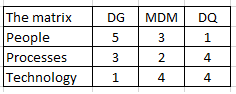
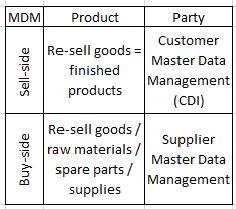 Now, back to PIM versus Product MDM. I’m not sure it is wise to divorce these two. It seems to be a kind of back looking exercise. I would like to marry them as part of looking forward in a multi-domain MDM world. To catch up on Monica’s arguments PIM has been much about the sell-side of things. I think we should be better at integrating the buy-side and the sell-side of Product MDM / PIM as examined in the post
  If we look at customer, or rather party, Master Data Management (MDM) it is much about real world alignment. In party master data management you describe entities as persons and legal entities in the real world and you should have descriptions that reflect the current state (and sometimes historical states) of these entities. Some reflections will be
  One example is in postal services as mentioned in the post
 Liliendahl on Data Quality