Toilet Seats and Data Quality

When working with data quality in the product master data management domain you are very dependent on your business partners. Product master data are shared along with the physical products in the ecosystem of manufacturers, distributors, retailers and end users.

Toilet seatIn a current role, I have worked a lot with sourcing product data from suppliers. One of our recurring examples is about one of our product categories being toilet seats. In that context, we have three different kind of suppliers:

  • Those who use the term “toilet seat” in their product descriptions. That is marvelous, then we can use that part of the product description directly as it is. Wonderful data quality.
  • Those who only use the term “seat” in their product description. Well, it is not really bad data quality for a dedicated manufacturer of bathroom stuff, because what could a seat else be in that context. However, for consistency reasons we have to correct “seat” into “toilet seat”.
  • Those who use the term “WC seat”. Actually, “WC seat” could be more accurate than “toilet seat”, because we are talking about seats for a room with water opposite to older solutions. Nevertheless, for consistency reasons we have to correct “WC seat” into “toilet seat”.

Manufacturers, distributors and retailers have to work together in order to create win-win situations by sharing product data with an optimal data quality. This is however not straight forward, as you always will be part of an ecosystem where your competitors operate too and often you are not prepared to share the same seat as your competitor.

Bookmark and Share

Growing Weight on Business Rules in MDM

Business rules has always been an important subject when it comes to data quality and Master Data Management (MDM). However, it seems that business rules are considered even more important over the recent years and in the future.

Fellow MDM professional Roberto Lichtenstein recently published a LinkedIn pulse post called “MDM and business rules” survey outcome.

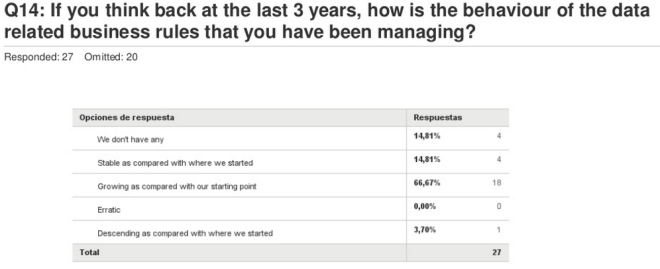
One of the survey results was about how the last 3 years behaviour of managing business rules has developed:

MDM and business rules

Two third of people answering the question indicated a growing inclusion of business rules (including yours truly in my current main role). So that’s a good growth. However nearly half of respondents did not answer that question, so a bit of caution may be relevant.

As Roberto mentions in his summary post there is a chicken and egg thing with process and data. I also find there is a chicken and egg theme with business rules and MDM. Letting business rules dictate the MDM behaviour is obvious. But MDM can sometimes initiate new business rules as examined in the post To-Be Business Rules and MDM.

Bookmark and Share

Master Data Agility and Business Agility

The term “data agility” was aired recently in a Forbes.com article by H.O. Maycotte. The article is called Ready, Set, Go – How Fast Is Your Data?

The article revolves around getting your data more fit. Notably, it is not about getting data fit for a known purpose of use, which is the thinking that has been around in the data and information quality realm for years. It is about having the data that makes you able to quickly adjust business strategies to meet changing customer needs.

AgileSome of this data will be master data. Master data is arguably the most difficult kind of data to work with in order to achieve data agility. This challenge was examined in the post Business Agility, Continuous Improvement and MDM.

A week ago I had the pleasure of hosting a workshop on the linkage between Business Process Management (BPM) and Master Data Management (MDM) at the Marcus Evans MDM conference in Barcelona, Spain. One of the solutions we referred to many times was to establish a common reporting approach across BPM and MDM grounded on the sentiment that you can’t manage what you can’t measure.

Setting improved agility as a goal for a master data programme is an additional approach. I am working on such a programme right now. Our executive sponsor actually wanted selling more stuff to be the goal. My promise is that the improved master data agility will lead to improved business agility that will lead to being able to sell more stuff in the future.

Bookmark and Share

Global MDM versus Local BPM

The linkage between Master Data Management (MDM) and Business Process Management (BPM) was intensively discussed at a workshop on a MDM conference organized by Marcus Evans in Barcelona, Spain today. More than 30 master data professionals from a range of large mainly European originated companies attended the workshop.

There was a broad agreement about that the intersection between MDM and BPM is growing – and should be doing so.

Google EarthOne of the challenges identified is that MDM tends to be global within the enterprise while BPM tends to be local.
The global versus local theme has frequently been mentioned as a challenge over the decade MDM has existed as a discipline. The core MDM global versus local challenges spans over common definitions, common value tables and common data models across different geographies. Having a mix of common business rules and business rules that have to be local adds to the difficulties. When applying the full impact of business process management with the variety of formal and informal organizational structures, decision rules and working culture there are certainly both wins and obstacles in linking MDM and BPM.

I think the commonly used phrase about thinking globally and acting locally makes sense in the intersection between MDM and BPM. Thinking big and starting small helps too.

Bookmark and Share

CDI, PIM, MDM and Beyond

The TLAs (Three Letter Acronyms) in the title of this blog post stands for:

  • Customer Data Integration
  • Product Information Management
  • Master Data Management

CDI and PIM are commonly seen as predecessors to MDM. For example, the MDM Institute was originally called the The Customer Data Integration Institute and still have this website: http://www.tcdii.com/.

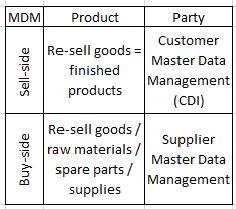
Today Multi-Domain MDM is about managing customer, or rather party, master data together with product master data and other master data domains as visualized in the post A Master Data Mind Map. Some of the most frequent other master domains are location master data and asset master data, where the latter one was explored in the post Where is the Asset? A less frequent master data domain is The Calendar MDM Domain.

QuadrantYou may argue that PIM (Product Information Management) is not the same as Product MDM. This question was examined in the post PIM, Product MDM and Multi-Domain MDM. In my eyes the benefits of keeping PIM as part of Multi-Domain MDM are bigger than the benefits of separating PIM and MDM. It is about expanding MDM across the sell-side and the buy-side of the business eventually by enabling wide use of customer self-service and supplier self-service.

The external self-service theme will in my eyes be at the centre of where MDM is going in the future. In going down that path there will be consequences for how we see data governance as discussed in the post Data Governance in the Self-Service Age. Another aspect of how MDM is going to be seen from the outside and in is the increased use of third party reference data and the link between big data and MDM as touched in the post Adding 180 Degrees to MDM.

Besides Multi-Domain MDM and the links between MDM and big data a much mentioned future trend in MDM is doing MDM in the cloud. The latter is in my eyes a natural consequence of the external self-service themes and increased use of third party reference data which all together with the general benefits of the SaaS (Software as a Service) and DaaS (Data as a Service) concepts will make MDM morph into something like MDaaS (Master Data as a Service) – an at least nearly ten year old idea by the way, as seen in this BeyeNetwork article by Dan E Linstedt.

Bookmark and Share

IDQ vs iDQ™

The previous post on this blog was called Informatica without Data Quality? This post digs into the messaging around the recent takeover of Informatica and the future for the data quality components in the Informatica toolbox.

In the comments Julien Peltier and Richard Branch discusses the cloud emphasis in the messaging from the new Informatica owners and especially the future of Master Data Management (MDM) in the cloud.

open-doorMy best experience with MDM in the cloud is with a service called iDQ™ – a service that shares TLA (Three Letter Acronym) with Informatica Data Quality by the way. The former stands for instant Data Quality. This is a service that revolves around turning your MDM inside-out as latest touched on this blog in the post The Pros and Cons of MDM 3.0.

iDQ™ specifically deals with customer (or rather party) master data, how to get this kind of master data right the first time and how to avoid duplicates as explored in the post The Good, Better and Best Way of Avoiding Duplicates.

Bookmark and Share

Business Agility, Continuous Improvement and MDM

Being able to react to market changes in an agile way is the path to the survival of your business today. As you may not nail it in the first go, the ability to correct with continuous improvement is the path for your business to stay alive.

open-doorDoing business process improvement most often involves master data as examined in the post Master Data and Business Processes. The people side of this is challenging. The technology side isn’t a walkover either.

When looking at Master Data Management (MDM) platforms in sales presentations it seems very easy to configure a new way of orchestrating a business process. You just drag and drop some states and transitions in a visual workflow manager. In reality, even when solely looking at the technical side, it is much more painful.

MDM solutions can be hard to maneuver. You have to consider existing data and the data models where the data sits. Master data is typically used with various interfaces across many business functions and business units. There are usually many system integrations running around the MDM component in an IT landscape.

A successful MDM implementation does not just cure some pain points in business processes. The solution must also be able to be maneuvered to support business agility and continuous improvement. Some of the data quality and data governance aspects of this is explored in the post Be Prepared.

Bookmark and Share

The Pros and Cons of MDM 3.0

A recent post on this blog was called Three Stages of MDM Maturity. This post ponders the need to extend your Master Data Management (MDM) solution to external business partners and take more advantage of third party data providers. We may call this MDM 3.0.

In a comment on LinkedIn Bernard PERRINEAU says:

MDM 3.0 Pros and Cons

Starting with the most often mentioned point against extending your MDM solution to the outside Vipul Aroh of Verdantis rightfully in a comment to the post mentions a wide spread hesitancy around. I think/hope this hesitancy is the same as the hesitancy we saw when Salesforce.com first emerged. Many people didn’t foresee a great future for Salesforce.com, because putting your customer base into the cloud was seen as a huge risk. But eventually the operational advantages in most cases have trumped the thought risks.

Ironically the existents of CRM systems, in the cloud or not, is a hindrance for MDM solutions to be system of entry or support data entry for the customer master data domain.  I remember when talking to a MDM vendor CEO about putting such features for customer data entry into a MDM solution his reply was something like: “Clients don’t want that, they want to consolidate downstream”. I think it is a pity that “clients want” to automate the mess and that MDM and other vendors wants to help them with that.

That said, there are IT system landscape circumstances to be overcome in order to put your MDM solution to the forefront.

But when doing that, and even when starting to do that, the advantages are plentiful. A story about a start of such a journey for customer master data is shared in the post instant Data Quality at Work. This approach is examined more in the post instant Single Customer View. To summarize you will gain both on getting data quality right the first time and at the same time save time (and time is money) in the data collection stage.

When it comes to product master data I think everyone working in that field acknowledges the insanity in how the same data are retyped, or messed around in spreadsheets, between manufactures, distributors, retailers and end users. Some approaches to overcome this are explored in the post Sharing Product Master Data. Each of these approaches has their pros and cons.

The rise of big data also points in the direction of having your MDM solution exposed to the outside as touched in the post Adding 180 Degrees to MDM.

Bookmark and Share

Master Data and Business Processes

The intersection of Master Data Management (MDM) and Business Process Management (BPM) is a very interesting aspect of implementing MDM solutions.

We may divide this battleground into three sectors:

  • Business processes that purely consumes master data
  • Business processes that potentially changes master data
  • Business processes that purely updates master data

BPM MDM

Business processes that purely consumes master data

An example of such a business process is the execution of a direct marketing campaign. Doing this in an effective way is heavily dependent on clean and updated master data. A key capability is the ability to separate which targeted real world entities belongs to the so called “new market” and which are existing customers (or prospects or churned customers). When working with known customers the ability to intelligently relate to previously products and their categories of interest is paramount. Often knowing about the right relation between targeted parties and locations is very valuable.

When doing MDM implementations and ongoing refinement the insight on how master data are used and creates value in business processes is the starting point.

Business processes that potentially changes master data

The most commonly mentioned wide business process is the order-to-cash process. During that process especially customer master data may be affected. A key question is whether the order is placed by a new customer or a known customer. If it truly is a new customer, then effective collection of accurate and timely master data determines the successful outcome of receiving the cash based on correct credit check, correct shipping information and more. If it is a known customer this is a chance to validate and eventually update customer master data.

While customer master data often is changed through business processes having another main purpose, this is not the case with product master data.

Business processes that purely updates master data

An example is from within manufacturing, distribution and retail where we have business processes with the sole purpose of enriching product master data. With the rise of customer self-service through e-commerce the data quality requirements for completeness and other data quality dimensions have increased a lot. This makes the orchestration of complex business processes for enriching product master data a whole new flavour of Business Process Management where master data itself is the outcome – of course in order to be optimally used in order-to-cash and other business processes.

PS: If you are interested in discussing BPM and MDM alignment on La Rambla in Barcelona on the 22nd April 2015, here is the chance.

Bookmark and Share

Three Stages of MDM Maturity

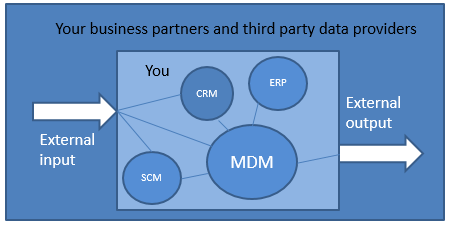
If you haven’t yet implemented a Master Data Management (MDM) solution you typically holds master data in dedicated solutions for Supply Chain Management (SCM), Enterprise Resource Planning (ERP), Customer Relation Management (CRM) and heaps of other solutions aimed at taking care of some part of your business depending on your particular industry.

MDM Stage 1
Multiple sources of truth

In this first stage some master data flows into these solutions from business partners in different ways, flows around between the solutions inside your IT landscape and flows out to business partners directly from the various solutions.

The big pain in this stage is that a given real world entity may be described very different when coming in, when used inside your IT landscape and when presented by you to the outside. Additionally it is hard to measure and improve data quality and there may be several different business processes doing the same thing in an alternative way.

The answer today is to implement a Master Data Management (MDM) solution. When doing that you in some degree may rearrange the way master data flows into your IT landscape, you move the emphasis on master data management from the SCM, ERP, CRM and other solutions to the MDM platform and orchestrate the internal flows differently and you are most often able to present a given real world entity in a consistent way to the outside.

MDM Stage 2
Striving for a single source of truth

In this second stage you have cured the pain of inconsistent presentation of a given real world entity and as a result of that you are in a much better position to measure and control data quality. But typically you haven’t gained much in operational efficiency.

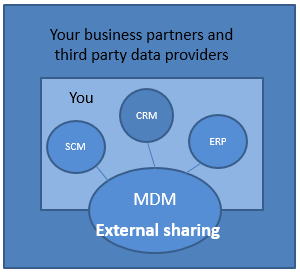
You need to enter a third stage. MDM 3.0 so to speak. In this stage you extend your MDM solution to your business partners and take much more advantage of third party data providers.

MDM Stage 3
Single place of trust

The master data kept by any organization is in a large degree a description of real world entities that also is digitalized by business partners and third party data providers. Therefore there are huge opportunities for reengineering your business processes for master data collection and interactive sharing of master data with mutual benefits for you and your business partners. These opportunities are touched in the post MDM 3.0 Musings.

Bookmark and Share