The People Behind the MDM / PIM Tools

Over at the sister site, The Disruptive MDM / PIM List, there are some blog posts that are interviews with some of the people behind some of the most successful Master Data Management (MDM) and Product Information Management (PIM) tools.
People behind MDM tools

CEO & Founder Upen Varanasi of Riversand Technologies provided some insights about Riversand’s vision of the future and how the bold decisions he had made several years ago led to the company’s own transformational journey and a new MDM solution. Read more in the post Cloud multi-domain MDM as the foundation for Digital Transformation.

In a recent interview FX Nicolas, VP of Products at Semarchy, tells about his MDM journey and explains how the Semarchy Intelligent Data Hub™:

  • Extends the scope of data available via the data hub beyond core master data
  • Takes an end-to-end approach for the data management initiative
  • Transparently opens the initiative to the whole enterprise

Read the full interview here.

I hope to be able to present more people behind successful solutions on The Disruptive MDM / PIM List Blog.
Longlist, Shortlist and Proof of Concept

When selecting a tool for a Master Data Management (MDM) / Product Information Management (PIM) / Data Quality Management (DQM) solution you can:

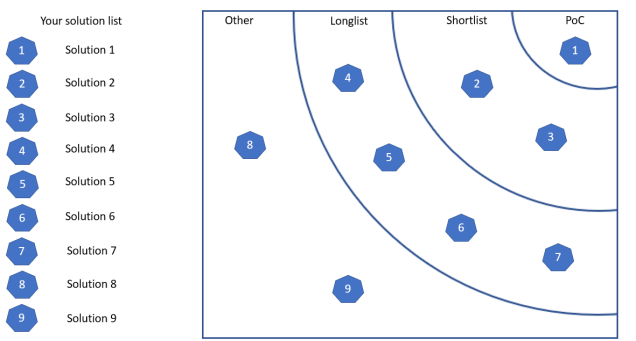
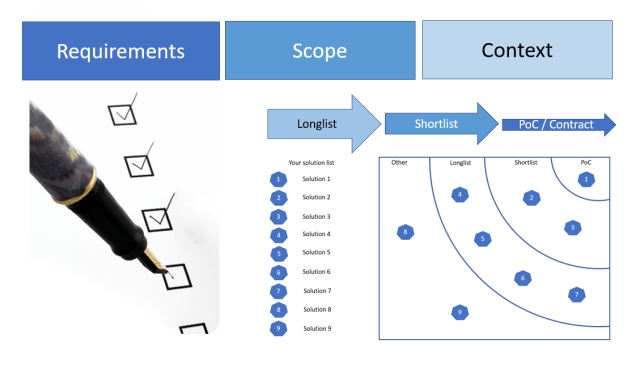
  • Select a longlist of 5 to 10 solutions that you after some research narrow down to a shortlist and after some more thorough research you will from this select a solution for a PoC / contract.
  • Select a shortlist of 3 to 5 solutions and after some research select a solution for a PoC / contract.
  • Directly select a solution for a Proof of Concept (PoC) and Business Case.

How would you – or did you – select a tool?


By the way: There are also some different approaches to get the work done:

Longlist shortlist PoC

Why Multienterprise MDM will Underpin Digital Transformation

I read (and write) a lot about why Master Data Management (MDM) is a core capability you need to succeed in digital transformation.

Over at the Profisee blog there is a post about that, extending the capability to be multidomain MDM. The post is called The Role of Multi-Domain MDM in Digital Transformation.

Also, at the Reltio blog as part of the #ModernDataMasters series, Tony Saldanha, author of the book  Why Digital Transformations Fail, explains: “Look at master data in terms of the entire virtual company – the total supply chain including your clients and suppliers – and create an ecosystem to drive standards across that.”

Tony continues: “The investment in master data within ecosystems is going to increase dramatically. People are going to realise that most of the waste that happens is at the seams of large organisations – not having a common language between the accounts payable of one company and the accounts receivable of another company means both companies are wasting resources and money.”

Multienterprise MDM Digital Transformation

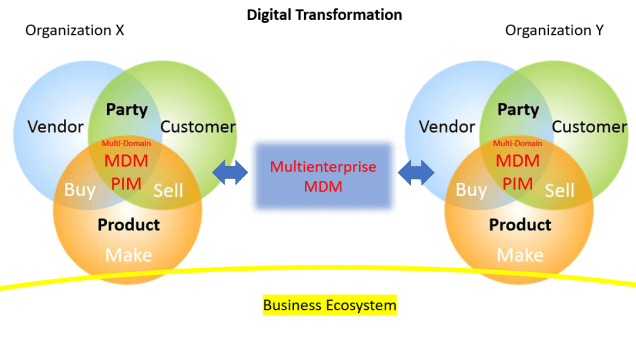
This way of looking at MDM as something that goes beyond each organization and evolves to be ecosystem wide is also called Multienterprise MDM.

In my eyes this is a very important aspect of using MDM within digital transformation. This theme is further examined in the post Why is Your Digital Ecosystem and MDM the Place to Begin in Digital Transformation?

Welcome Reifier on the Disruptive MDM / PIM List

The Disruptive MDM / PIM List is list of solutions in the Master Data Management (MDM), Product Information Management (PIM) and Data Quality Management (DQM) space.

The list presents both larger solutions that also is included by the analyst firms in their market reports and smaller solutions you do not hear so much about, but may be exactly the solution that addresses the specific challenges you have.

The latest entry on the list, Reifier, is one of the latter ones.

Matching data records and identifying duplicates in order to achieve a 360-degree view of customers and other master data entities is the most frequently mentioned data quality issue. Reifier is an artificial intelligence (AI) driven solution that tackles that problem.

Read more about Reifier here.

New entry Reifier

MDM / PIM solution ranking based on your context, scope and requirements

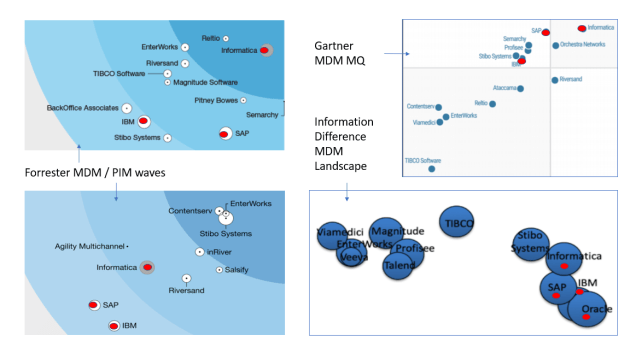
Popular Master Data Management (MDM) and Product Information Management (PIM) market reports with solution vendor rankings as the Gartner MDM Magic Quadrant, the Forrester MDM / PIM wave and the Information Difference MDM Landscape are generic, meaning they are not based on the specific context, scope and requirements that every organization on the look for a solution has.

So, no organization can just pick the solution positioned in the top right corner at their favourite analyst firm, neither make a shortlist with the solutions being most top-right or even a longlist with the well positioned solutions. They will need own research or consultancy from the report makers or consultancy firms – or yours truly.

Well, until now.

At The Disruptive MDM / PIM List there is a new service that, based on information about your context, scope and requirements, will provide a solution list that is fit for you.

Your solution list

Curious? Go to select your solution here.

Unifying Data Quality Management, MDM and Data Governance

During the end of last century data quality management started to gain traction as organizations realized that the many different applications and related data stores in operation needed some form of hygiene. Data cleansing and data matching (aka deduplication) tools were introduced.

In the 00’s Master Data Management (MDM) arised as a discipline encompassing the required processes and the technology platforms you need to have to ensure a sustainable level of data quality in the master data used across many applications and data stores. The first MDM implementations were focused on a single master data domain – typically customer or product. Then multidomain MDM (embracing customer and other party master data, location, product and assets) has become mainstream and we see multienterprise MDM in the horizon, where master data will be shared in business ecosystems.

MDM also have some side disciplines as Product Information Management (PIM), Digital Asset Management (DAM) and Reference Data Management (RDM). Sharing of product information and related digital assets in business ecosystems is here supported by Product Data Syndication.

Lately data governance has become a household term. We see multiple varying data governance frameworks addressing data stewardship, data policies, standards and business glossaries. In my eyes data governance and data governance frameworks is very much about adding the people side to the processes and technology we have matured in MDM and Data Quality Management (DQM). And we need to combine those themes, because It is not all about People or Processes or Technology. It is about unifying all this.

In my daily work I help both tool providers and end user organisations with all this as shown on the page Popular Offerings.

DG DQ and MDM


Top 15 MDM / PIM Requirements in RFPs

A Request for Proposal (RFP) process for a Master Data Management (MDM) and/or Product Information Management (PIM) solution has a hard fact side as well as there are The Soft Sides of MDM and PIM RFPs.

The hard fact side is the detailed requirements a potential vendor has to answer to in what in most cases is the excel sheet the buying organization has prepared – often with the extensive help from a consultancy.

Here are what I have seen as the most frequently included topics for the hard facts in such RFPs:

  • MDM and PIM: Does the solution have functionality for hierarchy management?
  • MDM and PIM: Does the solution have workflow management included?
  • MDM and PIM: Does the solution support versioning of master data / product information?
  • MDM and PIM: Does the solution allow to tailor the data model in a flexible way?
  • MDM and PIM: Does the solution handle master data / product information in multiple languages / character sets / script systems?
  • MDM and PIM: Does the solution have capabilities for (high speed) batch import / export and real-time integration (APIs)?
  • MDM and PIM: Does the solution have capabilities within data governance / data stewardship?
  • MDM and PIM: Does the solution integrate with “a specific application”? – most commonly SAP, MS CRM/ERPs, SalesForce?
  • MDM: Does the solution handle multiple domains, for example customer, vendor/supplier, employee, product and asset?
  • MDM: Does the solution provide data matching / deduplication functionality and formation of golden records?
  • MDM: Does the solution have integration with third-party data providers for example business directories (Dun & Bradstreet / National registries) and address verification services?
  • MDM: Does the solution underpin compliance rules as for example data privacy and data protection regulations as in GDPR / other regimes?
  • PIM: Does the solution support product classification and attribution standards as eClass, ETIM (or other industry specific / national standards)?
  • PIM: Does the solution support publishing to popular marketplaces (form of outgoing Product Data Syndication)?
  • PIM: Does the solution have a functionality to ease collection of product information from suppliers (incoming Product Data Syndication)?

Learn more about how I can help in the blog page about MDM / PIM Tool Selection Consultancy.

MDM PIM RFP Wordle

MDM Vendor Revenues According to Gartner

A recent post on this blog has the title MDM Spending Might be 5 Billion USD per Year.

The 5 B USD figure was a guestimate based on an estimate by Information Difference about the total yearly revenue at 1.6 B USD collected by MDM software vendors.

Prash Chandramohan, who has his daily work at Informatica, made a follow up blog post with the title The Size of the Global Master Data Management Market. In here Prash mentions some of the uncertainties there are when making such a guestimate.

In a Linkedin discussion on that post Ben Rund, who is at Riversand, asks about other sources – Gartner and others.

The latest Gartner MDM Magic Quadrant mentions the 2017 revenues as estimated by Gartner:

MDM market vendors re Gartner

It is worth noticing that Oracle is not a Gartner MDM Magic Quadrant vendor anymore and the Gartner report indicate that Oracle still have an MDM (or is it ADM?) revenue from the installed base resembling the ones of the other mega-vendors being SAP, IBM and Informatica.

Update: The revenues mentioned are assumed to be software license and maintenance. The vendors may then have additional professional services revenue.

The 14 MDM vendors that qualified for inclusion in the latest quadrant constituted, according to Gartner estimates, 84% of the estimated MDM market revenue (software and maintenance) for 2017  – which according to Gartner criteria must be excluding Oracle.

Why is Your Digital Ecosystem and MDM the Place to Begin in Digital Transformation?

The question “Why is Your Digital Ecosystem the Place to Begin?” was asked by Frank Diana of Tata Consultancy Services in the article Why an ecosystem strategy is where digital transformations begin.

As said by Frank Diana: “Whatever can be digitized is being digitized, and that means it’s available to be shared with other, digitally-enabled companies.”

This is true for master data as well. The role of Master Data Management (MDM) in making digital transformation a success was examined in the Disruptive MDM solution list post Digital Transformation Success Rely on MDM / PIM Success.

The concepts mentioned were:

  • Providing a 360-degree view of master data entities
  • Enabling happy self-service scenarios
  • Underpinning the best customer experience
  • Encompassing Internet of Things (IoT)

Providing a 360-degree view of master data entities through Golden Records in Multidomain MDM will be much easier by sharing master data that is already digitalised as third-party reference data and/or at business partners.

Enabling happy self-service scenarios can be done much more effectively by opening up the master data onboarding to business partners and customers them selves and by letting product data flow easily between trading partners as pondered in the post Linked Product Data Quality.

Underpinning the best customer experience will require that you utilize data from and about the whole business ecosystem where your company is a participant.

Encompassing Internet of Things (IoT) means that you must share master within the business ecosystem as touched in the post IoT and MDM.Digital Transformation MDM and business ecosystems

MDM Megavendors vs the Other MDM Vendors

In the latest Gartner Master Data Management Solutions magic quadrant it is stated that “Gartner-estimated 2016 revenues of the four largest vendors commanded over 77% of the market (SAP, IBM, Oracle and Informatica). These four held a Gartner-estimated market share of just over 73% in 2017.”

There seems to be a little decrease in the dominance from the megavendors, though the market according to Gartner is still ruled by the big four. The number of licenses sold by these vendors and those midsize vendors who also are in the quadrant can be found in the post Counting MDM Licenses.

For the future trend it is also worth noticing, that Oracle is not a part of the MDM magic quadrant anymore, as Oracle in the Gartner lingo is not an MDM vendor, but an ADM vendor today. Oracle is not included in the latest Forrester MDM wave either.

Another market distinction is around MDM versus Product Information Management (PIM) solutions. The post Several Sources of Truth about MDM / PIM Solutions examines the positioning by Gartner and Forrester and in that sense the magavendors are better at MDM than PIM.

Any Gartner estimation will be biased towards large vendors having large clients as these are the Gartner clients. In a LinkedIn discussion a big four person suggested that the market is fragmented and there are many MDM-like solutions.

This remark followed the market estimation from a fresh market report from Information Difference. The positioning results from here were shown in the post Movements in the MDM Vendor Landscape 2019. In here the megavendors did not perform so well on the technology axis, which is largely made up by customer satisfaction feedback in the underlying survey.

So, what do you think? Will the megavendors still rule the MDM market or will the midsize and smaller vendors get a larger piece of the cake?

MDM megavendors

For bigger picture click here.