Data Born Companies and the Rest of Us

harriThis post is a new feature here on this blog, being guest blogging by data management professionals from all over the world. First up is Harri Juntunen, Partner at Twinspark Consulting in Finland:

Data and clever use of data in business has had and will have significant impact on value creation in the next decade. That is beyond reasonable doubt. What is less clear is, how this is going to happen? Before we answer the question, I think it is meaningful to make a conceptual distinction between data born companies and the rest of us.

Data born born companies are companies that were conceived from data. Their business models are based  on monetising clever use of data. They have organised everything from their customer service to operations to be capable of maximally harness data. Data and capabilities to use data to create value is their core competency. These companies are the giants of data business: Google, Facebook, Amazon, Über, AirBnB. The standard small talk topics in data professionals’ discussions.

However, most of the companies are not data born. Most of the companies were originally established to serve a different purpose. They were founded to serve some physical needs and actually maintaining them physically, be it food, spare parts or factories. Obviously, all of these companies in  e.g. manufacturing and maintenance of physical things need data to operate. Yet, these companies are not organised around the principles of data born companies and capabilities to harness data as the driving force of their businesses.

We hear a lot of stories and successful examples about how data born companies apply augmented intelligence and other latest technology achievements. Surely, technologies build around of data are important. The key question to me is: what, in practice, is our capability to harness all of these opportunities in companies that are not data born?

In my daily practice I see excels floating around and between companies. A lot of manual work caused by unstandardised data, poor governance and bad data quality. Manual data work simply prevents companies to harness the capabilities created by data born companies. Yet, most of the companies follow the data born track without sufficient reflection. They adopt the latest technologies used by the data born companies. They rephrase same slogans: automation, advanced analytics, cognitive computing etc. And yet, they are not addressing the fundamental and mundane issues in their own capabilities to be able to make business and create value with data. Humans are doing machine’s job.

Why? Many things relate to this, but data quality and standardization are still pressing problems in every day practice in many companies. Let alone between companies. We can change this. The rest of us can reborn from data just by taking a good look of our mundane data practices instead of aspiring to go for the next big thing.

P.S. The Google Brain team had reddit a while ago and they were asked “what do you think is underrated?

The answer:

“Focus on getting high-quality data. “Quality” can translate to many things, e.g. thoughtfully chosen variables or reducing noise in measurements. Simple algorithms using higher-quality data will generally outperform the latest and greatest algorithms using lower-quality data.”

https://www.reddit.com/r/MachineLearning/comments/4w6tsv/ama_we_are_the_google_brain_team_wed_love_to/

About Harri Juntunen:

Harri is seasoned data provocateur and ardent advocate of getting the basics right. Harri says: People and data first, technology will follow.

You can contact Harri here:

+358 50 306 9296

harri.juntunen@twinspark.fi

www.twinspark.fi


Everyday Digital Transformation

Ben Rund of Informatica has a Youtube video running these days with the title/question: Enough Heard on Digital Transformation by Uber & AirBnB?

I share this sentiment with Ben. You don’t have to disrupt the whole world to take part in digital transformation and you don’t have to start something completely new. As an established enterprise you can transform your current business and combine the good things from the past with the new opportunities aroused from the digital evolution.

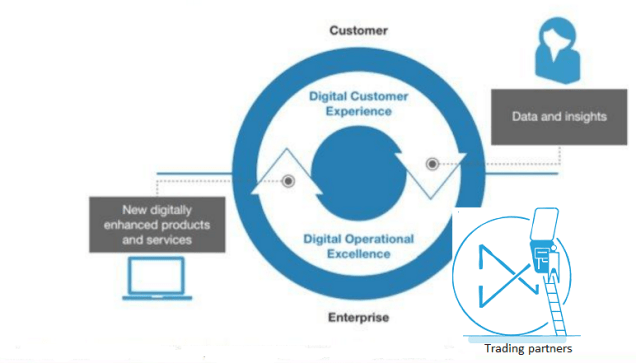
Forrester, the other analyst firm, some years ago devided digital transformation into a loop of:

  • Digital Customer Experience
  • Digital Operational Excellence

The below figure visualizes this landscape:

digital

What I would like to elaborate on related to this picture is the business ecosystem of your enterprise, which must be included in the everyday digital transformation.

Let’s take the example of product information management:

However, connect is better than collect. If you are dependent on receiving spreadsheets with product information from your trading partners or you let them put their spreadsheets into your supplier product data portal, you have an everyday digital transformation in front of you.

The solution for that is Product Data Lake.

digital2

A System of Engagement for Business Ecosystems

Master Data Management (MDM) is increasingly being about supporting systems of engagement in addition to the traditional role of supporting systems of record. This topic was first examined on this blog back in 2012 in the post called Social MDM and Systems of Engagement.

The best known systems of engagement are social networks where the leaders are Facebook for engagement with persons in the private sphere and LinkedIn for engagement with people working in or for one or several companies.

But what about engagement between companies? Though you can argue that all (soft) engagement is neither business-to-consumer (B2C) nor business-to-business (B2B) but human-to-human (H2H), there are some hard engagement going on between companies.

pdl-whyOne of the most important ones is exchange of product information between manufacturers, distributors, resellers and large end users of product information. And that is not going very well today. Either it is based on fluffy emailing of spreadsheets or using rigid data pools and portals. So there are definitely room for improvement here.

At Product Data Lake we have introduced a system of engagement for companies when it comes to the crucial task of exchanging product information between trading partners. Read more about that in the post What a PIM-2-PIM Solution Looks Like.

Shipping Product Information

When looking out of the windows from Product maersk-seen-from-pdl-in-sunshineData Lake global headquarters (well, that is also our home office) we see our neighbour, which is the global headquarters of Maersk, a major worldwide operating shipping company.

In all humbleness we do very parallel business. Maersk is good at moving goods. We are going to move data about the goods. Product data or product information if you like.

The reason of being for a shipping company is that it would be very ineffective for each manufacturer of goods, if they should arrange and carry out the transportation of their manufactured goods to each distributor around the world. Furthermore, it would be equally ineffective, if each distributor should arrange and carry out the transportation of their range of goods to each reseller or large end buyer.

Until now, this ineffectiveness has unfortunately been the case when it comes to exchanging data about the goods. Manufacturers are asked by their distributors to provide product information in a different way for each – most often meaning in a different spreadsheet. And the same craziness repeats itself when it comes to exchanging data between distributors, resellers and large end users of product information.

At Product Data Lake we have set sail to end this insanity and bring digitalization to shipping of product information. Learn more about how exactly we will arrange that journey on Product Data Lake Documentation and Data Governance.

Bookmark and Share

Ways of Sharing Product Data in Business Ecosystems

Sharing product data within business ecosystems of manufacturers, distributors, retailers and end users has grown dramatically during the last years driven by the increased use of e-commerce and other customer self-service sales approaches.

At Product Data Lake we recently had a survey about how companies shares product data today. The figures were as seen below:

our survey

The result shows that there are different approaches out there. Spreadsheets still rules the world though closely, in this survey, followed by external data portals. Direct system to system approaches are also present while supplier portals seems to be not that common.

At the Product Data Lake we aim to embrace those different approaches. Well, regarding use of spreadsheets and digital asset files via eMail our embracement is meant to be that of a constrictor snake. The Product Data Lake is the solution to end the hailstorms of spreadsheets with product data within cross company supply chains.

For external data portals, the Product Data Lake offers the concept of a data reservoir. A data reservoir in the Product Data Lake can be with an industry focus or with a special focus on certain data elements as for example sustainability data as described in the post Sustainability Data in PIM.

Direct systems to system exchange can be orchestrated through the Product Data Lake and supplier portals can served by the Product Data Lake. In that way existing investments in those approaches, that typically are implemented to serve basic data elements shared with your top trading partners, can be supplemented by a method that caters for exchange with all your trading partners and covering all data elements and digital assets.

Bookmark and Share

Take an Ultra Short Survey on Product Data Exchange

How do you exchange product data with your trading partners today? At the Product Data Lake we would like to know some more about that. We do expect that many still send eMails with spreadsheets and digital assets. But please tell us how it is with you. Take the survey by clicking here.

Survey

Also please comment on this blog post on your plans or if you work with Product Information Management (PIM) as a service provider and have experiences to share.

Bookmark and Share

Data Management for Business Ecosystems

Business ecosystems is an important concept of the digital age. The father of business ecosystems, James F. Moore, defined business ecosystems as:

“An economic community supported by a foundation of interacting organizations and individuals—the organisms of the business world. The economic community produces goods and services of value to customers, who are themselves members of the ecosystem. The member organisms also include suppliers, lead producers, competitors, and other stakeholders”.

The problem with data management methodologies and tools today, as I see it, is that they emphasizes on the needs inside the corporate walls of a single company without much attention to, that every single company is a member of one or several business ecosystems as examined in the post called MDM and SCM: Inside and outside the corporate walls.

Opening your data management, including your Master Data Management (MDM), up to the outside is scary business, as the ecosystems often will include your competitors as well as mentioned in the post Toilet Seats and Data Quality.

Nevertheless, if you want your company to survive in the digital age by building up your company’s digitilazation effort you have to extend your data management strategy to encompass the business ecosystems where you are a member.

And now some promotion:

Helene light 03
The Product Data Lake: A tool for business ecosystems

Take A Quick Tour around the Product Data Lake

Bookmark and Share

Big data and PIM: A match made in space

Product Information Management (PIM) have over the recent years emerged as an important technology enabled discipline for every company taking part in a supply chain. These companies are manufacturers, distributor, retailers and large end users of tangible products requiring a drastic increased variety of product data to be used in ecommerce and other self-service based ways of doing business.

At the same time we have seen the raise of big data. Now, if you look at every single company, product data handled by PIM platforms perhaps does not count as big data. Sure, the variety is a huge challenge and the reason of being for PIM solutions as they handle this variety better than traditional Master Data Management (MDM) solutions and ERP solutions.

The variety is about very different requirements in data quality dimensions based on where a given product sits in the product hierarchy. Measuring completeness has to be done for the concrete levels in the hierarchy, as a given attribute may be mandatory for one product but absolutely ridiculous for another product. An example is voltage for a power tool versus for a hammer. With consistency, there may be attributes with common standards (for example product name) but many attributes will have specific standards for a given branch in the hierarchy.

Product information also encompasses digital assets, being PDF files with product sheets, line drawings and lots of other stuff, product images and an increasing amount of videos with installation instructions and other content. The volume is then already quite big.

Image coming soon
A missing product image is a sign of a broken product data business process

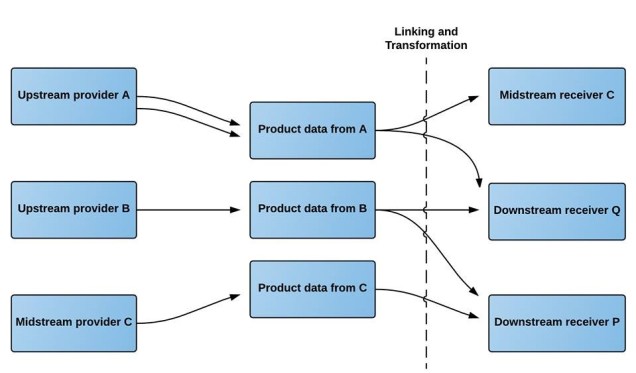
Volume and velocity really comes into the game when we look at eco-systems of manufacturers, distributors and retailers. The total flow of product data can then be described with the common characteristics of big data: Volume, velocity and variety. Even if you look at it for a given company and their first degree of separation with trading partners, we are talking about big data where there is an overwhelming throughput of new product links between trading partners and updates to product information that are – or not least should have been – exchanged.

Within big data we have the concept of a data lake. A key success factor of a data lake solution is minimizing the use of spreadsheets. In the same way, we can use a data lake, sitting in the exchange zone between trading partners, for product information as elaborated further in the post Gravitational Collapse in the PIM Space.

Bookmark and Share

Growing Weight on Business Rules in MDM

Business rules has always been an important subject when it comes to data quality and Master Data Management (MDM). However, it seems that business rules are considered even more important over the recent years and in the future.

Fellow MDM professional Roberto Lichtenstein recently published a LinkedIn pulse post called “MDM and business rules” survey outcome.

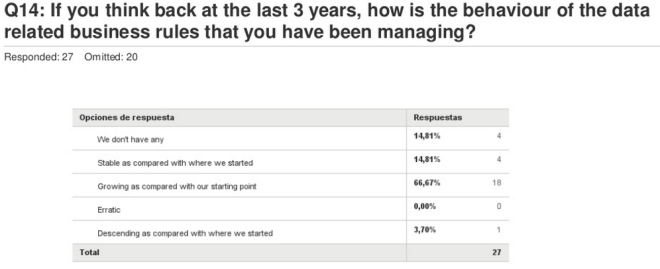
One of the survey results was about how the last 3 years behaviour of managing business rules has developed:

MDM and business rules

Two third of people answering the question indicated a growing inclusion of business rules (including yours truly in my current main role). So that’s a good growth. However nearly half of respondents did not answer that question, so a bit of caution may be relevant.

As Roberto mentions in his summary post there is a chicken and egg thing with process and data. I also find there is a chicken and egg theme with business rules and MDM. Letting business rules dictate the MDM behaviour is obvious. But MDM can sometimes initiate new business rules as examined in the post To-Be Business Rules and MDM.

Bookmark and Share