Scaling Up The Disruptive MDM / PIM / DQM List

The Disruptive MDM / PIM / DQM List was launched in the late 2017.

Here the first innovative Master Data Management (MDM) and Product Information Management (PIM) tool vendors joined the list with a presentation page showcasing the unique capabilities offered to the market.

The blog was launched at the same time. Since then, a lot of blog posts – including guest blog posts – have been posted. The topics covered have been about the list, the analysts and their market reports as well as the capabilities that are essential in solutions and their implementation.

In 2019 the MDM and PIM tool vendors were joined by some of the forward-looking best-of-breed Data Quality Management (DQM) tool vendors.

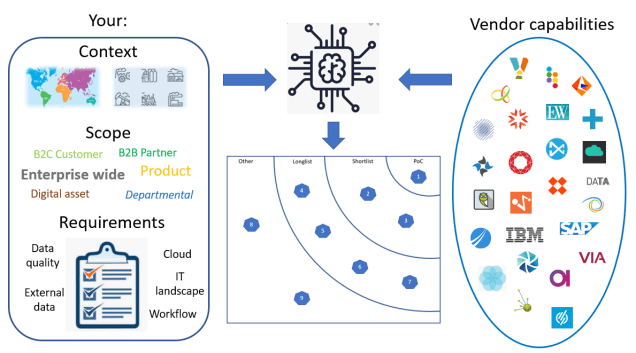
The Select Your Solution service was launched at the same time. Here organizations – and their consultants – who are on the look for a MDM / PIM / DQM solution can jumpstart the selection process by getting a list of the best solutions based on their individual context, scope and requirements. More than 100 hundred end user organizations or their consultants have received such a list.

MDMlist timeline

Going into the 20es the list is ready to be scaled up. The new sections being launched are:

  • The Service List: In parallel with the solution providers it is possible for service providers – like implementation partners – to register on The Service List. This list will run besides The Solution List. For an organization on the look for an MDM / PIM / DQM solution it is equally important to select the right solution and the right implementation partner.
  • The Resource List: This is a list – going live soon – with white papers, webinars and other content from potentially all the registered tool vendors and service providers divided into sections of topics. Here end user organizations can get a quick overview of the content available within the themes that matters right now.
  • The Case Study List: The next planned list is a list of case studies from potentially all the registered tool vendors and service providers. The list will be divided into industry sectors. Here end user organizations can get a quick overview of studies from similar organizations.

If you have questions and/or suggestions for valuable online content on the list, make a comment or get in contact here:

← Back

Thank you for your response. ✨

Analyst MDM / PIM / DQM Solution Reports Update March 2020

Analyst firms occasionally publish market reports with solution overview for Master Data Management (MDM), Product Information Management (PIM) and Data Quality Management (DQM).

The publication schedule from the analyst firms can be unpredictable.

Information Difference is an exception. There have during the years every year been a Data Quality landscape named Q1 and published shortly after that quarter and an MDM landscape named Q2 and published shortly after that quarter. However, these reports are relying on participation from relevant vendors and not all vendors prioritize this scheme.

Forrester is quite unpredictable both with timing and which market segments (MDM, PIM, DQM) to be covered.

Gartner is a bit steadier. However, for example the MDM solution reports have been coming in varying intervals during the latest years.

Here is an overview of the latest major reports:

Stay tuned on this blog to get the latest on analyst reports and news on market movements.

MDM PIM DQM analysts and solutions

Looking for the Right MDM / PIM / DQM Implementation Partner

The Disruptive MDM / PIM / DQM List has been running for a couple of years and is now a list of 15 of some of the most innovative and forward looking solutions on the Master Data Management (MDM), Product Information Management (PIM) and Data Quality Management (DQM) market.

The list can be seen as an online MDM / PIM / DQM conference:

The Online MDM PIM DQM Conference

In these times when offline MDM / PIM / DQM conferences are cancelled, I thought it might be useful to uncover if there is an interest among implementation partners in this space to join the list on an adjacent list on the site covering these services, as it besides choosing the right solution is equally important to choose the right implementation partner.

So, if you as an implementation partner are interested, you can register here.

Alternatively, give me a shout here:

← Back

Thank you for your response. ✨

How the Covid-19 Outbreak Can Change Data Management

From sitting at home these are my thoughts about how data management can be changed due to the current outbreak of the Covid-19 (Corona) virus and the longer-term behaviour impact after the pandemic hopefully will be over.

Ecommerce Will Grow Faster

Both households and organizations are buying more online and this trend is increasing due to the urge of keeping a distance between humans. The data management discipline that underpins well executed ecommerce is Product Information Management (PIM). We will see more organizations implementing PIM solutions and we must see more effective and less time-consuming ways of implementing PIM solutions.

Data Governance Should Mature Faster

The data governance discipline has until now been quite immature and data governance activities have been characterized by an endless row of offline meetings. As data governance is an imperative in PIM and any other data management quest, we must shape data governance frameworks that are more ready to use, and we must have online learning resources available for both professionals and participating knowledge workers with various roles.

Data Sharing Could Develop Faster

People, organizations and countries initially act in a selfish manner during a crisis, but we must realize that collaboration including data sharing is the only way forward. Hopefully we will see more widespread data sharing enterprise wide as this will ease remote working. Also, we could see increasing interenterprise (business ecosystem wide) data sharing which in particular will ease PIM implementations through automated Product Data Syndication (PDS).

Covid Data Management

No One MDM Solution Can Fully Satisfy All Current and Future Use Cases

The title of this post is taken from the Gartner Critical Capabilities for Master Data Management Solutions.

One implication of this observation is that you when selecting your solution will not be able to use a generic analyst ranking of solutions as examined in the post Generic Ranking of Vendors versus an Individual Selection Service.

Selection Model

This is the reason of being for The Disruptive MDM / PIM / DQM List.

Another implication is that even the best fit MDM solution will not necessarily cover all your needs.

One example is within data matching, where I have found that the embedded solutions in MDM tools often only have limited capabilities. To solve this case, there are best of breed data matching solutions on the market able to supplement the MDM solutions.

Another example close to me is within multienterprise (business ecosystem wide) MDM, as MDM solutions are focused on each given organization. Here your interaction with a trading partner, and the interaction by the trading partner with you, can be streamlined with a solution like Product Data Lake.

What is a Golden Record?

The term golden record is a core concept within Master Data Management (MDM) and Data Quality Management (DQM). A golden record is a representation of a real world entity that may be compiled from multiple different representations of that entity in a single or in multiple different databases within the enterprise system landscape.

A golden record is optimized towards meeting data quality dimensions as:

  • Being a unique representation of the real world entity described
  • Having a complete description of that entity covering all purposes of use in the enterprise
  • Holding the most current and accurate data values for the entity described

In Multidomain MDM we work with a range of different entity types as party (with customer, supplier, employee and other roles), location, product and asset. The golden record concept applies to all of these entity types, but in slightly different ways.

Party Golden Record

Having a golden record that facilitates a single view of customer is probably the most known example of using the golden record concept. Managing customer records and dealing with duplicates of those is the most frequent data quality issue around.

If you are not able to prevent duplicate records from entering your MDM world, which is the best approach, then you have to apply data matching capabilities. When identifying a duplicate you must be able to intelligently merge any conflicting views into a golden record as examined in the post Three Master Data Survivorship Approaches.

In lesser degree we see the same challenges in getting a single view of suppliers and, which is one of my favourite subjects, you ultimately will want to have a single view on any business partner, also where the same real world entity have both customer, supplier and other roles to your organization.

Location Golden Record

Having the same location only represented once in a golden record and applying any party, product and asset record, and ultimately golden record, to that record may be seen as quite academic. Nevertheless, striving for that concept will solve many data quality conundrums.

Location management have different meanings and importance for different industries. One example is that a brewery makes business with the legal entity (party) that owns a bar, café, restaurant. However, even though the owner of that place changes, which happens a lot, the brewery is still interested in being the brand served at that place. Also, the brewery wants to keep records of logistics around that place and the historic volumes delivered to that place. Utility and insurance are other examples of industries where the location golden record (should) matter a lot.

Knowing the properties of a location also supports the party deduplication process. For example, if you have two records with the name “John Smith” on the same address, the probability of that being the same real world entity is dependent on whether that location is a single-family house or a nursing home.
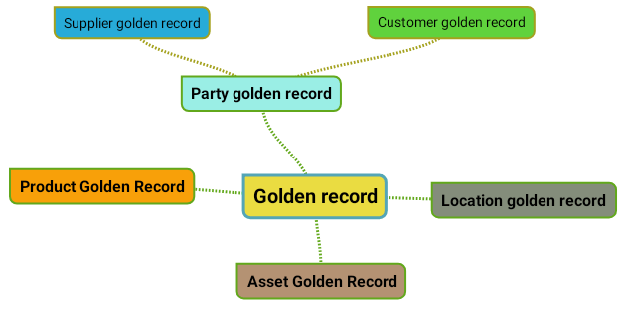
Golden RecordsProduct Golden Record

Product Information Management (PIM) solutions became popular with the raise of multi-channel where having the same representation of a product in offline and online channels is essential. The self-service approach in online sales also drew the requirements of managing a lot more product attributes than seen before, which again points to a solution of handling the product entity centralized.

In large organizations that have many business units around the world you struggle with having a local view and a global view of products. A given product may be a finished product to one unit but a raw material to another unit. Even a global SAP rollout will usually not clarify this – rather the contrary.

While third party reference data helps a lot with handling golden records for party and location, this is lesser the case for product master data. Classification systems and data pools do exist, but will certainly not take you all the way. With product master data we must, in my eyes, rely more on second party master data meaning sharing product master data within the business ecosystems where you operate.

Asset (or Thing) Golden Record

In asset master data management you also have different purposes where having a single view of a real world asset helps a lot. There are namely financial purposes and logistic purposes that have to aligned, but also a lot of others purposes depending on the industry and the type of asset.

With the raise of the Internet of Things (IoT) we will have to manage a lot more assets (or things) than we usually have considered. When a thing (a machine, a vehicle, an appliance) becomes intelligent and now produces big data, master data management and indeed multi-domain master data management becomes imperative.

You will want to know a lot about the product model of the thing in order to make sense of the produced big data. For that, you need the product (model) golden record. You will want to have deep knowledge of the location in time of the thing. You cannot do that without the location golden records. You will want to know the different party roles in time related to the thing. The owner, the operator, the maintainer. If you want to avoid chaos, you need party golden records.

The Latest Disruptive MDM Entry: Unidata

Gartner has restarted mentioning some of the Master Data Management (MDM) solutions not (yet) meeting the threshold criteria for the MDM Magic Quadrant as reported in the post What has Changed with the Gartner MDM Magic Quadrant?

One of the solutions in this tiny crowd is Unidata.

The sister site to this blog is The Disruptive MDM / PIM / DQM List. So very timely it is good to be able to present Unidata on this site as well – and providing some more information than Gartner do.

An interesting fact about Unidata is that the core of its data management platform is under an open license which is “part of the company’s strategy and mission to form a community of experts in the field of data management and is aimed at developing the industry as a whole”.

Learn more about Unidata here.Unidata image