How to Avoid Losing 5 Billion Euros

Two years ago I made a blog post about how 5 billion Euros were lost due to bad identity resolution at European authorities. The post was called Big Time ROI in Identity Resolution.

In the carbon trade scam criminals were able to trick authorities with fraudulent names and addresses.

One way of possible discovery of the fraudster’s pattern of interrelated names and physical and digital locations was, as explained in the post, to have used an “off the shelf” data matching tool in order to achieve what is sometimes called non-obvious relationship awareness. When examining the data I used the Omikron Data Quality Center.

Another and more proactive way would have been upstream prevention by screening identity at data capture.

Identity checking may be a lot of work you don’t want to include in business processes with high volume of master data capture, and not at least screening the identity of companies and individuals on foreign addresses seems a daunting task.

One way to help with overcoming the time used on identity screening covering many countries is using a service that embraces many data sources from many countries at the same time. A core technology in doing so is cloud service brokerage. Here your IT department only has to deal with one interface opposite to having to find, test and maintain hundreds of different cloud services for getting the right data available in business processes.

Right now I’m working with such a solution called instant Data Quality (iDQ).

Really hope there’s more organisations and organizations out there wanting to avoid losing 5 billion Euros, Pounds, Dollars, Rupees, Whatever or even a little bit less.

Bookmark and Share

Big Reference Data as a Service

This morning I read an article called The Rise of Big Data Apps and the Fall of SaaS by Raj De Datta on TechCrunch.

I think the first part of the title is right while the second part is misleading. Software as a Service (SaaS) will be a big part of Big Data Apps (BDA).

The article also includes a description of LinkedIn merely as a social recruitment service. While recruiters, as reported in the post Indulgent Moderator or Ruthless Terminator?, certainly are visible on this social network, LinkedIn is much more than that.

Among other things LinkedIn is a source of what I call big reference data as examined in the post Social MDM and Systems of Engagement.

Besides social network profiles big reference data also includes big directory services, being services with large amount of data about addresses, business entities and citizens/consumers as told in the post The Big ABC of Reference Data.

Right now I’m working with a Software as a Service solution embracing Big (Reference) Data as a Service thus being a Big Data App called instant Data Quality.

And hey, I have made a pin about that:

Bookmark and Share

Social MDM and Systems of Engagement

Social Master Data Management has been an interest of mine the last couple of years and last week I have tried to reach out to others in exploring this new era of Master Data Management by creating a group on LinkedIn called Social MDM.

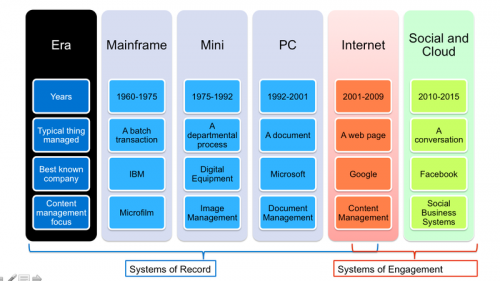
When reading a nice blog with the slogan ”Welcome to the Real (IT) World!” by Max J. Pucher I came across a good illustration by John Mancini showing the history of IT and how the term “Systems of Record” is being replaced (or at least supplemented) by the term “Systems of Engagement”:

Master Data Management (MDM) includes having a System of Record (SOR) describing the core entities that takes part in the transactional systems of record that supports the daily business in every organization. For example a golden MDM record is describing the party that acts as a customer on an order record while the products in the underlying order lines are described in golden MDM records for the things dealt with within the organization.

Social Master Data Management (Social MDM) will be about supplementing that System of Record so we are able to further describe the parties taking part in the new Systems of Engagement and link with the old Systems of Records. These parties are reflected as social network profiles that are owned by the same human beings who are our (prospective) customers, part of the same household or are a contact for a company being a (prospective) customer or any other business partner.

For a guy like me who started in IT in the mainframe era (just after it had ended according to the above illustration) and went on with mini computers, PC’s and the internet it’s very exciting to be moving on into the social and cloud era.

It will be good to be joined by even more data quality and MDM practitioners and anyone else in the LinkedIn Social MDM group.

Bookmark and Share

Data Quality at Terminal Velocity

Recently the investment bank Saxo Bank made a marketing gimmick with a video showing a BASE jumper trading foreign currency with the banks mobile app at terminal velocity (e.g. the maximum speed when free falling).

Today business decisions have to be taken faster and faster in the quest for staying ahead of competition.

When making business decisions you rely on data quality.

Traditionally data quality improvement has been made by downstream cleansing, meaning that data has been corrected long time after data capture. There may be some good reasons for that as explained in the post Top 5 Reasons for Downstream Cleansing.

But most data quality practitioners will say that data quality prevention upstream, at data capture, is better.

I agree; it is better.  Also, it is faster. And it supports faster decision making.

The most prominent domain for data quality improvement has always been data quality related to customer and other party master data. Also in this quest we need instant data quality as explained in the post Reference Data at Work in the Cloud.

Bookmark and Share

Know Your Foreign Customer

I’m not saying that Customer Master Data Management is easy. But if we compare the capabilities within most companies with handling domestic customer records they are often stellar compared to the capabilities of handling foreign customer records.

It’s not that the knowledge, services and tools doesn’t exist. If you for example are headquartered in the USA, you will typically use best practice and services available there for domestic records. If you are headquartered in France, you will use best practice and services available there for domestic records. Using the best practices and services for foreign (seen from where you are) records is more seldom and if done, it is often done outside enterprise wide data management.

This situation can’t, and will not, continue to exist. With globalization running at full speed and more and more enterprise wide data management programs being launched, we will need best practices and services embracing worldwide customer records.

Also new regulatory compliance will add to this trend. Being effective next year the US Foreign Account Tax Compliance Act (FATCA) will urge both US Companies and Foreign Financial Institutions to better know your foreign customers and other business partners.

In doing that, you have to know about addresses, business directories and consumer/citizen hubs for an often large range of countries as described in the post The Big ABC of Reference Data.

It may seem a daunting task for each enterprise to be able to embrace big reference data for all the countries where you have customers and other business partners.

My guess, well, actually plan, is, that there will be services, based in the cloud, helping with that as indicated in the post Partnerships for the Cloud.

Bookmark and Share

Partnerships for the Cloud

Earlier this month Loraine Lawson was so kind to quote me in an article on IT Business Edge called New Partnerships Create Better Customer Data via the Cloud.

The article mentions some cloud services from StrikeIron and Melissadata. These services are currently based on improving North American, being US and Canadian, customer data.

I am involved in similar services that currently are based on improving Danish customer data, which then covers the rest of North America being Greenland.

Improving customer data from all over the world is surely a daunting task that needs partnerships.

The cloud is the same, the reference data isn’t and the rules and traditions aren’t either as governments around the world has found 240 (or so) different solutions to balancing privacy concerns and administrative efficiency.

So, if not partnering, you risk getting solutions that are nationally international.

Bookmark and Share

Sharing Social Master Data

If a company runs a Customer Relationship Management (CRM) system all employees are supposed to enter their interactions with customers and prospects including adding new accounts and contacts if it’s the first engagement.

With the rise of social networks first engagements are increasingly done in those networks. Furthermore new employees often bring old contacts from former employments with them thus utilizing an established relationship that probably is manifested in one or more already existing social network connections.

As explained in the post Social Master Data Management the term ”Social CRM” has been around for a while. We now see CRM solutions where the account and contact master data primarily is build on extracting those data from social networks.

I have just tried out such a solution called Nimble.

If you are more than a one-man-band company it’s interesting in what degree you are willing (or forced) to share your connections as master data entities for the CRM solution.

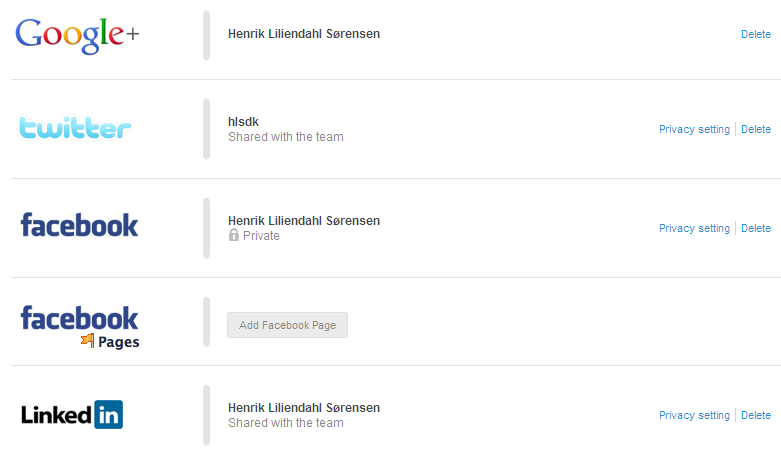
In Nimble you have the choice of differentiate for each network. I would probably freely choose a setup with Twitter and LinkedIn as shared with the team, but Facebook as private:

But that is just how I think based on my way of using social networks.

There is a fundamental data quality versus privacy issue around utilizing employee’s social network connections as master data for CRM and eventually enterprise wide Master Data Management (MDM).

All things equal data quality will be best if everyone contributes within reason. Not at least in sales, but also more or less in other functions, you are hired also because of your relations.

What do you think?

Bookmark and Share

Reference Data at Work in the Cloud

One of the product development programs I’m involved in is about exploiting rich external reference data and using these data in order to get data quality right the first time and being able to maintain optimal data quality over time.

The product is called instant Data Quality (abbreviated as iDQ ™). I have briefly described the concept in an earlier post called instant Data Quality.

iDQ ™combines two concepts:

  • Software as a Service
  • Data as a Service

While most similar solutions are bundled with one specific data provider the iDQ ™ concept embraces a range data sources. The current scope is around customer master data where iDQ ™ may include Business-to-Business (B2B) directories, Business-to-Consumer (B2C) directories, real estate directories, Postal Address Files and even social media network data from external sources as well as internal master data at the same time all presented in a compact mash-up.

The product has already gained a substantial success in my home country Denmark leading to the formation of a company solely working with development and sales of iDQ ™.

The results iDQ ™ customers gains may seem simple but are the core advantages of better data quality most enterprises are looking for, like said by one of Denmark’s largest companies:

“For DONG Energy iDQ ™ is a simple and easy solution when searching for master data on individual customers. We have 1,000,000 individual customers. They typically relocate a few times during the time they are customers of us. We use iDQ ™ to find these customers so we can send the final accounts to the new address. iDQ ™ also provides better master data because here we have an opportunity to get names and addresses correctly spelled.

iDQ ™ saves time because we can search many databases at the time. Earlier we had to search several different databases before we found the right master data on the customer. ”

Please find more testimonials here.

I hope to be able to link to testimonials in more languages in the future.

Bookmark and Share

What to do in 2012

The time between Christmas and New Year is a good time to think about if you are going to do the right things next year. In doing so, you will have to look back at the current year and see how you can develop from there.

In my professional life as a data quality and master data management practitioner my 2011 to do list included these three main activities:

  • Working with Multi-Domain Master Data Quality
  • Exploiting rich external reference data sources in the cloud
  • Doing downstream data cleansing

In a press release from May 2011 Gartner (the analyst firm) Highlights Three Trends That Will Shape the Master Data Management Market. These are:

  • Growing Demand for Multidomain MDM Software
  • Rising Adoption of MDM in the Cloud
  • Increasing Links Between MDM and Social Networks

It looks like I was working in the right space for the first two things but stayed in the past regarding the third activity being downstream data cleansing.

The third thing to embrace in the future, social MDM we may call it, has been an area of interest for me the last couple of years and actually some downstream data cleansing projects has touched making master data useful for including social media networks in the loop.  

I’m not sure if 2012 will be a breakthrough for social MDM, but I think there will be some exciting opportunities out there for paving the road for social MDM.

Bookmark and Share