Work Clothes versus Fashion: A Product Information Perspective

Work clothes and clothes for private (and white collar) use are as products quite similar. You have the same product groups as shoes, trousers, belts, shirts, jackets, hats and so on.

However, the sales channels have different structures and the product information needed in sales, not at least self-service sales as in ecommerce, are as Venus and Mars.

Online fashion sales are driven by nice images – nice clothes on nice models. The information communicated is often fluffy with only sparse hard facts on data like fabrics, composition, certificates, origin. Many sales channel nodes only deal with fashion.

Selling work clothes, including doing it on the emerging online channels, does include images. But they should be strict to presenting the product as is. There is a huge demand for complete and stringent product information.

Work clothes are often sold in conjunction with very different products as for example building materials, where the requirements for product information attributes are not the same. Work clothes comes, as fashion, in variants in sizes and colors. This is not so often used, or used quite differently, when selling for example building materials.

At Product Data Lake we offer a product information sharing environments for manufacturers of work clothes and their merchants who may have a lot of other products in range with different product information requirements. We call it Product Data Syndication Freedom.


Work Clothes versus Fashion

How Manufacturers of Building Materials Can Improve Product Information Efficiency

Building materials is a very diverse product group. Even within a manufacturing enterprise there may be considerable variances in what kind of product information you need for different product groups. If production is taking place on plants around the world, then local demands and cultural differences is another source of diversity in how product information is handled.

In many cases building materials are not sold directly to end users, but are forwarded in the supply chain to re-sellers being distributors/wholesalers, merchants/dealers and marketplaces. These trading partners each have their range of products and specific requirements for product information which makes it very hard for the manufacturer to prepare product information that fits all.

The IT enabled discipline aimed at solving such challenges is called product data syndication. There are namely these three kinds of product data syndication relevant to manufacturers:

  • Enterprise wide product data syndication aiming at linking, transforming and consolidating product information created by various business units and production sites around the world. The goal is to have consistent, accurate and timely information ending up in one place, often being an in-house Product Information Management (PIM) or Master Data Management (MDM) solution.
  • Ecosystem wide product data syndication push aiming at providing product information to re-sellers in a uniform way. On the other hand, it should be possible for the diverse crowd of re-sellers to pull that information adhering to each one’s requirements for format, completeness and conformity at a certain time.
  • Ecosystem wide product data syndication pull also in many cases applies to a manufacturer. It is not unusual that a manufacturer complements the own produced product range with special products supplied from other manufacturers, where product information must be provided by those. In addition to that manufacturers buys raw materials, spare parts for machinery and other products where product information is needed when the surrounding processes should be automated.

At Product Data Lake, we offer a solution to these challenges. We emphasize on these capabilities:

  • Product Data Quality aiming at improvements of completeness of product data, as well as the accuracy, timeliness, consistency and conformity of the product information shared with trading partners and end users.
  • Product Data Syndication Freedom, as the solution is suited for consolidating enterprise wide diversities and pushing information to trading partners in a uniform way while making it possible for trading partners to pull the product information in their many ways.

Learn more about the solution and the benefits for manufacturers of building materials on the Product Data Push site.

Materials

New Routes for Products. New Routes for Product Information

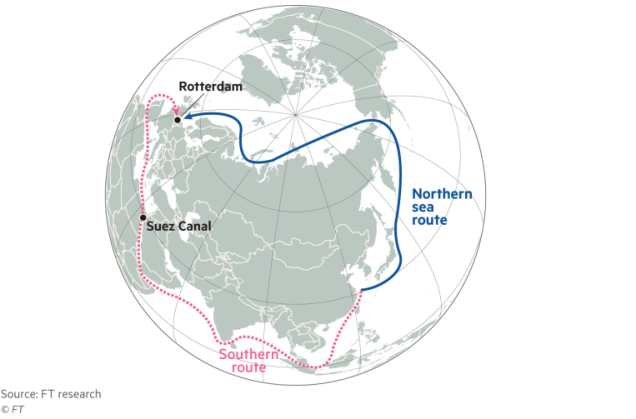
One of the news this week was that Maersk for the first time is taking a large container ship from East Asia to Europe using a Northern Route through the Arctic waters as told in this Financial Times article.

Arctic route

The purpose of this trip is to explore the possibility of avoiding the longer Southern Route including shoehorning the sea traffic through the narrow Suez Canal. A similar opportunity exists around North America as an alternative to going through The Panama Canal.

Similar to moving products and finding new routes for that we may also explore new routes when it comes to moving information about products. Until now the possibilities, besides cumbersome exchange of spreadsheets, have been to shoehorn product information from the manufacturer into a consensus-based data portal or data pool from where the merchant can fetch the information in accurate the same shape as his competitors does.

At Product Data Lake we have explored shorter, more agile and diverse new routes for that. We call it Product Data Syndication Freedom.
Good to have Agility Multichannel on the Disruptive MDM / PIM List

The latest entry on The Disruptive List of Master Data Management Solutions is Agility Multichannel, who provides a well proven Product Information Management (PIM) solution for marketers to acquire, enrich and deliver accurate and timely product content through every touchpoint, channel and region along with the analytical support required to maximize effectiveness in the market.

Recently Agility Multichannel was acquired by Magnitude Software and is thus a part of a broader software offering alongside with the Magnitude MDM solution which was previously known as Kalido.

Agility is close to me as Agility was one of the first forward looking MDM and PIM market players to join as ambassador at Product Data Lake.

You can learn more about the Agility Multichannel solution here.

banner

The Three MDM Ages

Master Data Management (MDM) is relatively new discipline. The future will prove what is was, but standing here in mid-2018 I see that we already had 2 ages and are now slowly proceeding into a 3rd age. These ages can be coined as:

  • Pre MDM,
  • Middle MDM and
  • High MDM

Pre MDM

In these dark ages the term Master Data Management may have been used, but there were not any established discipline, methodologies, frameworks and technology solutions around that truly could count as MDM.

We had Customer Data Integration (CDI) around, we had Product Information Management (PIM) in the making and some of us were talking Data Quality Management – and that in practice being namely deduplication / data matching.

Middle MDM

MDM as Three Letter Acronym (TLA) emerged in the mid 00’s as told in the post Happy 10 Years Birthday MDM Solutions.

It was at that time Aaron Zornes changed his stage name from The Customer Data Integration Institute to The MDM Institute.

During this age many MDM solutions slowly but steadily have developed into multi-domain MDM solutions as reported over at the Disruptive MDM List in the blog post called 4 Vendor Paths to Multidomain MDM covering the road travelled by 10 vendors on the MDM market.

Most MDM solutions in the Middle MDM Age have been deployed on-premise

High MDM

We are now cruising into the High MDM Age. First and foremost a lot more organizations are now implementing MDM. Many new deployments are cloud based. New ways are tried out like encompassing more than master data in the same platform.

The jury is of course still out about what will be some main trends of the High MDM Age. My money is placed on what Gartner, the analyst firm, calls Multienterprise MDM as elaborated in the post Ecosystem Wide MDM.

MDM Ages.png

Welcome Dynamicweb PIM on the Disruptive MDM and PIM List

This Disruptive Master Data Management Solutions list is a list of available:

  • Master Data Management (MDM) solutions
  • Customer Data Integration (CDI) solutions
  • Product Information Management (PIM) solutions
  • Digital Asset Management (DAM) solutions.

You can use this site as a supplement to the likes of Gartner, Forrester, MDM Institute and others when selecting a MDM / CDI / PIM / DAM solution, not at least because this site will include both larger and smaller disruptive MDM, PIM and similar solutions.

The latest entry on the list is Dynamicweb PIM. This is a mature cloud-based Product Information Management (PIM) solution that can be deployed either as a stand-alone PIM implementation or in their combined all-in-one platform together with content management, ecommerce and marketing and tightly integrated with popular ERP and CRM solutions. This integrated approach offers a short time to value opportunity for midsized companies on the quest to ramp up online sales.

Read more about the Dynamicweb PIM solution here.

Dynamicweb PIM front

There is no PIM quadrant, but there is a PIM wave

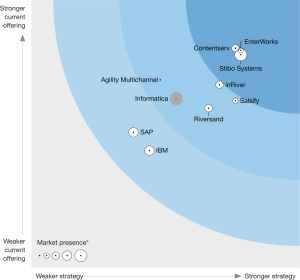
2018-Forrester-PIM-WaveWith the, in my eyes well justified, merge of the two Master Data Management (MDM) quadrants Gartner, the analyst firm, is somehow missing some ranking of specialised Product Information Management (PIM) vendors.

However, Forrester, the other analyst firm, still have their wave with the fresh new Forrester Wave™: Product Information Management Solutions, Q2 2018.

Two of the leaders have already announced their position as you can see here with Enterworks and Contentserv.

If you want to know more about the best PIM solutions on the market, you can also read about Enterworks, Contentserv, Stibo Systems, Riversand and Agility Multichannel on the disruptive list of MDM, PIM and DAM solutions.


Ecosystem Wide Product Information Management

The concept of doing Master Data Management (MDM) not only enterprise wide but ecosystem wide was examined in the post Ecosystem Wide MDM.

As mentioned, product master data is an obvious domain where business outcomes may occur first when stretching your digital transformation to encompass business ecosystems.

The figure below shows the core delegates in the ecosystem wide Product Information Management (PIM) landscape we support at Product Data Lake:

Ecosystem Wide PIM.png

Your enterprise is in the centre. You may have or need an in-house PIM solution where you manipulate and make product information more competitive as elaborated in the post Using Internal and External Product Information to Win.

At Product Data Lake we collaborate with providers of Artificial Intelligence (AI) capabilities and similar technologies in order to improve data quality and analyse product information.

As shown in the top, there may be a relevant data pool with a consensus structure for your industry available, where you exchange some of product information with trading partners. At Product Data Lake we embrace that scenario with our reservoir concept.

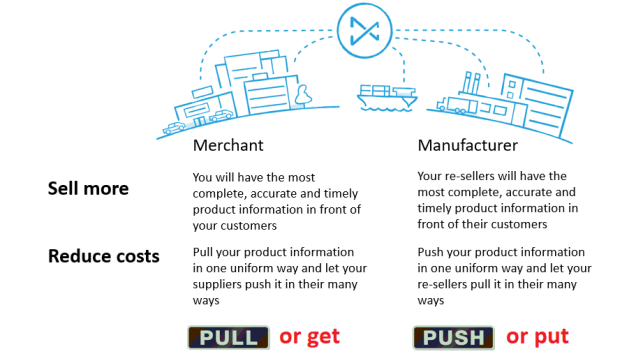
Else, you will need to make partnerships with individual trading partners. At Product Data Lake we make that happen with a win-win approach. This means, that providers can push their product information in a uniform way with the structure and with the taxonomy they have. Receivers can pull the product information in a uniform way with the structure and with the taxonomy they have. This product data syndication concept is outlined in the post Sell more. Reduce costs.

Where to Buy a Magic Wand?

Sometimes you may get the impression that sales, including online sales, is driven by extremely smart sales and marketing people targeting simple-minded customers.

Let us look at an example with selling a product online. Below are two approaches:

Magic wand

Bigger picture is available here.

My take is that the data rich approach is much more effective than the alternative (but sadly often used one). Some proof is delivered in the post Ecommerce Su…ffers without Data Quality.

In many industries, the merchant who will cash in on the sale will be the one having the best and most stringent data, because this serves the overwhelming majority of buying power, who do not want to be told what to buy, but what they are buying.

So, pretending to be an extremely smart data management expert, I will argue that you can monetize on product data by having the most complete, timely, consistent, conform and accurate product information in front of your customers. This approach is further explained in the piece about Product Data Lake.

Product Data Lake Version 1.7 is Live

Win-Win

The good thing about providing Software-as-a-Service is that you do not have to ship the software to all your users and the good thing about using Software-as-a-Service is that program updates are immediately available to the users without that an IT department has to schedule, plan, test and go live with a new version of an application.  This is also true for Product Data Lake, the cloud service also being a win-win application by providing business benefits to both manufacturers and merchants of goods.

Using Application Programming Interfaces (APIs)

Already existing means to feed to and consume product information from Product Data Lake include FTP file drops, traditional file upload from your desktop or network drives or actually entering data into Product Data Lake. With version 1.7, that went live this week, you can now also use our APIs for system to system data exchange by both pushing (put) data into the lake and pulling (get) data from the lake.

Get the Overview

Get the full Product Data Lake Overview here (opens a PDF file).

Get