Can You Keep Track of MDM and PIM Vendors?

If you have the job to shortlist a range of MDM and/or PIM vendors to help you getting a grip on product master data (MDM) and detailed product features (PIM), or have the job to assist a client in doing so, you may have a hard time.

As mentioned in the post Disruptive Forces in MDM Land now Gartner (the analyst firm) only mentions the 11 most expensive MDM vendors. This leaves very little room for taking into account the differences in product specific offerings, geographic presence, industry focus and other parameters.

As a consequence, PIM and Product MDM Consultant Nadim Georges WARDÉ, who runs his business from Geneva in Switzerland, is keeping track of the vendors in his own comprehensive list and have kindly provided the list to be shared here on the blog:

Nadim Warde List

You can access the full spreadsheet here.

The list also has a small section on professional service vendors, vendors that have achieved substantial funding and finally a list of vendors supporting product serialization exchange within the pharma industry – a topic covered on this blog in the post Spectre vs James Bond and the Unique Product Identifier.


Welcome Riversand on The Disruptive MDM List

I am delighted to welcome Riversand as the next disruptive MDM / PIM / DAM solution on The Disruptive Master Data Management Solutions list.

As a European MDM and PIM (Product Information Management) practitioner I have followed Riversand’s growing presence on the European scene both through being on the customer side in solution selection activities, on conferences and on the social media community and I have watched that MDM / PIM peers as Mark Thorpe and Ben Rund have joined the company.

Riversand is in a very exciting development with a recent funding that is used to accelerate Riversand’s global expansion and for further investment in its disruptive MDM platform. See how Riversand presents themselves on The Disruptive MDM List here.

banner


Gall’s Law, Minimal Viable Product and Product Information Management

Back in 1975 John Gall expressed this law: A complex system that works is invariably found to have evolved from a simple system that worked. A complex system designed from scratch never works and cannot be patched up to make it work. You have to start over with a working simple system.

Since then, we have learned the term Minimal Viable Product, which has the same sentiment.

Building a product from scratch by starting small and making that work in a context new to most potential users is close to me these days. The Product Data Lake venture I am involved with is exploring some frontiers as:

Our business model also allows you as a partner or customer to start small and influence the solution while you achieve the business benefits in a more and more profitable way.

As a subscriber you can grow with us through these phases:

  • Skateboard: Start testing with a selected trading partner. As a manufacturer you can push your product information in your way and as a merchant you can pull this information in your way.
  • Bicycle: Pedal further by including more trading partners. It will be a win-win for everyone.
  • Motorbike: Fuel the business benefits by reaching out to dozens of trading partners.
  • Car: Encompass all your regular trading partners in a comfortable journey where you – and your trading partners – will sell more and reduce costs.

mvp

Building a MDM Solution Using Best-in-Class Modules

Sometimes keeping it simple is the shortcut to getting it all wrong. While I am a believer in mastering all master data domains under the same vision and strategy, there are still best-in-class options when it comes to orchestrating processes and applying technology in the right chunks.

Customer Data Integration (CDI)

A recent post on this blog was called What Happened to CDI? This post examines the two overlapping disciplines Master Data Management (MDM) and Customer Data Integration (CDI). In a comment Jeff Jones argues that MDM vendors have forgotten about proper CDI workflows. Jeff says: “It seems the industry wants to go from Source to Match/Merge, instead of Source to Match/Identify and finally to Merge.” Please find and jump into the discussion here.

Also, this question was touched some years ago in the post The Place for Data Matching in and around MDM.

Product Information Management (PIM)

The product domain within Multi-Domain MDM also holds some risks of forgetting the proper ways of handling product information. In this domain we must also avoid being blinded by the promise of a single source of master data with surrounding processes and applied technology.

There are many end-to-ends to cover properly as exemplified in the post A Different End-to-End Solution for Product Information Management (PIM).


Master Data or

Welcome Stibo Systems on The Disruptive MDM List

I am happy to welcome Stibo Systems and their STEP platform as the next disruptive Master Data Management Solution on the disruptive MDM list. You can learn more about, and review, Stibo Systems STEP here.

My first encounter with Stibo Systems was 7 years ago when I started an engagement there taking part in the first steps in transforming Stibo Systems from a Product Master Data Management / Product Information Management (PIM) vendor to a multi-domain MDM vendor.

Since then I worked for some of Stibo Systems clients with implementing the STEP solution.

During both engagements types I learned how a robust but still extremely flexible MDM solution STEP is and also came to know the very professional staff at Stibo Systems. You can see them below:

Stibo Systems Group photo

PIM-2-PIM and More Business Outcome

The importance of having a viable Product Information Management (PIM) solution has become well understood at companies participating in supply chains. Having a PIM solution provides business outcome as told here on the blog in a recent guest post featuring the Pimcore PIM solution. The post is called Investing In PIM Is Like Investing In Customer Value.

The next step towards more business outcome from PIM is to handle product information in close collaboration with your trading partners.

At Product Data Lake we provide such a PIM-2-PIM solution. Instead of the old way of collecting product information via spreadsheets and portals, we facilitate that trading partners connect as examined in the post What a PIM-2-PIM Solution Looks Like.

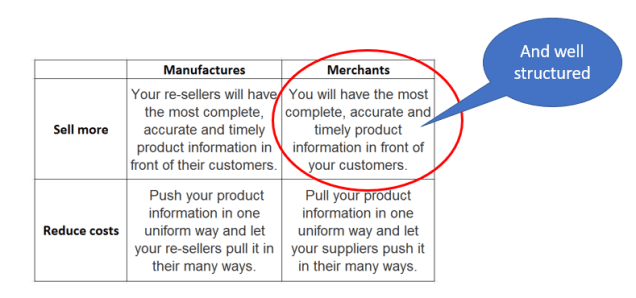
By doing that both manufacturers and merchants will be able to sell more and at the time reduce costs of product information exchange as shown in the post Sell more. Reduce costs.

Sell more Reduce costs

The Disruptive MDM List

As reported in the previous post on this blog, Gartner (the analyst firm) has stopped having a list of smaller and potential disruptive MDM solutions in their Magic Quadrant for Master Data Management Solutions.

I think it is time to have an alternative list of MDM solutions with room for the disruptive ones.

Therefore, I have created a new site for a list of MDM and similar solutions. This site is meant to be a list of available:

  • Master Data Management (MDM) solutions
  • Customer Data Integration (CDI) solutions
  • Product Information Management (PIM) solutions
  • Digital Asset Management (DAM) solutions

You can use this site as an alternative to the likes of Gartner, Forrester, MDM Institute and others when selecting a MDM / CDI / PIM / DAM solution, not at least because this site will also include smaller and disruptive solutions.

Vendors can register their solutions here and the crowd, being processional users, can review the solutions.

I will welcome vendors of all sizes, at all stages and from all geographies to register your solution at the disruptive MDM list.

Master Data or

Please have a look at the current stage of The Disruptive MDM List

Investing In PIM Is Like Investing In Customer Value

In his fourth guest blog post here on this blog Rajneesh Kumar of Pimcore makes the case for investing in Product Information Management in order to drive customer engagement and sell more:

shutterstock_627467546 (002)

What makes customers to buy a product? Lots of theories are conceptualized regarding the science, art, and psychology of customer behavior. Companies leave no stone unturned to grab customers’ attention and importune them to buy products. But, things are not as simple as it looks like because the buying cycle is becoming more and more complicated with growing options and multiple customer touch points.

Brands must adapt to the new reality, faster. They need to make consistent efforts in all dimensions. During each buying stage, customers formulate a consideration set and evaluate each option on criteria significant to them. Thus, organizations need to consider all aspects of buying cycle to woo more customers. Here are few factors that can play an important part to hook more customers:

Create Desire:

Let’s put aside what’s in consumer’ mind rather than focus on what should be presented to customers. The simpler and authentic product information would be, easier it will be for customers to make a buying decision. The first line of engagement is to infuse trust with reliable information that would influence and attract buyers. It must create desire amongst customers while providing value that is required.

Unlock Full Value:

Every product has its unique value. More explicitly you represent it; better the chances will be to attract customers. Make sure the hidden USP or locked value of your product should come in front of the customers at every channel where customers interact. Every type of product information, its attributes, and its relations make a decisive contribution in buying decision. You must make a conscious effort to reveal the full value and all potential benefits.

Immerse in Omnichannel World:

We live in a world of interconnected systems and brands cannot flourish without taking an omnichannel approach. It means your product information must be seamless across all channels. And, it is something you cannot go wrong with. Every customer demands same experience across all channels. Never let the bad omnichannel experience ruin the party. You must do it when you can do it.

Be Agile:

‘I am the first one who grabbed it.’ Customers love competition amongst themselves. When we add up competitors’ equation, you can understand how competitive the market has become. Delays kill the experience. You always need to make sure your product is introduced timely to get maximum benefits. In today’s scenarios, maintaining and managing spreadsheets won’t work. You got to be agile in today’s time to ensure higher growth. Decrease complexity within the purchase occasion as much as you can.

Investing in Product Information Management:

In the world of digital, product information management is an involving discipline. Product information management in organizations encompasses a wide range of functions. In most centrally managed organizations, product information management is seen as a key functional area alongside other key functions. While product quality, brand, and price, responsiveness, speediness, courtesy may be important in the shopping process, high level of product knowledge may be more important for organizations to streamline the process.

But, it is equally important to have a rock-solid product information management system that facilitates in consolidating scattered data, provides faster-time-to-market and enables omnichannel success, including:

  • Provide trusted, relevant and complete product data that delight customers.
  • Quickly publish consistent and accurate product information across channel for seamless omnichannel experience.
  • Provide a consolidated view of product information to enable sales and marketing teams to cross-sell and up-sell.
  • Consolidate, enrich, translate, and manage product data and other various data such as customer data, vendor data, and other digital assets.
  • Keep track of web, mobile, app, marketplace, and social.
  • Enable Point of Sale integration, digital signage, and web-to-print omnichannel enablement.

The other side of the story is that there is still no clear-cut unanimity about how a product information management solution does good to an organization. Thus, it is essential to understand the critical role of product information in achieving desired business goals. We recommend you start not just by identifying your product information management challenges but also how solving the problems will make your life easier, plus you can run your business better.

Forward-thinking brands understand the need to unleash the disruptive power of consolidated information to drive customer engagement and boost revenue. Thus, the investment in providing better and unique customer value should be deeply considered. It is not just a technology or platform investment; it is a customer investment.

Rajneesh KumarA digital marketer and growth hacker, Rajneesh Kumar is currently marketing manager at Pimcore Global Services (PGS), an award-winning consolidated open source platform for product information management (PIM), web content management (CMS), digital asset management (DAM) and e-commerce. He is well versed with web analytic tools, paid media marketing and has hands on experience on seo techniques, organic promotion and content marketing.

Sell more. Reduce costs.

Business outcome is the end goal of any data management activity may that be data governance, data quality management, Master Data Management (MDM) and Product Information Management (PIM).

Business outcome comes from selling more and reducing costs.

At Product Data Lake we have a simple scheme for achieving business outcome through selling more goods and reducing costs of sharing product information between trading partners in business ecosystems:

Sell more Reduce costs

Interested? Get in touch:

← Back

Thank you for your response. ✨