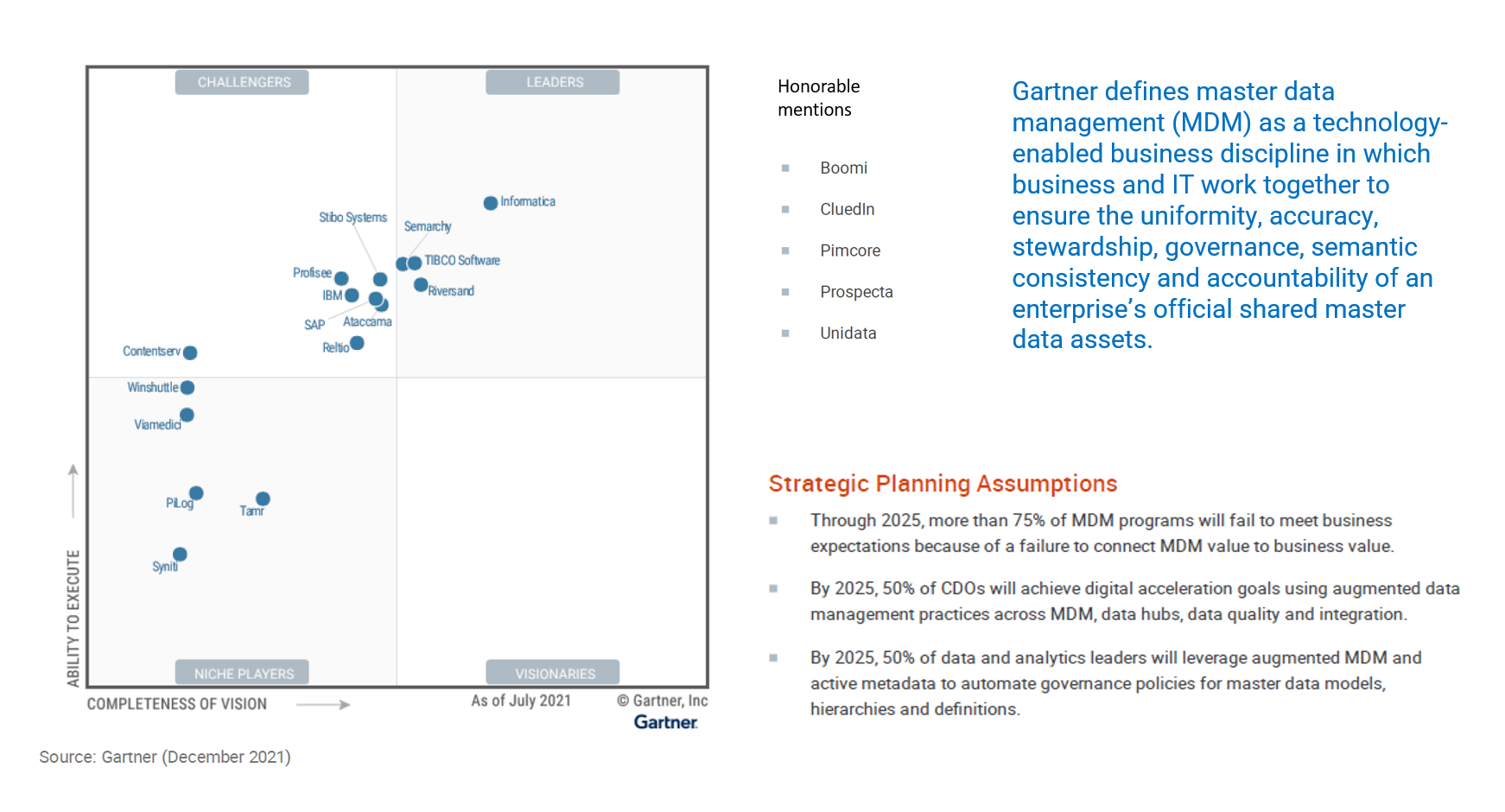
The latest Gartner Magic Quadrant for Master Data Management Solutions is out.
If we look at the vendor positioning not much has happened since the January 2021 quadrant. Tamr is a new solution in the quadrant while Cluedin and Pimcore are now listed under honorable mentions. Informatica is as always closest to the top-right corner.
Augmented data management and augmented MDM are the new main buzzwords as seen in the strategic planning assumptions. Also, the vendors capabilities for doing the augmented stuff are stated as strengths and cautions.
So, what is this augmented data management and augmented MDM by the way? It is in short a compilation of utilizing several trending technologies as Machine Learning (ML), Artificial Intelligence (AI), graph approaches (as examined in the post MDM and Knowledge Graph) with the aim of automating and scaling data management including MDM.
If this will be the final shape of whatever augmented MDM is though in my eyes a bit unsure and even Gartner has doomed augmented MDM to be obsolete before reaching the plateau of productivity in their latest hype cycle for Data and Analytics Governance and Master Data Management. Anyway, I am sure we will see some form of extended MDM covering more domains than customer, supplier and product and utilizing the emerging technologies.
If you want to read the full Gartner report for free, you can get it from Informatica here.
Today it is time to present the fourth vendor to be on The Disruptive MDM / PIM / DQM List in 2022. That is Reltio.
I have been following Reltio here on the blog since 2013 as this MDM vendor has grown from an entrepreneur to a recognized solution provider recently manifested as being a leader in the Forrester MDM Wave and receiving 120 M USD in funding last month.
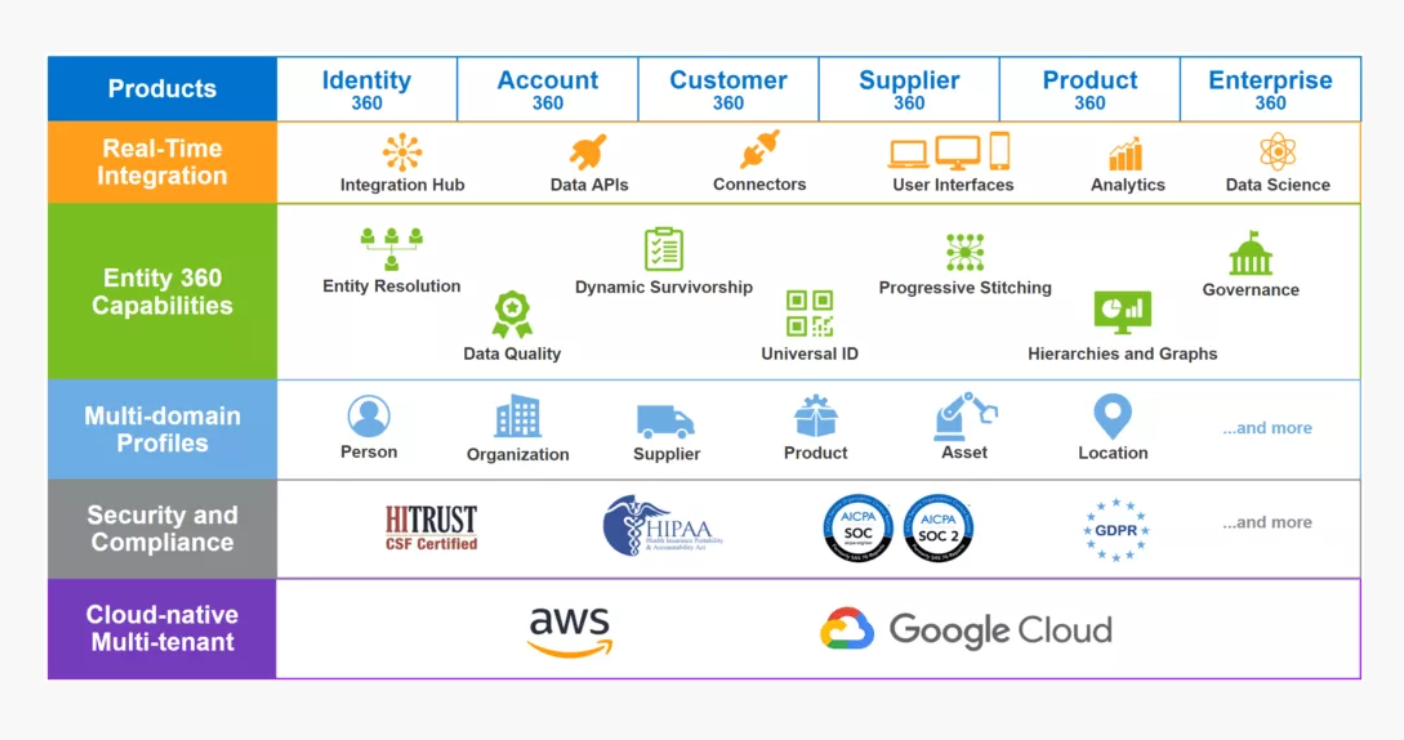
Reltio is a multi-domain cloud-native MDM solution covering a broad range of MDM capabilities.
Utilizing a knowledge graph has an overlap with Master Data Management (MDM).
If we go back 10 years MDM and Data Quality Management had a small niche discipline that was called (among other things) entity resolution as explored in the post Non-Obvious Entity Relationship Awareness. The aim of this was the same that today can be delivered in a much larger scale using knowledge graph technology.
During the past decade there have been examples of using graph technology for MDM as for example mentioned in the post Takeaways from MDM Summit Europe 2016. However, most attempts to combine MDM and graph have been to visualize the relationships in MDM using a graph presentation.
When utilizing knowledge graph approaches you will be able to detect many more relationships than those that are currently managed in MDM. This fact is the foundation for a successful co-existence between MDM and knowledge graph with these synergies:
MDM hubs can enrich knowledge graph with proven descriptions of the entities that are the nodes (vertices) in the knowledge graph.
Additional detected relationships (edges) and entities (nodes) from the knowledge graph that are of operational and/or general analytic interest enterprise wide can be proven and managed in MDM.
In this way you can create new business benefits from both MDM and knowledge graph.
In the round of presenting the solutions for The Disruptive MDM / PIM / DQM List 2022 the next vendor is Magnitude Software.
Magnitude Software has two solutions on the list:
Kalido MDM where you can define and model critical business information from any domain – customer, product, financial, vendor, supplier, location and more – to create and manage accurate, integrated, and governed data that business users trust.
Agility Multichannel PIM which has the capabilities to get products to market faster with a simple-to-use, comprehensive Product Information Management solution that makes it easy to support commerce across digital and traditional channels.
Data fabric has been named a key strategic technology trend in 2022 by Gartner, the analyst firm.
According to Gartner, “by 2024, data fabric deployments will quadruple efficiency in data utilization while cutting human-driven data management tasks in half”.
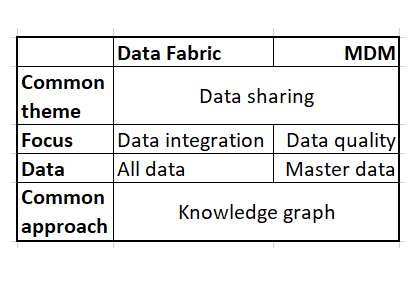
Master Data Management (MDM) and data fabric are overlapping disciplines as examined in the post Data Fabric vs MDM. I have seen data strategies where MDM is put as a subset to data fabric and data strategies where they are separate tracks.
In my head, there is a common theme being data sharing.
Then there is a different focus, where data fabric seems to be focusing on data integration. MDM is also about data integration, but more about data quality. Data fabric takes care of all data while MDM obviously is about master data, though the coverage of business entities within MDM seems to be broadening.
Another term closely tied to data fabric – and increasingly with MDM as well – is knowledge graph. Knowledge graph is usually considered a mean to achieve a good state of data fabric. In the same way you can use a knowledge graph approach to achieve a good state of MDM when it comes to managing relationships – if you include a data quality facet.
The latest Gartner Hype Cycle for Data and Analytics Governance and Master Data Management includes some of the MDM trends that have been touched here on the blog.
If we look at the post peak side, there are these five terms in motion:
Single domain MDM represented by the two most common domains being MDM of Product Data and MDM of Customer Data.
Multidomain MDM has moved on from the Trough of Disillusionment to climbing up the Slope of Enlightenment. I have been waiting for this to happen for 10 years – both in the hype cycle and in the real-world – since I founded the Multi-Domain MDM Group on LinkedIn back then.
Interinterprise MDM has swapped place with Cloud MDM, so this term is now ahead of Cloud MDM. It is though hard to imagine Interenterprise MDM without Cloud MDM, and MDM in the cloud will also according Gartner reach the the Plateau of Productivity before ecosystem wide MDM. The promise of this is also in accordance with a poll I made as told in the post Interenterprise MDM Will be Hot.
You can get the full report from the MDM consultancy parsionate here.
One of the most addressed domains in Master Data Management (MDM) is the vendor domain – or is it called the supplier domain?
I have seen the terms vendor and supplier used synonymously many times at different MDM end user organizations, by MDM system integrators and by MDM platform vendors where I have been engaged. This ambiguity exists in English, the most used corporate language, whereas in other languages the distinction seems to be much clearer.
In a recent post by Jignesh Patel of Stibo Systems it is suggested that supplier and vendor are two opposite terms. The post is called What Vendor Data Is and Why It Matters to Manufacturers. I remember to have read the similar post before, probably in a previous version, and commented that this interpretation, in an MDM context, confuses me.
The linguistic issue is to me that a supplier is someone you buy from, and a vendor is someone who sells to you. But as interpreted in the above post, a vendor could also be someone who sells for you. In the latter case I however have mostly seen terms as dealer and reseller used.
Another possible distinction will be that a supplier is someone who deliver goods and services. A vendor will be someone who deliver the bill. So, in an MDM implementation supplier will be used if the MDM implementation is product oriented and vendor will be used if the MDM implementation is procurement and/or financial oriented or dominated.
This distinction reveals an interesting MDMish observation which is that usually the one who deliver the goods and services and the one who deliver the bill is the same entity – but not always.
What is your stance? Is vendor and supplier the same, a bit different or opposite?
The previous acquisitions have strengthened the Precisely offerings around data quality for the customer master data domain and the adjacent location domain.
The Winshuttle take over will make Precisely a multidomain vendor adding cross domain capabilities and specific product domain capabilities.
The original Winshuttle capabilities revolves around process automation for predominately SAP environments covering all master data domains and further Application Data Management (ADM).
As Winshuttle recently took over the Product Information Management (PIM) solution provider Enterworks, this will bring capabilities around product master data management and thus make Precisely a provider for a broad spectrum of master data domains.
The interesting question will be in what degree Precisely over the time will be willing to and able to integrate these different solutions so a one-stop-shopping experience will become a one-stop digital experience for their clients.
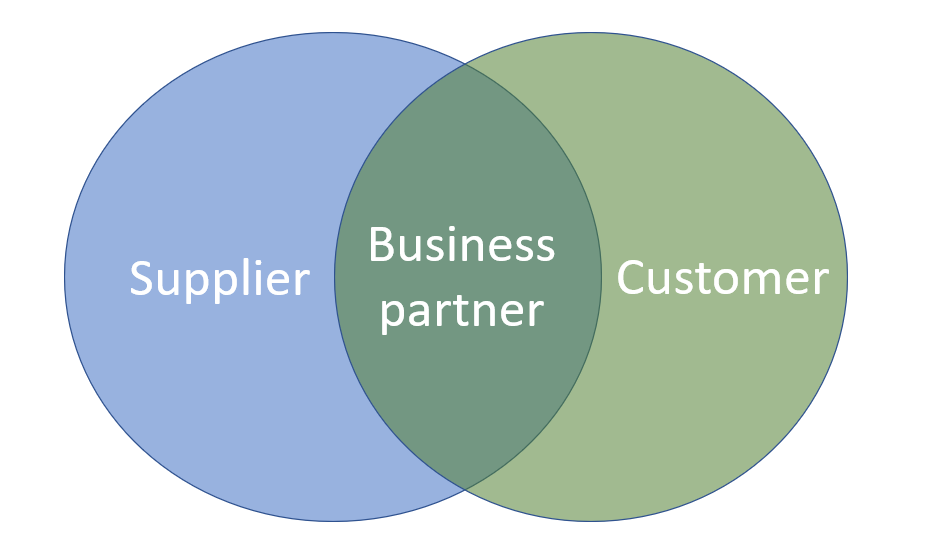
When blueprinting a Master Data Management (MDM) solution one aspect is if – or in what degree – you should combine supplier MDM and customer MDM. This has been a recurring topic on this blog as for example in the post How Bosch is Aiming for Unified Partner Master Data Management.
In theory, you should combine the concept for these two master domains in some degree. The reasons are:
There is always an overlap of the real-world entities that has both a customer and a supplier role to your organization. The overlap is often bigger than you think not at least if you include the overlap of company family trees that have members in one of these roles.
The basic master data for these master data domains are the same: Identification numbers, names, addresses, means of communication and more.
The third-party enrichment opportunities are the same. The most predominant possibilities are integration with business directories (as Dun & Bradstreet and national registries) and address validation (as Loqate and national postal services).
In practice, the problem is that the business case for customer MDM and supplier MDM may not be realized at the same time. So, one domain will typically be implemented before the other depending on your organization’s business model.
Solution Considerations
Most MDM solutions must coexist with an – or several – ERP solutions. All popular enterprise grade ERP solutions have adapted the business partner view with a common data model for basic supplier and customer data. This is the case with SAP S/4HANA and for example the address book in Microsoft Dynamics AX and Oracle JD Edwards.
MDM solutions themselves does also provide for a common structure. If you model one domain before the other, it is imperative that you consider all business partner roles in that model.
Data Governance Considerations
A data governance framework may typically be rolled out one master data domain at the time or in parallel. It is here essential that the data policies, data standards and business glossary for basic customer master data and basic supplier master data is coordinated.
Business Case Considerations
The business case for customer MDM will be stronger if the joint advantages with supplier MDM is incorporated – and vice versa.
This includes improvement in customer/supplier engagement and the derived supply/value chain effectiveness, cost sharing of third-party data enrichment service expenses and shared gains in risk assessment.
When working with the product domain in Master Data Management (MDM) and with Product Information Management (PIM) we have traditionally been working with the product model meaning that we manage data about how a product that can be produced many times in exactly the same way and resulting in having exactly the same features. In other words, we are creating a digital twin of the product model.
As told in the post Spectre vs James Bond and the Unique Product Identifier the next level in product data management is working with each product instance meaning each produced thing that have a set of data attached that is unique to that thing. Such data can be:
Serial number or other identification as for example the Unique Device Identification (UDI) known in healthcare
Manufacturing date and time
Specific configuration
Current and historical position
Current and historical owner
Current and historical installer, maintainer and other caretaker
Produced sensor data if it is a smart device
There is a substantial business potential in being better than your competitor in managing product instances. This boils down to that data is power – if you use the data.
When managing this data, we are building a digital twin of the product instance.
Maintaining that digital twin is a collaborative effort involving the manufacturer, the logistic service provider, the owner, the caretaker, and other roles. For that you need some degree of Interenterprise MDM.




 Liliendahl on Data Quality