Golden Records in Multi-Domain MDM

The term golden record is a core concept within Master Data Management (MDM). A golden record is a representation of a real world entity that may be compiled from multiple different representations of that entity in a single or in multiple different databases within the enterprise system landscape.

GoldIn Multi-domain MDM we work with a range of different entity types as party (with customer, supplier, employee and other roles), location, product and asset. The golden record concept applies to all of these entity types, but in slightly different ways.

Party Golden Records

Having a golden record that facilitates a single view of customer is probably the most known example of using the golden record concept. Managing customer records and dealing with duplicates of those is the most frequent data quality issue around.

If you are not able to prevent duplicate records from entering your MDM world, which is the best approach, then you have to apply data matching capabilities. When identifying a duplicate you must be able to intelligently merge any conflicting views into a golden record.

In lesser degree we see the same challenges in getting a single view of suppliers and, which is one of my favourite subjects, you ultimately will want to have a single view on any business partner, also where the same real world entity have both customer, supplier and other roles to your organization.

Location Golden Records

Having the same location only represented once in a golden record and applying any party, product and asset record, and ultimately golden record, to that record may be seen as quite academic. Nevertheless, striving for that concept will solve many data quality conundrums.

GoldLocation management have different meanings and importance for different industries. One example is that a brewery makes business with the legal entity (party) that owns a bar, café, restaurant. However, even though the owner of that place changes, which happens a lot, the brewery is still interested in being the brand served at that place. Also, the brewery wants to keep records of logistics around that place and the historic volumes delivered to that place. Utility and insurance is other examples of industries where the location golden record (should) matter a lot.

Knowing the properties of a location also supports the party deduplication process. For example, if you have two records with the name “John Smith” on the same address, the probability of that being the same real world entity is dependent on whether that location is a single-family house or a nursing home.

Product Golden Record

Product Information Management (PIM) solutions became popular with the raise of multi-channel where having the same representation of a product in offline and online channels is essential. The self-service approach in online sales also drew the requirements of managing a lot more product attributes than seen before, which again points to a solution of handling the product entity centralized.

In large organizations that have many business units around the world you struggle with having a local view and a global view of products. A given product may be a finished product to one unit but a raw material to another unit. Even a global SAP rollout will usually not clarify this – rather the contrary.

GoldWhile third party reference data helps a lot with handling golden records for party and location, this is lesser the case for product master data. Classification systems and data pools do exist, but will certainly not take you all the way. With product master data we must, in my eyes, rely more on second party master data meaning sharing product master data within the business ecosystems where you are present.

Asset (or Thing) Golden Records

In asset master data management you also have different purposes where having a single view of a real world asset helps a lot. There are namely financial purposes and logistic purposes that have to aligned, but also a lot of others purposes depending on the industry and the type of asset.

With the raise of the Internet of Things (IoT) we will have to manage a lot more assets (or things) than we usually have considered. When a thing (a machine, a vehicle, an appliance) becomes intelligent and now produces big data, master data management and indeed multi-domain master data management becomes imperative.

You will want to know a lot about the product model of the thing in order to make sense of the produced big data. For that, you need the product (model) golden record. You will want to have deep knowledge of the location in time of the thing. You cannot do that without the location golden records. You will want to know the different party roles in time related to the thing. The owner, the operator, the maintainer. If you want to avoid chaos, you need party golden records.

Who will become Future Leaders in the Gartner Multidomain MDM Magic Quadrant?

Gartner emphasizes that the new Magic Quadrant for Master Data Management Solutions Published 19 January 2017 is not solely about multidomain MDM or a consolidation of the two retired MDM quadrants for customer and product master data. However, a long way down the report it still is.

If you want a free copy both Informatica here and Riversand here offers that.

The Current Pole Position and the Pack

The possible positioning was the subject in a post here on the blog some while ago. This post was called The Gartner Magic Quadrant for MDM 2016. The term 2016 has though been omitted in the title of the final quadrant probably because it took into 2017 to finalize the report as reported in the post Gartner MDM Magic Quadrant in Overtime.

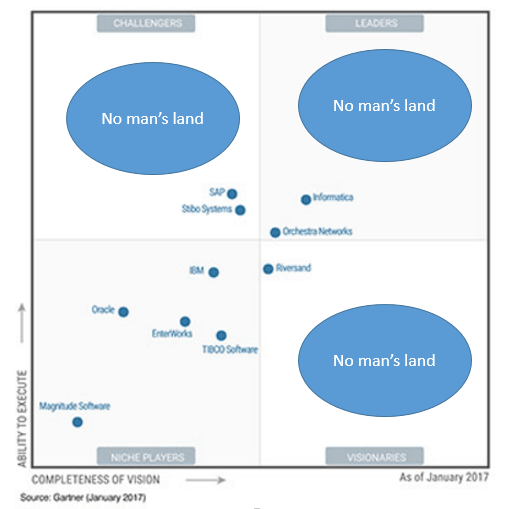
Below is my look at the positioning in the current quadrant:

mdm-mq

Starting with the multidomain MDM point the two current leaders, Informatica and Orchestra, have made their way to multidomain in two different ways. Pole position vendor Informatica has used mergers and acquisitions with the old Siperian MDM solution and the Heiler PIM (Product Information Management) solution to build the multidomain MDM leadership. Orchestra Networks has built a multidomain MDM solution from the gound.

The visionary Riversand is coming in from the Product MDM / PIM world as a multidomain MDM wannabe and so is the challenger Stibo. I think SAP is in their right place: Enormous ability to execute with not so much vision.

If you go through the strengths and cautions of the various vendors, you will find a lot of multidomain MDM views from Gartner.

The Future Race

While the edges of the challengers and visionaries’ quadrants are usually empty in a Gartner magic quadrant, the top right in this first multidomain MDM quadrant from Gartner is noticeably empty too. So who will we see there in the future?

Gartner mentions some interesting upcoming vendors earning too little yet. Examples are Agility Multichannel (a Product Data Lake ambassador by the way), Semarchy and Reltio.

The future race track will according to Gartner go through:

  • MDM and the Cloud
  • MDM and the Internet of Things
  • MDM and Big Data

PS: At Product Data Lake we are heading there in full speed too. Therefore, it will be a win-win to see more MDM vendors joining as ambassadors or even being more involved.

MDM: The Technology Trends

There are certainly many things going on in the Master Data Management (MDM) realm when it comes to technologies applied.

The move from on premise based solutions to cloud based solutions has been visible for some years. It is not a rush yet, but we see more and more master data services being offered as cloud services as well as many vendors of full stack MDM platforms offers both on premise, cloud and even hybrid solutions.

As reported in the post Emerging Database Technologies for Master Data new underlying database technologies are put in place instead of the relational database solutions that until now have ruled the MDM world. As mentioned graph databases as Neo4J and document databases as MongoDB (which now also support graph) are examples of new popular choices.

blockchainAs examined by Gartner (the analyst Firm) there are Two Ways of Exploiting Big Data with MDM, either doing it directly or by linking. Anyway, the ties between big data and master data management is in my eyes going to be a main focus for the technology trends in the years to come. Other important ties includes the raise of Industry 4.0 / Internet of Things and blockchain approaches.
We are still waiting for The Gartner Magic Quadrant for Master Data Management Solutions 2016 and the related Critical Capabilities document, so it will be very exciting, in fact more exciting that the vendor positioning, to learn about how Gartner sees the technology trends affecting the MDM landscape.

What are your expectations about Master Data Management and new emerging technologies?

Gartner MDM Magic Quadrant in Overtime

The Gartner Master Data Management Solutions Magic Quadrant 2016 did not go live in 2016. Estimated release date was 19th November 2016, but still there is no sign of the quadrant either on the Gartner site or at vendor bragging on social media.

We can only guess about why the quadrant is delayed, but a possible explanation is that vendor feedback on the suggested positioning has been harsh. I am not among the ones who believes Gartner actually takes money from vendors for inclusion and positioning in the quadrant. Still, Gartner has a substantial business relationship with those vendors. If a vendor feels they are really wrongly misplaced, they may question the judgement in the other payable services from Gartner.

While waiting, there is still time to have your guess on who has persuaded Gartner to be where in the quadrant as already many have done in the post The Gartner Magic Quadrant for MDM 2016.

And yes, the prize for best guess is still a genuine Product Data Lake t-shirt.

t-shirt

The Intersections of 360 Degree MDM

In the Master Data Management (MDM) realm we have some common notions, being

  • 360 degree Customer Master Data Management, meaning how different views on customers in a company’s various business units and sales channels can be handled as a shared single view.
  • 360 degree Vendor (or Supplier) Master Data Management, meaning how different views on vendors/suppliers in a company’s various business units and supply chains can be handled as a shared single view.
  • 360 degree Product Master Data Management, meaning how different views on products in a company’s various business units, sales channels and supply chains can be handled as a shared single view.

Multi-Side MDM

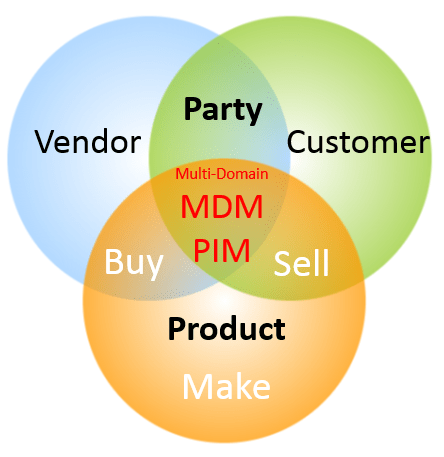
Multi-Domain Master Data Management (MDM) is the discipline that brings all these views together. Here it is not enough that the same brand of technology is used for all three domains. Handling the intersections is the important part.

The intersection of Vendor/supplier and Customer is known as the Party Master Data domain. My recommendation is to have a common party (or business partner) structure for identification, names, addresses and contact data. This should be supported by data quality capabilities strongly build on external reference data (third party data). Besides this common structure, there should be specific structures for customer, vendor/supplier and other party roles.

The Vendor/supplier and Product Master Data intersection is related to buying products, namely how to on-board data about the vendor/supplier as a party, in the vendor role (financial stuff), the supplier role (logistic stuff) and then on-boarding his product information. My recommendation for on-boarding product information from suppliers being manufacturers is to make this a Win-Win solution for both parties as described in the post How a PLM-2-PIM Solution Becomes a WIN-WIN Solution.

The Customer and Product Master Data intersection is about supporting how you sell products. The term omnichannel is popular for that these days. Again, Product Information Management (PIM) plays a crucial role here and my recommendations for that is expressed in the post Adding Business Ecosystems to Omnichannel.

Cross Border Master Data Management

One of the most intriguing sides of data quality and Master Data Management (MDM) is, in my eyes, how you can extend a national solution to an international solution.

Google EarthMany implementations starts with a national scope and we also see many tools and services built for a national scope. Success on a national scale does unfortunately not always guarantee success on an international scale.
Besides all the important stuff around different culture challenges and how to drive change management in an international environment, there are also some things about the master data itself that are challenging.

  • Location Master Data is probably the most obvious domain where we face issues when going international. Postal addresses are formatted differently around the world. Approximately half of the world puts the house number in front of the street name, approximately half of the world puts the house number after the street name and then in some places you don’t use house numbers on a street, but in blocks. City and postal code has the same issue. The worst solutions here tries to put the rest of the world into the first implemented national solution as told in the post Nationally International.
  • Party Master Data, also when looking beyond postal addresses, must encompass many national constraints and opportunities, not at least when it comes to exploiting third party data:
    • Utilizing business directories is one common way. Here you have to balance the use of many different best of breed national providers or taking it from a more harmonized provider of an international directory. Where I (also) work right now, we have chosen the latter solution as reported in the post Using a Business Entity Identifier from Day One.
    • If you, as I am, are coming from Scandinavia you are also amazed by the difficulties around the world there are in healthcare, elections and other areas when there is no public available national identifier for citizens as examined in the post Counting Citizens.
  • Product Master Data does in many ways look the same across countries. However, standards for product data often still are specific to a single or a specific range of countries. Also, if the national implementation was not in a country with multiple languages and the international scope includes more languages, you must encompass multilingual capacities for product information management.

What have you experienced when going from national to international?

The Gartner Magic Quadrant for MDM 2016

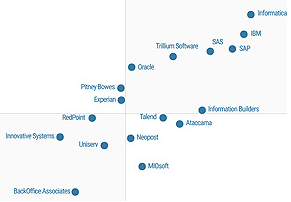
The Gartner Magic Quadrant for Master Data Management Solutions 2016 is …… not out.

Though it can be hard for a person not coming from the United States to read those silly American dates, according to this screenshot from today, it should have been out the 19th November 2016.

gartner-mdm-2016

I guess no blue hyperlink means it has not be aired yet and I do not recall having seen any vendor bragging on social media yet either.

The plan that Gartner will retire the old two quadrants for Customer MDM and Product MDM was revealed by Andrew White of Gartner earlier this year in the post Update on our Magic Quadrant’s for Master Data Management 2016.

Well, MDM implementations are often delayed, so why not the Multidomain MDM quadrant too.

In the meantime, we can take a quiz. Please comment with your guess on who will be the leaders, visionaries, challengers and niche players. Closest guess will receive a Product Data Lake t-shirt in your company’s license level size (See here for options).

Interenterprise Data Sharing and the 2016 Data Quality Magic Quadrant

dqmq2016The 2016 Magic Quadrant for Data Quality Tools by Gartner is out. One way to have a free read is downloading the report from Informatica, who is the most-top-right vendor in the tool vendor positioning.

Apart from the vendor positioning the report as always contains valuable opinions and observations about the market and how these tools are used to achieve business objectives.

Interenterprise data sharing is the last mentioned scenario besides BI and analytics (analytical scenarios), MDM (operational scenarios), information governance programs, ongoing operations and data migrations.

Another observation is that 90% of the reference customers surveyed for this Magic Quadrant consider party data a priority while the percentage of respondents prioritizing the product data domain was 47%.

My take on this difference is that it relates to interenterprise data sharing. Parties are per definition external to you and if your count of business partners (and B2C customers) exceeds some thousands (that’s the 90%), you need some of kind of tool to cope with data quality for the master data involved. If your product data are internal to you, you can manage data quality without profiling, parsing, matching and other core capabilities of a data quality tool.  If your product data are part of a cross company supply chain, and your count of products exceeds some thousands (that’s the 47%), you probably have issues with product data quality.

In my eyes, the capabilities of a data quality tool will also have to be balanced differently for product data as examined in the post Multi-Domain MDM and Data Quality Dimensions.

Black Friday Afterthoughts before Christmas

Black Friday & Christmas: 5 Retail Strategies for Providing a Wonderful Shopping Experience” is the title of a recent blog post by Antonia Renner on the Informatica blog.

This blog post revolves around how Master Data Management (MDM) and Product Information Management (PIM) can be the foundation of a better shopping experience and how to do this within driving digital transformation, being agile, and streamlining internal and external collaboration and workflows.

I agree with that. My only concern around the means mentioned relates to the section about how great customer experience starts with great supplier product data. The proposed approach for that is a self-service supplier data portal.

pdl-whyFrom what I have experienced, the concept of a supplier data portal for product data has limited chances of success. The problem for you as retailer or other form of downstream trading partner is your supplier. They will eventually have to deal with hundreds of supplier portals with different format and structure by the choice of their downstream trading partners, whereof you are just one. If you are a big one to them, it might work. Else probably not.

In the same way, your supplier could offer their customer data portal, build with their choice of format and structure. If they are a big one to you, you might go with that. Else, you probably would object to dealing with hundreds of different upstream data portals for you to go-to.

My Christmas present to you – suppliers, retailers, other supply chain nodes / PIM-MDM solution vendors – is a free trial / ambassadorship on Product Data Lake.

Product Data Lake is a cloud service for sharing product data in business ecosystems. Product Data Lake ensures:

  • Completeness of product information by enabling trading partners to exchange product data in a uniform way
  • Timeliness of product information by connecting trading partners in a process driven way
  • Conformity of product information by encompassing various international standards for product information
  • Consistency of product information by allowing upstream trading partners and downstream trading partners to interact with in-house structure of product information
  • Accuracy of product information by ensuring transparency of product information across the supply chain

It’s in your hands. See you on Product Data Lake.

A System of Engagement for Business Ecosystems

Master Data Management (MDM) is increasingly being about supporting systems of engagement in addition to the traditional role of supporting systems of record. This topic was first examined on this blog back in 2012 in the post called Social MDM and Systems of Engagement.

The best known systems of engagement are social networks where the leaders are Facebook for engagement with persons in the private sphere and LinkedIn for engagement with people working in or for one or several companies.

But what about engagement between companies? Though you can argue that all (soft) engagement is neither business-to-consumer (B2C) nor business-to-business (B2B) but human-to-human (H2H), there are some hard engagement going on between companies.

pdl-whyOne of the most important ones is exchange of product information between manufacturers, distributors, resellers and large end users of product information. And that is not going very well today. Either it is based on fluffy emailing of spreadsheets or using rigid data pools and portals. So there are definitely room for improvement here.

At Product Data Lake we have introduced a system of engagement for companies when it comes to the crucial task of exchanging product information between trading partners. Read more about that in the post What a PIM-2-PIM Solution Looks Like.