Updating a Social Business Directory

Business directories have been around for ages. In the old days it was paper based as in the yellow pages for a phone book. The yellow pages have since made it to be online searchable. We also know commercial business directories as the Dun & Bradstreet WorldBase as well as government operated national wide directories of companies and industry specific business directories.

Such business directories often takes a crucial role in master data quality work as sources for data enrichment in the quest for getting as close as possible to a single version of the truth when dealing with B2B customer master data, supplier master data and other business partner master data.

A classic core data model for Master Data in CRM systems, SCM solutions and Master Data hubs when doing B2B is that you have:

  • Accounts being the BUSINESS entities who are your customers, suppliers, prospects and all kind of other business partners
  • Contacts being the EMPLOYEEs working there and acting in the roles as decision makers, influencers, gate keepers, users and so on
Today we also have to think about social master data management, being exploiting reference data in social media as a supplementary source of external data.

As all social activity this exercise goes two ways:

  • Finding and monitoring your existing and wanted business partners in the social networks
  • Updating your own data

Most business entities in this world are actually one-man-bands. So are mine. Therefore I went to the LinkedIn company pages this morning and updated data about my company Liliendahl Limited: Unlimited Data Quality and Master Data Management consultancy for tool and service vendors.


Bookmark and Share

Real World Identity

How far do you have to go when checking your customer’s identity?

This morning I read an article on the Danish Computerworld telling about a ferry line now dropping a solution for checking if the passenger using an access card is in fact the paying customer by using a lightweight fingerprint stored on the card. The reason for dropping was by the way due to the cost of upgrading the solution compared to future business value and not any renewed privacy concerns.

I have been involved in some balancing of real world alignment versus fitness for use and privacy in public transport as well as described in the post Real World Alignment. Here it was the question about using a national identification number when registering customers in public transportation.

As citizens of the world we are today used to sometimes having our iris scanned when flying as our passport holds our unique identification that way. Some of the considerations around using biometrics in general public registration were discussed in the post Citizen ID and Biometrics.

In my eyes, or should we say iris, there is no doubt that we will meet an increasing demand of confirming and registering our identification around. Doing that in the fight against terrorism has been there for long. Regulatory compliance will add to that trend as told in the post Know Your Foreign Customer, mentioning the consequences of the FATCA regulation and other regulations.

When talking about identity resolution in the data quality realm we usually deal with strings of text as names, addresses, phone numbers and national identification numbers. Things that reflect the real world, but isn’t the real world.

We will however probably adapt more facial recognition as examined in the post The New Face of Data Matching. We do have access to pictures in the cloud, as you may find your B2C customers picture on FaceBook and your B2B customer contacts picture on LinkedIn or other similar services. It’s still not the real world itself, but a bit closer than a text string. And of course the picture could be false or outdated and thus more suitable for traction on a dating site.

Fingerprint is maybe a bit old fashioned, but as said, more and more biometric passports are issued and the technology for iris and retinal scanning is used around for access control even on mobile devices.

In the story starting this post the business value for reinvesting in a biometric solution wasn’t deemed positive. But looking from the print on my fingers down to my hand lines I foresee some more identity resolution going beyond name and address strings into things closer to the real world as facial recognition and biometrics.

Bookmark and Share

Sharing Social Master Data

If a company runs a Customer Relationship Management (CRM) system all employees are supposed to enter their interactions with customers and prospects including adding new accounts and contacts if it’s the first engagement.

With the rise of social networks first engagements are increasingly done in those networks. Furthermore new employees often bring old contacts from former employments with them thus utilizing an established relationship that probably is manifested in one or more already existing social network connections.

As explained in the post Social Master Data Management the term ”Social CRM” has been around for a while. We now see CRM solutions where the account and contact master data primarily is build on extracting those data from social networks.

I have just tried out such a solution called Nimble.

If you are more than a one-man-band company it’s interesting in what degree you are willing (or forced) to share your connections as master data entities for the CRM solution.

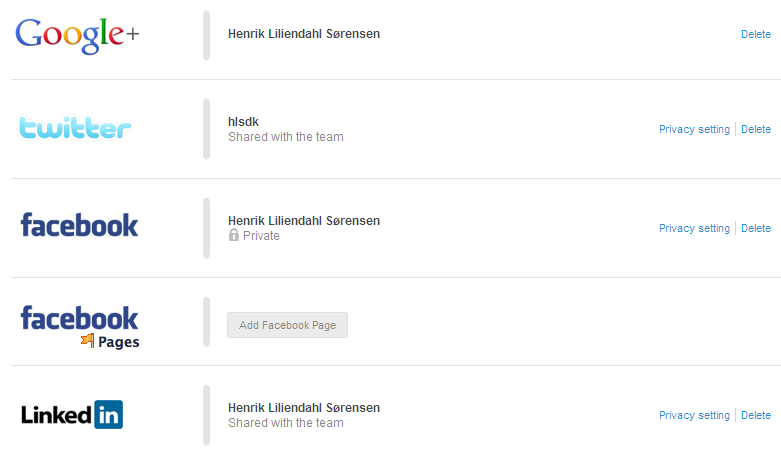
In Nimble you have the choice of differentiate for each network. I would probably freely choose a setup with Twitter and LinkedIn as shared with the team, but Facebook as private:

But that is just how I think based on my way of using social networks.

There is a fundamental data quality versus privacy issue around utilizing employee’s social network connections as master data for CRM and eventually enterprise wide Master Data Management (MDM).

All things equal data quality will be best if everyone contributes within reason. Not at least in sales, but also more or less in other functions, you are hired also because of your relations.

What do you think?

Bookmark and Share

Informatics for adding value to information

Recently the Global Agenda Council on Emerging Technologies within the World Economic Forum has made a list of the top 10 emerging technologies for 2012. According to this list the technology with the greatest potential to provide solutions to global challenges is informatics for adding value to information.

As said in the summary: “The quantity of information now available to individuals and organizations is unprecedented in human history, and the rate of information generation continues to grow exponentially. Yet, the sheer volume of information is in danger of creating more noise than value, and as a result limiting its effective use. Innovations in how information is organized, mined and processed hold the key to filtering out the noise and using the growing wealth of global information to address emerging challenges.”

Big data all over

Surely “big data” is the buzzword within data management these days and looking for extreme data quality will be paramount.

Filtering out the noise and using the growing wealth of global information will help a lot in our endurance to make a better world and to make better business.

In my focus area, being master data management, we also have to filtering out the noise and exploit the growing wealth of information related to what we may call Big Master Data.

Big external reference data

The growth of master data collections is also seen in collections of external reference data.

For example the Dun & Bradstreet Worldbase holding business entities from around the world has lately grown quickly from 100 million entities to over 200 millions entities. Most of the growth has been due to better coverage outside North America and Western Europe, with the BRIC countries coming in fast. A smaller world resulting in bigger data.

Also one of the BRICS, India, is on the way with a huge project for uniquely identifying and holding information about every citizen – that’s over a billion. The project is called Aadhaar.

When we extend such external registries also to social networking services by doing Social MDM, we are dealing with very fast growing number of profiles in Facebook, LinkedIn and other services.

Surely we need informatics for adding the value of big external reference data into our daily master data collections.

Bookmark and Share

Indulgent Moderator or Ruthless Terminator?

I am the founder/moderator of two small niche LinkedIn groups in the data quality and Master Data Management (MDM) realm:

As a moderator I feel responsible for keeping the discussions in the group on target.

I guess my challenges in doing so resemble what nearly every other moderator on LinkedIn groups are faced with.

The postings that keep creating trouble are related to:

  • Jobs
  • Promotions

LinkedIn does have a facility to place entries into these two alternative tabs. But people seldom do that voluntary.

Jobs

In fact I’m pleased when a job is posted in one of the groups. But I also know that many people don’t like job postings coming up among the “normal” discussions in the groups.

I’m not so naive that I think recruiters forget to post as a job or don’t know how to do it. Many recruiters don’t respect the rules even if reminded. And some recruiters keep on entering the same job over and over again.

Therefore I have to mark recruiters, who twice “forget”, as subject to indulgent moderation. As said, I like job postings, so until now I haven’t practiced ruthless termination apart from deleting double entries – but that is also a destination of data matching anyway.

Promotions

With the relative small number of members in the groups in question, and recognising that most participants are tool vendors and service providers, I find it refreshing and informative with entries with promotional content, however most pleased when it’s done with limited marketing triviality.     

My indulgence may be explained by that I’m interconnected with tool makers and service providers myself. So these promotions are great ready-made competitor monitoring.

However, my indulgence has its limits when it comes to off topic promotion.

A special case here is outsourcing promotions. I find it peculiar that those people practicing this trade don’t target the message for the group where posted. It shouldn’t be too hard to make an angle with data matching or Multi-Domain MDM for your services. But I find that most out-sourcing people copy-paste their usual stuff.

So, in this area I mostly am the ruthless terminator. And there is seldom any hasta la vista, baby.

Bookmark and Share

Klout Data Quality

Today it was announced that yet a social media service has passed a 100 million mark, as now 100 Million People have Klout.

Klout is a service that measures your online influence based on your activity on Twitter, LinkedIn, FaceBook and so on. The main measure is a score between 1 and 100.


As many others I have from time to time been tempted to have a narcissistic look at my profile. I haven’t recorded it, but it seems to me that some of the other attributes on Klout changes a lot. Or maybe it’s just me who is moving around in the social media realm in all directions.

Today my Klout style is being a “broadcaster”. And that may be right, as I’m re-tweeting a lot of links. But I’m sure I was a “specialist” the last time I checked, and that is in the opposite corner of the style quadrant. Well, never mind, every description of the styles is positive.

Klout also have beliefs in what topics you are influential about. One of my top 10 topics is “magic”. I think I must be more careful about tweeting about “data quality magic”. Another topic of mine is “Tripoli”. That’s right too; I did make one tweet about Tripoli that ended up as an information quality trainwreck.

Unfortunately I’m not influential about data quality or MDM at all. I’ll have to work on that.

Bookmark and Share

More Social Master Data Management

Yesterday my American cyberspace friend Jim Harris was so kind to send an invitation for Google+ – the new social network service you must hook into. Thanks Jim, now I had to fill in yet a profile, upload the same picture as always and start networking from scratch once again 🙂

As many people I have several profiles in different social network services as Twitter, Facebook and LinkedIn. As I’m doing business also with German speaking countries I also use XING as alternative to LinkedIn as told in the post LinkedIn and the other Thing.

In a comment to that post my Austria based French connection Olivier Mathurin noted: “Disconnected duplicated siloed professional profiles, mmm…”

In a post on this blog called Social Master Data Management made one year ago it is discussed how social CRM will add new sources from social networks to the external reference data sources we already know from old time CRM.

With all the different faces everyone are wearing in the social media realm this isn’t going to be easy and one may consider if social master data management is a wrong path giving the individual nature and built-in privacy in social networking services.    

Well, Gartner (the analyst firm) says that increasing links between MDM and social networks is one of the Three Trends That Will Shape the Master Data Management Market.

So, acknowledging that Gartner predictions are self-fulfilling, you better get moving into LinkedIn, Xing, Viadeo, Twitter, Facebook, (forget MySpace), Google+  and what’s next.

Bookmark and Share

Timing Your Social Media Activity

When engaging in social media I often consider what time and what day to publish a new blog post, tweeting about it and promoting it on LinkedIn.

My audience is roughly distributed as 40 % Americas (almost all in North America), 40 % EMEA (almost all in Europe) and 20 % Asia and Pacifics.

That makes it a pretty much around the clock audience with a peak in page views and comments between UTC 14:00 and 17:00, which is when the working day in Europe is still on and the Americans are waking up.  However that doesn’t necessary mean that I should publish in the peak hours. In fact I haven’t been able to measure that the time of publishing affects number of page views and comments. So I’ll keep on publishing at the time I have anything to say and have the time to write about it.

If I look at weekdays working days are double as busy as weekends with Monday as best day probably catching up with people that don’t do social media in weekends. So I’ll keep on publishing at the days I have anything to say and feel inspired to write about it.

Bookmark and Share

Data Quality and Data Visualization

This is a self-centric blog post about data quality and data visualization.

The figure to the right is a statistic about who viewed my profile in a certain period on LinkedIn.

Looking at that makes me think about a couple of data quality and data visualization issues especially linked to visualization of data on a world map.

Hidden value

Fortunately there is both a map and some numbers below, because the map is too small to show from where I have the most views: My very small home country Denmark.

Misleading proportions

I have no views from the grey countries. So I should certainly concentrate on Greenland (the big grey land in the top of the map) to get more viewers, right?

Well, the Mercator projections make areas close to the poles like Greenland look much bigger than in the real world. Greenland is a big island, but in fact only less than 1/3 of Australia (the almost as big light blue land in the down under right corner) – and Greenland only has 1/400 of the population of Australia.

Cultural dependency

My blogging and LinkedIn activities are in English due to the moderate population of Denmark. Therefore, and because of the spread of LinkedIn biased in the English speaking world, it’s no surprise most viewers are from English speaking countries.

Bookmark and Share

A Prince and a Princess

Even though I’m not a royalist I’m afraid this will be the second hypocritical blog post within a year with a royal introduction.  The first one was about Royal Exceptions.

The big news on all channels today in Denmark (and Australia) is that (Australian born) Crown Princess Mary has given birth to twins; a boy and a girl then being a prince and a princess or as we say in blunt data quality language: A male and a female.  

The gender of individuals has always been a prominent element in party master data management and not at least in data matching.

Right now we are having a discussion in the LinkedIn Data Matching group concerning Data Quality of Gender / Sex Codes and the Impacts on Identity Data Matching.

So far we have covered issues as:

  • Trustworthiness for assigned gender codes
  • Scoring mechanisms in matching including gender codes
  • Diversity impact in assigning/verifying gender from names
  • Using gender codes for salutation

Please join the discussion and if you are not already a member of the LinkedIn Data Matching group: Join the group here.

Bookmark and Share