255 Reasons for Data Quality Diversity

255 is one source of truth about how many countries we have on this planet. Even with this modest list of reference data there are several sources of the truth. Another list may have 262 entries and a third list 240 entries.

As I have made a blog post some years ago called 55 reasons to improve data quality I think 255 fits nice in the title of this post.

The 55 reasons to improve data quality in the former post revolves around name and address uniqueness. In the quest for having uniqueness, and fulfilling other data quality dimensions as completeness and timeliness, a have often advocated for using deep (or big) reference data sources as address directories, business directories and consumer/citizen directories.

Doing so in the best of breed way involves dealing with a huge number of reference data sources. Services claimed to have worldwide coverage often falls a bit short compared to local services using local reference sources.

For example when I lived in Denmark, at tiny place in one corner of the world, I was often amazed how address correction services from abroad only had (sometimes outdated) street level coverage, while local reference data sources provides building number and even suite level validation.

Another example was discussed in the post The Art in Data Matching where the multi-lingual capacities needed to do well in Belgium was stressed in the comments.

Every country has its own special requirement for getting name and address data quality right, the data quality dimensions for reference data are different and governments has found 255 (or so) different solutions to balancing privacy and administrative effectiveness.

Right now I’m working on internationalization and internationalisation of a data and software service called instant Data Quality. This service makes big reference data from all over the world available in a single mashup. For that we need at least 255 partners.

Bookmark and Share

Finding Me

Many people have many names and addresses. So have I.

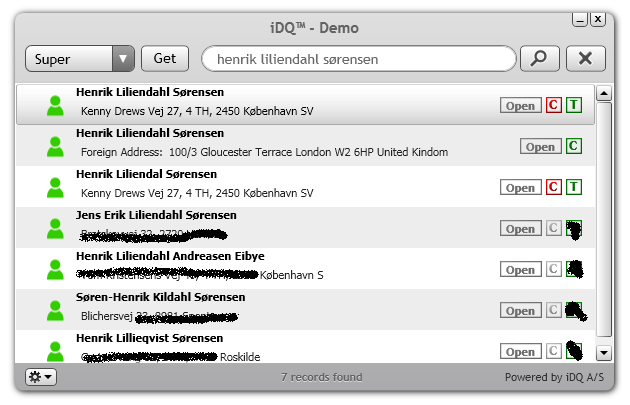
A search for me within Danish reference sources in the iDQ tool gives the following result:

Green T is positive in the Danish Telephone Books. Red C is negative in the Danish Citizen hub. Green C is positive in the Danish Citizen Hub.

Even though I have left Denmark I’m still registered with some phone subscriptions there. And my phone company hasn’t fully achieved single customer view yet, as I’m registered there with two slightly different middle (sur)names.

Following me to the United Kingdom I’m registered here with more different names.

It’s not that I’m attempting some kind of fraud, but as my surname contains The Letter Ø, and that letter isn’t part of the English alphabet, my National Insurance Number (kind of similar to the Social Security Number in the US) is registered by the name “Henrik Liliendahl Sorensen”.

But as the United Kingdom hasn’t a single citizen view, I am separately registered at the National Health Service with the name “Henrik Sorensen”. This is due to a sloppy realtor, who omitted my middle (sur)name on a flat rental contract. That name was taken further by British Gas onto my electricity bill. That document is (surprisingly for me) my most important identity paper in the UK, and it was used as proof of address when registering for health service.

How about you, do you also have several identities?

Bookmark and Share

MDM Summit Europe 2012 Preview

I am looking forward to be at the Master Data Management Summit Europe 2012 next week in London. The conference runs in parallel with the Data Governance Conference Europe 2012.

Data Governance

As I am living within a short walking distance of the venue I won’t have so much time thinking as Jill Dyché had when she recently was on a conference within driving distance, as reported on her blog post After Gartner MDM in which Jill considers MDM and takes the road less traveled. In London Jill will be delivering a key note called: Data Governance, What Your CEO Needs to know.

On the Data Governance tracks there will be a panel discussion called Data Governance in a Regulatory Environment with some good folks: Nicola Askham, Dylan Jones, Ken O’Connor and Gwen Thomas.

Nicola is currently writing an excellent blog post series on the Six Characteristics Of A Successful Data Governance Practitioner. Dylan is the founder of DataQualityPro. Ken was the star on the OCDQblog radio show today discussing Solvency II and Data Quality.

Gwen, being the founder of The Data Governance Institute, is chairing the Data Governance Conference while Aaron Zornes, the founder of The MDM Institute, is chairing the MDM Summit.

Master Data, Social MDM and Reference Data Management

The MDM Institute lately had an “MDM Alert”  with Master Data Management & Data Governance Strategic Planning Assumptions for 2012-13 with the subtitle: Pervasive & Pandemic MDM is in Your Future.

Some of the predictions are about reference data and Social MDM.

Social master data management has been a favorite subject of mine the last couple of years, and I hope to catch up with fellow MDM practitioners and learning how far this has come outside my circles.

Reference Data is a term often used either instead of Master Data or as related to Master Data. Reference data is those data defined and initially maintained outside a single enterprise. Examples from the customer master data realm are a country list, a list of states in a given country or postal code tables for countries around the world.

The trend as I see it is that enterprises seek to benefit from having reference data in more depth than those often modest populated lists mentioned above. In the customer master data realm such big reference data may be core data about:

  • Addresses being every single valid address typically within a given country.
  • Business entities being every single business entity occupying an address in a given country.
  • Consumers (or Citizens) being every single person living on an address in a given country.

There is often no single source of truth for such data.

As I’m working with an international launch of a product called instant Data Quality (iDQ™) I look forward to explore how MDM analysts and practitioners are seeing this field developing.

Bookmark and Share

The Taxman: Data Quality’s Best Friend

Collection of taxes has always been a main driver for having registries and means of identifying people, companies and properties.

5,000 years ago the Egyptians made the first known census in order to effectively collect taxes.

As reported on the Data Value Talk blog, the Netherlands have had 200 years of family names thanks to Napoleon and the higher cause of collecting taxes.

Today the taxman goes cross boarder and wants to help with international data quality as examined in the post Know Your Foreign Customer. The US FATCA regulation is about collecting taxes from activities abroad and as said on the Trillium blog: Data Quality is The Core Enabler for FATCA Compliance.

My guess is that this is only the beginning of a tax based opportunity for having better data quality in relation to international data.

In a tax agenda for the European Union it is said: “As more citizens and companies today work and operate across the EU’s borders, cooperation on taxation has become increasingly important.”.

The EU has a program called FISCALIS in the making. Soon we not only have to identify Americans doing something abroad but practically everyone taking part in the globalization.

For that we all need comprehensive accessibility to the wealth of global reference data through “cutting-edge IT systems” (a FISCALIS choice of wording).

I am working on that right now:

Bookmark and Share

Data Quality at Terminal Velocity

Recently the investment bank Saxo Bank made a marketing gimmick with a video showing a BASE jumper trading foreign currency with the banks mobile app at terminal velocity (e.g. the maximum speed when free falling).

Today business decisions have to be taken faster and faster in the quest for staying ahead of competition.

When making business decisions you rely on data quality.

Traditionally data quality improvement has been made by downstream cleansing, meaning that data has been corrected long time after data capture. There may be some good reasons for that as explained in the post Top 5 Reasons for Downstream Cleansing.

But most data quality practitioners will say that data quality prevention upstream, at data capture, is better.

I agree; it is better.  Also, it is faster. And it supports faster decision making.

The most prominent domain for data quality improvement has always been data quality related to customer and other party master data. Also in this quest we need instant data quality as explained in the post Reference Data at Work in the Cloud.

Bookmark and Share

Partnerships for the Cloud

Earlier this month Loraine Lawson was so kind to quote me in an article on IT Business Edge called New Partnerships Create Better Customer Data via the Cloud.

The article mentions some cloud services from StrikeIron and Melissadata. These services are currently based on improving North American, being US and Canadian, customer data.

I am involved in similar services that currently are based on improving Danish customer data, which then covers the rest of North America being Greenland.

Improving customer data from all over the world is surely a daunting task that needs partnerships.

The cloud is the same, the reference data isn’t and the rules and traditions aren’t either as governments around the world has found 240 (or so) different solutions to balancing privacy concerns and administrative efficiency.

So, if not partnering, you risk getting solutions that are nationally international.

Bookmark and Share

Reference Data at Work in the Cloud

One of the product development programs I’m involved in is about exploiting rich external reference data and using these data in order to get data quality right the first time and being able to maintain optimal data quality over time.

The product is called instant Data Quality (abbreviated as iDQ ™). I have briefly described the concept in an earlier post called instant Data Quality.

iDQ ™combines two concepts:

  • Software as a Service
  • Data as a Service

While most similar solutions are bundled with one specific data provider the iDQ ™ concept embraces a range data sources. The current scope is around customer master data where iDQ ™ may include Business-to-Business (B2B) directories, Business-to-Consumer (B2C) directories, real estate directories, Postal Address Files and even social media network data from external sources as well as internal master data at the same time all presented in a compact mash-up.

The product has already gained a substantial success in my home country Denmark leading to the formation of a company solely working with development and sales of iDQ ™.

The results iDQ ™ customers gains may seem simple but are the core advantages of better data quality most enterprises are looking for, like said by one of Denmark’s largest companies:

“For DONG Energy iDQ ™ is a simple and easy solution when searching for master data on individual customers. We have 1,000,000 individual customers. They typically relocate a few times during the time they are customers of us. We use iDQ ™ to find these customers so we can send the final accounts to the new address. iDQ ™ also provides better master data because here we have an opportunity to get names and addresses correctly spelled.

iDQ ™ saves time because we can search many databases at the time. Earlier we had to search several different databases before we found the right master data on the customer. ”

Please find more testimonials here.

I hope to be able to link to testimonials in more languages in the future.

Bookmark and Share

Single Customer Hierarchy View

One of the things I do over and over again as part of my work is data matching.

There is a clear tendency that the goal of the data matching efforts increasingly is a master data consolidation taking place before the launch of a master data management (MDM) solution. Such a goal makes the data matching requirements considerably more complex than if the goal is a one-shot deduplication before a direct marketing campaign.

Hierarchy Management

In the post Fuzzy Hierarchy Management I described how requirements for multiple purposes of use of customer master data makes the terms false positive and false negative fuzzy.

As I like to think of a customer as a party role there are essentially two kinds of hierarchies to be aware of:

  • The hierarchies the involved party is belonging to in the real world. This is for example an individual person seen as belonging to a household or a company belonging at a place in a company family tree.
  • The hierarchies of customer roles as seen in different business functions and by different departments. For example two billing entities may belong to the same account in a CRM system in one example, but in another example two CRM accounts have the same billing entity. 

The first type of hierarchy shouldn’t be seen differently between enterprises. You should reach the very same result in data matching regardless of what your organization is doing. It may however be true that your business rules and the regularity requirements applying to your industry and geography may narrow down the need for exploration.

In the latter case we must of course examine the purpose of use for the customer master data within the organization.

Single Customer View

It is in my experience much easier to solve the second case when the first case is solved. This approach was evaluated in the post Lean MDM.

The same approach also applies to continuous data quality prevention as part of a MDM solution. Aligning with the real world and it’s hierarchies as part of the data capture makes solving the customer roles as seen in different business functions and by different departments much easier.  The benefits of doing this is explained in the post instant Data Quality.

It is often said that a “single customer view” is an illusion. I guess it is. First of all the term “single customer view” is a vision, but a vision worth striving at. Secondly customers come in hierarchies. Managing and reflecting these hierarchies is a very important aspect of master data management. Therefore a “single customer view” often ends up as having a “single customer hierarchy view”.    

Bookmark and Share

Managing Client On-Boarding Data

This year I will be joining FIMA: Europe’s Premier Financial Reference Data Management Conference for Data Management Professionals. The conference is held in London from 8th to 10th November.

I will present “Diversities In Using External Registries In A Globalised World” and take part in the panel discussion “Overcoming Key Challenges In Managing Client On-Boarding Data: Opportunities & Efficiency Ideas”.

As said in the panel discussion introduction: The industry clearly needs to normalise (or is it normalize?) regional differences and establish global standards.

The concept of using external reference data in order to improve data quality within master data management has been a favorite topic of mine for long.

I’m not saying that external reference data is a single source of truth. Clearly external reference data may have data quality issues as exemplified in my previous blog post called Troubled Bridge Over Water.

However I think there is a clear trend in encompassing external sources, increasingly found in the cloud, to make a shortcut in keeping up with data quality. I call this Data Quality 3.0.

The Achilles Heel though has always been how to smoothly integrate external data into data entry functionality and other data capture processes and not to forget, how to ensure ongoing maintenance in order to avoid else inevitable erosion of data quality.

Lately I have worked with a concept called instant Data Quality. The idea is to make simple yet powerful functionality that helps with hooking up with many external sources at the same time when on-boarding clients and making continuous maintenance possible.

One aspect of such a concept is how to exploit the different opportunities available in each country as public administrative practices and privacy norms varies a lot over the world.

I’m looking forward to present and discuss these challenges and getting a lot of feedback.

Bookmark and Share

We Will Become More Open

Yesterday I read a post called Taking Stock Of DQ Predictions For 2011 by Clarke Patterson of Informatica Corporation. Informatica is a well established vendor within data integration, data quality and master data management. The post is based on post called Six Data Management Predictions for 2011 by Steve Sarsfield of Talend. Talend is an open source vendor within data integration, data quality and master data management.

One of the six predictions for 2011 is: Data will become more open.

Steves (open source based) take on this is:

“In the old days good quality reference data was an asset kept in the corporate lockbox. If you had a good reference table for common misspellings of parts, cities, or names for example, the mind set was to keep it close and away from falling into the wrong hands.  The data might have been sold for profit or simply not available.  Today, there really is no “wrong hands”.  Governments and corporations alike are seeing the societal benefits of sharing information. More reference data is there for the taking on the internet from sites like data.gov and geonames.org.  That trend will continue in 2011.  Perhaps we’ll even see some of the bigger players make announcements as to the availability of their data. Are you listening Google?”

Clarkes (propriety software based) take is as follows:

“As data becomes more open, data quality tools will need to be able to handle data from a greater number of sources used for a broader number of purposes.  Gone are the days of single domain data manipulation.  To excel in this new, open market, you’ll need a data quality tool that can profile, cleanse and monitor data regardless of domain, that is also locale-aware and has pre-built rules and reference data.”

I agree with both views which by the way are on each of The Two Sides To The IT Coin – Data Centric IT vs Process Centric IT as explained by Robin Bloor in another recent post on the blog by data integration vendor Pervasive Software.

Steves and Clarkes perspectives are also close to me as my 2011 to do list includes:

  • Involvement in a solution called iDQ (instant Data Quality). The solution is about how we can help system users doing data entry by adding some easy to use technology that explores the cloud for relevant data related to the entry being done.
  • Helping enhancing a hot MDM hub solution with further data quality and multi-domain capabilities.

Bookmark and Share