Psychographic Master Data Management

As told in the post Psychographic Data Quality marketers are moving from demographic marketing to psychographic marketing where a lot more data than before are used to getting the right message, to the right suspect at the right time. This affects the way we are working with data quality around customer master data and eventually how we do multi-domain master data management.

Using data for building psychographic profiles not only deals with lead generation. It’s usable throughout the whole customer master data life cycle by for example:

  • psychographic MDMFinding the best suspects at the right moment
  • Keeping the prospects on the optimal track coordinated with the prospects need
  • Ensuring a well received customer experience and facilitating up-sell and cross-sell.
  • Preventing churn
  • Making win-back possible

These opportunities apply to business-to-consumer (B2C) and business-to-business (B2B) as well.

Location master data management is essential in this quest as well, because we are not abandoning the basic demographic attributes in the physiographic world. We are building a deeper data universe on top of the traditional demographic (and firmographic) data. Having accurate location master data only helps here.

Mastering product master data is essential in the psychographic world too. This does not only apply to having your product hierarchies well manages for your own products, but will eventually also lead to a need for handling data on your competitors products and services in order to listen to social data streams.

Master Data Management (MDM) will extend to Social Master Data Management and must support wider exploitation of big data sources by being the hub for the psychographic customer profiles and the reference for descriptions of the product and service realm related to the psychographic attributes.

Bookmark and Share

The Internet of Things and the Fat-Finger Syndrome

When coining the term “the Internet of Things” Kevin Ashton said:

“The problem is, people have limited time, attention and accuracy—all of which means they are not very good at capturing data about things in the real world.”

Indeed, many many data quality flaws are due to a human typing the wrong thing. We usually don’t do that intentionally. We do it because we are human.

Typographical errors, and the sometimes dramatic consequences, are often referred to as the “fat-finger syndrome”.

As reported in the post Killing Keystrokes avoiding typing is a way forward for example by sharing data instead of typing in the same data (a little bit differently) within every organization.

IoT Data QualityThe Internet of Things, being common access to data provided by a huge number of well defined devices, is another development in avoiding typos.

It’s not that data coming from these devices can’t be flawed. As debated in the post Social Data vs Sensor Data there may be challenges in sensor data due to errors in a human setting up the sensors.

Also misunderstandings by humans in combining sensor data for analytics and predictions may cause consequences as bad as those based on the traditional fat-finger syndrome.

All in all I guess we won’t see a decrease in the need to address data quality in the future, we just will need to use different approaches, methodologies and tools to fight bad data and information quality.

Are you interested in what all this will be about? Why not joining the Big Data Quality group on LinkedIn?

Bookmark and Share

The Future of Data Stewardship

Data Stewardship is performed by data stewards.

What is a Data Steward?

A steward may in a general sense be:

  • One employed in a large household or estate to manage domestic concerns – typically an old role.
  • An employee on a ship, airplane, bus, or train who attends passengers needs – typically a new role.

My guess is that data stewardship also will tend to be going from the first kind of role related to data to the latter kind role related to data.

The current data steward role is predominately seen as the oversight of the house-holding related to the internal enterprise data assets. It’s about keeping everything there clean and tidy. It involves having routines and rules that ensure that things with data are done properly according to the traditions and culture in the enterprise.

Big Data Stewardship

In the future enterprises will rely much more on external data. Exploiting third party reference data and open government data and digging into big data sources as social data and sensor data will shift the focus from looking mostly into keeping the internal data fit for purposes.

As such you as a data steward will become more like the steward on a ship, airplane, bus or train. Data will come and go. After a nice welcoming smile you will have to carefully explain about the safety procedures. Some data will be fairly easy to handle – mostly just spending the time sleeping. Other data will be demanding asking for this and that and changing its mind shortly after. Some data will be a frequent traveler and some data will be there for the first time.

So, are you ready to attend the next batch of travelling data on board your enterprise?

star trek enterprise

Bookmark and Share

How is Social MDM different?

In a recent interview with yours truly on the Fliptop blog I had the chance to answer a question about how Social MDM is different from traditional MDM (Master Data Management). Check out the interview here.

As said in the interview I think that:

“The main difference between MDM as it has been practiced until now and Social MDM is that traditional MDM has been around handling internal master data and Social MDM will be more around exploiting external reference data and sharing those data.”

This is in line with a take away from the MDM Summit Europe 2013 as reported in the post Adding 180 Degrees to MDM.

But, as asked by a member of the Social MDM group on LinkedIn:

What is the industry or analysts’ consensus on the meaning of Social MDM? Is it just gathering Master Data from social sources? Not really MDM – where is the Management part?”

Social MDM IconYou may follow the discussion here.

I definitely think that the management part is there, but it is different. Management is different in the social sphere in general. Data governance is different when it comes to social data (and other big data for that matter). Relying on social collaboration when maintaining master data is different from implementing “a data steward regime”.

In my eyes the management part is about balancing the use of internal master and the use of external reference data. Every organization should very carefully assess if they are good at maintaining different aspects of their internal master data (Hint: Many aren’t). Getting help from traditional data collectors and the new social sources and using social collaboration may very well be an important part of the solution.

Bookmark and Share

Adding 180 Degrees to MDM

Master Data Management (MDM) has traditionally been about being better at utilizing and sharing internal registrations about our customers, suppliers, products, assets and other core business entities.

My latest work around master data management revolves around the concept of bringing in external data sources in order to make on-boarding processes more efficient and provide more accurate, complete and timely master data.

So, it was good to see that this approach is gaining more traction when attending the MDM Summit Europe 2013.

The old stuff

Andy Walker of BP presented how BP has built the management of party master data around aligning with the D&B WorldBase for business-to-business (B2B) customer and vendor master data.

Knowing about with which actual legal entities you are doing business and which external hierarchies they belong to is crucial for BP both in daily operations and when it comes to reporting and analysis utilizing party master data.

Using business directories isn’t new at all; it has been around for ages and from what I have seen: It works when you do it properly and consistently.

The new stuff

Big data was a hot topic on the conference. As reported in a post from the first day embracing big data may lead to Double Trouble with Social MDM and Big Data.

Steve Jones TweetHowever, digging into big data and doing social MDM may certainly also provide new opportunities as we by utilizing these new sources actually may be able to obtain (or closing in at) a 360 degree view on various master data entity types. It is, as said and tweeted by Steve Jones of Capgemini, about looking outside-in.

Bookmark and Share

Double Trouble with Social MDM and Big Data

Yesterday was the first day at the MDM Summit Europe 2013 in London.

One of the workshops I attended was called Master Data Governance for Cloud/Social MDM/Big Data. The workshop was lead by Malcolm Chisholm, one of my favorite thought leaders within data management.

According to Malcolm Chisholm, and I totally agree with that, the rise of social networks and big data will have a tremendous impact on future MDM (Master Data Management) architecture. We are not going to see that these new opportunities and challenges will replace the old way of doing MDM. Integration of social data and other big data will add new elements to the existing component landscape around MDM solutions.

Like it or not, things are going to be more complicated than before.

We will have some different technologies and methodologies handling the old systems of record and the new systems of engagement at the same time, for example relational databases (as we know it today) for master data and columnar databases for big data.

Profiling results from analysis of big data will be added to the current identity resolution centric master data elements handled in current master data solutions. Furthermore, there will be new interfaces for social collaboration around master data maintenance on top of the current interfaces.

So, the question is if taking on the double trouble is worth it. Doing nothing, in this case sticking to small data, is always a popular option. But will the organizations choosing that path exist in the next decade? – or will they be outsmarted by newcomers?

MDM Summit Europe 2013

Bookmark and Share

How important is big data quality?

Along with the rise of big data the question about quality of big data and the importance of taking data quality into consideration when analyzing big data is raised again and again.

We had a poll in the LinkedIn Big Data Quality group. The results are as shown below:

Big Data Important

So, some people consider data quality to be more important for big data than for small data (the data we have analyzed until the rise of big data), some people consider data quality to be less important with big data, but the majority of people who voted (included yours truly), consider the quality of big data to be equally important as it has been with small data.

As expressed in some comments voting “the same” is often an aggregate of some things that are more important and other things that are less important.

Also some people have voted “mu”  (wrong question) and in the comments explained that you really can’t compare small data with big data.

A repeated sentiment in the comments is that data quality for small data is going to be more important with the rise of big data as examined in the post Small Data with Big Impact.

Bookmark and Share

Crap, Damned Crap, and Big Data

Lately Jim Harris made a thought provoking post on the Mike2 blog. The post is called A Contrarian’s View of Unstructured Data.

Herein Jim wrote:

“My contrarian’s view of unstructured data is that it is, in large part, gigabytes of gossip and yottabytes of yada yada digitized, rumors and hearsay amplified by the illusion-of-truth effect and succumbing to the perception-is-reality effect until the noise amplifies so much that its static solidifies into a signal.”

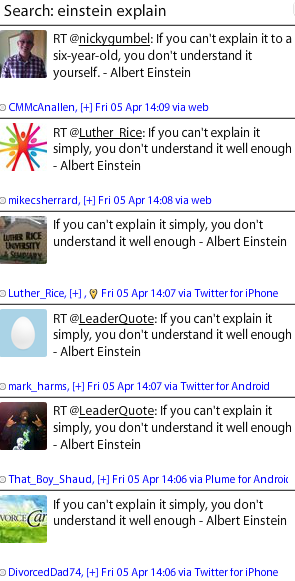
Indeed, the sound of social data may be like that. Yesterday I wrote a post called Keep It Real, Stupid. Herein I mentioned an apparently fake quote by Albert Einstein saying:

“If you can’t explain it simply, you don’t understand it well enough”.

Today I tried to see how the fake quote was doing on Twitter.

OMG: Going on more than one tweet per minute along with some mutations of the quote saying:

“If you can’t explain it to a six-year-old, you don’t understand it yourself”.

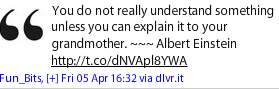
“You do not really understand something unless you can explain it to your grandmother”.

OK folks: Sense-making of social data is not going to be simple. Not even relatively simple.

Simply Einstein Tweets

Simply Einstein Tweet 2

Right:

Simply Einstein Tweet 3

Bookmark and Share

Big Data and Data Matching

Data matching has been an established discipline for many years and most data quality tools have more or less sophisticated features for data matching as well as many MDM (Master Data Management) platforms have data matching capabilities.

BigDataQuality
The LinkedIn Big Data Quality group

In a way the data matching realm has become slightly dull the recent years. People don’t get excited anymore over a discussion about if deterministic matching or probabilistic matching is the right way.  Soundex is old, edit distance has been around for ages and matchcodes may have outlived themselves.

So, it’s good to see a new beast turning up. Data matching with big data.

It may be about deduplicating (deduping) volumes that is bigger than traditional data matching can handle. You know: Dedoop’ing.

But it is also very much about matching big data with small data, first and foremost master data. And having well matched master data. Kimmo Kontra wrote a good post about that recently. The post is called Big Grease, Big Data, and Big Apple – manholes and MDM.

The case presented by Kimmo holds many exciting implementations of data matching like for example proximity matching of locations.

Bookmark and Share

Small Data with Big Impact

In an ongoing discussion on LinkedIn there are some good points on: How important is data quality for big data compared to data quality for small data?

A repeated sentiment in the comments is that data quality for small data is going to be more important with the rise of big data.

The small data we are talking about here is first and foremost master data.

Master Data Challenges with Big Data

As with traditional transaction data master data is also describing the who, what, where and when of big data.

If we are having issues with completeness, timeliness and uniqueness in our master data any prediction based on big data matched with master data is going to be as chaotic as weather forecasts.

big small dataWe also need to expand the range of entities embraced by our master data management implementations as exemplified in the post Social MDM and Future Competitive Intelligence.

Matching Big Data with Master Data

Some of the issues in matching big data with master data I have stumbled upon are:

  • Who: How do we link the real world entities reflected in our traditional systems of record with the real world entities behind who’s talking in systems of engagement? This question was touched in post Making Sense with Social MDM.
  • What: How do we manage our product hierarchies and product descriptions so they fulfill both (different) internal purposes and external usage? More on this in the post Social PIM.
  • Where: How do we identify a given place? If you think this is easy, why not read the post Where is the Spot?
  • When: Date and time comes in many formats and relating events to the wrong schedule may have us  Going in the Wrong Direction.

How: You may for example follow this blog. Subscription is in the upper right corner 🙂

Bookmark and Share