Reference Data at Work in the Cloud

One of the product development programs I’m involved in is about exploiting rich external reference data and using these data in order to get data quality right the first time and being able to maintain optimal data quality over time.

The product is called instant Data Quality (abbreviated as iDQ ™). I have briefly described the concept in an earlier post called instant Data Quality.

iDQ ™combines two concepts:

  • Software as a Service
  • Data as a Service

While most similar solutions are bundled with one specific data provider the iDQ ™ concept embraces a range data sources. The current scope is around customer master data where iDQ ™ may include Business-to-Business (B2B) directories, Business-to-Consumer (B2C) directories, real estate directories, Postal Address Files and even social media network data from external sources as well as internal master data at the same time all presented in a compact mash-up.
The product has already gained a substantial success in my home country Denmark leading to the formation of a company solely working with development and sales of iDQ ™.

The results iDQ ™ customers gains may seem simple but are the core advantages of better data quality most enterprises are looking for, like said by one of Denmark’s largest companies:

“For DONG Energy iDQ ™ is a simple and easy solution when searching for master data on individual customers. We have 1,000,000 individual customers. They typically relocate a few times during the time they are customers of us. We use iDQ ™ to find these customers so we can send the final accounts to the new address. iDQ ™ also provides better master data because here we have an opportunity to get names and addresses correctly spelled.

iDQ ™ saves time because we can search many databases at the time. Earlier we had to search several different databases before we found the right master data on the customer. ”

Please find more testimonials here.

I hope to be able to link to testimonials in more languages in the future.

Bookmark and Share

Nationally International

I am right now in the process of moving most of my business from the Kingdom of Denmark to the United Kingdom.

During that process I have become a regular customer at the Gatwick Express, the (sometimes) fast train going from London’s second largest airport to central London.

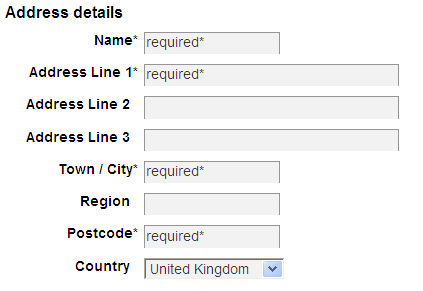
When buying tickets online they require you to enter a billing address. Here you can choose between entering a UK address or an international address.

If you enter a UK address the site takes advantage of the UK postal code system where you just have to enter a postcode, which is very granular in the UK, and a house number, and then the system will know your address.

Alternatively you can choose to enter an international address. In that case you will get a form with more fields for you to enter. But, in order not to be too international the form still have the UK way of formatting an address.

Also the default country is United Kingdom which I guess is the only value that should not be applicable for this form.

Bookmark and Share

Party, Product, Place. Period.

In a recent post here on this blog the Master Data Management domain usually called locations was examined and followed by excellent comments.

Also in the DAMA International LinkedIn group there was a great discussion around the location domain.

The comments touched two subjects:

  • Are locations just geographic locations or can we deal with “digital locations” as eMail addresses, phone numbers, websites, go-to-meeting ID’s, social network ID’s and so as locations as well?
  • How do we model the relations between parties, products and locations?

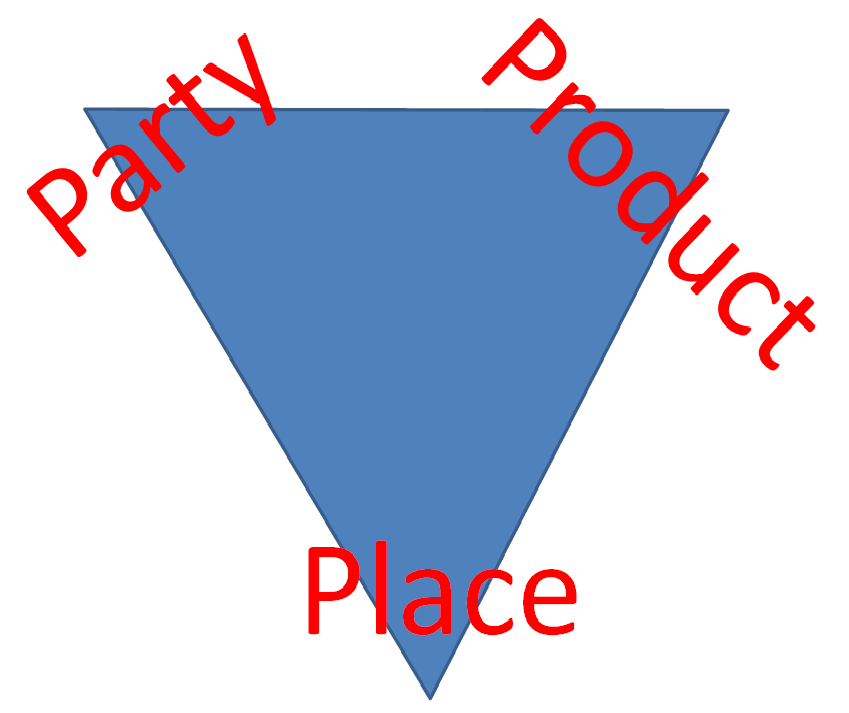
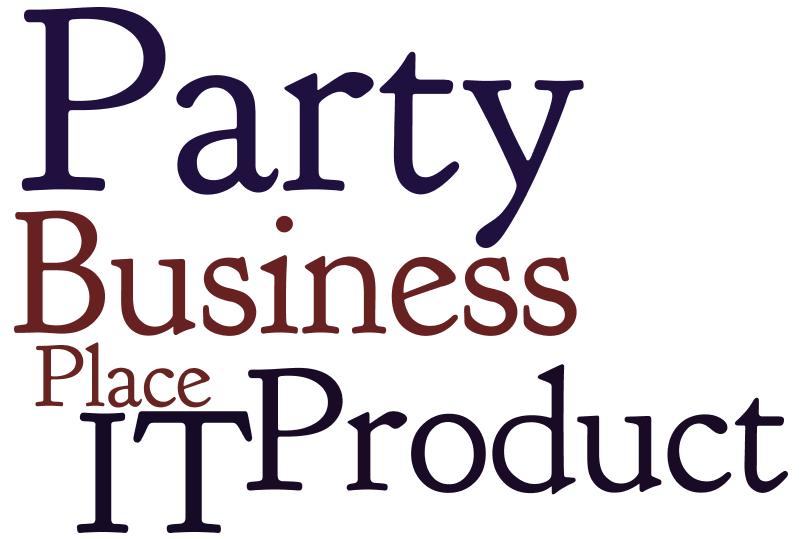
Sometimes I like to use the word places instead of locations as we then have a P-trinity of parties, products and places.

I’m not sure if places have a stronger semantic link to geography than locations have. Anyway, my thoughts on the location domain were merely connected to geography. The digital locations mentioned also in my eyes are more related to parties and not so much products. The same is true for another good old substitute for a location or address being a mailbox (like “Postbox 1234”), which is a valid notion for the destination of a letter or small package, and often seen in database columns else filled with geographic locations.

So, sticking to places being physical, geographic locations: How do we model parties, products and places?

First of all it’s important that we are able to model different concepts within each domain in one single way. A very common situation in many enterprise data landscapes is that different forms of parties exist with different models, like a model for customers, a model for suppliers, a model for employees and other models for other business partner roles.

The association between a party entity and a location entity is in most cases a time dependent relation like this consumer was billed on this address in this period. The relation between the party and the product is the good old basic data model, that we invoiced this and this product on that date. The product and place relation is very industry specific. One example will be that an on-site service contract applies to this address in this period.

Time, often handled as a period, will indeed add a fourth P to the P-trinity of party, product and place.

Bookmark and Share

Down the Street

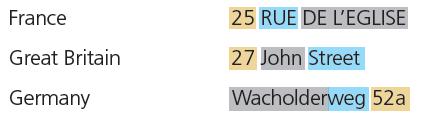
Having an address consisting of a house number and a street name, or vice versa, is the usual way of addressing in most parts of the world. This construct is also featured in the presentation of the Universal Postal Union’s (UPU) international standard initiative (S42):

(Click on image to see the presentation)

Somehow I always end up living at a place with issues in relation to this construct.

Our current address is (without unit):

“Kenny Drews Vej 27” which would be “27 Kenny Drews Way” in an Anglo-phone country.

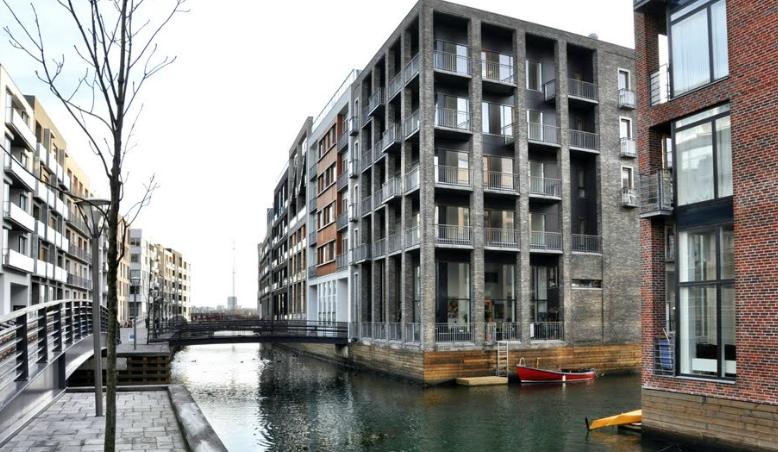
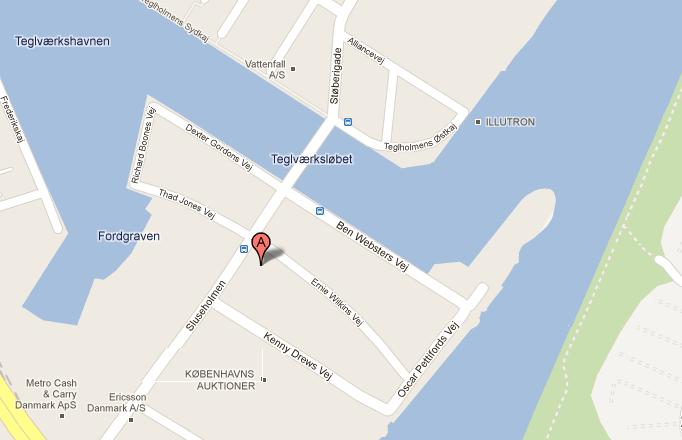
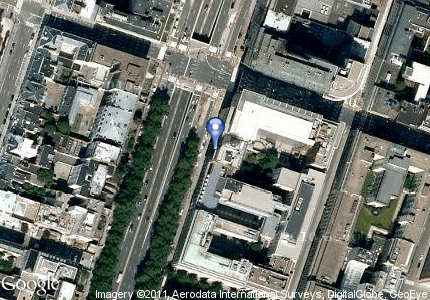
But our area has a new style of block buildings with canals between as we like to pretend that we live in Venice or Amsterdam:

This means that the house numbers aren’t sequenced down the street, but is spread round the block as if we were living in Japan. Google maps have the position exactly as it is:

Number 27 on Kenny Drews Vej is actually much closer to two other streets, which makes it very difficult when people are visiting us the first time and for some also the second time.

But that’s because I, and some of our visitors, are old fashioned. As Prashanta Chan says in his blog post Geocoding: Accurate Location Master Data: It will be much better to invite folks to your geocode.

The same thing applies to when you want some goods delivered to your premises or want a taxi as close to your front door as possible.

And regarding letters delivered by the good old postman: They will probably all be sent electronically before the UPU S42 addressing mapping standard is adapted by everyone.

Bookmark and Share

The Art in Data Matching

I’ve just investigated a suspicious customer data match:

A Company on Kunstlaan no 99 in Brussel

was matched with high confidence with:

The Company on Avenue des Arts no 99 in Bruxelles

At first glance it perhaps didn’t look as a confident match, but I guess the computer is right.

The diverse facts are:

  • Brussels is the Belgian capital
  • Belgium has two languages: French and Flemish (a variant of Dutch)
  • Some parts of the country is French, some parts is Flemish and the capital is both
  • Brussels is Bruxelles in French and Brussel in Flemish
  • Kunst is Flemish meaning Art (as in Dutch, German and Scandinavian too)
  • Laan is Flemish meaning Avenue (same origin as Lane I guess)
  • Avenue des Arts is French meaning Avenue of Art (French is easy)

Technically the computer in this case did as follows:

  • Compared the names like “A Company” and “The Company” and found a close edit distance between the two names.
  • Remembered from some earlier occasions that “Kunstlaan” and “Avenue des Arts” was accepted as a match.
  • Remembered from numerous earlier occasions that “Brussel”(or “Brüssel) and “Bruxelles” was accepted as a match.

It may also have been told beforehand that “Kunstlaan” and “Avenue des Art” are two names of the same street in some Belgian address reference data which I guess is a must when doing heavy data matching on the Belgian market.

In this case it was a global match environment not equipped with worldwide address reference data, so luckily the probabilistic learning element in the computer program saved the day.

Bookmark and Share

Product Placement

This wasn’t actually meant as a blog post series about the place entity in multi-domain master data management. But I think I have been carried away by my work, so now it is.

Places probably are most common related to the party domain as seen in the previous post called A Place in Time. But places certainly also have multiple relations to the product domain then forming a P trinity of parties, products and places in multi-domain master data management as seen in the post Your Place or My Place?

As with most things in the product domain also the product-place relations usually are very industry specific.

Some of the product-place relations I have worked with come from these industries:

Insurance

The fees you have to pay for some insurance products are related to the place where you live. In order to having the right fees (and for a lot of other reasons) an insurance company needs to analyze data based on the product-place relations. This may by the way go very wrong as told in the post A Really Bad Address.

Hospitality

Your product is a place where the selling attributes includes both the properties belonging to the place itself and the properties of the places being nearby.

Real Estate

Do I have to say more than three words: Location, Location, Location.

Your product-place relations

Tell me about what product-place relations you have worked with?

Bookmark and Share

A Place in Time

I remember when I had the first chemistry lesson in high school our teacher told us that we should forget all about the chemistry we had learned in primary school, because this was a too simply model not reflecting how the real world of chemistry actually work.

Since I have started working with data quality and master data management I have a pet peeve in data modeling, namely being the probably most common example of doing data modeling: The classic customer table. Example from a SQL tutorial here:

Compared to how the real world works this example has some diversity flaws, like:

  • state code as a key to a state table will only work with one country (the United States)
  • zipcode is a United States description only opposite to the more generic “Postal Code”
  • fname (First name) and lname (Last name) don’t work in cultures where given name and surname have the opposite sequence
  • The length of the state, zipcode and most other fields are obviously too small almost anywhere

More seriously we have:

  • fname and lname (First name and Last name) and probably also phone should belong to an own party entity acting as a contact related to the company
  • company name should belong to an own party entity acting in the role as customer
  • address1, address2, city, state, zipcode should belong to an own place entity probably as the current visiting place related to the company

Now I know this is just a simple example from a tutorial where you should not confuse by adding too much complexity. Agreed.

However many home grown solutions in business life and even many commercial ready-made applications use that kind of a data model to describe one of the most important business entities being our customers.

It may be that such a model does fit the purpose of use in some operations. Sometimes yes, sometimes no. But when reusing data from such a model on enterprise level and when adding business intelligence you are in big trouble. That is why we need master data hubs and why we need to transform data coming into the master data hub.

From such a customer record we don’t create just one golden record. We make or link several different related multi-domain entities as:

  • The contact as a person in our party domain – maybe we knew her before
  • The company in our party domain – maybe we knew the sister as a supplier before
  • The address in our place (location) domain – maybe we knew that address as a place in time before

Bookmark and Share

Your Place or My Place?

We, and that’s including myself, often talk about multi-domain master data management as a marriage between party master data management (also called Customer Data Integration abbreviated as CDI) and Product Master Data Management (also called Product Information Management abbreviated as PIM).

The third most common master data domain is locations (or places). I like the term place, because then we have a P trinity: Parties, Products and Places. However there may be a fourth P involved, as I read a post today by Steven Jones of Capgemini telling that multi-domain MDM is a Pointless question.

The Premise of the Pointlessness is that Party and Product is an IT Perspective. The rest of the business sees the world from mainly either a customer centric perspective or a supply centric perspective.

I agree about that these perspectives exists too and actually made a blog post recently on sell side vs buy side master data quality.

I don’t agree about that this is an (pointless) IT versus business question, obviously also because I have a hard time recognizing the great divide between IT and business. From my perspective is IT a part of the business just like sales, marketing and purchase is it too. And from a product vendor perspective in the MDM realm you actually address the conjunction of business and technological needs a bit opposite to either being a database manager vendor aimed mostly at the IT part of business or a CRM or SCM vendor aimed mostly at the sales or purchase part of business.

Multi-domain MDM isn’t in my perspective a pointless place, but a meeting place between IT and all the other places in business and the core business entities being parties, products and places.

Bookmark and Share

The Value of Free Address Data

In yesterdays blog post I wrote about Free and Open Sources of Reference Data. As mentioned we have had some discussions in my home country Denmark about fees for access to public sector data.

However since 2002 basic Danish public sector data about addresses has been free without a fee. This summer a report about the benefits from this practice was released. Link in Danish here.

I’ll quote the key findings:

  • The direct economic gains for the Danish community in the last five years 2005-2009 is approximately 471 million DKK (63 million EUR). The total cost until 2009 has been about 15 million DKK (2 million EUR).
  • Approximately 30% of the profits are made in the public sector and approximately 70% at the private actors.

I think this is a fine example of the win-win situation we’ll get when sharing data between public sector and private sector.

Bookmark and Share

Business Directory Match: Global versus Local

When doing data quality improvement in business-to-business party master data an often used shortcut is matching your portfolio of business customers with a business directory and preferably picking new customers from the directory in the future.

If you are doing business in more than one country you will have some considerations about what business directory to use like engaging with a local business directory for each country or engaging with a single business directory covering all countries in question.

There are pro’s and con’s.

One subject is conformity. I have met this issue a couple of times. A business directory covering many countries will have a standardized way of formatting the different elements like a postal address, whereas a local (national) business directory will use best practice for the particular country.

An example from my home country Denmark:

The Dun & Bradstreet WorldBase is a business directory holding 170 million business entities from all over the world. A Danish street address is formatted like this:

Address Line 1 = Hovedgaden 12 A, 4. th

Observe that Denmark belongs to that half of the earth where house numbers are written after the street name.

In a local business directory (based on the public registry) you will be able to get this format:

Street name = Hovedgaden
Street code = 202 4321
House number = 012A
Floor = 04
Side/door = TH

Here you get an atomized address with metadata for the atomized elements and the unique address coding used in Denmark.

Bookmark and Share