Why is Your Digital Ecosystem and MDM the Place to Begin in Digital Transformation?

The question “Why is Your Digital Ecosystem the Place to Begin?” was asked by Frank Diana of Tata Consultancy Services in the article Why an ecosystem strategy is where digital transformations begin.

As said by Frank Diana: “Whatever can be digitized is being digitized, and that means it’s available to be shared with other, digitally-enabled companies.”

This is true for master data as well. The role of Master Data Management (MDM) in making digital transformation a success was examined in the Disruptive MDM solution list post Digital Transformation Success Rely on MDM / PIM Success.

The concepts mentioned were:

  • Providing a 360-degree view of master data entities
  • Enabling happy self-service scenarios
  • Underpinning the best customer experience
  • Encompassing Internet of Things (IoT)

Providing a 360-degree view of master data entities through Golden Records in Multidomain MDM will be much easier by sharing master data that is already digitalised as third-party reference data and/or at business partners.

Enabling happy self-service scenarios can be done much more effectively by opening up the master data onboarding to business partners and customers them selves and by letting product data flow easily between trading partners as pondered in the post Linked Product Data Quality.

Underpinning the best customer experience will require that you utilize data from and about the whole business ecosystem where your company is a participant.

Encompassing Internet of Things (IoT) means that you must share master within the business ecosystem as touched in the post IoT and MDM.Digital Transformation MDM and business ecosystems

PIM and PDS

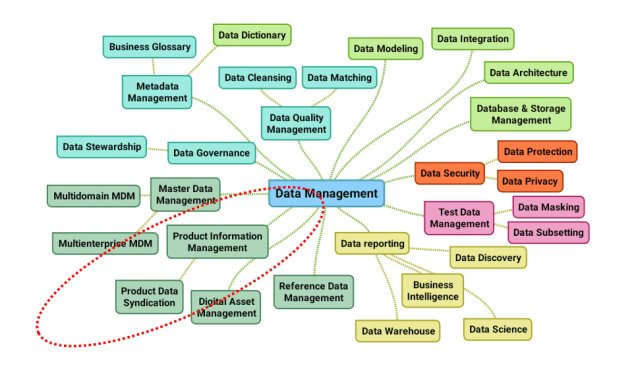
Product Information Management (PIM) has a sub discipline called Product Data Syndication (PDS).

PIM and PDS

While PIM basically is about how to collect, enrich, store and publish product information within a given organization, PDS is about how to share product information between trading partners. One challenge here is that two trading partners very seldom use the same product classification system(s), taxonomy and structure for product information.

Some PIM vendors offer PDS as extensions to their PIM offerings. Examples are Stibo Systems and Salsify. Other MDM (Master Data Management) / PIM vendors are facilitating PDS through general data integration services in their wider data management offerings. Examples are Informatica and Dell Boomi.

Product Data Synchronization is a variant concept of PDS. The most known service is the Global Data Synchronization Network (GSDN) operated by GS1 through data pool vendors, where 1WorldSync is the dominant one. In here trading partners are following the same classification, taxonomy and structure for a group of products (typically food and beverage) and their most common attributes in use in a given geography.

However, from working as a consultant in the MDM and PIM space i know that there are lots of organizations who cannot utilize the current offerings in a cost effective way and having all their needs for covering the many product attributes you need to share today as well as product relationships and the related digital assets. This is the reason why we have launched a Product Data Syndication service called Product Data Lake.

MDM Megavendors vs the Other MDM Vendors

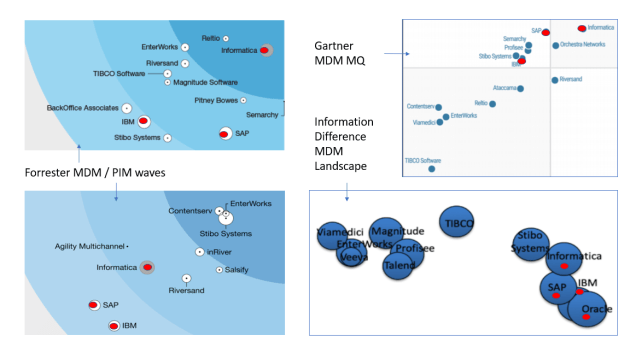
In the latest Gartner Master Data Management Solutions magic quadrant it is stated that “Gartner-estimated 2016 revenues of the four largest vendors commanded over 77% of the market (SAP, IBM, Oracle and Informatica). These four held a Gartner-estimated market share of just over 73% in 2017.”

There seems to be a little decrease in the dominance from the megavendors, though the market according to Gartner is still ruled by the big four. The number of licenses sold by these vendors and those midsize vendors who also are in the quadrant can be found in the post Counting MDM Licenses.

For the future trend it is also worth noticing, that Oracle is not a part of the MDM magic quadrant anymore, as Oracle in the Gartner lingo is not an MDM vendor, but an ADM vendor today. Oracle is not included in the latest Forrester MDM wave either.

Another market distinction is around MDM versus Product Information Management (PIM) solutions. The post Several Sources of Truth about MDM / PIM Solutions examines the positioning by Gartner and Forrester and in that sense the magavendors are better at MDM than PIM.

Any Gartner estimation will be biased towards large vendors having large clients as these are the Gartner clients. In a LinkedIn discussion a big four person suggested that the market is fragmented and there are many MDM-like solutions.

This remark followed the market estimation from a fresh market report from Information Difference. The positioning results from here were shown in the post Movements in the MDM Vendor Landscape 2019. In here the megavendors did not perform so well on the technology axis, which is largely made up by customer satisfaction feedback in the underlying survey.

So, what do you think? Will the megavendors still rule the MDM market or will the midsize and smaller vendors get a larger piece of the cake?

MDM megavendors

For bigger picture click here.

If a country list is that hard, MDM is really hard

A twitter post directing to an article with the title Make the Right Choice Using the Right Criteria: A Checklist for Exploring MDM Solutions and Capabilities made me curious and got my click.

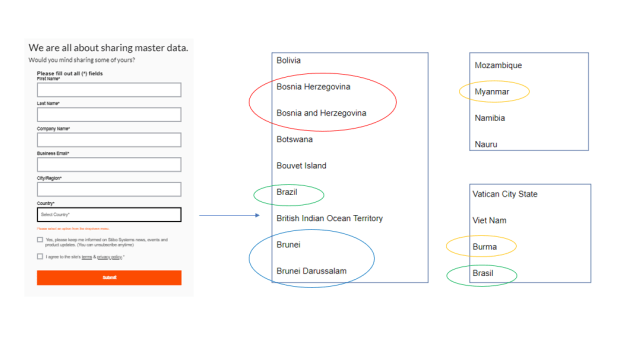
However, before reading too much I was prompted with an inescapable form asking for my details in a master data sharing tone.

Well, then I could as well explore the mandatory country list. No surprise. A master (or reference) data havoc. Two Bosnia (and) Herzegovina entries. Two Brunei entries. Two Brazil entries. Two Burma / Myanmar entries.

Country List Havoc by Stibo Systems

MDM Spending Might be 5 Billion USD per Year

The latest Master Data Management Landscape report from Information Difference was covered in the post Movements in the MDM Vendor Landscape 2019.

Apart from positioning some of the tool vendors on a chart, the report also estimates the size of the MDM market. Information difference estimates that the software vendors make 1.6 B USD per year. Hereof are pure license sales 885 M USD, maintenance fees are 273 M USD per year and professional services counts for 450 M USD per year.

In addition, the report says: “Our research shows that on average the people costs of a MDM project are four times that of the software license cost, so there is clearly a large and separate consultancy market associated with MDM”.

So, the additional spending might be in the area of 3.5 B USD (depending on how you calculate and if that multiplier is right). These costs go to system integrators, freelance MDM consultants and internal staff. From my experience internal staff are sparsely represented in MDM implementations, so yes, there is a large consultancy market within MDM.

The total 5 Billion USD spend by end user organizations yearly on MDM then look like this:

MDM Spending 2019
MDM Yearly Spending. Source: Information Difference

The good question that follows will of course be on the size and distribution of the business benefits achieved.

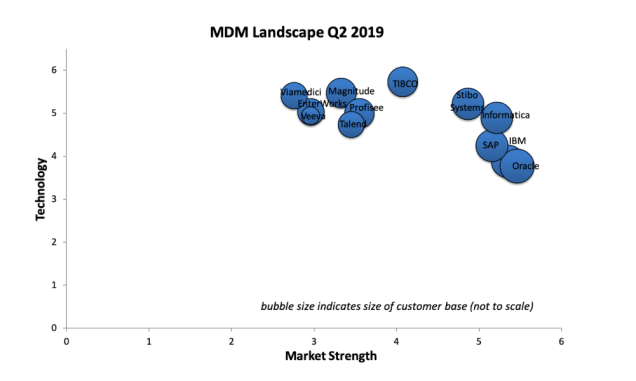
Movements in the MDM Vendor Landscape 2019

The MDM Vendor Landscape 2019 from Information Difference is out. You can compare to the landscape from a year ago when looking at the MDM Vendor Landscape 2018.

Some vendors from last year as Contentserv and Semarchy is missing this year. This is in my thinking not because they have left the marked or have become irrelevant. I will guess it is about unwillingness to contribute to the research at too many market researchers.

Profisee is added which is in line with an increased Master Data Management market exposure from the folks at Profisee.

At the recurring vendors there is little movement except that Viamedici has moved a bit up on the technology axis and Informatica (perhaps surprisingly) has fallen a bit on that axis.

Orchestra Networks is now named Ticbo following the take over since last landscape.

The plot is here:

MDM Landscape Q2 2019

PS: Many of the vendors in the list this year and last year – and some more – are presented in depth on The Disruptive MDM / PIM List.

PPS: If you represent a vendor not on The Disruptive MDM / PIM List, you can register here.

Human Errors and Data Quality

Every time there is a survey about what causes poor data quality the most ticked answer is human error. This is also the case in the Profisee 2019 State of Data Management Report where 58% of the respondents said that human error is among the most prevalent causes of poor data quality within their organization.

This topic was also examined some years ago in the post called The Internet of Things and the Fat-Finger Syndrome.

Errare humanum estEven the Romans knew this as Seneca the Younger said that “errare humanum est” which translates to “to err is human”. He also added “but to persist in error is diabolical”.

So, how can we not persist in having human errors in data then? Here are three main approaches:

  • Better humans: There is a whip called Data Governance. In a data governance regime you define data policies and data standards. You build an organizational structure with a data governance council (or any better name), have data stewards and data custodians (or any better title). You set up a business glossary. And then you carry on with a data governance framework.
  • Machines: Robotic Processing Automation (RPA) has, besides operational efficiency, the advantage of that machines, unlike humans, do not make mistakes when they are tired and bored.
  • Data Sharing: Human errors typically occur when typing in data. However, most data are already typed in somewhere. Instead of retyping data, and thereby potentially introduce your misspelling or other mistake, you can connect to data that is already digitalized and validated. This is especially doable for master data as examined in the article about Master Data Share.

The Soft Sides of MDM and PIM RFPs

Master Data Management (MDM) and Product Information Management (PIM) solutions are, as many other enabling technologies, often purchased using a formal Request for Proposal (RFP) process.

In such a process the theory is that the buying organization, often with the help from an external consultancy, states the functional and non-functional requirements, measure the solutions against these requirements using a weighted score model and then objectively selects the solution with the highest score.

In practice there are in my experience some more subjective and soft sides to this process. This is not at least the case in the longlist/shortlist phase and when taking the final decision. I have seen my share of overruling the scoring.

One aspect is the geographical presence of the vendor. This includes where the solution provider is based and of course also the presence around the world through local offices and partner network as told in the post Mapping MDM and PIM Solutions.

Another aspect is the subject matter expertise shown by the vendor. This includes written material provided but also available on website and blogs and of course during presentations. An example could be the emphasis on master data versus product information as exemplified in the post MDM, PIM or Both.

I have had the fortunate opportunity of being at both sides of the table during the years and are still doing that as shown in the article about Popular Offerings.

MDM PIM RFP

Mapping MDM and PIM Solutions

There are several parameters considered by organizations on the look for solutions that handles Master Data Management (MDM) and Product Information Management (PIM) or both. One is how MDM’ish or PIM’ish the solution is as examined in the post MDM, PIM or Both.

Another aspect is the geographical presence. This includes where the solution provider is based and of course also the presence around the world through local offices and partner network.

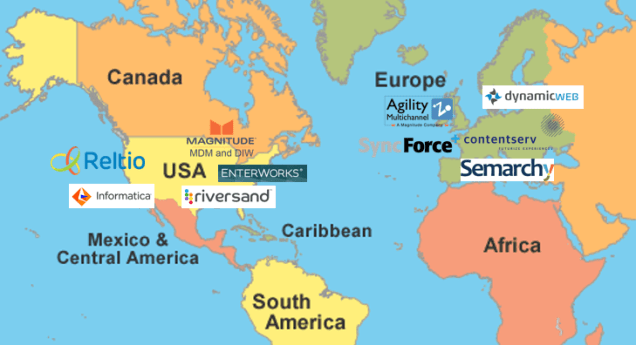
Here are some of the solution providers from North America and Europe on a map:

MDM World Map

Reltio is a Silicon Valley based MDM provider. Learn more about Reltio Cloud here.

Semarchy has moved their head quarter to Silicon Valley but has their origin and most of the operation still in Lyon, France. Learn more about Semarchy xDM here.

Riversand is coming out of Houston, Texas. Learn more about Riversand here.

EnterWorks is based in Sterling, Virginia. Learn about Enterworks here.

CONTENTSERV is head quartered in Baar, Switzerland. Learn more about CONTENTSERV here.

SyncForce is located in Eindhoven, Netherlands. Learn about SyncForce here.

Dynamicweb PIM is from Aarhus, Denmark. Learn more about Dynamicweb PIM here.

Informatica is another Silicon Valley firm. Informatica has bought firms from around the world as lately Toronto, Canada based AllSight, now branded as Informatica Customer 360 Insights. Learn more about Informatica Customer 360 Insights here.

Magnitude and Agility® are now married. They are respectively located in Austin, Texas and York, UK. Learn more about Magnitude MDM here and learn more about Agility here.

Where is your (preferred) MDM / PIM solution located? – and what is the world reach?