Right now I am working with a MDM (Master Data Management) service for sharing product data in the business ecosystems of manufacturers, distributors, retailers and end users of product information.
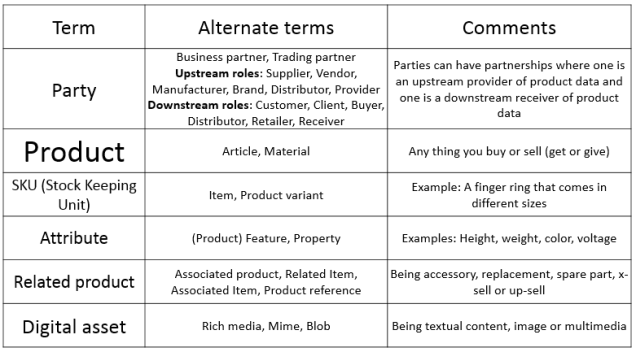
One of the challenges in putting such a service to the market is choosing the best term for the entities handled by the service.
Below is the current selection with the chosen term and some recognized alternate terms used frequently and found in various standards that exists for exchanging product data:
Please comment, if you think there are other English (or variant of English) terms that deserves to be in here.
This week I had the pleasure of being at the Informatica MDM 360 event in Paris. The “360” predicate is all over in the Informatica communication. There are the MDM 360 events around the world. The Product 360 solution – the new wrap of the old Heiler PIM solution, as I understand it. The Supplier 360 solution. Some Customer 360 stuff including the Cloud Customer 360 for Salesforce edition.
All these solutions constitutes one of the leading Multi-Domain MDM offerings on the market – if not the leading. We will be wiser on that question when Gartner (the analyst firm) makes their first Multi-Domain MDM Magic Quadrant later this year as reported in the post Gravitational Waves in the MDM World.
Until now, Informatica has been very well positioned for Customer MDM, but not among the leaders for Product MDM in the ranking according to Gartner. Other analysts, as Information Difference, have Informatica in the top right corner of the (Multi-Domain) MDM landscape as seen here.
MDM and big data is another focus area for Informatica and Informatica has certainly been one of the first MDM vendors who have embraced big data – and that not just with wording in marketing. Today we cannot say big data without saying data lake. Informatica names their offering the Intelligent Data Lake.
For me, it will be interesting to see how Informatica can take full Multi-Domain MDM leadership with combining a good Product MDM solution with an Intelligent Data Lake.
Until now, much of the methodology and technology in the Master Data Management (MDM) world has been about how to optimize the use of what can be called first party master data. This is master data already collected within your organization and the approaches to MDM and the MDM solutions offered has revolved around federating internal silos and obtain a single source of truth within the corporate walls.
Besides that third-party data has been around for many years as described in the post Third-Party Data and MDM. Use of third party data in MDM has mainly been about enriching customer and supplier master data from business directories and in some degree utilizing standardized pools of product data in various solutions.
Using third party data for customer and supplier master data seems to be a very good idea as exemplified in the post Using a Business Entity Identifier from Day One. This is because customer and supplier master looks pretty much the same to every organization. With product master data this is not case and that is why third party sources for product master data may not be fully effective.
Second party data is data you get directly from the external source. With customer and supplier master data we see that approach in self-registration services. My recommendation is to combine self-registration and third party data in customer and supplier on-boarding processes. With product master data I think leaning mostly to second party connections in business ecosystems seems like the best way forward. There is more on that in a discussion on the LinkedIn MDM – Master Data Management Group.
Yesterday I popped in at the combined Master Data Management Summit Europe 2016 and Data Governance Conference Europe 2016.
This event takes place Monday to Thursday, but unfortunately I only had time and money for the Tuesday this year. Therefore, my report will only be takeaways from Tuesday’s events. On a side note the difficulties in doing something pan-European must have troubled the organisers of this London event as avoiding the UK May bank holidays has ended in starting on a Monday where most of the rest of Europe had a day off due to being Pentecost Monday.
Tuesday morning’s highlight for me was Henry Peyret of Forrester shocking the audience in his Data Governance keynote by busting the myth about the good old excuse for doing nothing, being the imperative of top-level management support, is not true.
Back in 2013 I wondered if graph databases will become common in MDM. Certainly graph databases has become the talk of the town and it was good to learn from Andreas Weber how the Germany based figurine manufacturer Schleich has made a home grown PIM / Product MDM solution based on graph database technology.
Ivo-Paul Tummers of Jibes presented the MDM (and beyond) roadmap for the Dutch food company Sligro. I liked the alley of embracing multi-channel, then omnichannel with self-service at the end of the road and how connect will overtake collect during this journey. This is exactly the reason of being for the Product Data Lake venture I am working on right now.
I am looking forward to visiting London in a fortnight and have already secured tickets for the new musical called Kinky Boots.
Another option is to pop in at the Master Data Management Summit Europe 2016 and the co-located Data Governance Conference Europe 2016 and visit the kinky booths where the exhibitors will tell you about their latest inventions. Someone to see could be:
Semarchy, who has always been kind of kinky with their evolutionary MDM approach as told in the post Eating the MDM Elephant. Last autumn I visited Semarchy in Lyon and it would be good to catch up with FX, Richard and other good people from this exciting MDM vendor.
Ataccama has a kinky logo. Also on a recent engagement, we have been working with the data quality analyzer tool from Ataccama. So will be good to learn about all the other stuff as for example the big data analyzer.
Stibo Systems, where I worked some years ago, has just released their new version 8.0 of STEP Trailblazer. This version has an enhanced web user interface. While STEP has always had lots of good functionality, I think many STEP users will welcome a more kinky user interface.
Is that piece of data wrong or right? This may very well be a question about in what language we are talking about.
In an earlier double post on this blog I had a small quiz about the name of the Pope in the Catholic church. The point was that all possible answers were right as explained in post When Bad Data Quality isn’t Bad Data. The thing is that the Pope over the wold has local variants over the English name Francis. François in French, Franziskus in German, Francesco in Italian, Francisco in Spanish Franciszek in Polish, Frans in Danish and Norwegian and so on.
In today’s globalized, or should I say globalised, world, it is important that our data can be represented in different languages and that the systems we use to handle the data is built for that. The user interface may be in a certain flavor/flavour of English only, but the data model must cater for storing and presenting data in multiple languages and even variants of languages as English in its many forms. Add to that the capability of handling other characters than Latin in other script systems than alphabets as examined in the post called Script Systems.
This challenge is very close to me right when we are building a service for sharing product information in business ecosystems. So will the Product Data Lake be multilingual? Mais oui! Natürlich. Jo da.
PS: The Product Data Lake will actually help with collecting product information in multiple languages through the supply chains of product manufacturers, distributors, retailers and end users.
It is never too late to start up, I have heard. So despite I usually brag about having +35 years of experience in the intersection of business and IT and a huge been done list in Data Quality and Master Data Management (MDM) which can get me nice consultancy engagements, a certain need on the market has been puzzling in my head for some time.
Before that, when someone asked me what to do in the MDM space I told them to create something around sharing master data between organisations. Most MDM solutions are sold to a given organization to cover the internal processes there. There are not many solutions out there that covers what is going on between organizations.
But why not do that myself? – with the help of some younger people.
You may have noticed, that I during the last year have been writing about something called the Product Data Lake. This has until recently mostly just been a business concept that could be presented on power point slides. So called slideware. But now it is becoming real software being deployed in the cloud.
At home in Denmark, some young people are working on our solution too as well as the related launching activities and social media upbeat. This includes a LinkedIn company page. For continuous stories about our start-up, please follow the Product Data Lake page on LinkedIn here.
“I’d like to hear back from anyone who has implemented party master data in either a single, unified schema or separate, individual schemas (Vendor, Customer, etc.).
What were the pros and cons of your approach? Would you do it the same way if you had it to do again?”
This is a classic consideration at the heart of multi-domain MDM. As I see it, and what I advise my clients to do, is to have a common party (or business partner) structure for identification, names, addresses and contact data. This should be supported by data quality capabilities strongly build on external reference data (third party data). Besides this common structure, there should be specific structures for customer, vendor/supplier and other party roles.
This subject was also recently examined here on the blog in the post Multi-Side MDM.
What is your opinion and experience with this question? Please have your say either here on the blog or in the LinkedIn Multi-Domain MDM Group.
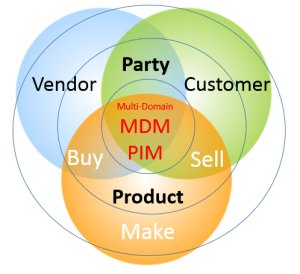
As reported in the post Gravitational Waves in the MDM World there is a tendency in the MDM (Master Data Management) market and in MDM programmes around to encompass both the party domain and the product domain.
The party domain is still often treated as two separate domains, being the vendor (or supplier) domain and the customer domain. However, there are good reasons for seeing the intersection of vendor master data and customer master data as party master data. These reasons are most obvious when we look at the B2B (business-to-business) part of our master data, because:
You will always find that many real world entities have a vendor role as well as a customer role to you
The basic master data has the same structure (identification, names, addresses and contact data
You need the same third party validation and enrichment capabilities for customer roles and vendor roles.
When we look at the product domain we also have a huge need to connect the buy side and the sell side of our business – and the make side for that matter where we have in-house production.
Multi-Domain MDM has a side effect, so to speak, about bringing the sell-side together with the buy- and make-side. PIM (Product Information Management), which we often see as the ancestor to product MDM, has the same challenge. Here we also need to bring the sell-side and and the buy-side together – on three frontiers:
Bringing the internal buy-side and sell-side together not at least when looking at product hierarchies
Bringing our buy-side in synchronization with our upstream vendors/suppliers sell-side when it comes to product data
Bringing our sell-side in synchronization with our downstream customers buy-side when it comes to product data
If you have ever visited some of the many castles around in Europe you may have noticed that there are many architectural similarities. You may also compare these basic structures of a castle with how we can imagine the data architecture related to Product Information Management (PIM).
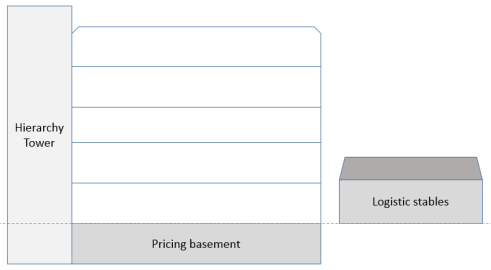
In my vision of a product information castle there is a main building with five floors of product information. There is a basement for pricing information where we often will find the valuable things as the crown jewels and other treasures. The hierarchy tower combines the pricing information and the different levels of product information. Besides the main castle, we find the logistic stables.
Hierarchy, pricing and logistic is part of whole picture
What we do not see on this figure is the product lifecycle management wall around the castle area.
Now, let us get back to the main building and examine what is on each of the floors in the building.
Ground PIM level: Basic product data
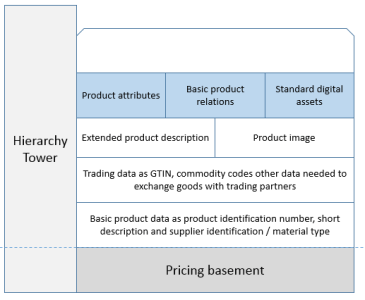
On the ground level, we find the basic product data that typically is the minimum required for creating a product in any system of record. Here we find the primary product identification number or code that is the internal key to all other product data structures and transactions related to the product. Then there usually is a short product description. This description helps internal employees identifying a product and distinguishing that product from other products. If an upstream trading partner produces the product, we may find the identification of that supplier here. If the product is part of internal production, we may have a material type telling about if it is a raw material, semi-finished product, finished good or packing material.
Except for semi-finished products, we may find more things on the next floor.
PIM level 2: Product trade data
This level has product data related to trading the product. We may have a unique Global Trade Item Number (GTIN) that may be in the form of an International Article Number (EAN) or a Universal Product Code (UPC). Here we have commodity codes and a lot of other product data that supports buying, receiving, selling and delivering the product.
Most castles were not build in one go. Many castles started modestly in maybe just two floors and a tiny tower. In the same way, our product information management solutions for finished and trading goods usually are built on the top of an elder ERP solution holding the basic and trading data.
PIM Level 3: Basic product recognition data
On the third level, we find the two grand ballrooms of product information. These ballrooms were introduced when eCommerce started to grow up.
The extended product description is needed because the usual short product description used internally have no meaning to an outsider as told in the post Customer Friendly Product Master Data. Some good best practices for governing the extended product description is to have a common structure of how the description is written, not to use abbreviations and to have a strict vocabulary as reported in the post Toilet Seats and Data Quality.
Having a product image is pivotal if you want to sell something without showing the real product face-to-face with the customer or other end user. A missing product image is a sign of a broken business process for collecting product data as pondered in the post Image Coming Soon.
PIM Level 4: Self-service product data
On the fourth level, we have three main chambers: Product attributes, basic product relations and standard digital assets.This data are the foundation of customer self-service and should, unless you are the manufacturer, be collected from the manufacturer via supplier self-service.
Product attributes are also sometimes called product properties or product features. These are up to thousands of different data elements that describes a product. Some are very common for most products like height, length, weight and colour. Some are very specific to the product category. This challenge is actually the reason of being for dedicated Product Information Management (PIM) solutions as told in the post MDM Tools Revealed.
Basic product relations are the links between a product and other products like a product that have several different accessories that goes with the product or a product being a successor of another now decommissioned product.
Standard digital assets are documents like installation guides, line drawings and data sheets as examined in the post Digital Assets and Product MDM.
PIM Level 5: Competitive product data
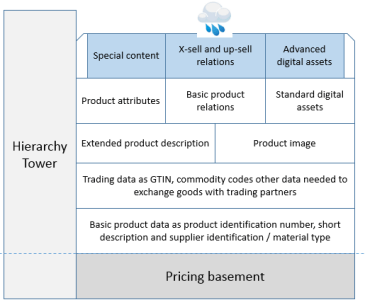
On the upper fifth floor we find elements like on the fourth floor but usually these are elements that you won’t necessarily apply to all products but only to your top products where you want to stand out from the crowd and distance yourself from your competitors.
Special content are descriptions of and stories about the product above the hard features. Here you tell about why the product is better than other products and in which circumstances the product can to be used. A common aim with these descriptions is also Search Engine Optimization (SEO).
X-sell (cross-sell) and up-sell product relations applies to your particular mix of products and may be made subjective as for example to look at up-sell from a profit margin point of view. X-sell and up-sell relations may be defined from upstream by you or your upstream trading partners but also dripping down on the roof from the behaviour of your downstream trading partners / customers as manifested in the classic webshop message: “Those who bought product A also bought / looked at product B”.
Advanced digital assets are broader and more lively material than the hard fact line drawings and other documents. Increasingly newer digital media types as video are used for this purpose.
All in all the rooftop takes us to the upper side of the cloud.
 All these solutions constitutes one of the leading Multi-Domain MDM offerings on the market – if not the leading. We will be wiser on that question when Gartner (the analyst firm) makes their first Multi-Domain MDM Magic Quadrant later this year as reported in the post
 Using third party data for customer and supplier master data seems to be a very good idea as exemplified in the post
 I am looking forward to visiting London in a fortnight and have already secured tickets for the new musical called
  Semarchy, who has always been kind of kinky with their evolutionary MDM approach as told in the post
  Ataccama has a kinky logo. Also on a recent engagement, we have been working with the data quality analyzer tool from Ataccama. So will be good to learn about all the other stuff as for example the
  Stibo Systems, where I worked some years ago, has just released their new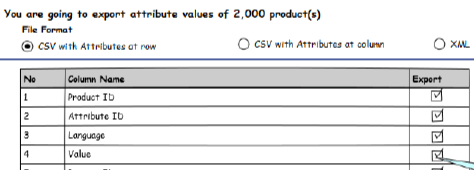
 You may have noticed, that I during the last year have been writing about something called the
  This is a classic consideration at the heart of multi-domain MDM. As I see it, and what I advise my clients to do, is to have a common party (or business partner) structure for identification, names, addresses and contact data. This should be supported by data quality capabilities strongly build on external reference data (third party data). Besides this common structure, there should be specific structures for customer, vendor/supplier and other party roles.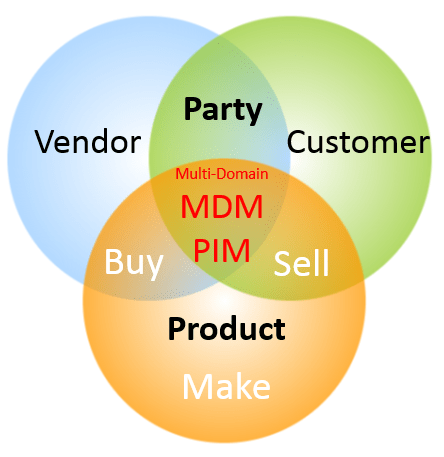




 Liliendahl on Data Quality