Pulling Data Quality from the Cloud

In a recent post here on the blog the benefits of instant data enrichment was discussed.

In the contact data capture context these are some examples:

  • Getting a standardized address at contact data entry makes it possible for you to easily link to sources with geo codes, property information and other location data.
  • Obtaining a company registration number or other legal entity identifier (LEI) at data entry makes it possible to enrich with a wealth of available data held in public and commercial sources.
  • Having a person’s name spelled according to available sources for the country in question helps a lot with typical data quality issues as uniqueness and consistency.

However, if you are doing business in many countries it is a daunting task to connect with the best of breed sources of big reference data. Add to that, that many enterprises are doing both business-to-business (B2B) and business-to-consumer (B2C) activities including interacting with small business owners. This means you have to link to the best sources available for addresses, companies and individuals.

A solution to this challenge is using Cloud Service Brokerage (CSB).

An example of a Cloud Service Brokerage suite for contact data quality is the instant Data Quality (iDQ™) service I’m working with right now.

This service can connect to big reference data cloud services from all over the world. Some services are open data services in the contact data realm, some are international commercial directories, some are the wealth of national reference data services for addresses, companies and individuals and even social network profiles are on the radar.

Bookmark and Share

Instant Data Enrichment

Data enrichment is one of the core activities within data quality improvement. Data enrichment is about updating your data in order to be more real world aligned by correcting and completing with data from external reference data sources.

Traditionally data enrichment has been a follow up activity to data matching and doing data matching as a prerequisite for data enrichment has been a good part of my data quality endeavor during the recent 15 years as reported in the post The GlobalMatchBox.

During the last couple of years I have tried to be part of the quest for doing something about poor data quality by moving the activities upstream. Upstream data quality prevention is better than downstream data cleansing wherever applicable. Doing the data enrichment at data capture is the fast track to improve data quality for example by avoiding contact data entry flaws.

It’s not that you have to enrich with all the possible data available from external sources at once. What is the most important thing is that you are able to link back to external sources without having to do (too much) fuzzy data matching later. Some examples:

  • Getting a standardized address at contact data entry makes it possible for you to easily link to sources with geo codes, property information and other location data at a later point.
  • Obtaining a company registration number or other legal entity identifier (LEI) at data entry makes it possible to enrich with a wealth of available data held in public and commercial sources.
  • Having a person’s name spelled according to available sources for the country in question helps a lot when you later have to match with other sources.

In that way your data will be fit for current and future multiple purposes.

Bookmark and Share

Avoiding Contact Data Entry Flaws

Contact data is the data domain most often mentioned when talking about data quality. Names and addresses and other identification data are constantly spelled wrong, or just different, by the employees responsible of entering party master data.

Cleansing data long time after it has been captured is a common way of dealing with this huge problem. However, preventing typos, wrong hearings and multi-cultural misunderstandings at data entry is a much better option wherever applicable.

I have worked with two different approaches to ensure the best data quality for contact data entered by employees. These approaches are:

  • Correction and
  • Assistance

Correction

With correction the data entry clerk, sales representative, customer service professional or whoever is entering the data will enter the name, address and other data into a form.

After submitting the form, or in some cases leaving each field on the form, the application will check the content against business rules and available reference data and return a warning or error message and perhaps a correction to the entered data.

As duplicated data is a very common data quality issue in contact data, a frequent example of such a prompt is a warning about that a similar contact record already exists in the system.

Assistance

With assistance we try to minimize the needed number of key strokes and interactively help with searching in available reference data.

For example when entering address data assistance based data entry will start with the highest geographical level:

  • If we are dealing with international data the country will set the context and know about if a state or province is needed.
  • Where postal codes (like ZIP) exists, this is the fast path to the city.
  • In some countries the postal code only covers one street (thoroughfare), so that’s settled by the postal code. In other situations we will usually have a limited number of streets that can be picked from a list or settled with the first characters.

(I guess many people know this approach from navigation devices for cars.)

When the valid address is known you may catch companies from business directories being on that address and, depending on the country in question, you may know citizens living there from phone directories and other sources and of course the internal party master data, thus avoiding entering what is already known about names and other data.

When catching business entities a search for a name in a business directory often leads to being able to pick a range of identification data and other valuable data and not at least a reference key to future data updates.

Lately I have worked intensively with an assistance based cloud service for business processes embracing contact data entry. We have some great testimonials about the advantages of such an approach here: instant Data Quality Testimonials.

Bookmark and Share

Häagen-Dazs Datakvalitet

There is a term called foreign branding. Foreign branding is describing an implied cachet or superiority of products and services with foreign-sounding names

Häagen-Dazs ice cream is an example of foreign branding. Though the brand was established in New York the name was supposed to sound Scandinavian.

However, Häagen-Dazs does sound and look somewhat strange to a Scandinavian. The reason is probably that the constellation of the letters “äa” and “zs” are not part of any native Scandinavian words.

By the way, datakvalitet is the Scandinavian compound word for data quality.

Getting datakvalitet right in world wide data isn’t easy. What works in some countries doesn’t work in other countries, not at least when we are talking datakvalitet regarding party master data such as customer master data, supplier master data and employee master data.

One of the reasons why datakvalitet for party master data is different is the various possibilities with applying big reference data sources. For example the availability of citizen data is different in New York than in Scandinavia. This affects the ways of reaching optimal datakvalitet as reported in the post Did They Put a Man on the Moon.

As part of the ongoing globalization handling international datakvalitet is becoming more and more common. Many enterprises try to deploy enterprise wide datakvalitet initiatives and shared service centers handles party master data uncommon to the people working there. This often results in finding a strange word like Häagen-Dazs.

Bookmark and Share

How to Avoid Losing 5 Billion Euros

Two years ago I made a blog post about how 5 billion Euros were lost due to bad identity resolution at European authorities. The post was called Big Time ROI in Identity Resolution.

In the carbon trade scam criminals were able to trick authorities with fraudulent names and addresses.

One way of possible discovery of the fraudster’s pattern of interrelated names and physical and digital locations was, as explained in the post, to have used an “off the shelf” data matching tool in order to achieve what is sometimes called non-obvious relationship awareness. When examining the data I used the Omikron Data Quality Center.

Another and more proactive way would have been upstream prevention by screening identity at data capture.

Identity checking may be a lot of work you don’t want to include in business processes with high volume of master data capture, and not at least screening the identity of companies and individuals on foreign addresses seems a daunting task.

One way to help with overcoming the time used on identity screening covering many countries is using a service that embraces many data sources from many countries at the same time. A core technology in doing so is cloud service brokerage. Here your IT department only has to deal with one interface opposite to having to find, test and maintain hundreds of different cloud services for getting the right data available in business processes.

Right now I’m working with such a solution called instant Data Quality (iDQ).

Really hope there’s more organisations and organizations out there wanting to avoid losing 5 billion Euros, Pounds, Dollars, Rupees, Whatever or even a little bit less.

Bookmark and Share

Big Reference Data as a Service

This morning I read an article called The Rise of Big Data Apps and the Fall of SaaS by Raj De Datta on TechCrunch.

I think the first part of the title is right while the second part is misleading. Software as a Service (SaaS) will be a big part of Big Data Apps (BDA).

The article also includes a description of LinkedIn merely as a social recruitment service. While recruiters, as reported in the post Indulgent Moderator or Ruthless Terminator?, certainly are visible on this social network, LinkedIn is much more than that.

Among other things LinkedIn is a source of what I call big reference data as examined in the post Social MDM and Systems of Engagement.

Besides social network profiles big reference data also includes big directory services, being services with large amount of data about addresses, business entities and citizens/consumers as told in the post The Big ABC of Reference Data.

Right now I’m working with a Software as a Service solution embracing Big (Reference) Data as a Service thus being a Big Data App called instant Data Quality.

And hey, I have made a pin about that:

Bookmark and Share

Data Quality vs Big Data

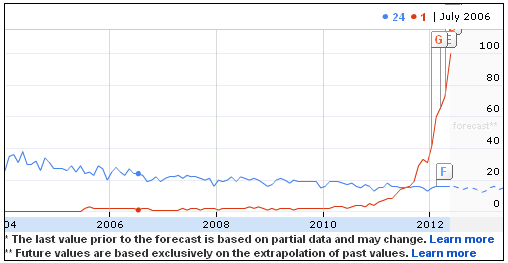
If you go to Google Insight and ask for how it goes with search interest for “data quality” versus how it is with “big data” you’ll get this graph:

“Data quality” (blue line) is a bear market. The interest is slowly but steadily decreasing. “Big data” (red line) is a bull market with a steep rising curve of interest starting in early 2011 and exploding in 2012.

So, what can you do if your blog is about data quality? For my part I’m writing a blog post on my data quality blog mentioning the term “big data” as many times as possible 🙂

I’m not saying “big data” is uninteresting. Not at all. I even use the term “big reference data” when describing how to exploit big directories and social network profiles in the quest for improving party master data quality.

In the short period of the “big data” hype it has often been said, that why should we start working with “big data” when we can’t manage small data yet?

While this makes some sense, it will in my eyes be a mistake not to try exploring what data quality techniques we can apply to “big data” and what data quality advantages we can harvest within “big data”.

We have known for years that the amount of data being available is drastically increasing. Now we just have a term to be used when searching for and talking about it. Like it or not; that term is “big data”.

Bookmark and Share

255 Reasons for Data Quality Diversity

255 is one source of truth about how many countries we have on this planet. Even with this modest list of reference data there are several sources of the truth. Another list may have 262 entries and a third list 240 entries.

As I have made a blog post some years ago called 55 reasons to improve data quality I think 255 fits nice in the title of this post.

The 55 reasons to improve data quality in the former post revolves around name and address uniqueness. In the quest for having uniqueness, and fulfilling other data quality dimensions as completeness and timeliness, a have often advocated for using deep (or big) reference data sources as address directories, business directories and consumer/citizen directories.

Doing so in the best of breed way involves dealing with a huge number of reference data sources. Services claimed to have worldwide coverage often falls a bit short compared to local services using local reference sources.

For example when I lived in Denmark, at tiny place in one corner of the world, I was often amazed how address correction services from abroad only had (sometimes outdated) street level coverage, while local reference data sources provides building number and even suite level validation.

Another example was discussed in the post The Art in Data Matching where the multi-lingual capacities needed to do well in Belgium was stressed in the comments.

Every country has its own special requirement for getting name and address data quality right, the data quality dimensions for reference data are different and governments has found 255 (or so) different solutions to balancing privacy and administrative effectiveness.

Right now I’m working on internationalization and internationalisation of a data and software service called instant Data Quality. This service makes big reference data from all over the world available in a single mashup. For that we need at least 255 partners.

Bookmark and Share

Finding Me

Many people have many names and addresses. So have I.

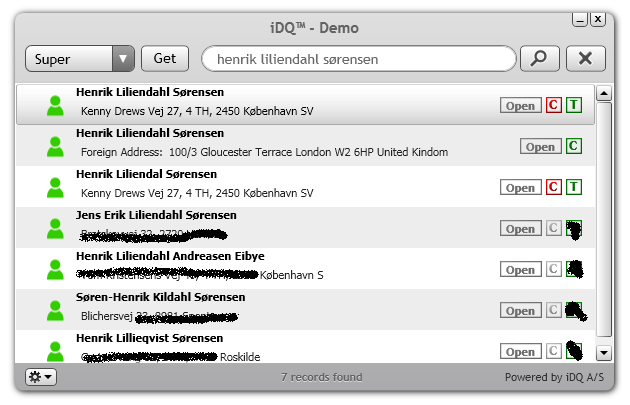
A search for me within Danish reference sources in the iDQ tool gives the following result:

Green T is positive in the Danish Telephone Books. Red C is negative in the Danish Citizen hub. Green C is positive in the Danish Citizen Hub.

Even though I have left Denmark I’m still registered with some phone subscriptions there. And my phone company hasn’t fully achieved single customer view yet, as I’m registered there with two slightly different middle (sur)names.

Following me to the United Kingdom I’m registered here with more different names.

It’s not that I’m attempting some kind of fraud, but as my surname contains The Letter Ø, and that letter isn’t part of the English alphabet, my National Insurance Number (kind of similar to the Social Security Number in the US) is registered by the name “Henrik Liliendahl Sorensen”.

But as the United Kingdom hasn’t a single citizen view, I am separately registered at the National Health Service with the name “Henrik Sorensen”. This is due to a sloppy realtor, who omitted my middle (sur)name on a flat rental contract. That name was taken further by British Gas onto my electricity bill. That document is (surprisingly for me) my most important identity paper in the UK, and it was used as proof of address when registering for health service.

How about you, do you also have several identities?

Bookmark and Share

MDM Summit Europe 2012 Preview

I am looking forward to be at the Master Data Management Summit Europe 2012 next week in London. The conference runs in parallel with the Data Governance Conference Europe 2012.

Data Governance

As I am living within a short walking distance of the venue I won’t have so much time thinking as Jill Dyché had when she recently was on a conference within driving distance, as reported on her blog post After Gartner MDM in which Jill considers MDM and takes the road less traveled. In London Jill will be delivering a key note called: Data Governance, What Your CEO Needs to know.

On the Data Governance tracks there will be a panel discussion called Data Governance in a Regulatory Environment with some good folks: Nicola Askham, Dylan Jones, Ken O’Connor and Gwen Thomas.

Nicola is currently writing an excellent blog post series on the Six Characteristics Of A Successful Data Governance Practitioner. Dylan is the founder of DataQualityPro. Ken was the star on the OCDQblog radio show today discussing Solvency II and Data Quality.

Gwen, being the founder of The Data Governance Institute, is chairing the Data Governance Conference while Aaron Zornes, the founder of The MDM Institute, is chairing the MDM Summit.

Master Data, Social MDM and Reference Data Management

The MDM Institute lately had an “MDM Alert”  with Master Data Management & Data Governance Strategic Planning Assumptions for 2012-13 with the subtitle: Pervasive & Pandemic MDM is in Your Future.

Some of the predictions are about reference data and Social MDM.

Social master data management has been a favorite subject of mine the last couple of years, and I hope to catch up with fellow MDM practitioners and learning how far this has come outside my circles.

Reference Data is a term often used either instead of Master Data or as related to Master Data. Reference data is those data defined and initially maintained outside a single enterprise. Examples from the customer master data realm are a country list, a list of states in a given country or postal code tables for countries around the world.

The trend as I see it is that enterprises seek to benefit from having reference data in more depth than those often modest populated lists mentioned above. In the customer master data realm such big reference data may be core data about:

  • Addresses being every single valid address typically within a given country.
  • Business entities being every single business entity occupying an address in a given country.
  • Consumers (or Citizens) being every single person living on an address in a given country.

There is often no single source of truth for such data.

As I’m working with an international launch of a product called instant Data Quality (iDQ™) I look forward to explore how MDM analysts and practitioners are seeing this field developing.

Bookmark and Share