Social PIM

During the last couple of years I have been talking about social MDM (Social Master Data Management) on this blog.

MDM (Master Data Management) mainly consists of two disciplines: CDI (Customer Data Integration) and PIM (Product Information Management).

With social MDM most of the talk have been around CDI as the integration of social network profiles with traditional customer (or party) master data.

But there is also a PIM side of social MDM.

Making product data lively

The other day Kimmo Kontra had a blog post called With Tiger’s clubs, you’ll golf better – and what it means to Product Information Management. Herein Kimmo examines how stories around products help with selling products. Kimmo concludes that within master data management there is going to be a need for storing and managing stories.

I agree. And having stories related to your products and services is a must for social selling. Besides having the right hard facts about products consistent across multiple channels, and having the right images and other rich media consistent as well, you will also need to include the right and consistent stories when the multiple channels embraces social media.

Sharing product data

How do we ensure that we share the same product information, including the same stories, across the ecosystem of product manufacturers, distributors and retailers?

Recently I learned about a cloud service called Actualog aiming at doing exactly that with emphasis on the daunting task of sharing product data in an international environment with different measurement systems, languages, alphabets and script systems.

Actualog very much resembles the cloud service called iDQ™ I’m working with related to customer data integration.

Listening to big data

As discussed in the post Big Data and Multi Domain Master Data Management a prerequisite for getting sense out of analyzing social data (and other big data sources) is, that you not only have a consistent view of the product data related to products that you sell yourself, but also have a consistent view of competing products and how they relate to your products.

So, social PIM requires you to extend the volume of products handled by your product information management solution probably in alternate product hierarchies.

Bookmark and Share

instant Data Quality and Business Value

During the last couple of years I have been working with a cloud service called instant Data Quality (iDQ™).

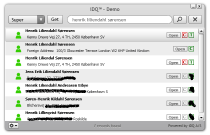
iDQ™ is basically a very advanced search engine capable of being integrated into business processes in order to get data quality for contact data right the first time and at the same time reduce the time needed for looking up and entering contact data.

With iDQ™ you are able to look up what is known about a given address, company and individual person in external sources (I call these big reference data) and what is already known inside your internal master data.

Orchestrating the contact data entry and maintenance processes this way does create better data quality along with creating business value.

The testimonials from current iDQ™ clients tells that story.

Dong Energy, a leader in providing clean and reliable energy, says:

Dong says

From the oil and gas industry Kuwait Petroleum, a company with trust as a core value, adds in:

Q8 says

In the non-profit sector the DaneAge Association, an organization supporting and counselling older people to make informed decisions, also get it:

DaneAge says

You may learn more about iDQ™ on the instant Data Quality site.

Bookmark and Share

Return on Investment in Big Reference Data

Currently I’m working with a cloud based service where we are exploiting available data about addresses, business entities and consumers/citizens from all over the world.

The cost of such data varies a lot around the world.

In Denmark, where the product is born, the costs of such data are relatively low. The joys of the welfare state also apply to access to open public sector data as reported in the post The Value of Free Address Data. Also you are able to check the identity of an individual in the citizen hub. Doing it online on a green screen you will be charged (what resembles) 50 cent, but doing it with cloud service brokerage, like in iDQ™, it will only cost you 5 cent.

In the United Kingdom the prices for public sector data about addresses, business entities and citizens are still relatively high. The Royal Mail has a license tag on the PAF file even for government bodies. Ordnance Survey is given the rest of AddressBase free for the public sector, but there is a big tag for the rest of the society. The electoral roll has a price tag too even if the data quality isn’t considered for other uses than the intended immediate purpose of use as told in the post Inaccurately Accurate.

At the moment I’m looking into similar services for the United States and a lot of other countries. Generally speaking you can get your hands on most data for a price, and the prices have come down since I checked the last time. Also there is a tendency of lowering or abandoning the price for the most basic data as names and addresses and other identification data.

As poor data quality in contact data is a big cost for most enterprises around the world, the news of decreasing prices for big reference data is good news.

However, if you are doing business internationally it is a daunting task to keep up with where to find the best and most cost effective big reference data sources for contact data and not at least how to use the sources in business processes.

Wednesday the 25th July I’m giving a presentation, in the cloud, on how iDQ™ comes to the rescue. More information on DataQualityPro.

Bookmark and Share

The Big Tower of Babel

3 years ago one of the first blog posts on this blog was called The Tower of Babel.

This post was the first of many posts about multi-cultural challenges in data quality improvement. These challenges includes not only language variations but also different character sets reflecting different alphabets and script systems, naming traditions, address formats, measure units, privacy norms, government registration practice to name some of the ones I have experienced.

When organizations are working internationally it may be tempting to build a new Tower of Babel imposing the same language for metadata (probably English) and the same standards for names, addresses and other master data (probably the ones of the country where the head quarter is).

However, building such a high tower may end up the same way as the Tower of Babel known from the old religious tales.

Alternatively a mapping approach may be technically a bit more complex but much easier when it comes to change management.

The mapping approach is used in the Universal Postal Unions’ (UPU) attempt to make a “standard” for worldwide addresses. The UPU S42 standard is mentioned in the post Down the Street. The S42 standard does not impose the same way of writing on envelopes all over the world, but facilitates mapping the existing ways into a common tagging mapped to a common structure.

Building such a mapping based “standard” for addresses, and other master data with international diversity, in your organization may be a very good way to cope with balancing the need for standardization and the risks in change management including having trusted and actionable master data.

The principle of embracing and mapping international diversity is a core element in the service I’m currently working with. It’s not that the instant Data Quality service doesn’t stretch into the clouds. Certainly it is a cloud service pulling data quality from the cloud. It’s not that that it isn’t big. Certainly it is based on big reference data.

Bookmark and Share

Beyond Address Validation

The quality of contact master data is the number one data quality issue around.

Lately there has been a lot of momentum among data quality tool providers in offering services for getting at least the postal address in contact data right. The new services are improved by:

  • Being cloud based offering validation services that are implemented at data entry and based on fresh reference data.
  • Being international and thus providing address validation for customer and other party data embracing a globalized world.

Capturing an address that is aligned with the real world may have a significant effect on business outcomes as reported by the tool vendor WorldAddresses in a recent blog post.

However, a valid address based on address reference data only tells you if the address is valid, not if the addressee is (still) on the address, and you are not sure if the name and other master data elements are accurate and complete. Therefore you often need to combine address reference data with other big reference data sources as business directories and consumer/citizen reference sources.

Using business directories is not new at all. Big reference sources as the D&B WorldBase and many other directories have been around for many years and been a core element in many data quality initiatives with customer data in business-to-business (B2B) environments and with supplier master data.

Combining address reference data and business entity reference data makes things even better, also because business directories doesn’t always come with a valid address.

Using public available reference data when registering private consumers, employees and other citizen roles has until now been practiced in some industries and for special reasons. Therefore the big reference data and the services are out there and being used today in some business processes.

Mashing up address reference data, business entity reference data and consumer/citizen reference data is a big opportunity for many organizations in the quest for high quality contact master data, as most organizations actually interact with both companies and private persons if we look at the total mix of business processes.

The next big source is going to be exploiting social network profiles as well. As told in the post Social Master Data Management social media will be an additional source of knowledge about our business partners. Again, you won’t find the full truth here either. You have to mashup all the sources.

Bookmark and Share

Mashing Up Big Reference Data and Internal Master Data

Right now I’m working on a cloud service called instant Data Quality (iDQ™).

It is basically a very advanced search engine capable of being integrated into business processes in order to get data quality right the first time and at the same time reducing the time needed for looking up and entering contact data.

With iDQ™ you are able to look up what is known about a given address, company and individual person in external sources (I call these big reference data) and what is already known in internal master data.

From a data quality point of view this mashup helps with solving some of the core data quality issues almost every organization has to deal with, being:

  • Avoiding duplicates
  • Getting data as complete as possible
  • Ensuring maximal accuracy

The mashup is also a very good foundation for taking real-time decisions about master data survivorship.

The iDQ™ service helps with getting data quality right the first time. However, you also need Ongoing Data Maintenance in order to keep data at a high quality. Therefore iDQ™ is build for trigging into subscription services for external reference data.

At iDQ we are looking for partners world-wide who see the benefit of having such a cloud based master data service connected to providing business-to-business (B2B) and/or business-to-consumer (B2C) data services, data quality services and master data management solutions.

Here’s the contact data: http://instantdq.com/contact/

Bookmark and Share

State of this Data Quality Blog

Today is a big day on this blog as it has been live for 3 years.

Success versus Failure

The first entry called Qualities of Data Architecture was a promise to talk about data quality success stories. The reason for emphasizing on success stories related to data quality is a feeling that data quality improvement is too often promoted by horror stories telling about how bad your business may go if you don’t pay attention to data quality.

The problem is that stories about failure usually aren’t taken too seriously. Jim Harris recently had a very good take on that in the post Data Quality and Chicken Little Syndrome.

So, I plan to tell even more success stories along with the inevitable stories about failure that so easily and obviously could have been avoided.

Getting Social

Using social networks to promote your blogging is quite natural.

At the same time social networks has emerged as new source in doing master data management (I call this Social MDM).

Exploring this new discipline over the hype peak, down through the valley of disappointment and up to the plateau of productivity will for sure be a recurring subject on this blog.

People, Processes and Technology

Sometimes you see a statement like “Data Quality is not about technology, it’s all about people”.

Well, most things we can’t solve easily are not just about one thing. In my eyes the old cliché about addressing people, processes and technology surely also relates to getting data quality right.

There are many good blogs around about people and processes. On this blog I’ll try to tell about my comfort zone being technology without forgetting people and processes.

The Hidden Agenda

Most people blogging are doing this to promote our (employers) expertise, services and tools and I am not different.

Lately I have written a lot about a second to none cloud based service for upstream data quality prevention. The wonder is called instant Data Quality.

While upstream prevention is the best approach to data quality still a lot of work must be done every day in downstream cleansing as told in the post Top 5 Reasons for Downstream Cleansing.

As I’m also working with a new stellar cloud based platform for data quality improvement productivity I will for sure share some props for that in the near future.

Bookmark and Share

Data Driven Data Quality

In a recent article Loraine Lawson examines how a vast majority of executives describes their business as “data driven” and how the changing world of data must change our approach to data quality.

As said in the article the world has changed since many data quality tools were created. One aspect is that “there’s a growing business hunger for external, third-party data, which can be used to improve data quality”.

Embedding third-party data into data quality improvement especially in the party master data domain has been a big part of my data quality work for many years.

Some of the interesting new scenarios are:

Ongoing Data Maintenance from Many Sources

As explained in the article on Wikipedia about data quality services as the US National Change of Address (NCOA) service and similar services around the world has been around for many years as a basic use of external data for data quality improvement.

Using updates from business directories like the Dun & Bradstreet WorldBase and other national or industry specific directories is another example.

In the post Business Contact Reference Data I have a prediction saying that professional social networks may be a new source of ongoing data maintenance in the business-to-business (B2B) realm.

Using social data in business-to-consumer (B2C) activities is another option though also haunted with complex privacy considerations.

Near-Real-Time Data Enrichment

Besides updating changes of basic master data from business directories these directories typically also contains a lot of other data of value for business processes and analytics.

Address directories may also hold further information like demographic stereotype profiles, geo codes and property data elements.

Appending phone numbers from phone books and checking national suppression lists for mailing and phoning preferences are other forms of data enrichment used a lot related to direct marketing.

Traditionally these services have been implemented by sending database extracts to a service provider and receiving enriched files for uploading back from the service provider.

Lately I have worked with a new breed of self service data enrichment tools placed in the cloud making it possible for end users to easily configure what to enrich from a palette of address, business entity and consumer/citizen related third-party data and executing the request as close to real-time as the volume makes it possible.

Such services also include the good old duplicate check now much better informed by including third-party reference data.

Instant Data Quality in Data Entry

As discussed in the post Avoiding Contact Data Entry Flaws third-party reference data as address directories, business directories and consumer/citizen directories placed in the cloud may be used very efficiently in data entry functionality in order to get data quality right the first time and at the same time reduce the time spend in data entry work.

Not at least in a globalized world where names of people reflect the diversity of almost any nation today, where business names becomes more and more creative and data entry is done at shared service centers manned with people from cultures with other address formatting rules, there is an increased need for data entry assistance based on external reference data.

When mashing up advanced search in third-party data and internal master when doing data entry you will solve most of the common data quality issues around avoiding duplicates and getting data as complete and timely as needed from day one.

Bookmark and Share

Pulling Data Quality from the Cloud

In a recent post here on the blog the benefits of instant data enrichment was discussed.

In the contact data capture context these are some examples:

  • Getting a standardized address at contact data entry makes it possible for you to easily link to sources with geo codes, property information and other location data.
  • Obtaining a company registration number or other legal entity identifier (LEI) at data entry makes it possible to enrich with a wealth of available data held in public and commercial sources.
  • Having a person’s name spelled according to available sources for the country in question helps a lot with typical data quality issues as uniqueness and consistency.

However, if you are doing business in many countries it is a daunting task to connect with the best of breed sources of big reference data. Add to that, that many enterprises are doing both business-to-business (B2B) and business-to-consumer (B2C) activities including interacting with small business owners. This means you have to link to the best sources available for addresses, companies and individuals.

A solution to this challenge is using Cloud Service Brokerage (CSB).

An example of a Cloud Service Brokerage suite for contact data quality is the instant Data Quality (iDQ™) service I’m working with right now.

This service can connect to big reference data cloud services from all over the world. Some services are open data services in the contact data realm, some are international commercial directories, some are the wealth of national reference data services for addresses, companies and individuals and even social network profiles are on the radar.

Bookmark and Share

Avoiding Contact Data Entry Flaws

Contact data is the data domain most often mentioned when talking about data quality. Names and addresses and other identification data are constantly spelled wrong, or just different, by the employees responsible of entering party master data.

Cleansing data long time after it has been captured is a common way of dealing with this huge problem. However, preventing typos, wrong hearings and multi-cultural misunderstandings at data entry is a much better option wherever applicable.

I have worked with two different approaches to ensure the best data quality for contact data entered by employees. These approaches are:

  • Correction and
  • Assistance

Correction

With correction the data entry clerk, sales representative, customer service professional or whoever is entering the data will enter the name, address and other data into a form.

After submitting the form, or in some cases leaving each field on the form, the application will check the content against business rules and available reference data and return a warning or error message and perhaps a correction to the entered data.

As duplicated data is a very common data quality issue in contact data, a frequent example of such a prompt is a warning about that a similar contact record already exists in the system.

Assistance

With assistance we try to minimize the needed number of key strokes and interactively help with searching in available reference data.

For example when entering address data assistance based data entry will start with the highest geographical level:

  • If we are dealing with international data the country will set the context and know about if a state or province is needed.
  • Where postal codes (like ZIP) exists, this is the fast path to the city.
  • In some countries the postal code only covers one street (thoroughfare), so that’s settled by the postal code. In other situations we will usually have a limited number of streets that can be picked from a list or settled with the first characters.

(I guess many people know this approach from navigation devices for cars.)

When the valid address is known you may catch companies from business directories being on that address and, depending on the country in question, you may know citizens living there from phone directories and other sources and of course the internal party master data, thus avoiding entering what is already known about names and other data.

When catching business entities a search for a name in a business directory often leads to being able to pick a range of identification data and other valuable data and not at least a reference key to future data updates.

Lately I have worked intensively with an assistance based cloud service for business processes embracing contact data entry. We have some great testimonials about the advantages of such an approach here: instant Data Quality Testimonials.

Bookmark and Share