Cross Border Master Data Management

One of the most intriguing sides of data quality and Master Data Management (MDM) is, in my eyes, how you can extend a national solution to an international solution.

Google EarthMany implementations starts with a national scope and we also see many tools and services built for a national scope. Success on a national scale does unfortunately not always guarantee success on an international scale.

Besides all the important stuff around different culture challenges and how to drive change management in an international environment, there are also some things about the master data itself that are challenging.

  • Location Master Data is probably the most obvious domain where we face issues when going international. Postal addresses are formatted differently around the world. Approximately half of the world puts the house number in front of the street name, approximately half of the world puts the house number after the street name and then in some places you don’t use house numbers on a street, but in blocks. City and postal code has the same issue. The worst solutions here tries to put the rest of the world into the first implemented national solution as told in the post Nationally International.
  • Party Master Data, also when looking beyond postal addresses, must encompass many national constraints and opportunities, not at least when it comes to exploiting third party data:
    • Utilizing business directories is one common way. Here you have to balance the use of many different best of breed national providers or taking it from a more harmonized provider of an international directory. Where I (also) work right now, we have chosen the latter solution as reported in the post Using a Business Entity Identifier from Day One.
    • If you, as I am, are coming from Scandinavia you are also amazed by the difficulties around the world there are in healthcare, elections and other areas when there is no public available national identifier for citizens as examined in the post Counting Citizens.
  • Product Master Data does in many ways look the same across countries. However, standards for product data often still are specific to a single or a specific range of countries. Also, if the national implementation was not in a country with multiple languages and the international scope includes more languages, you must encompass multilingual capacities for product information management.

What have you experienced when going from national to international?

The Gartner Magic Quadrant for MDM 2016

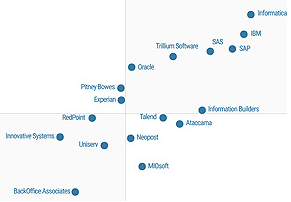
The Gartner Magic Quadrant for Master Data Management Solutions 2016 is …… not out.

Though it can be hard for a person not coming from the United States to read those silly American dates, according to this screenshot from today, it should have been out the 19th November 2016.

gartner-mdm-2016

I guess no blue hyperlink means it has not be aired yet and I do not recall having seen any vendor bragging on social media yet either.

The plan that Gartner will retire the old two quadrants for Customer MDM and Product MDM was revealed by Andrew White of Gartner earlier this year in the post Update on our Magic Quadrant’s for Master Data Management 2016.

Well, MDM implementations are often delayed, so why not the Multidomain MDM quadrant too.

In the meantime, we can take a quiz. Please comment with your guess on who will be the leaders, visionaries, challengers and niche players. Closest guess will receive a Product Data Lake t-shirt in your company’s license level size (See here for options).

Interenterprise Data Sharing and the 2016 Data Quality Magic Quadrant

dqmq2016The 2016 Magic Quadrant for Data Quality Tools by Gartner is out. One way to have a free read is downloading the report from Informatica, who is the most-top-right vendor in the tool vendor positioning.

Apart from the vendor positioning the report as always contains valuable opinions and observations about the market and how these tools are used to achieve business objectives.

Interenterprise data sharing is the last mentioned scenario besides BI and analytics (analytical scenarios), MDM (operational scenarios), information governance programs, ongoing operations and data migrations.

Another observation is that 90% of the reference customers surveyed for this Magic Quadrant consider party data a priority while the percentage of respondents prioritizing the product data domain was 47%.

My take on this difference is that it relates to interenterprise data sharing. Parties are per definition external to you and if your count of business partners (and B2C customers) exceeds some thousands (that’s the 90%), you need some of kind of tool to cope with data quality for the master data involved. If your product data are internal to you, you can manage data quality without profiling, parsing, matching and other core capabilities of a data quality tool.  If your product data are part of a cross company supply chain, and your count of products exceeds some thousands (that’s the 47%), you probably have issues with product data quality.

In my eyes, the capabilities of a data quality tool will also have to be balanced differently for product data as examined in the post Multi-Domain MDM and Data Quality Dimensions.

Black Friday Afterthoughts before Christmas

Black Friday & Christmas: 5 Retail Strategies for Providing a Wonderful Shopping Experience” is the title of a recent blog post by Antonia Renner on the Informatica blog.

This blog post revolves around how Master Data Management (MDM) and Product Information Management (PIM) can be the foundation of a better shopping experience and how to do this within driving digital transformation, being agile, and streamlining internal and external collaboration and workflows.

I agree with that. My only concern around the means mentioned relates to the section about how great customer experience starts with great supplier product data. The proposed approach for that is a self-service supplier data portal.

pdl-whyFrom what I have experienced, the concept of a supplier data portal for product data has limited chances of success. The problem for you as retailer or other form of downstream trading partner is your supplier. They will eventually have to deal with hundreds of supplier portals with different format and structure by the choice of their downstream trading partners, whereof you are just one. If you are a big one to them, it might work. Else probably not.

In the same way, your supplier could offer their customer data portal, build with their choice of format and structure. If they are a big one to you, you might go with that. Else, you probably would object to dealing with hundreds of different upstream data portals for you to go-to.

My Christmas present to you – suppliers, retailers, other supply chain nodes / PIM-MDM solution vendors – is a free trial / ambassadorship on Product Data Lake.

Product Data Lake is a cloud service for sharing product data in business ecosystems. Product Data Lake ensures:

  • Completeness of product information by enabling trading partners to exchange product data in a uniform way
  • Timeliness of product information by connecting trading partners in a process driven way
  • Conformity of product information by encompassing various international standards for product information
  • Consistency of product information by allowing upstream trading partners and downstream trading partners to interact with in-house structure of product information
  • Accuracy of product information by ensuring transparency of product information across the supply chain

It’s in your hands. See you on Product Data Lake.

Alternatives to Product Data Lake

Within Product Information Management (PIM) there is a growing awareness about that sharing product information between trading partners is a very important issue.

So, how do we do that? We could do that, on a global scale, by using:

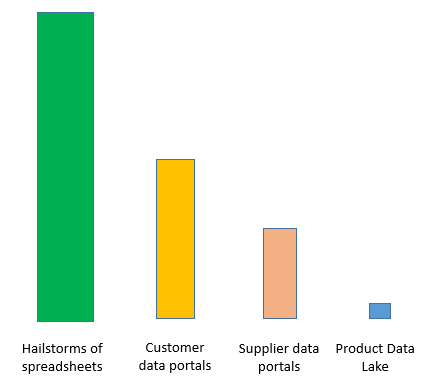
  • 1,234,567,890 spreadsheets
  • 2,345,678 customer data portals
  • 901,234 supplier data portals

Spreadsheets is the most common mean to exchange product information between trading partners today. The typical scenario is that a receiver of product information, being a downstream distributor, retailer or large end user, will have a spreadsheet for each product group that is sent to be filled by each supplier each time a new range of products is to be on-boarded (and potentially each time you need a new piece of information). As a provider of product information, being a manufacturer or upstream distributor, you will receive a different spreadsheet to be filled from each trading partner each time you are to deliver a new range of products (and potentially each time they need a new piece of information).

Customer data portals is a concept a provider of product information may have, plan to have or dream about. The idea is that each downstream trading partner can go to your customer data portal, structured in your way and format, when they need product information from you. Your trading partner will then only have to deal with your customer data portal – and the 1,234 other customer data portals in their supplier range.

Supplier data portals is a concept a receiver of product information may have, plan to have or dream about. The idea is that each upstream trading partner can go to your supplier data portal, structured in your way and format, when they have to deliver product information to you. Your trading partner will then only have to deal with your supplier data portal – and the 567 other supplier data portals in their business-to-business customer range.

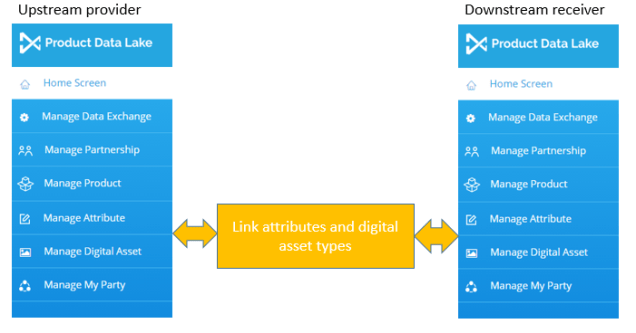
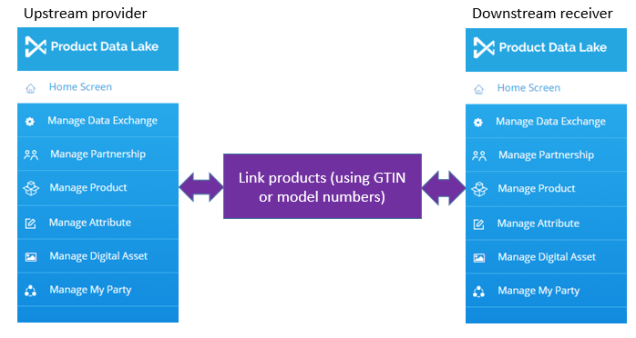
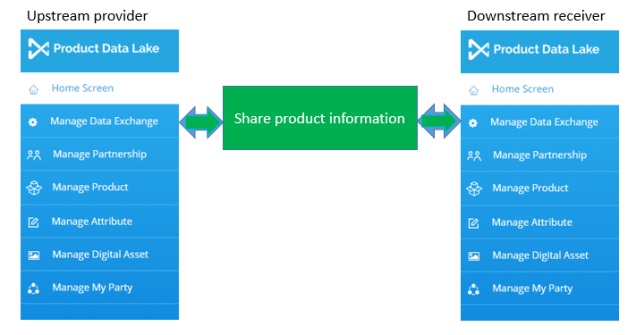
Product Data Lake is the sound alternative to the above options. Hailstorms of spreadsheets does not work. If everyone has either a passive customer data portal or a passive supplier data portal, no one will exchange anything. The solution is that you as a provider of product information will push your data in your structure and format into Product Data Lake each time you have a new product or a new piece of product information. As a receiver you will set up pull requests, that will give you data in your structure and format each time you have a new range of products, need a new piece of information or each time your trading partner has a new piece of information.

Learn more about how that works in Product Data Lake Documentation and Data Governance.

alternatives
Potential number of solutions / degree of dissatisfaction / total cost of ownership


Shipping Product Information

When looking out of the windows from Product maersk-seen-from-pdl-in-sunshineData Lake global headquarters (well, that is also our home office) we see our neighbour, which is the global headquarters of Maersk, a major worldwide operating shipping company.

In all humbleness we do very parallel business. Maersk is good at moving goods. We are going to move data about the goods. Product data or product information if you like.

The reason of being for a shipping company is that it would be very ineffective for each manufacturer of goods, if they should arrange and carry out the transportation of their manufactured goods to each distributor around the world. Furthermore, it would be equally ineffective, if each distributor should arrange and carry out the transportation of their range of goods to each reseller or large end buyer.

Until now, this ineffectiveness has unfortunately been the case when it comes to exchanging data about the goods. Manufacturers are asked by their distributors to provide product information in a different way for each – most often meaning in a different spreadsheet. And the same craziness repeats itself when it comes to exchanging data between distributors, resellers and large end users of product information.

At Product Data Lake we have set sail to end this insanity and bring digitalization to shipping of product information. Learn more about how exactly we will arrange that journey on Product Data Lake Documentation and Data Governance.

Bookmark and Share

Is blockchain technology useful within MDM?

This question was raised on this blog back in January this year in the post Tough Questions About MDM.

Since then the use of the term blockchain has been used more and more in general and related to Master Data Management (MDM). As you know, we love new fancy terms in our else boring industry.

blockchainHowever, there are good reasons to consider using the blockchain approach when it comes to master data. A blockchain approach can be coined as centralized consensus, which can be seen as opposite to centralized registry. After the MDM discipline has been around for more than a decade, most practitioners agree that the single source of truth is not practically achievable within a given organization of a certain size. Moreover, in the age of business ecosystems, it will be even harder to achieve that between trading partners.
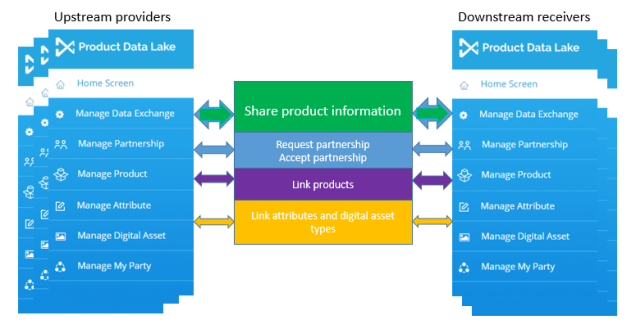
This way of thinking is at the backbone of the MDM venture called Product Data Lake I’m working with right now. Yes, we love buzzwords. As if cloud computing, social network thinking, big data architecture and preparing for Internet of Things wasn’t enough, we can add blockchain approach as a predicate too.

In Product Data Lake this approach is used to establish consensus about the information and digital assets related to a given product and each instance of that product (physical asset or thing) where it makes sense. If you are interested in how that develops, why not follow Product Data Lake on LinkedIn.

Bookmark and Share

Data Management Platforms for Business Ecosystems

The importance of looking at your enterprise as a part of business ecosystems was recently stressed by Gartner, the analyst firm, as reported in an article with the very long title stating: Gartner Says CIOs Need to Take a Leadership Role in Creating a Business Ecosystem to Drive a Digital Platform Strategy.

In my eyes, this trend will have a huge impact on how data management platforms should be delivered in the future. Until now much of the methodology and technology for data management platforms have been limited to how these things are handled within the corporate walls. We will need a new breed of data management platforms build for business ecosystems.

pdl-top-narrow

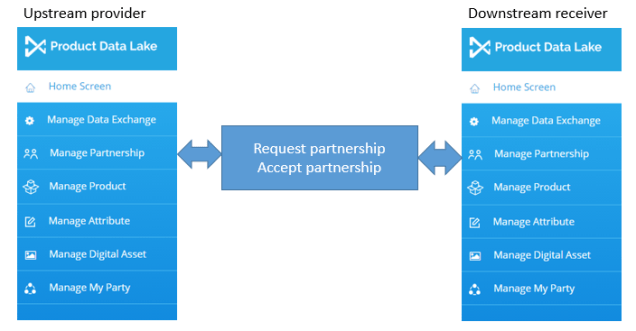
Such platforms will have the characteristics of other new approaches to handling data. They will resemble social networks where you request and accept connections. They will embrace data as big data and data lakes, where every purpose of data consumption are not cut in stone before collecting data. These platforms will predominately be based in the cloud.

Right now I am working with putting such a data management service up in the cloud. The aim is to support product data sharing for business ecosystems. I will welcome you, and your trading partners, as subscriber to the service. If you help trading partners with Product Information Management (PIM) there is a place for you as ambassador. Anyway, please start with following Product Data Lake on LinkedIn.

Sign Up is Open

Over the recent one and a half year many of the posts on this blog has been about Product Data Lake, a cloud service for sharing product data in the business ecosystems of manufacturers, distributors, retailers and end users of product information.

From my work as a data quality and Master Data Management (MDM) consultant, I have seen the need for a service to solve data quality issues, when it comes to product master data. My observation has been that the root cause of these issues are found in the way that trading partners exchange product information and digital assets.

It is the aim of Product Data Lake to ensure:

  • Completeness of product information by enabling trading partners to exchange product data in a uniform way
  • Timeliness of product information by connecting trading partners in a process driven way
  • Conformity of product information by encompassing various international standards for product information
  • Consistency of product information by allowing upstream trading partners and downstream trading partners to interact with in-house structure of product information
  • Accuracy of product information by ensuring transparency of product information across the supply chain.

You can learn more about how Product Data Lake works on the documentation site.

pdl-how-much-smallBecome a:

Sign Up is open on www.productdatalake.com

Bookmark and Share