The difference between doing Business-to-Consumer (B2C) or Business-to-Business (B2B) reflects itself in many IT enabled disciplines.
When it comes to Product Information Management (PIM) this is true as well. As PIM has become essential with the rise of eCommerce, some of the differences are inherited from the eCommerce discipline. There is a discussion on this in a post on the Shopify blog by Ross Simmonds. The post is called B2B vs B2C Ecommerce: What’s The Difference?
Some significant observations to go into the PIM realm is that for B2B, compared to B2C:
The audience is (on average) narrower
The price is (on average) higher
The decision process is (on average) more thoughtful
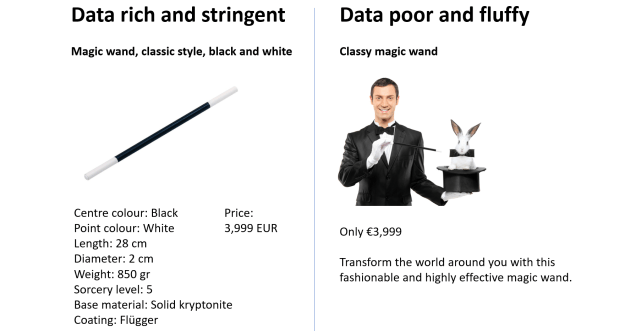
To sum up the differences I would say that some of the technology you need, for example PIM solutions, is basically the same but the data to go into these solutions must be more elaborate and stringent for B2B. This means that for B2B, compared to B2C, you (on average) need:
More complete and more consistent attributes (specifications, features, properties) for each product and these should be more tailored to each product group.
More complete and consistent product relations (accessories, replacements, spare parts) for each product.
More complete and consistent digital assets (images, line drawings, certificates) for each product.
How to achieve that involves deep collaboration in the supply chains of manufacturers, distributors and merchants. The solutions for that was examined in the post The Long Tail of Product Data Synchronization.
Ultima Thule is a name for a distant place beyond the known world and the nickname of the most distant object in the solar system closely observed by a man-made object today the 1st January 2019. Before the flyby scientists were unsure if it was two objects, a peanut formed object or another shape. The images probing what it is will be downloaded during the next couple of months.
There are many market reports covering the Master Data Management (MDM) and Product Information Management (PIM) market. Below you can find 4 of these coming from who is usually considered as the more reliable analyst houses around:
In a comment to this post Nadim observes that this Gartner quadrant is mixing up pure MDM players and PIM players.
That is true. It has always been a discussion point if one should combine or separate solutions for Master Data Management (MDM) and Product Information Management (PIM). This is a question to be asked by end user organizations and it is certainly a question the vendors on the market(s) ask themselves.
If we look at the vendors included in the 2018 Magic Quadrant the PIM part is represented in some different ways.
I would say that two of the newcomers, Viamedici and Contentserv (yellow dots in below figure), are mostly PIM players today. This is also mentioned as a caution by Gartner and is a reason for the current left-bottom’ish placement in the quadrant. But both companies want to be more multidomain MDM’ish.
8 years ago, I was engaged at Stibo Systems as part of their first steps on the route from PIM to multidomain MDM. Enterworks and Riversand (the orange dots in above figure) is on the same road.
Informatica has taken a different path towards the same destination as they back in 2012 bought the PIM player Heiler. Gartner has some cautions about how well the MDM and PIM components makes up a whole in the Informatica offerings and similar cautions was expressed around the Forrester PIM Wave as seen in the comments to the post There is no PIM quadrant, but there is a PIM wave.
The term narcissism originates from Greek mythology, where the young Narcissus fell in love with his own image reflected in a pool of water. While this is about how a natural person may behave it can certainly also be applied to how a company behaves.
Not to show empathy to customers
I think we all know the classic sales presentation with endless slides about how big and wonderful the selling company is and how fantastic the products they sell are. This approach contradicts everything we know about selling, which is to start with the needs and pain points at the buying company and then how the selling company effectively can fulfill the needs and make the pain points go away.
Not to show empathy to trading partners
While business outcomes originate from selling to your customers it certainly also is affected by how you treat your trading partners and how you can put yourself in their place.
An example close to me is exchange of product information (product data syndication) between trading partners. We often see solutions which is made to make it easy for you but then being difficult for your trading partner. This includes requiring your spreadsheet format to filled out by your trading partner, may be a customer data portal set up by a manufacturer or opposite a supplier data portal set up by a merchant. These are narcissistic dead ends as told in the post The Death Trap in Product Information Management: Your Customer/Supplier Portal.
Until now my venture called Product Data Lake has been a rather technical quest. As with most start-ups the first years have been around building the actual software (in our case facilitated by Larion Computing in Vietnam), adjusting the market fit and run numerous trials with interested parties.
Now it is time to go to market for real. I am happy that another Henrik has joined as CEO and will emphasize on leading the marketing, sales and financial activities.
While I will be concentrating on the product strategy and product management activities it is time to recap the business outcomes we want our subscribers and partners to achieve. Let me express those towards three kinds of business partners:
Manufacturers and brand owners:
On the upstream side of Product Data Lake our goal is to let you as a manufacturer and/or brand owner:
Sell more: Your re-sellers will have the most complete, accurate and timely product information in front of their customers.
Reduce costs: Push your product information in one uniform way and let your re-sellers pull it in their many ways.
Our concept, using emerging technologies within Product Data Lake, will free you from applying many different solutions to providing product information to your re-sellers. You will avoid errors. You will be able to automate the processes and you will be easy to do business with in the eyes of your trading partners.
The people who will use your products want to get complete product information when making the buying decision wherever they are in the supply chain.
You can follow the news stream for this on our LinkedIn showcase page called Product Data Push.
Merchants (dealers and retailers):
On the downstream side of Product Data Lake our goal is to let you as a merchant (dealer or retailer) gain substantial business outcome.
You will sell more by having the most complete, accurate and timely product information in front of your online customers when they make self-service buying decisions.
You will reduce costs as you can pull product information in one uniform way and let your suppliers push it in their many ways. Hereby you can automate the processes, avoid errors and reduce product returns.
Our solution, using emerging technologies within Product Data Lake, will make you be easy to do business with in the eyes of your suppliers and make your product information transform into a powerful weapon in the quest for winning more online market share.
The people who may buy your product range deserves to know all about it and wants to get that information when making the buying decision. Remember: 81 % of visitors will leave a web-shop with incomplete product information.
You can follow the news stream for this on our LinkedIn showcase page called Product Data Pull.
Technology and service partners:
Ambassadors at Product Data Lake can sign up subscribers, assisting these subscribers in uploading their relevant product information portfolio to Product Data Lake and assisting these subscribers in linking their product information with the product information at their trading partners. As an ambassador, you will:
Have the opportunity to work with a big data solution within Product Information Management.
Have the opportunity to make data mapping and/or data integration services and cross-sell of other services for subscribers in a whole supply ecosystem.
Get 25 % kickback on new subscriptions in a potentially exponentially growing subscriber base in supply ecosystems
As Reservoir you can bring new life into product data portals and pools. Product Data Lake is a unique opportunity for service providers with product data portfolios for utilizing modern data management technology and offer a comprehensive way of linking, collecting and distributing product data within the business processes used by subscribers. Signing up as reservoir is free.
The linking theme also related to applying artificial intelligence / machine learning to mapping between the different product information taxonomies in use at trading partners, where we collaborate with business partners who provide such capabilities.
You can follow the news stream for this on our LinkedIn showcase page called Product Data Link.
20 years ago, when I started working as a contractor and entrepreneur in the data management space, data was not on the top agenda at many enterprises. Fortunately, that has changed.
An example is displayed by Schneider Electric CEO Jean-Pascal Tricoire in his recent blog post on how digitization and data can enable companies to be more sustainable. You can read it on the Schneider Electric Blog in the post 3 Myths About Sustainability and Business.
Manufacturers in the building material sector naturally emphasizes on sustainability. In his post Jean-Pascal Tricoire says: “The digital revolution helps answering several of the major sustainability challenges, dispelling some of the lingering myths regarding sustainability and business growth”.
One of three myths dispelled is: Sustainability data is still too costly and time-consuming to manage.
From my work with Master Data Management (MDM) and Product Information Management (PIM) at manufacturers and merchants in the building material sector I know that managing the basic product data, trading data and customer self-service ready product data is hard enough. Taking on sustainability data will only make that harder. So, we need to be smarter in our product data management. Smart and sustainable homes and smart sustainable cities need smart product data management.
In his post Jean-Pascal Tricoire mentions that Schneider Electric has worked with other enterprises in their ecosystem in order to be smarter about product data related to sustainability. In my eyes the business ecosystem theme is key in the product data smartness quest as pondered in the post about How Manufacturers of Building Materials Can Improve Product Information Efficiency.
The intersection between Artificial Intelligence (AI) and Master Data Management (MDM) – and the associated discipline Product Information Management (PIM) – is an emerging topic.
A use case close to me
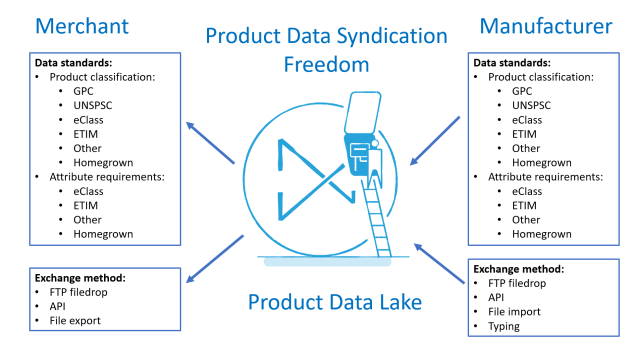
In my work at setting up a service called Product Data Lake the inclusion of AI has become an important topic. The aim of this service is to translate between the different taxonomies in use at trading partners for example when a manufacturer shares his product information with a merchant.
In some cases the manufacturer, the provider of product information, may use the same standard for product information as the merchant. This may be deep standards as eCl@ss and ETIM or pure product classification standards as UNSPSC. In this case we can apply deterministic matching of the classifications and the attributes (also called properties or features).
However, most often there are uncovered areas even when two trading partners share the same standard. And then again, the most frequent situation is that the two trading partners are using different standards.
In that case we initially will use human resources to do the linking. Our data governance framework for that includes upstream (manufacturer) responsibility, downstream (merchant) responsibility and our ambassador concept.
As always, applying too much human interaction is costly, time consuming and error prone. Therefore, we are very eagerly training our machines to be able to do this work in a cost-effective way, within a much shorter time frame and with a repeatable and consistent outcome to the benefit of the participating manufacturers, merchants and other enterprises involved in exchanging products and the related product information.
Learning from others
This week I participated in a workshop around exchanging experiences and proofing use cases for AI and MDM. The above-mentioned use case was one of several use cases examined here. And for sure, there is a basis for applying AI with substantial benefits for the enterprises who gets this. The workshop was arranged by Camelot Management Consultants within their Global Community for Artificial Intelligence in MDM.
There is a tendency when deploying Product Information Management (PIM) solutions, that you may want to add a portal for your trading partners:
If you are a manufacturer, you could have a customer portal where your downstream re-sellers can fetch the nicely arranged product information that is the result of your PIM implementation.
If you are a merchant, you could have a supplier portal where your upstream suppliers can deliver their information nicely arranged according to your product information standards in your PIM implementation.
This is a death trap for both manufacturers and merchants, because:
As a trading manufacturer and merchant, you probably follow different standards, so one must obey to the other. The result is that one side will have a lot of manual and costly work to do to obey the strongest trading partner. Only a few will be the strongest all the time.
If all manufacturers have a customer portal and all merchants have a supplier portal everyone will be waiting for the other and no product information will flow in the supply chains.
There are three kinds of data monetization: Selling data, wrapping data around products and utilizing advanced analytics leading to fast operational decision making. These options were examined in the post Three Flavors of Data Monetization.
If we look at the middle option, wrapping data around products, and narrow it down to wrapping data around tangible products, there are some ways to execute that for supply change delegates, not at least if the participating business entities embraces the business ecosystem where goods are moved through:
Manufacturers need to streamline the handling of product information internally. This includes disciplines as PLM (Product Lifecycle Management) and PIM (Product Information Management). On top of that, manufacturers need to be effective in the way the product information is forwarded to direct customers and distributors/wholesalers and merchants as exemplified in the post How Manufacturers of Building Materials Can Improve Product Information Efficiency.
Merchants need to utilize the best way of getting data into inhouse PIM (Product Information Management) solutions or other kind of solutions where data flows in from trading partners. Many merchants have a huge variety in product information needs as told in the post Work Clothes versus Fashion: A Product Information Perspective. On top of that a merchant will have supplying manufacturers and distributors with varying formats and capabilities to offer product information as discussed in the post PIM Supplier Portals: Are They Good or Bad?.
Shippers may extend their offerings from moving the goods between manufacturers and merchants (or directly to end users) to also moving the information about the goods as suggested in the post New Routes for Products. New Routes for Product Information.
The end goal is that the buyer personas in self-service scenarios will be able to make a fact based and full informed decision as pondered in the post Where to Buy a Magic Wand?
 When it comes to Product Information Management (PIM) this is true as well. As PIM has become essential with the rise of eCommerce, some of the differences are inherited from the eCommerce discipline. There is a discussion on this in a post on the Shopify blog by Ross Simmonds. The post is called B2B vs B2C Ecommerce: What’s The Difference?

 The term narcissism originates from Greek mythology, where the young Narcissus fell in love with his own image reflected in a pool of water. While this is about how a natural person may behave it can certainly also be applied to how a company behaves.

 Liliendahl on Data Quality