Gravitational Waves in the MDM World

One of the big news this week was the detection of gravitational waves. The big thing about this huge step in science is that we now will be able to see things in space, we could not see before. These are things we have plenty of clues about, but we cannot measure them because they do not emit electromagnetic radiation and the light from them is absorbed or reflected by cosmic bodies or dust before it reaches our telescopes.

We have kind of the same in the MDM (Master Data Management) world. We know that there is such a thing called multi-domain Master Data Management but our biggest telescope, the Gartner magic quadrants, only until now clearly identified customer Master Data Management and product Master Data Management as latest touched in the post The Perhaps Second Most Important MDM Quadrant 2015 is Out.

Indeed, many MDM programmes that actually does encompass all MDM domains do split the efforts into traditional domains as customer, vendor and product with separate teams observing their part of the sky. It takes a lot to advocate for that despite vendors belongs to the buy side and customers belongs to the sell side of the organization, there are strong ties between these objects. We can detect gravity in terms of that a vendor and a customer can be the same real world entity and vendors and customers have the same basic structure being a party.

GW MDM

Products do behave differently depending on the industry where your organization belongs. You may make products utilizing raw materials you buy and transform into finished products you sell or/and you may buy and sell the same physical product as a distributor, retailer or other value adding node in the supply chain. In order to handle the drastic increased demand for product data related to eCommerce, PIM (Product Information Management) has been known for long and many organizations everywhere in supply chains have already established PIM capabilities inside their organization with or without and inside or outside product Master Data Management.

What we still need to detect is a good system for connecting the PIM portion of sell sides upstream and buy sides downstream in supply chains. Right now we only see a blurred galaxy of spreadsheets as examined in the post Excellence vs Excel.


Bookmark and Share

MDM Tools Revealed

Every organization needs Master Data Management (MDM). But does every organization need a MDM tool?

In many ways the MDM tools we see on the market resembles common database tools. But there are some things the MDM tools do better than a common database management tool. The post called The Database versus the Hub outlines three such features being:

  • Controlling hierarchical completeness
  • Achieving a Single Business Partner View
  • Exploiting Real World Awareness

Controlling hierarchical completeness and achieving a single business partner view is closely related to the two things data quality tools do better than common database systems as explained in the post Data Quality Tools Revealed. These two features are:

  • Data profiling and
  • Data matching

Specialized data profiling tools are very good at providing out-of-the-box functionality for statistical summaries and frequency distributions for the unique values and formats found within the fields of your data sources in order to measure data quality and find critical areas that may harm your business. These capabilities are often better and easier to use than what you find inside a MDM tool. However, in order to measure the improvement in a business context and fix the problems not just in a one-off you need a solid MDM environment.

When it comes to data matching we also still see specialized solutions that are more effective and easier to use than what is typically delivered inside MDM solutions. Besides that, we also see business scenarios where it is better to do the data matching outside the MDM platform as examined in the post The Place for Data Matching in and around MDM.

Looking at the single MDM domains we also see alternatives. Customer Relation Management (CRM) systems are popular as a choice for managing customer master data.  But as explained in the post CRM systems and Customer MDM: CRM systems are said to deliver a Single Customer View but usually they don’t. The way CRM systems are built, used and integrated is a certain track to create duplicates. Some remedies for that are touched in the post The Good, Better and Best Way of Avoiding Duplicates.

integriertWith product master data we also have Product Information Management (PIM) solutions. From what I have seen PIM solutions has one key capability that is essentially different from a common database solution and how many MDM solutions, that are built with party master data in mind, has. That is a flexible and super user angled way of building hierarchies and assigning attributes to entities – in this case particularly products. If you offer customer self-service, like in eCommerce, with products that have varying attributes you need PIM functionality. If you want to do this smart, you need a collaboration environment for supplier self-service as well as pondered in the post Chinese Whispers and Data Quality.
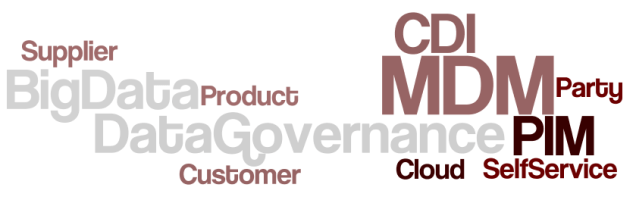
All in all the necessary components and combinations for a suitable MDM toolbox are plentiful and can be obtained by one-stop-shopping or by putting some best-of-breed solutions together.

The Evolution of MDM

Master Data Management (MDM) is a bit more than 10 years old as told in the post from last year called Happy 10 Years Birthday MDM Solutions. MDM has developed from the two disciplines called Customer Data Integration (CDI) and Product Information Management (PIM). For example, the MDM Institute was originally called the The Customer Data Integration Institute and still have this website:http://www.tcdii.com/.

Today Multi-Domain MDM is about managing customer, or rather party, master data together with product master data and other master data domains as visualized in the post A Master Data Mind Map.

You may argue that PIM (Product Information Management) is not the same as Product MDM. This question was examined in the post PIM, Product MDM and Multi-Domain MDM. In my eyes the benefits of keeping PIM as part of Multi-Domain MDM are bigger than the benefits of separating PIM and MDM. It is about expanding MDM across the sell-side and the buy-side of the business eventually by enabling wide use of customer self-service and supplier self-service.

MDM

The external self-service theme will in my eyes be at the centre of where MDM is going in the future. In going down that path there will be consequences for how we see data governance as discussed in the post Data Governance in the Self-Service Age. Another aspect of how MDM is going to be seen from the outside and in is the increased use of third party reference data and the link between big data and MDM as touched in the post Adding 180 Degrees to MDM.

Besides Multi-Domain MDM and the links between MDM and big data a much mentioned future trend in MDM is doing MDM in the cloud. The latter is in my eyes a natural consequence of the external self-service themes and increased use of third party reference data.

If you happen to be around Copenhagen in the late January I can offer you the full story at a late afternoon event taking place in the trendy meatpacking district and arranged by the local IT frontrunner company ChangeGroup. The event is called Master Data Management: Before, now and in the future.

My 2016 MDM Clairvoyance

Bowl
Magic glass bowl

Now is the time of the year where you can try predicting what will happen in the next year within a certain field of interest to you.

When we talk about predictions within data management, we usually mean something based on analysing historical data with emphasis on seeing some recent trends.

My precognitions for the Master Data Management (MDM) market I have to admit is of the more traditional kind. Gut feelings. Qualified guessing if you like.

So, here are three foreseeings:

  • Gartner, the analyst firm, will finally stop publishing two magic quadrants for MDM (one for customer and product MDM) and, using some suitable data from their surveys, admit that there now is only one true multidomain market for larger MDM vendors. They might however introduce a new quadrant for what was more or less known as Product Information Management (PIM). But under a new term and with focus on eCommerce capabilities.
  • There will be more acquisitions in the market than seen since five years ago. At least one of the larger former product MDM specialists will buy a customer MDM specialist first and foremost in order to gain reference clients. Also MDM vendors will be looking for buying land in the new big data world.
  • The numbers and scopes of MDM projects will increase and therefore there will be a shortage of people with MDM experience. This trend will pave the way for more agile approaches to MDM including implementing less complex MDM solutions and services whereof most, in contradiction to the multidomain trend, will be domain (customer/party, product, location) niche players.

MDM and SCM: Inside and outside the corporate walls

QuadrantIn my journey through the Master Data Management (MDM) landscape, I am currently working from a Supply Chain Management (SCM) perspective. SCM is very exciting as it connects the buy-side and the sell-side of a company. In that connection we will be able to understand some basic features of multi-domain MDM as touched in a recent post about the MDM ancestors called Customer Data Integration (CDI) and Product Information Management (PIM). The post is called CDI, PIM, MDM and Beyond.

MDM and SCM 1.0: Inside the corporate walls

Traditional Supply Chain Management deals with what goes on from when a product is received from a supplier, or vendor if you like, to it ends up at the customer.

In the distribution and retail world, the product physically usually stays the same, but from a data management perspective we struggle with having buying views and selling views on the data.

In the manufacturing world, we sees the products we are going to sell transforming from raw materials over semi-finished products to finished goods. One challenge here is when companies grow through acquisitions, then a given real world product might be seen as a raw material in one plant but a finished good in another plant.

Regardless of the position of our company in the ecosystem, we also have to deal with the buy side of products as machinery, spare parts, supplies and other goods, which stays in the company.

MDM and SCM 2.0: Outside the corporate walls

SCM 2.0 is often used to describe handling the extended supply chain that is a reality for many businesses today due to business process outsourcing and other ways of collaboration within ecosystems of manufacturers, distributors, retailers, end users and service providers.

From a master data management perspective the ways of handling supplier/vendor master data and customer master data here melts into handling business-partner master data or simply party master data.

For product master data there are huge opportunities in sharing most of these master data within the ecosystems. Usually you will do that in the cloud.

In such environments, we have to rethink our approach to data / information governance. This challenge was, with set out in cloud computing, examined by Andrew White of Gartner (the analyst firm) in a blog post called “Thoughts on The Gathering Storm: Information Governance in the Cloud”.

Spectre vs James Bond and the Unique Product Identifier

bond_24_spectreThe latest James Bond movie is out. It is called Spectre. Spectre is the name of a criminal organization.

In the movie “Bond, James Bond” alias 007 and in this case Mickey Mouse sneaks into a Spectre meeting. At that meeting the Spectre folks reports how they maliciously earns money. One way is selling falsified medicine.

Of course Bond hits Spectre hard during the movie. And if Bond didn’t hit all the villains, data management will do so related to falsified medicine.

The method is using a unique product identifier.

Usually in master data management, we describe a product to the level of unique characteristics also called a Stock Keeping Unit (SKU). In the pharmaceutical world that will typically be a brand name, a concentration of active substances, a dosage type and pack size and possibly a destination country.

From the electronics and machinery sectors, we know the approach of assigning each physical instance of the product a serial number. The same approach is becoming mandatory for medicine in more and more countries. The pharmaceutical manufacturers will assign a unique number to every package (and sometimes also shipping boxes) and report those to the health care authorities around the world. At the point of delivery, it is checked that the identifier equals an original product instance.

The identifier is formed by a product identifier being a Global Trade Identification Number (GTIN) or a National Drug Code (NDC) plus a randomly assigned serial number, making it hard to guess the serial number part.

Data Quality: The Union of First Time Right and Data Cleansing

The other day Joy Medved aka @ParaDataGeek made this tweet:

https://twitter.com/ParaDataGeek

Indeed, upstream prevention of bad data to enter our databases is sure the better way compared to downstream data cleaning. Also real time enrichment is better than enriching long time after data has been put to work.

That said, there are situations where data cleaning has to be done. These reasons were examined in the post Top 5 Reasons for Downstream Cleansing. But I can’t think of many situations, where a downstream cleaning and/or enrichment operation will be of much worth if it isn’t followed up by an approach to getting it first time right in the future.

If we go a level deeper into data quality challenges, there will be some different data quality dimensions with different importance to various data domains as explored in the post Multi-Domain MDM and Data Quality Dimensions.

With customer master data we most often have issues with uniqueness and location precision. While I have spend many happy years with data cleansing, data enrichment and data matching tools, I have during the last couple of years been focusing on a tool for getting that first time right.

Product master data are often marred by issues with completeness and (location) conformity. The situation here is that tools and platforms for mastering product data are focussed on what goes on inside a given organization and not so much about what goes on between trading partners. Standardization seems to be the only hope. But that path is too long to wait for and may in some way be contradicting the end purpose as discussed under the post Image Coming Soon.

So in order to have a first time right solution for product master data sharing, I have embarked on a journey with a service called the Product Data Lake. If you want to join, you are most welcome.

PS: The product data lake also has the capability of catching up with the sins of the past.

Bookmark and Share

Image Coming Soon

End customer self-service has grown dramatically during the last decades due to the increasing adoption of ecommerce. When customers shop online they need a lot of information about the product they intent to buy. One of the pieces of information they need is an image of the product. The image helps customers to understand if it is the intended product they are going to buy and helps with quickly differentiating among a range of products.

Unfortunately the most common image around on web shops is the “image coming soon”.

Image coming soon

Completeness is a huge problem in Product Information Management (PIM) as examined in my previous post called Multi-Domain MDM and Data Quality Dimensions. A missing product image is a classic completeness issue for product master data.

As a web shop you can collect a product image in several ways, namely:

  • Take the image yourself
  • Get it from the manufacturer

The former approach is cumbersome and usually only used for selected products for a special purpose of use. The latter one is far the most common. When you deal with many products and constant new on-boarding of products, you want to have a uniform and automated approach to collect images along with all the other product information needed for the specific product category.

A clumsy variant of the latter is scraping it from your manufacturer’s website or even your competitor’s website. Or having someone far away doing that for you.

The better way is to start sharing product data and digital assets, including product images, within the ecosystems of manufacturers, distributors, retailers and end users. Stay tuned. A service for that is coming soon 🙂

Bookmark and Share

Chinese Whispers and Data Quality

There is a game called Chinese Whispers or Broken Telephone or some other names. In that game, one person whispers a message to another person. The message is passed through a line of people until the last player announces the message to the entire group. At that point the message is often quite different or very shortened. The reasons for that is human unreliability including how we put our own perceptions and filters into a message.

When working with data quality you often see the same phenomenon when data is passed through a chain. One area I have observed in recent years is within Product Information Management (PIM). Here the chain is not just the data chain within a given company but the whole data chain in ecosystems of manufacturers, distributors, retailers and end users.

While Product Information Management (PIM) solutions and Product Master Data Management (Product MDM) solutions – if there is a difference – address the issues within a given company, we haven’t seen adequate solutions for solving the problem in the exchange zones between trading partners.

Broken data supply chain

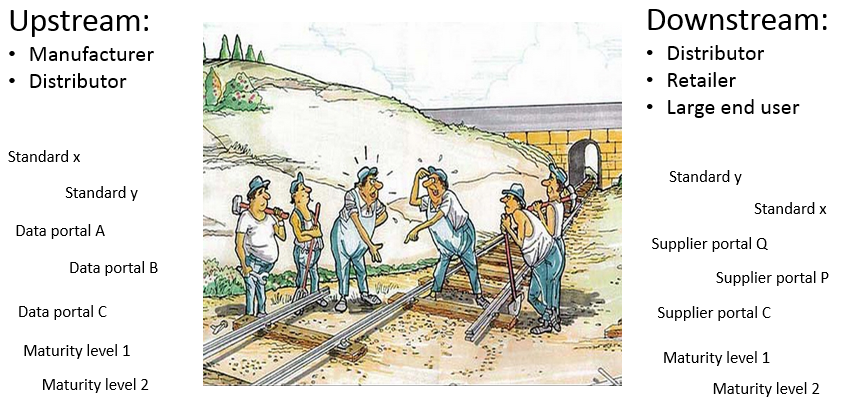
From what I have seen the solutions that upstream providers of product data work with and the solutions that downstream receivers of product data work with will not go well together.

Consequently, I am right now working with a solution to end Chinese whispers in product data supply chains. Check out the Product Data Lake.

Bookmark and Share

Toilet Seats and Data Quality

When working with data quality in the product master data management domain you are very dependent on your business partners. Product master data are shared along with the physical products in the ecosystem of manufacturers, distributors, retailers and end users.

Toilet seatIn a current role, I have worked a lot with sourcing product data from suppliers. One of our recurring examples is about one of our product categories being toilet seats. In that context, we have three different kind of suppliers:

  • Those who use the term “toilet seat” in their product descriptions. That is marvelous, then we can use that part of the product description directly as it is. Wonderful data quality.
  • Those who only use the term “seat” in their product description. Well, it is not really bad data quality for a dedicated manufacturer of bathroom stuff, because what could a seat else be in that context. However, for consistency reasons we have to correct “seat” into “toilet seat”.
  • Those who use the term “WC seat”. Actually, “WC seat” could be more accurate than “toilet seat”, because we are talking about seats for a room with water opposite to older solutions. Nevertheless, for consistency reasons we have to correct “WC seat” into “toilet seat”.

Manufacturers, distributors and retailers have to work together in order to create win-win situations by sharing product data with an optimal data quality. This is however not straight forward, as you always will be part of an ecosystem where your competitors operate too and often you are not prepared to share the same seat as your competitor.

Bookmark and Share