Going in the Wrong Direction

When travelling with the London Underground I have several times noticed that the onboard passenger information system is set wrong, typically as if we are going in the opposite direction as what was announced on the station and where the train actually is heading.

People’s reactions

The reaction among the passengers to this data quality flaw varies. Most people who seem to be frequent commuters don’t seem to bother but keeps calm and carries on. Tourists on the other hand get confused and immediately try to appoint the culprit among them who apparently got them on the wrong train.

As the information system keeps on announcing the next station as the one we just left everyone not being new passengers keeps calm and carries on in the opposite direction of the data presented.

Big data quality issues

The problem with wrong journey settings in data collection within public transportation has actually been a challenge I have worked with a lot.

Besides confusing the passengers if presented on the onboard passenger information display and voicing, the data collection may also be corrupted leading to data quality issues when data is stored in a data warehouse or by other techniques in order to facilitate analysis of passenger travel patterns, how well the services applies to schedules and other reporting based on these big numbers of transaction data collected every day.

Aligning with master data

The challenge is to correctly join the transaction data with the right master data entities. A vehicle stop, and in some cases the passenger boarding and alighting, must be associated with the right product being a given journey on a given service according to a given time schedule.

Many other exploitations of big data shares the same basic data quality challenge. If we don’t get the transaction data joined correctly with the master data entities involved, any analysis and reporting may be going in the wrong direction.

Bookmark and Share

Social PIM

During the last couple of years I have been talking about social MDM (Social Master Data Management) on this blog.

MDM (Master Data Management) mainly consists of two disciplines: CDI (Customer Data Integration) and PIM (Product Information Management).

With social MDM most of the talk have been around CDI as the integration of social network profiles with traditional customer (or party) master data.

But there is also a PIM side of social MDM.

Making product data lively

The other day Kimmo Kontra had a blog post called With Tiger’s clubs, you’ll golf better – and what it means to Product Information Management. Herein Kimmo examines how stories around products help with selling products. Kimmo concludes that within master data management there is going to be a need for storing and managing stories.

I agree. And having stories related to your products and services is a must for social selling. Besides having the right hard facts about products consistent across multiple channels, and having the right images and other rich media consistent as well, you will also need to include the right and consistent stories when the multiple channels embraces social media.

Sharing product data

How do we ensure that we share the same product information, including the same stories, across the ecosystem of product manufacturers, distributors and retailers?

Recently I learned about a cloud service called Actualog aiming at doing exactly that with emphasis on the daunting task of sharing product data in an international environment with different measurement systems, languages, alphabets and script systems.

Actualog very much resembles the cloud service called iDQ™ I’m working with related to customer data integration.

Listening to big data

As discussed in the post Big Data and Multi Domain Master Data Management a prerequisite for getting sense out of analyzing social data (and other big data sources) is, that you not only have a consistent view of the product data related to products that you sell yourself, but also have a consistent view of competing products and how they relate to your products.

So, social PIM requires you to extend the volume of products handled by your product information management solution probably in alternate product hierarchies.

Bookmark and Share

Hot and Magic Medal Counting

In the ongoing Olympic Games one often displayed list is the list of medals per nation.

The list reminds me about the occasional analyst report ranking of Data Quality tools and Master Data Management (MDM) solutions. The latest one is fresh pressed as told in the post called Product Information Management is HOT for Business by Ventana Research, where the PIM vendors are ranked with Stibo Systems being the most HOT.

The counting of medals in the Olympic Games in London this afternoon looks like this:

As expected the top race is between the big teams from United States and China just as the mega vendors of tools also always receives good rankings by analysts though with a few exceptions as reported in the post The Data Quality Tool Vendor Difference, where the Gartner MAGIC Quadrant is compared with the ranking from Information Difference.

As often seen the home team, Great Britain and Northern Ireland, is also doing very well. With tools we also see that the Most Times the Home Team Wins despite of analyst ranking when a local client selects a tool.

Other big teams as Russia, Japan and Australia are currently struggling to get more gold medals to climb the list if ranked by gold (instead of total number of medals). Perhaps we will see a closer race with more teams in the last week just as expected with MDM tools as reported in the post Photo Finish in MDM Vendor Race.

The smaller nations often does it better in a small range of disciplines, like Ethiopia in running and Denmark in rowing and sailing resembling the situation described in the post Who is not Using Data Quality MAGIC, as there are plenty of Data Quality tools out there very feasible in certain tasks and local circumstances.

Bookmark and Share

Photo Finish in MDM Vendor Race

With the London Olympics going on we will probably see a lot of winners after a photo finish.

I noticed another photo finish in a recent analyst report called The MDM Landscape Q2 2012 by the Information Difference.

The MDM (Master Data Management) vendors are scored by technology and market strength. If we look at the technology axis – the vertical one, there is a close race.

Orchestra shared the victory on twitter:

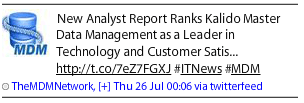
Kalido was also mentioned on twitter:

The linked press release from Kalido has a subtitle telling that Kalido was in front of the megavendors.

As mentioned in the report the vendors are actually not competing in the exact same discipline. Some vendors MDM offerings are part of a larger suite, some vendors focus on a single domain (like product) or industry and some vendors are generalists embracing multi-domain MDM.

This situation is also why another analyst firm, Gartner, have two magic quadrants for MDM vendors: One for customer MDM and one for product MDM.

However the trend is that more and more vendors are going towards multi-domain MDM. I know that for sure as I have been involved in one of the product MDM specialists journeys within multi-domain MDM.

So we could expect an even closer match in the Multi-Domain MDM race in the years to come.

Bookmark and Share

The Big Tower of Babel

3 years ago one of the first blog posts on this blog was called The Tower of Babel.

This post was the first of many posts about multi-cultural challenges in data quality improvement. These challenges includes not only language variations but also different character sets reflecting different alphabets and script systems, naming traditions, address formats, measure units, privacy norms, government registration practice to name some of the ones I have experienced.

When organizations are working internationally it may be tempting to build a new Tower of Babel imposing the same language for metadata (probably English) and the same standards for names, addresses and other master data (probably the ones of the country where the head quarter is).

However, building such a high tower may end up the same way as the Tower of Babel known from the old religious tales.

Alternatively a mapping approach may be technically a bit more complex but much easier when it comes to change management.

The mapping approach is used in the Universal Postal Unions’ (UPU) attempt to make a “standard” for worldwide addresses. The UPU S42 standard is mentioned in the post Down the Street. The S42 standard does not impose the same way of writing on envelopes all over the world, but facilitates mapping the existing ways into a common tagging mapped to a common structure.

Building such a mapping based “standard” for addresses, and other master data with international diversity, in your organization may be a very good way to cope with balancing the need for standardization and the risks in change management including having trusted and actionable master data.

The principle of embracing and mapping international diversity is a core element in the service I’m currently working with. It’s not that the instant Data Quality service doesn’t stretch into the clouds. Certainly it is a cloud service pulling data quality from the cloud. It’s not that that it isn’t big. Certainly it is based on big reference data.

Bookmark and Share

Staying in Doggerland

Currently I’m travelling a lot between my present home in London, United Kingdom and Copenhagen, Denmark where I have most of my family and where the iDQ headquarter is.

When flying between London and Copenhagen you pass the southern North Sea. In the old days (8,000 years ago) this area was a land occupied by human beings. This ancient land is known today as Doggerland.

Sometimes I feel like a citizen of Doggerland not really belonging in the United Kingdom or Denmark.

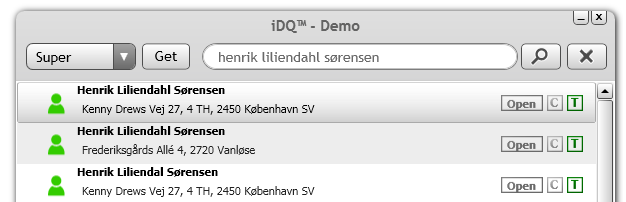
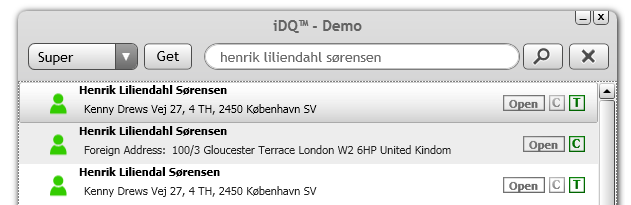
I still have some phone subscriptions in Denmark I use there and my family are using there.  The phone company seems to have a hard time getting a 360 degree customer view as I have two different spellings of my name and two different addresses as seen on the screen when I look up myself in the iDQ service:

Besides having a Customer Relationship Mess (CRM) the phone company has recently shifted their outsourcing partner (from CSC to TCS). This has caused a lot of additional mess, apparently also closing one of my subscriptions due to that they have failed to register my payments. They did however send a chaser they say, but to the oldest of the addresses where I don’t pick up mail anymore.

I called to settle the matter and asked if they could correct the address not in use anymore. They couldn’t. The operator did some kind of query into the citizen hub similar to what I can do on iDQ:

However the customer service guy’s screen just showed that I have no address in Denmark in the citizen hub (called CPR), so he couldn’t change the address.

Apparently the phone company have correctly picked up an accurate address in the citizen hub when I got the subscription but failed to update it (along with the other subscriptions) when I moved to another domestic address and now don’t have an adequate business rule when I’m registered at a foreign address.

So now I’m staying in Doggerland.

Bookmark and Share

Beyond Address Validation

The quality of contact master data is the number one data quality issue around.

Lately there has been a lot of momentum among data quality tool providers in offering services for getting at least the postal address in contact data right. The new services are improved by:

  • Being cloud based offering validation services that are implemented at data entry and based on fresh reference data.
  • Being international and thus providing address validation for customer and other party data embracing a globalized world.

Capturing an address that is aligned with the real world may have a significant effect on business outcomes as reported by the tool vendor WorldAddresses in a recent blog post.

However, a valid address based on address reference data only tells you if the address is valid, not if the addressee is (still) on the address, and you are not sure if the name and other master data elements are accurate and complete. Therefore you often need to combine address reference data with other big reference data sources as business directories and consumer/citizen reference sources.

Using business directories is not new at all. Big reference sources as the D&B WorldBase and many other directories have been around for many years and been a core element in many data quality initiatives with customer data in business-to-business (B2B) environments and with supplier master data.

Combining address reference data and business entity reference data makes things even better, also because business directories doesn’t always come with a valid address.

Using public available reference data when registering private consumers, employees and other citizen roles has until now been practiced in some industries and for special reasons. Therefore the big reference data and the services are out there and being used today in some business processes.

Mashing up address reference data, business entity reference data and consumer/citizen reference data is a big opportunity for many organizations in the quest for high quality contact master data, as most organizations actually interact with both companies and private persons if we look at the total mix of business processes.

The next big source is going to be exploiting social network profiles as well. As told in the post Social Master Data Management social media will be an additional source of knowledge about our business partners. Again, you won’t find the full truth here either. You have to mashup all the sources.

Bookmark and Share

Finding the Truth in Social Business Directories

LinkedIn has a section called companies. When browsing around on LinkedIn you are sometimes hinted to follow a company that LinkedIn think will be of interest for you.

The other day my hint included two identical logo’s for the old Master Data Management (MDM) vendor called Siperian. Curiously and data quality geeky as I am I checked and actually there are two Siperians on LinkedIn companies:

Both have an identical head quarter address in California, USA.

So, even MDM vendors have created duplicates.

Also, Siperian was acquired by the Data Integration giant Informatica some years ago, so you should expect that the Siperians was emptied. But that is not the case. Some Siperian folks still claims working for one of the Siperian duplicates (though many also for Imformatica at the same time).

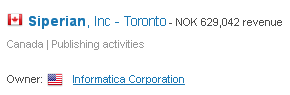
Now, I was not sure about the legal status of the old Siperian company. So I went to another social network called Companybook. On that site the company registry is based on an external business directory.

Here it seems that the Siperian company in Toronto, Canada actually still exist, though marked as owned by Informatica.

So, I’m still looking for that single source of the truth out there. Until then I will mashup the external sources out there with my internal MDM vendor knowledge as told in the post yesterday called Mashing Up Big Reference Data with Internal Master Data.

Bookmark and Share

Mashing Up Big Reference Data and Internal Master Data

Right now I’m working on a cloud service called instant Data Quality (iDQ™).

It is basically a very advanced search engine capable of being integrated into business processes in order to get data quality right the first time and at the same time reducing the time needed for looking up and entering contact data.

With iDQ™ you are able to look up what is known about a given address, company and individual person in external sources (I call these big reference data) and what is already known in internal master data.

From a data quality point of view this mashup helps with solving some of the core data quality issues almost every organization has to deal with, being:

  • Avoiding duplicates
  • Getting data as complete as possible
  • Ensuring maximal accuracy

The mashup is also a very good foundation for taking real-time decisions about master data survivorship.

The iDQ™ service helps with getting data quality right the first time. However, you also need Ongoing Data Maintenance in order to keep data at a high quality. Therefore iDQ™ is build for trigging into subscription services for external reference data.

At iDQ we are looking for partners world-wide who see the benefit of having such a cloud based master data service connected to providing business-to-business (B2B) and/or business-to-consumer (B2C) data services, data quality services and master data management solutions.

Here’s the contact data: http://instantdq.com/contact/

Bookmark and Share

Hierarchy Management in Social MDM

Hierarchy management is a core feature in master data management (MDM). When it comes to integrating social data and social network profiles into MDM, hierarchy management will be very important too.

Aggregated Level of Social MDM in B2C

The primarily privacy related challenges of social MDM not at least within business-to-consumer (B2C) have been a topic of a lot of blogging lately.  Examples are:

One way of overcoming the privacy considerations is linking to social data and social network profiles at an aggregate level.

Using aggregate level linking is already well known in direct marketing with the use of demographic stereotypes. These stereotypes are based on groups of consumers often defined by their address and/or their age. Combining this knowledge with product master data was examined in the post Customer Product Matrix Management.

Social MDM will add new dimensions to this way of using hierarchies in master data and linking the data across multiple channels without the need to uniquely identify a real world person in every aspect.

Contact Level Social MDM in B2B

As discussed in the post Business Contact Reference Data social network profiles has lot to offer within mastering business-to-business (B2B) contact data.

While access to external reference data at the account level has been around for many years by having available public and commercial (and even open) business directories, the problem of identifying and maintain correct and timely data about the contacts at these accounts has been huge.

Integrating with social networks can help here and social networks are actually also integrating more and more with the traditional business directories. LinkedIn has business directory links for larger companies today and lately I noticed a new professional social network called CompanyBook that is based on linking your profile to a (complete) business directory. By the way: The business directory data available in CompanyBook is surprisingly deep, for example revenue data is free for you to grab.

When it comes to contact data they are basically maintained out there by you. A service like LinkedIn is often described as a recruitment service. In my eyes it is a lot more than that. It is along with similar services a goldmine (within a minefield) for getting MDM within B2B done much better.

Bookmark and Share