The Dangers of being a Global Shopper

The global shopper is a multi-channel beast.

A global shopper may be a tourist or a business traveler buying goods in exciting cities around the world in shops most probable operated by the very same brands that occupies his local high street. The global shopper may also do his business from his living room by shopping online on sites with strange foreign privacy rules and unusual registration forms.

Oxford_StreetBeing a global shopper is risky business.

For example it’s unbelievable why Oxford Street in London hasn’t been made into a pedestrian street long time ago like any other respectable high street in major cities. But no, global shoppers on Oxford Street are constantly in danger of being hit by a red double-decker bus when crossing the street for a good bargain while looking to the right wrong side.

And how about shoe sizes? Measuring systems and standards around the world is a jungle and as a global shopper you will in 8 ½ out of 10 trials pick the wrong number 42.

Going online isn’t any better.

When registering your home address on a foreign site you are on very slippery ground.

If the site is from the United States, and you are not, you have to choose living in one of 50 different states meaning nothing to you. But there is no way around. My favorite state then is Alaska usually being on the top of the list.

Having a postal code with letters in it can be a no go. Not having a postal code is much like not existing at all.

But don’t give up. As a global shopper you will be able to find sites online with absolutely no clue about what an address looks like. Only thing of course will be the question about if you actually will get your goods or have to settle with the credit card withdrawal only.

Bookmark and Share

Business in the Driver’s Seat for MDM

It has always been a paradox in Master Data Management (MDM), and many other IT enabled disciplines, that while most people agree that the business part of business should take the lead, often it is the IT part of business that is running the projects.

However, at Tetra Pak, a multi-national company of Swedish origin, MDM has been approached as a business problem rather than as an IT problem.

Yesterday I touched base with Program Manager Jesper Persson at Tetra Pak.

A main reason for Tetra Pak to focus on MDM was having a very specific business problem related to master data, not an IT problem. Taking it from there the business has been in the driver’s seat for the MDM journey.

Master data quality and related data quality dimensions are seen as triggers for the essential KPI’s related to process performance. The model for getting this right is starting with the business requirements, putting the needed data governance in place, getting on with managing master data which leads to the actual master data maintenance all as part of business process management.

Jesper is telling a lot more at the Master Data Management Summit Europe 2013 in London in the session Business in the Driver’s Seat for MDM – Integrating MDM with BPM.

MDM Summit Europe 2013

Bookmark and Share

MDM Summit Europe 2013 Wordle

The Master Data Management Summit Europe 2013, co-located with the Data Governance Conference Europe 2013, takes place in London the 15th to 17th April.

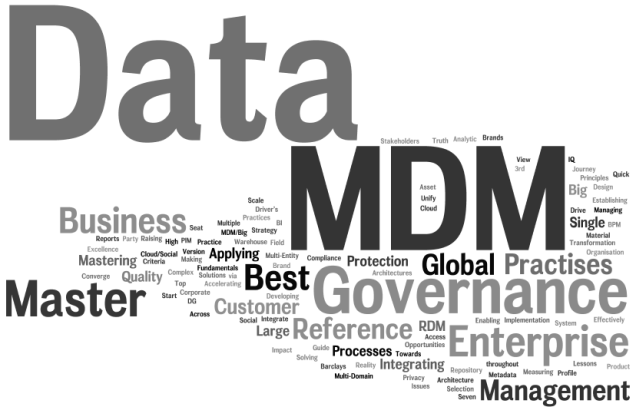
Here is a wordle with the session topics:

MDMDG 2013 wordle

Some of the words catching my eyes are:

Global is part of several headlines. There is no doubt about that governing master data on a global scale is a very timely subject. Handling master data in a domestic context can be hard enough, but enterprises are facing a daunting task when embracing party master data, product master data and location master data covering the diversity of languages, script systems, measuring systems, national standards and regulatory requirements. However, there is no way around the challenges when synergies in global enterprises are to be harvested.

RDM (Reference Data Management) is becoming a popular subject as well. Being successful with governing master data requires a steady hand with the reference data layer that sits on top of the master data. Some reference data sets may be small, but the importance of getting them right must not be underestimated.

Business. Oh yes. All the data stuff is there to enable business processes, drive business transformation and make business opportunities.

Bookmark and Share

Multi-Entity MDM vs Multidomain MDM

puzzleOn the upcoming MDM Summit Europe 2013 in London this April you will be able to learn about Multi-Entity MDM as well as Multi-Domain MDM.

So, what is the difference between Multi-Entity MDM and Multi-Domain MDM?

To my knowledge it is two terms having the same meaning. It is doing the two main preceding disciplines for MDM being Customer Data Integration (CDI) and Product Information Management (PIM) at the same time presumably using the same software brand.

Multi-Entity MDM was probably the first term used and still used by The MDM Institute while Multidomain MDM is used by Gartner (the analyst firm) and most tool vendors today. For example Stibo Systems is focusing on mutidomain recently in this press release about latest achievements.

Talking about Gartner and the vendor crowd Gartner analyst Andrew White wrote a blog post the other day: Round-Up of Master Data Management (MDM) 2012, and looking forward to 2013.

Herein White bashes the vendors by saying:

“Vendor hype related to multidomain …. continued to be far in excess of reality”.

What do you think? Is Andrew White right about that? And what about Multi-Entity MDM, is that any better?

Bookmark and Share

The Letter Æ

This blog is written in English. Therefore the letters used are normally restricted to A to Z.

The English alphabet is one of many alphabets using Latin (or Roman) letters. Other alphabets like the Russian uses Cyrillic letters. Then there are other script systems in the world which besides alphabets are abjads, abugidas, syllabic scripts and symbol scripts. Learn more about these in the post Script Systems.

Æ, which in lower case is æ, was part of the old English alphabet. For example an old English king was called Æthelred the Unready.

The letter Æ is a combined AE and is pronounced in English as the first letter in Edmund and Edward.

Today Æ exists in a few alphabets: The Danish/Norwegian, the Faroese and the Icelandic. People and places from the corresponding Viking territories  may have the letter Æ/æ as part of the string. For example the home of Microsoft Dynamics AX and NAV is the town Vedbæk north of Copenhagen. When represented in the English alphabet the town name will be Vedbaek.

So Vedbæk and Vedbaek should be a 100% match when doing data matching. And so should Vedbæk and Vedb%C%A6k when systems are as bad as Æthelred the Unready was in handling the Vikings.

And oh, Æthelred wasn’t actually unready. He was unræd meaning bad-counseled.

Bookmark and Share

Rapid and Vanity Addressing – and the Apple Hotel

Mid next month iDQ will move our London office to a new address:

iDQ A/S
2nd Floor
Berkeley Square House
Berkeley Square
London
W1J 6BD
United Kingdom

It’s a good old English address including a lot of lines on an envelope.

The address could be either shorter or longer.

The address below will in fact be enough to have a letter delivered:

iDQ A/S
2nd Floor
W1J 6BD
UK

Due to the granular UK postal code system a single post code may either be a single address a part of a long road or a small street.

This structure is also what is exploited in what is called rapid addressing, where you only type in the need data and the rest is supplied by a (typically cloud) service.

But sometimes people want their addresses presented in a different way than the official way. Maybe I want our address to be:

iDQ A/S
2nd Floor
Berkeley Square House
Berkeley Square
Mayfair
London
W1J 6BD
United Kingdom

Mayfair is a nice part of London. Insisting in including this element in the address is an example of vanity addressing.

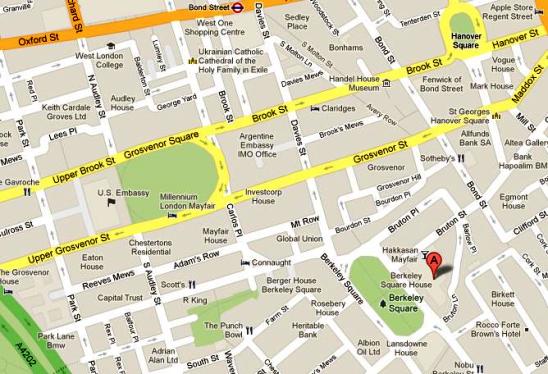
Here’s the map of the area:

Notice the place in the upper right corner of the Google Map: Apple Store Regent Street. With an icon with a bed. This means it’s a hotel. Is the Apple Store really a hotel? No – except for some while ago when people slept in front of the store waiting for a product with a notable map service as reported by Richard Northwood (aka The Data Geek) in the post Data Quality Failure – Apple Style.

Well Google, you can’t win them all.

Bookmark and Share

Customer Management, Data Quality and MDM

Today I am visiting the Call Centre and Customer Management Expo 2012 in London and have a chance to learn about what’s going on in this area – and what happens to data quality and master data management.

Postcodes Anywhere

At the PostcodeAnywhere stand the talk is about data quality. PostcodeAnywhere has become a well known vendor of services for validating addresses in the United Kingdom based on the unique structure of the UK postal code and addressing system. I had a chat with Marketing Executive Ed Nash about the challenges of delivering similar services for all the other countries on the planet with their particular ways of addressing.

Phone Number Testing

Peter Muswell of ”ThePhone Number Testing Company” describes his company as the best kept secret in customer management. Indeed, I haven’t heard of this service before. The trick is a service for testing if a phone number is alive or not – notably without making any ghost calls. The service works in the UK. It works in some other countries and it doesn’t work in some other other countries. Just like most other data quality services.

Social Customer Service

The Salesforce.com stand is all about Social Customer Service. There is plenty of functionality offered for getting social with CRM (Customer Relationship Management). The tricky part, as confirmed by the Salesforce.com representative, is to manage customer master data embracing all the traditional data as addresses and phone numbers and the new keys to social data being social network profile identifiers. Sure, there will be a huge demand for Social Master Data Management (Social MDM).

Bookmark and Share

Going in the Wrong Direction

When travelling with the London Underground I have several times noticed that the onboard passenger information system is set wrong, typically as if we are going in the opposite direction as what was announced on the station and where the train actually is heading.

People’s reactions

The reaction among the passengers to this data quality flaw varies. Most people who seem to be frequent commuters don’t seem to bother but keeps calm and carries on. Tourists on the other hand get confused and immediately try to appoint the culprit among them who apparently got them on the wrong train.

As the information system keeps on announcing the next station as the one we just left everyone not being new passengers keeps calm and carries on in the opposite direction of the data presented.

Big data quality issues

The problem with wrong journey settings in data collection within public transportation has actually been a challenge I have worked with a lot.

Besides confusing the passengers if presented on the onboard passenger information display and voicing, the data collection may also be corrupted leading to data quality issues when data is stored in a data warehouse or by other techniques in order to facilitate analysis of passenger travel patterns, how well the services applies to schedules and other reporting based on these big numbers of transaction data collected every day.

Aligning with master data

The challenge is to correctly join the transaction data with the right master data entities. A vehicle stop, and in some cases the passenger boarding and alighting, must be associated with the right product being a given journey on a given service according to a given time schedule.

Many other exploitations of big data shares the same basic data quality challenge. If we don’t get the transaction data joined correctly with the master data entities involved, any analysis and reporting may be going in the wrong direction.

Bookmark and Share

Hot and Magic Medal Counting

In the ongoing Olympic Games one often displayed list is the list of medals per nation.

The list reminds me about the occasional analyst report ranking of Data Quality tools and Master Data Management (MDM) solutions. The latest one is fresh pressed as told in the post called Product Information Management is HOT for Business by Ventana Research, where the PIM vendors are ranked with Stibo Systems being the most HOT.

The counting of medals in the Olympic Games in London this afternoon looks like this:

As expected the top race is between the big teams from United States and China just as the mega vendors of tools also always receives good rankings by analysts though with a few exceptions as reported in the post The Data Quality Tool Vendor Difference, where the Gartner MAGIC Quadrant is compared with the ranking from Information Difference.

As often seen the home team, Great Britain and Northern Ireland, is also doing very well. With tools we also see that the Most Times the Home Team Wins despite of analyst ranking when a local client selects a tool.

Other big teams as Russia, Japan and Australia are currently struggling to get more gold medals to climb the list if ranked by gold (instead of total number of medals). Perhaps we will see a closer race with more teams in the last week just as expected with MDM tools as reported in the post Photo Finish in MDM Vendor Race.

The smaller nations often does it better in a small range of disciplines, like Ethiopia in running and Denmark in rowing and sailing resembling the situation described in the post Who is not Using Data Quality MAGIC, as there are plenty of Data Quality tools out there very feasible in certain tasks and local circumstances.

Bookmark and Share

Naming the Olympians

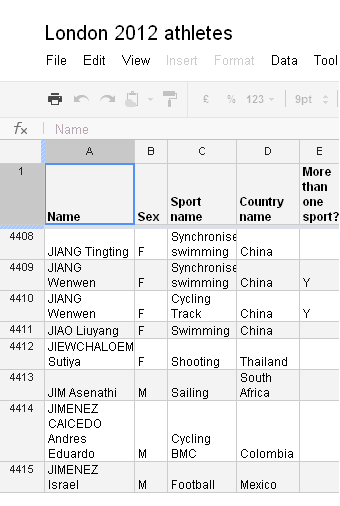
The British newspaper The Guardian has a feature on their website where you can get data about the Olympians. Link here: London 2012 Olympic athletes: the full list.

Browsing the list is a good reminder of the world-wide diversity we have with person names.

The names are here formatted with the surname(s) followed by the given name(s). The surname is in upper case.

The sequence of names is for the Chinese and other East Asian Olympians like they are used to opposite to other Olympians from places where we have the first name being the given name and last name being our surname.

Having the surname in upper case also shows where Olympians have two surnames as it is custom in Spanish cultures.

And oh yes. The South African guy has JIM as his surname.

Finally from this screen shot there is a good question. Is JIANG Wenwen superb at both synchronized swimming and track cycling – or is it two different Olympians with the same name. Some names are very common in China. A little goggling tells me it is two different persons. The synchronized swimmer is more related to her twin sister and swimming partner JIANG Tingting.

Let’s check if there is more than one “John Smith”.

Nope.

But it could be fun if “Kim Smith” and “Kimberley Smith” came from the same country.

Many Olympians actually don’t have the names reflected in this sheet as many have names in a different alphabet or script system.

The Danish cycling rider “SORENSEN Nicki” actually share my last name, as we know him as “Nicki Sørensen”. The Serbs, Ukrainians and Russian Olympians have their original name in the Cyrillic alphabet, but they have been transliterated to the English alphabet and Olympians from countries with other script systems than an alphabet have had their names gone through a transcription to the (English) alphabet.

So, is the list bad data quality?

Bookmark and Share