The days of castle and moat are over, just as brick and mortar is slowly diminishing too

A recent post called Ecosystem Architecture is replacing Enterprise Architecture from Oliver Cronk of Deloitte has these statements:

Kronborg_Castle“Organisations need architectural thinking beyond their organisational boundaries” and “The days of Enterprise Architecture taking a castle and moat approach are over”.

The end of the castle and moat thinking in Enterprise Architecture (and Business Information Architecture) is also closely related to the diminished importance of the brick and mortar ways of selling, being increasingly overtaken by eCommerce.

However, some figures I have noticed that cause the brick and mortar way to resist the decline by still having a castle and moat thinking is:

Merchants, distributors and manufacturers need to move on from the castle and moat thinking in Enterprise Architecture and Business Information Architecture and start interacting effectively in their business ecosystems with product information.

This is the thinking behind Product Data Lake. You can keep your castle by breaking down the walls and replace the moat with a stream as shown in our 5 + 5 Business Benefits.

Encompassing Relational, Document and Graph the Best Way

The use of graph technology in Master Data Management (MDM) has been a recurring topic on this blog as the question about how graph approaches fits with MDM keeps being discussed in the MDM world.

Multi-Domain MDM GraphRecently Salah Kamel, the CEO at the agile MDM solution provider Semarchy, wrote a blog post called Does MDM Need Graph?

In here Salah states: “A meaningful graph query language and visualization of graph relationships is an emerging requirement and best practice for empowering business users with MDM; however, this does not require the massive redesign, development, and integration effort associated with moving to a graph database for MDM functionality”.

In his blog post Salah discusses how relationships in the multi-domain MDM world can be handled by graph approaches not necessarily needing a graph database.

At Product Data Lake, which is a business ecosystem wide product information sharing service that works very well besides Semarchy MDM inhouse solutions, we are on the same page.

Currently we are evaluating how graph approaches are best delivered on top of our document database technology (using MongoDB). The current use cases in scope are exploiting related products in business ecosystems and how to find a given product with certain capabilities in a business ecosystem as examined in the post Three Ways of Finding a Product.

Room for Improvement in the PIM World

Ventana Stibo ReportThe analyst firm Ventana Research recently made a report called The Next Generation of Product Information Management with the subtitle Maximizing the Potential Value of Products for Customers and Suppliers.

One, perhaps shocking, number mentioned in the report is that there is “room for improvement, as only 5 percent of organizations share all their product data electronically with supply chain partners”.

However, this resonates very well with my experience, as it has been hard to find a good way to share all kind of product information electronically with all your trading partners, as:

  • The most common used way today is exchanging spreadsheets, which is cumbersome and error prone and therefore many companies experience that it simply is not done or only done partly and certainly not timely.
  • Using consensus data pools (eg GS1 GDSN) only covers a fraction of product groups and product data elements with varying penetration and coverage in different geographies
  • Providing supplier product data portals (and customer product data portals) is a flawed one-sided concept as discussed in the post PIM Supplier Portals: Are They Good or Bad?

This is the reason why Product Data Lake has been launched.

You can get an 18 pager write up of the research report free from Stibo Systems here.

PS: If you are a PIM solution vendor or a PIM system integrator you can, as a legal entity, help with and gain from filling this room by becoming a Product Data Lake Commissioner.

Three Game Changers within Product Information Management

Product Information Management (PIM) is a fast-growing discipline enabled by PIM platforms. While the current market for PIM platforms is much about supporting a consistent in-house management of the information related to product models we make, buy and sell, there are new opportunities arising. Three of them on my radar are:

globalInternet of Things (IoT)

With the rise of IoT and the related theme Industry 4.0 we will in the future not just have to deal with the product model but also each physical instance of that product. As an example of how many product groups that might embrace, read about that IKEA is thinking about embedding its furniture with artificial intelligence.

Value webs

The recent buzzword in the chain starting with “supply chain” and going over “value chain” is “value web”. Learn about the arrival of continuously evolving business ecosystems and value webs in this article from Deloitte University Press. Product information management encompassing business ecosystems will be imperative in value webs.

Product Data Lake

This is in all humbleness my venture by having launched a PIM-2-PIM platform that deals with the current main pain in product information management, being exchanging product information between trading partners. We do that in an agile and automated way by supporting partnerships in value webs and are soon adding things to Product Data Lake.

Get into the game by registering for a trial account on Product Data Lake.

A Product Information Management (PIM) Solar System

Hundreds of years ago the geocentric model was replaced by heliocentrism, meaning that we recognize that the earth travels around the sun and not the other way around.

When it comes to Product Information Management (PIM), we also need a Copernican Revolution, meaning that it is good to manage product information consistently inside a given company, but it is better to manage product information in the light of the business ecosystem where we participate.

Exchanging product information in the business ecosystems of manufacturers, distributors and merchants cannot work properly by asking all your trading partners to use your version of a spreadsheet – if they don’t get to you first with their version. Nor will self-centered supplier / customer product data portals work as examined in the post PIM Supplier Portals: Are They Good or Bad?

Your company is not a lonely planet. You are part of a business ecosystem, where you may be:

  • Upstream as the maker of goods and services. For that you need to buy raw materials and indirect goods from the parties being your vendors. In a data driven world you also to need to receive product information for these items. You need to sell your finished products to the midstream and downstream parties being your B2B customers. For that you need to provide product information to those parties.
  • Midstream as a distributor (wholesaler) of products. You need to receive product information from upstream parties being your vendors, perhaps enrich and adapt the product information and provide this information to the parties being your downstream B2B customers.
  • Downstream as a retailer/etailer or large end user of product information. You need to receive product information from upstream parties being your vendors and enrich and adapt the product information so you will be the preferred seller to the parties being your B2B customers and/or B2C customers.

At Product Data Lake we support business ecosystems in Product Information Management (PIM). And this is not just a nice model. There are concrete business benefits too. 5 for you and 5 for your trading partner:  Check our 10 business benefits.

WordChart

Three Ways of Embracing Digital Ecosystem Platforms

Gartner, the analyst firm, has recently promoted their take on the five kinds of digital platforms you will need to consider in your digital transformation journey.

Gartner Digital Platforms 2The top right kind of platform is the ecosystem one. This kind of platform will facilitate how you interact with business partners.

I my eyes, there are three kind of ways you can do that:

  1. You provide and own an ecosystem digital platform for your business partners
  2. You participate in an ecosystem digital platform provided and owned by one of your business partners
  3. You participate in a neutral provided and owned ecosystem digital platform for a given purpose

Currently I am working with Product Data Lake, which is the third kind of platform. In this ecosystem digital platform you can exchange product information with your trading partners. There are alternatives of the other kinds as discussed in the post PIM Supplier Portals: Are They Good or Bad?

Plug and Play – The Future for Data

What does the future for data and the need for power when travelling have in common? A lot, as Ken O’Connor explains in today’s guest blog post:

Bob Lambert wrote an excellent article recently summarising the New Direction for Data set out at Enterprise Data World 2017 (#EDW17).  As Bob points out “Those (organisations) that effectively manage data perform far better than organisations that don’t”. A key theme from #EDW17 is for data management professionals to “be positive” and to focus on the business benefits of treating data as an asset.  On a related theme, Henrik on this blog has been highlighting the emergence and value to be derived from business ecosystems and digital platforms.  

Building on Bob and Henrik’s ideas, I believe we need a paradigm shift in the way we think and talk about data.  We need to promote the business benefits of data sharing via “Plug and Play Data”.

AdaptorWhen we travel, we expect to be able to use our mobile devices anywhere in the world. We do this by using universal adaptors that convert country specific plug shapes and power levels for us.   

We need to apply the same concept to data. To enable data to be more easily reused across and between enterprises, we need to create “plug and play data”.         

How can organisations create “plug and play data”?

In the past, organisations could simply verify that the data they create / capture / ingest and share conforms to the business rules for their own organisation. That “silo-based” approach is no longer tenable. In today’s world, as Henrik points out, organisations increasing play a role within a business ecosystem, as part of a data supply chain. Hence they need to exchange data with business partners. To do this, they need to apply a “Data Sharing Concept” within a “Common Data Architecture” as set out by Michael Brackett in his excellent books “Data Resource Simplexity” and  “Data Resource Integration”.  Michael describes a “Data Sharing Medium”, which is similar in concept to the universal adaptor above. For data sharing, this involves organisations within a  given business ecosystem agreeing a “preferred form” for data sharing.  
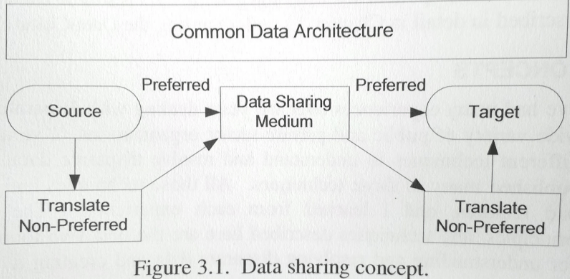
Data Sharing.png

I quote Michael “The Common Data Architecture provides a construct for readily sharing data. When the source data are not in the preferred form, the source organisation must translate those non-preferred data to the preferred form before being shared over the data sharing medium. Similarly, when the target organisation uses the preferred data, they can be readily received from the data sharing medium. When the target organisation does not use preferred data, they must translate the preferred data to their non-preferred form. The “data sharing concept” states that shared data are transmitted over the data sharing medium as preferred data. Any organisation, whether source or target, that does not have or use data in the preferred form is responsible for translating the data.

In conclusion:

We Data Management Professionals need to educate both Business and IT on the need for, and the benefits of “plug and play data”. We need to help business leaders to understand that data is no longer used by just one business process. We need to explain that even tactical solutions within Lines of Business need to consider Enterprise and business ecosystem demands for data such as:

  1. Data feed into regulatory systems
  2. Data feeds to and from other organisations in the supply chain
  3. Ultimate replacement of application with newer generation system

We must educate the business on the increasingly dynamic information requirements of the Enterprise and beyond – which can only be satisfied creating “plug and play data” that can be easily reused and interconnected.

Ken O’Connor is an independent consultant with extensive experience helping multi-national organisations satisfy the Data Quality / Data Governance requirements of regulatory compliance programmes such as GDPR, Solvency II, BASEL II/III, Anti-Money Laundering, Anti-Fraud, Anti-Terrorist Financing and BCBS 239 (Risk Data Aggregation and Reporting).

Ken’s “Data Governance Health Check” provides an independent, objective assessment of your organisation’s internal data management processes to help you to identify gaps you may need to address to comply with regulatory requirements.

Ken is a founding board member of the Irish Data Management Association (DAMA) chapter. He writes a popular industry blog that regularly focuses on a wide range of data management issues faced by modern organisations: (Kenoconnordata.com).

You may contact Ken directly by emailing: Ken@Kenoconnordata.com

Ecosystems are The Future of Digital and MDM

A recent blog post by Dan Bieler of Forrester ponders that you should Power Your Digital Ecosystems with Business Platforms.

In his post, Dan Bieler explains that such business platforms support:

·      The infrastructure that connect ecosystem participants. Business platforms help organizations transform from local and linear ways of doing business toward virtual and exponential operations.

·      A single source of truth for ecosystem participants. Business platforms become a single source of truth for ecosystems by providing all ecosystem participants with access to the same data.

·      Business model and process transformation across industries. Platforms support agile reconfiguration of business models and processes through information exchange inside and between ecosystems.

A single source of truth (or trust) for ecosystem participants is something that rings a bell for every Master Data Management (MDM) practitioner. The news is that the single source will not be a single source within a given enterprise, but a single source that encompasses the business ecosystem of trading partners.

Gartner Digital Platforms.png

Gartner, the other analyst firm, has also recently been advocating about digital platforms where the ecosystem type is the top right one. As stated by Gartner: Ecosystems are the future of digital.

I certainly agree. This is why all of you should get involved at Master Data Share.


Multi-Domain MDM and PIM, Party and Product

Multi-Domain Master Data Management (MDM) and Product Information Management (PIM) are two interrelated disciplines within information management.

While we may see Product Information Management as the ancestor or sister to Product Master Data Management, we will in my eyes gain much more from Product Information Management if we treat this discipline in conjunction with Multi-Domain Master Data Management.

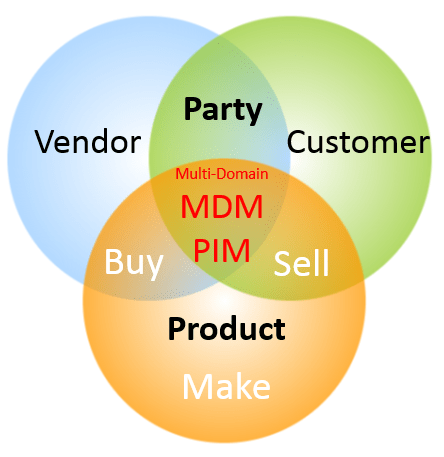
Party and product are the most common handled domains in MDM. I see their intersections as shown in the figure below:

Multi-Side MDM

Your company is not an island. You are part of a business ecosystem, where you may be:

  • Upstream as the maker of goods and services. For that you need to buy raw materials and indirect goods from the parties being your vendors. In a data driven world you also to need to receive product information for these items. You need to sell your finished products to the midstream and downstream parties being your B2B customers. For that you need to provide product information to those parties.
  • Midstream as a distributor (wholesaler) of products. You need to receive product information from upstream parties being your vendors, perhaps enrich and adapt the product information and provide this information to the parties being your downstream B2B customers.
  • Downstream as a retailer or large end user of product information. You need to receive product information from upstream parties being your vendors and enrich and adapt the product information so you will be the preferred seller to the parties being your B2B customers and/or B2C customers.

Knowledge about who the parties being your vendors and/or customers are and how they see product information, is essential to how you must handle product information.  How you handle product information is essential to your trading partners.

You can apply party and product interaction for business ecosystems as explained in the post Party and Product: The Core Entities in Most Data Models.

3 Old and 3 New Multi-Domain MDM Relationship Types

Master Data Management (MDM) has traditionally been mostly about party master data management (including not at least customer master data management) and product master data management. Location master data management has been the third domain and then asset master data management is seen as the fourth – or forgotten – domain.

With the rise of Internet of Things (IoT), asset – seen as a thing – is seriously entering the MDM world. In buzzword language, these things are smart devices that produces big data we can use to gain much more insight about parties (in customer roles), products, locations and the things themselves.

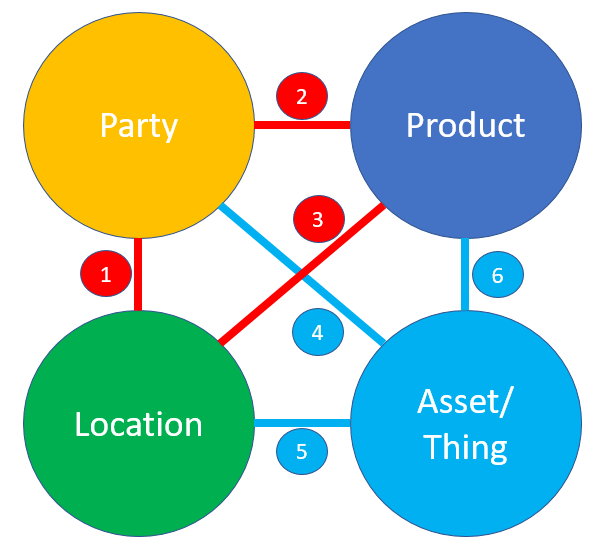
In the old MDM world with party, product and location we had 3 types of relationships between entities in these domains. With the inclusion of asset/thing we have 3 more exiting relationship types.

Multi-Domain MDM Relations

The Old MDM World

1: Handling the relationship between a party at its location(s) is one of the core capabilities of a proper party MDM solution. The good old customer table is just not good enough as explained in the post A Place in Time.

2: Managing the relationship between parties and products is essential in supplier master data management and tracking the relationship between customers and products is a common use case as exemplified in the post Customer Product Matrix Management.

3:  Some products are related to a location as told in the post Product Placement.

The New MDM World

4: We need to be aware of who owns, operates, maintains and have other party roles with any smart device being a part of the Internet of Things.

5: In order to make sense of the big data coming from fixed or moving smart devices we need to know the location context.

6: Further, we must include the product information of the product model for the smart devices.

Expanding to Business Ecosystems

In my eyes, it is hard to handle the 3 old relationship types separately within a given enterprise. When including things and the 3 new relationship types, expanding master data management to the business ecosystems you have with trading partners will be imperative as elaborated in the post Data Management Platforms for Business Ecosystems.