Customer Management, Data Quality and MDM

Today I am visiting the Call Centre and Customer Management Expo 2012 in London and have a chance to learn about what’s going on in this area – and what happens to data quality and master data management.

Postcodes Anywhere

At the PostcodeAnywhere stand the talk is about data quality. PostcodeAnywhere has become a well known vendor of services for validating addresses in the United Kingdom based on the unique structure of the UK postal code and addressing system. I had a chat with Marketing Executive Ed Nash about the challenges of delivering similar services for all the other countries on the planet with their particular ways of addressing.

Phone Number Testing

Peter Muswell of ”ThePhone Number Testing Company” describes his company as the best kept secret in customer management. Indeed, I haven’t heard of this service before. The trick is a service for testing if a phone number is alive or not – notably without making any ghost calls. The service works in the UK. It works in some other countries and it doesn’t work in some other other countries. Just like most other data quality services.

Social Customer Service

The Salesforce.com stand is all about Social Customer Service. There is plenty of functionality offered for getting social with CRM (Customer Relationship Management). The tricky part, as confirmed by the Salesforce.com representative, is to manage customer master data embracing all the traditional data as addresses and phone numbers and the new keys to social data being social network profile identifiers. Sure, there will be a huge demand for Social Master Data Management (Social MDM).

Bookmark and Share

instant Data Quality at Work

DONG Energy is one of the leading energy groups in Northern Europe with approximately 6,400 employees and EUR 7.6 billion in revenue in 2011.

The other day I sat down with Ole Andres, project manager at DONG Energy, and talked about how they have utilized a new tool called iDQ™ (instant Data Quality) in order to keep up with data quality around customer master data.

iDQ™ is basically a very advanced search engine capable of being integrated into business processes in order to get data quality for contact data right the first time and at the same time reduce the time needed for looking up and entering contact data.

Fit for multiple business processes

Customer master data is used within many different business processes. Dong Energy has successfully implemented iDQ™ within several business processes, namely:

  • Assigning new customers and ending old customers on installation addresses
  • Handling returned mail
  • Debt collection

Managing customer master data in the utility sector has many challenges as there are different kinds of addresses to manage such as installation addresses, billing addresses and correspondence addresses as well as different approaches to private customers and business customers including considering the grey zone between who is a private account and who is a business account.

New technology requires change management

Implementing new technology into a large organization doesn’t just go by itself. Old routines tend to stick around for a while. DONG Energy has put a lot of energy, so to say, into training the staff in reengineering business processes around customer master data on-boarding and maintenance including utilizing the capabilities of the iDQ™ tool.

Acceptance of new tools comes with building up trust in the benefits of doing things in a new way.

Benefits in upstream data quality 

A tool like iDQ™ helps a lot with safeguarding the quality of contact data where data is born and when something happens in the customer data lifecycle. A side effect, which is at least as important stresses Ole Andres, is that data collection is going much faster.

Right now DONG Energy is looking into further utilizing the rich variety of reference data sources that can be found in the iDQ™ framework.

Bookmark and Share

Where is the Spot?

One of things we often struggle with in data quality improvement and master data management is postal addresses. Postal addresses have different formats around the world, names of streets are spelled alternatively and postal codes may be wrong, too short or suffer from other flaws.

An alternative way of identifying a place is a geocode and sometimes we may think: Hurray, geocodes are much better in uniquely identifying a place.

Well, unfortunately not necessarily so.

First of all geocodes may be expressed in different systems. The most used ones are:

  • Latitude and longitude: Even though the globe is not completely round, this system for most purposes is good for aligning positions with the real world.
  • UTM: When the world is reflected on a paper or on a computer screen it becomes flat. UTM reflects the world on a flat surface very well aligned with the metric system making distance calculations straight forward.
  • WGS: This is the system in use in many GPS devices and also the one behind Google Maps.

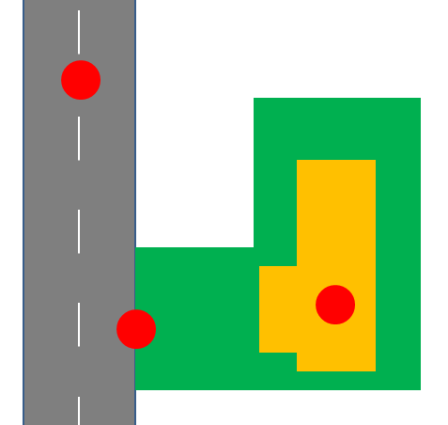
Next, where is the address exactly placed?

I have met at least three different approaches:

  • It could be where the building actually is and then if the precision is deep and/or the building is big on different places around the building.
  • It could be where the ground meets a public road. This is actually most often the case, as route planning is a very common use case for geocodes. The spot is fit for the purpose of use so to say.
  • It could, as reported in the post  Some Times Big Brother is Confused, be any place on (and beside) the street as many reference data sources interpolates numbers equally along the street or in other ways gets it wrong by keeping it simple.

Bookmark and Share

Return on Investment in Big Reference Data

Currently I’m working with a cloud based service where we are exploiting available data about addresses, business entities and consumers/citizens from all over the world.

The cost of such data varies a lot around the world.

In Denmark, where the product is born, the costs of such data are relatively low. The joys of the welfare state also apply to access to open public sector data as reported in the post The Value of Free Address Data. Also you are able to check the identity of an individual in the citizen hub. Doing it online on a green screen you will be charged (what resembles) 50 cent, but doing it with cloud service brokerage, like in iDQ™, it will only cost you 5 cent.

In the United Kingdom the prices for public sector data about addresses, business entities and citizens are still relatively high. The Royal Mail has a license tag on the PAF file even for government bodies. Ordnance Survey is given the rest of AddressBase free for the public sector, but there is a big tag for the rest of the society. The electoral roll has a price tag too even if the data quality isn’t considered for other uses than the intended immediate purpose of use as told in the post Inaccurately Accurate.

At the moment I’m looking into similar services for the United States and a lot of other countries. Generally speaking you can get your hands on most data for a price, and the prices have come down since I checked the last time. Also there is a tendency of lowering or abandoning the price for the most basic data as names and addresses and other identification data.

As poor data quality in contact data is a big cost for most enterprises around the world, the news of decreasing prices for big reference data is good news.

However, if you are doing business internationally it is a daunting task to keep up with where to find the best and most cost effective big reference data sources for contact data and not at least how to use the sources in business processes.

Wednesday the 25th July I’m giving a presentation, in the cloud, on how iDQ™ comes to the rescue. More information on DataQualityPro.

Bookmark and Share

Staying in Doggerland

Currently I’m travelling a lot between my present home in London, United Kingdom and Copenhagen, Denmark where I have most of my family and where the iDQ headquarter is.

When flying between London and Copenhagen you pass the southern North Sea. In the old days (8,000 years ago) this area was a land occupied by human beings. This ancient land is known today as Doggerland.

Sometimes I feel like a citizen of Doggerland not really belonging in the United Kingdom or Denmark.

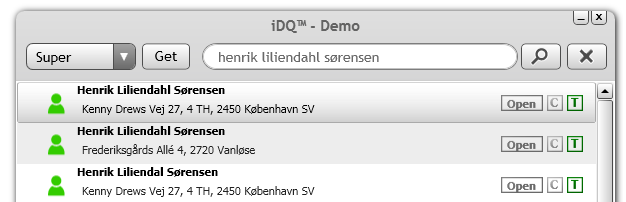
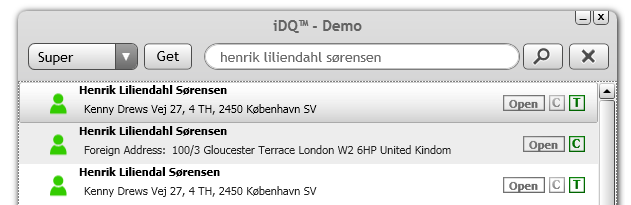
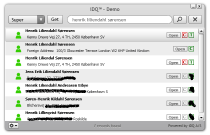
I still have some phone subscriptions in Denmark I use there and my family are using there.  The phone company seems to have a hard time getting a 360 degree customer view as I have two different spellings of my name and two different addresses as seen on the screen when I look up myself in the iDQ service:

Besides having a Customer Relationship Mess (CRM) the phone company has recently shifted their outsourcing partner (from CSC to TCS). This has caused a lot of additional mess, apparently also closing one of my subscriptions due to that they have failed to register my payments. They did however send a chaser they say, but to the oldest of the addresses where I don’t pick up mail anymore.

I called to settle the matter and asked if they could correct the address not in use anymore. They couldn’t. The operator did some kind of query into the citizen hub similar to what I can do on iDQ:

However the customer service guy’s screen just showed that I have no address in Denmark in the citizen hub (called CPR), so he couldn’t change the address.

Apparently the phone company have correctly picked up an accurate address in the citizen hub when I got the subscription but failed to update it (along with the other subscriptions) when I moved to another domestic address and now don’t have an adequate business rule when I’m registered at a foreign address.

So now I’m staying in Doggerland.

Bookmark and Share

Beyond Address Validation

The quality of contact master data is the number one data quality issue around.

Lately there has been a lot of momentum among data quality tool providers in offering services for getting at least the postal address in contact data right. The new services are improved by:

  • Being cloud based offering validation services that are implemented at data entry and based on fresh reference data.
  • Being international and thus providing address validation for customer and other party data embracing a globalized world.

Capturing an address that is aligned with the real world may have a significant effect on business outcomes as reported by the tool vendor WorldAddresses in a recent blog post.

However, a valid address based on address reference data only tells you if the address is valid, not if the addressee is (still) on the address, and you are not sure if the name and other master data elements are accurate and complete. Therefore you often need to combine address reference data with other big reference data sources as business directories and consumer/citizen reference sources.

Using business directories is not new at all. Big reference sources as the D&B WorldBase and many other directories have been around for many years and been a core element in many data quality initiatives with customer data in business-to-business (B2B) environments and with supplier master data.

Combining address reference data and business entity reference data makes things even better, also because business directories doesn’t always come with a valid address.

Using public available reference data when registering private consumers, employees and other citizen roles has until now been practiced in some industries and for special reasons. Therefore the big reference data and the services are out there and being used today in some business processes.

Mashing up address reference data, business entity reference data and consumer/citizen reference data is a big opportunity for many organizations in the quest for high quality contact master data, as most organizations actually interact with both companies and private persons if we look at the total mix of business processes.

The next big source is going to be exploiting social network profiles as well. As told in the post Social Master Data Management social media will be an additional source of knowledge about our business partners. Again, you won’t find the full truth here either. You have to mashup all the sources.

Bookmark and Share

Sharing Bigger Data

Yesterday I attended an event called Big Data Forum 2012 held in London.

Big data seems to be yet a buzzing term with many definitions. Anyway, surely it is about datasets that are bigger (and more complex) than before.

The Olympics is Going to be Bigger
One session on the big data forum was about how BBC will use big data in covering the upcoming London Olympics on the BBC website.

James Howard who I know as speckled_jim on Twitter told that the bulk of the content on the BBC Sports website is not produced by BBC. The data is sourced from external data providers and actually also the structure of the content is based on the external sources.

So for the Olympics there will be rich content about all the 10,000 athletes coming from all over the world. The BBC editorial stuff will be linked to this content of course emphasizing on the British athletes.

I guess that other broadcasting bodies and sports websites from all over the world will base the bulk of the content from the same sources and then more or less link targeted own produced content in the same way and with their look and feel.

There are some data quality issues related to sourcing such data Jim told. For example you may have your own guideline for how to spell names in other script systems.

I have noticed exactly that issue in the news from major broadcasters. For example BBC spells the new Egyptian president Mursi while CNN says his name is Morsi.

Bigger Data in Party Master Data Management

The postal validation firm Postcode Anywhere recently had a blog post called Big Data – What’s the Big Deal?

The post has the well known sentiment that you may use your resources better by addressing data quality in “small data” rather than fighting with big data and that getting valid addresses in your party master data is a very good place to start.

I can’t agree more about getting valid addresses.

However I also see some opportunities in sharing bigger datasets for valid addresses. For example:

  • The reference dataset for UK addresses typically based on the Royal Mail Postal Address File (PAF) is not that big. But the reference dataset for addresses from all over the world is bigger and more complex. And along with increasing globalization we need valid addresses from all over the world.
  • Rich address reference data will be more and more available. The UK PAF file is not that big. The AddressBase from Ordnance Survey in the UK is bigger and more complex. So are similar location reference data with more information than basic postal attributes from all over world not at least when addressed together.
  • A valid address based on address reference data only tells you if the address is valid, not if the addressee is (still) on the address. Therefore you often need to combine address reference data with business directories and consumer/citizen reference sources. That means bigger and more complex data as well.

Similar to how BBC is covering the Olympics my guess is that organizations will increasingly share bigger public address, business entity and consumer/citizen reference data and link private master data that you find more accurate (like the spelling example) along with essential data elements that better supports your way of doing business and makes you more competitive.

My recent post Mashing Up Big Reference Data and Internal Master Data describes a solution for linking bigger data within business processes in order to get a valid address and beyond.

Bookmark and Share

Mashing Up Big Reference Data and Internal Master Data

Right now I’m working on a cloud service called instant Data Quality (iDQ™).

It is basically a very advanced search engine capable of being integrated into business processes in order to get data quality right the first time and at the same time reducing the time needed for looking up and entering contact data.

With iDQ™ you are able to look up what is known about a given address, company and individual person in external sources (I call these big reference data) and what is already known in internal master data.

From a data quality point of view this mashup helps with solving some of the core data quality issues almost every organization has to deal with, being:

  • Avoiding duplicates
  • Getting data as complete as possible
  • Ensuring maximal accuracy

The mashup is also a very good foundation for taking real-time decisions about master data survivorship.

The iDQ™ service helps with getting data quality right the first time. However, you also need Ongoing Data Maintenance in order to keep data at a high quality. Therefore iDQ™ is build for trigging into subscription services for external reference data.

At iDQ we are looking for partners world-wide who see the benefit of having such a cloud based master data service connected to providing business-to-business (B2B) and/or business-to-consumer (B2C) data services, data quality services and master data management solutions.

Here’s the contact data: http://instantdq.com/contact/

Bookmark and Share

Sometimes Big Brother is Confused

Google Maps knows a lot. It knows about addresses and it knows about companies on these addresses.

As with most services it seems that Google Maps gets the reference data from different sources.

The other day I went to visit “Channel 4”, the British TV channel that hosted the UK “Big Brother” reality show until lately.

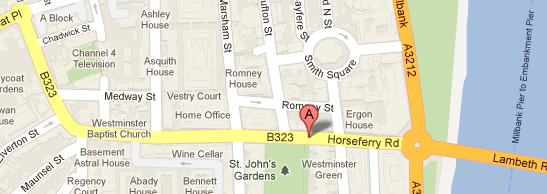
I typed in the address “124 Horseferry Road, London, United Kingdom” and got the point:

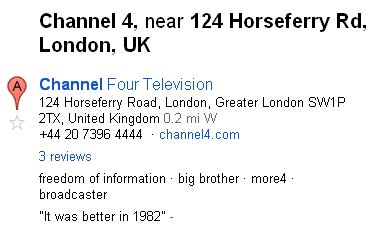
However, it seems that there is a large building up to the left called “Channel 4 Television”. Strange. Then I tried with “Channel 4, 124 Horseferry Road, London, United Kingdom”:

Oh, so I will find “Channel Four Television, 124 Horseferry Road” in the “Channel 4 Television” building only 0.2 miles west of “124 Horseferry Rd”:

Bookmark and Share

Pulling Data Quality from the Cloud

In a recent post here on the blog the benefits of instant data enrichment was discussed.

In the contact data capture context these are some examples:

  • Getting a standardized address at contact data entry makes it possible for you to easily link to sources with geo codes, property information and other location data.
  • Obtaining a company registration number or other legal entity identifier (LEI) at data entry makes it possible to enrich with a wealth of available data held in public and commercial sources.
  • Having a person’s name spelled according to available sources for the country in question helps a lot with typical data quality issues as uniqueness and consistency.

However, if you are doing business in many countries it is a daunting task to connect with the best of breed sources of big reference data. Add to that, that many enterprises are doing both business-to-business (B2B) and business-to-consumer (B2C) activities including interacting with small business owners. This means you have to link to the best sources available for addresses, companies and individuals.

A solution to this challenge is using Cloud Service Brokerage (CSB).

An example of a Cloud Service Brokerage suite for contact data quality is the instant Data Quality (iDQ™) service I’m working with right now.

This service can connect to big reference data cloud services from all over the world. Some services are open data services in the contact data realm, some are international commercial directories, some are the wealth of national reference data services for addresses, companies and individuals and even social network profiles are on the radar.

Bookmark and Share