Reference Data at Work in the Cloud

One of the product development programs I’m involved in is about exploiting rich external reference data and using these data in order to get data quality right the first time and being able to maintain optimal data quality over time.

The product is called instant Data Quality (abbreviated as iDQ ™). I have briefly described the concept in an earlier post called instant Data Quality.

iDQ ™combines two concepts:

  • Software as a Service
  • Data as a Service

While most similar solutions are bundled with one specific data provider the iDQ ™ concept embraces a range data sources. The current scope is around customer master data where iDQ ™ may include Business-to-Business (B2B) directories, Business-to-Consumer (B2C) directories, real estate directories, Postal Address Files and even social media network data from external sources as well as internal master data at the same time all presented in a compact mash-up.

The product has already gained a substantial success in my home country Denmark leading to the formation of a company solely working with development and sales of iDQ ™.

The results iDQ ™ customers gains may seem simple but are the core advantages of better data quality most enterprises are looking for, like said by one of Denmark’s largest companies:

“For DONG Energy iDQ ™ is a simple and easy solution when searching for master data on individual customers. We have 1,000,000 individual customers. They typically relocate a few times during the time they are customers of us. We use iDQ ™ to find these customers so we can send the final accounts to the new address. iDQ ™ also provides better master data because here we have an opportunity to get names and addresses correctly spelled.

iDQ ™ saves time because we can search many databases at the time. Earlier we had to search several different databases before we found the right master data on the customer. ”

Please find more testimonials here.

I hope to be able to link to testimonials in more languages in the future.

Bookmark and Share

What to do in 2012

The time between Christmas and New Year is a good time to think about if you are going to do the right things next year. In doing so, you will have to look back at the current year and see how you can develop from there.

In my professional life as a data quality and master data management practitioner my 2011 to do list included these three main activities:

  • Working with Multi-Domain Master Data Quality
  • Exploiting rich external reference data sources in the cloud
  • Doing downstream data cleansing

In a press release from May 2011 Gartner (the analyst firm) Highlights Three Trends That Will Shape the Master Data Management Market. These are:

  • Growing Demand for Multidomain MDM Software
  • Rising Adoption of MDM in the Cloud
  • Increasing Links Between MDM and Social Networks

It looks like I was working in the right space for the first two things but stayed in the past regarding the third activity being downstream data cleansing.

The third thing to embrace in the future, social MDM we may call it, has been an area of interest for me the last couple of years and actually some downstream data cleansing projects has touched making master data useful for including social media networks in the loop.  

I’m not sure if 2012 will be a breakthrough for social MDM, but I think there will be some exciting opportunities out there for paving the road for social MDM.

Bookmark and Share

Warning about warnings

In the two months where I have been living now I have seen as many warnings about ”wet floor” and ”slippery ground” as I had until then in my entire life. And I’m not that young.

Given the amount of these warnings all over makes me think that the message is: “Yes, we know that you may tilt and hurt yourself. Actually we don’t care and we don’t intend to do anything about it. But at least now you can’t say, that we didn’t warn you”.

It also makes me think about what is being done about poor data quality all over. There are lots of warnings out there and lots of ways and methodology available about how to measure bad data. But when it comes to actually doing something to solve the problems, well, warning signs seems to be the most preferred remedy.

I’m as guilty as anyone else I guess. I have even proposed a data quality immaturity model once.

Doing something about “wet floor” and “slippery ground” often have a short term workaround and a long term solution. And actually “wet floor” is often due to a recent cleaning action.

A common saying is: “Don’t Bring Me Problems—Bring Me Solutions!”.

Let’s try to put up fewer warning signs and work on having less slippery ground including immediately after a cleaning action.

Bookmark and Share

Nationally International

I am right now in the process of moving most of my business from the Kingdom of Denmark to the United Kingdom.

During that process I have become a regular customer at the Gatwick Express, the (sometimes) fast train going from London’s second largest airport to central London.

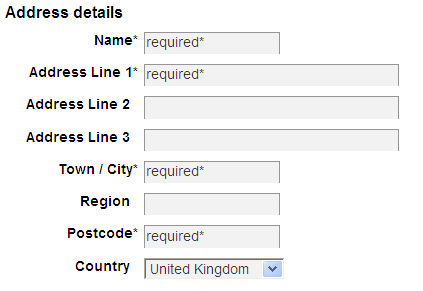
When buying tickets online they require you to enter a billing address. Here you can choose between entering a UK address or an international address.

If you enter a UK address the site takes advantage of the UK postal code system where you just have to enter a postcode, which is very granular in the UK, and a house number, and then the system will know your address.

Alternatively you can choose to enter an international address. In that case you will get a form with more fields for you to enter. But, in order not to be too international the form still have the UK way of formatting an address.

Also the default country is United Kingdom which I guess is the only value that should not be applicable for this form.

Bookmark and Share

The Pond

The term ”The Pond” is often used as an informal term for the Atlantic Ocean, especially the North Atlantic Ocean being the waters that separates North America and Europe.

Within information technology and not at least my focus areas being data quality and master data management there is a lot of exchange going on over the pond as European companies are using North American technology and sometimes vice versa. Also European companies are setting up operations in North America and of course also the other way around.

Some technologies works pretty much the same regardless of in which country it is deployed. A database manager product is an example of that kind of technology. Other pieces of software must be heavily localized. An ERP application belongs to that category. Data quality and master data management tools and implementation practice are indeed also subject to diversity considerations.

When North American companies go to Europe my gut feeling is that an overwhelming part of them chooses to start with a European or EMEA wide head quarter on the British Isles – and that again means mostly in the London area.

The reasons for that may be many. However I guess that the fact that people on the British Isles doesn’t speak a strange language has a lot to say. What many North American companies with a head quarter in London often has to realize then is, that this move only got them half way over the pond.  

Bookmark and Share

The Present Birthday

Today (or maybe yesterday) Steve Jones of Capgemeni wrote a blog post called Same name, same birth date – how likely is it? The post examines the likelihood of that two records with the same name and birthday is representing same real world individual. The chance that a match is a false positive is of course mainly depending on the frequency of the name.

Another angle in this context I have observed over and over again is the chance of a false negative if the name and other data are the same, but the birthday is different. In this case you may miss matching two records that are actually reflecting the same real world individual.

One should think that a datum like a birthday usually should be pretty accurate. My practical experience is that it in many cases isn’t.

Some examples:

Running against the time

Every fourth year when we have Olympic Games there is always controversies about if a tiny female athlete really is as old as said.

I have noticed the same phenomenon when I had the chance to match data about contesters from several years of subscription data at a large city marathon in order to identify “returning customers”.

I’m always looking for false positives in data matching and was really surprised when I found several examples of same name and contact data but a birthday been raised one year for each appearance at the marathon.

That’s not my birthday, this is my birthday

Swedish driving license numbers includes the birthday of the holder as the driving license number is the same as the all-purpose national ID that starts with the birthday.

In a database with both a birthday field and a driving license number field there were heaps of records with mismatch between those two fields.

This wasn’t usually discovered because this rule only applies to Swedish driving license numbers and the database also had registrations for a lot of other nationalities.

When investigating the root cause of this there were as usual not a single explanation and the problem could be both that the birthday belonged to someone else and the driving license belonged to someone else.

Using both fields cut down the number of false negatives here.

Today’s date format is?

In the United States and a few other countries it’s custom to use the month-day-year format when typing a date. In most other places we have the correct sequence of either day-month-year or year-month-day.  Once I matched data concerning foreign seamen working on ships in the Danish merchant fleet. When tuning the match process I found great numbers of good matches when twisting the date formats for birthdays, as the same seaman was registered on different ships with different captains and at different ports around the world.

When adding the fact that many birthdays was typed as 1st January of the known year of birth or 1st day in the known month of birth a lot of false positives was saved.

The question about occupation in the merchant fleet was actually a political hot potato at that time and until then the parliament had discussed the matter based on wrong statistics.

PS

I have used birthday synonymously with “date of birth” which of course is a (meta) data quality problem.

Bookmark and Share

Nonprofit Data Quality

One of the industries where I have worked a lot with data quality issues is at nonprofit organizations such as charities and other form of membership based organizations.

A general characteristic of such organizations is that they have databases with as many “customers” as huge global enterprises; however the number of employee records is only a fraction compared to those large companies.

So the emphasis is often not at creating well manned data governance organizational structures but implementing the best automation available in order to have optimal party master data management, where the parties involved are members and other roles played by individuals and companies with a common interest.

Many nonprofit organizations have several different fundraising activities going on at the same time. This means that real world individuals, households, organizations and their contacts are registered through different channels. The challenges of getting a “single view of customer” from the data streams created in these processes are discussed in the post Multi-Purpose Data Quality.

There are many nonprofit organizations working internationally. The often decentralized management structures in nonprofit organizations means that way of doing things will naturally be different between countries where nonprofits are operating. Also the differences in legislation and culture are important. Some examples related to how to exploit master data are examined in the post Feasible Names and Addresses.

When it comes to creating business cases for data quality nonprofits are basically of course not different from any other organization. The main goals are increased fundraising and lowering administration costs. As said, the low number of employees often leads to using technology. The low amount of money available often leads to using agile technology.

Bookmark and Share

Faster than the Speed of Light

One phrase I always have disliked is: “It can’t be done”.

What couldn’t be done yesterday at some place may be done today at your place.

Everyone knows that the bumblebee can’t fly. Except the bumblebee. So it does fly.

We all know that nothing can travel faster than the speed of light.

Well, until that a recent experiment at CERN showed that something apparently did travel faster than the light as told in an article on Sky News this morning called Amazement as Speed of Light ‘Is Broken’.

So, don’t always say that data quality can’t be improved because of this and that. Maybe it really couldn’t be done yesterday but things have changed today.

Bookmark and Share

Painted Data Quality

In a recent blog post called Plato’s Data by Jim Harris we are reminded about that data isn’t the real world but only an illusion of reality.

This makes me think about in what degree the data quality discipline is an exact science or merely an art. And surely there is a large element of art in some activities within data quality improvement as I also participated in a radio show on Jim’s blog discussing The Art of Data Matching.

One kind of (real) art is painting. Within painting good art may be that a painting reflects the real world as precisely as possible. But good art may certainly also be that the painting, like a surrealistic painting, doesn’t look like the real world, but makes you think.

With today’s technology you might also say that why bother making a painting that looks like the real world if you can simply take a photo.

However, with many good (famous) photos there is usually a controversy about if the photo was staged. An example is Raising the Flag on Iwo Jima, that also made it to a stamp.

For the record: The photo is believed not to be staged by the photographer, but it was the second raising of the flag where a smaller flag was replaced by a more impressive one. There wasn’t a hard fighting for the mountain top where the flag was raised. The fierce fighting on the island was down in the caves.   

My 3 cents….

Bookmark and Share

Party, Product, Place. Period.

In a recent post here on this blog the Master Data Management domain usually called locations was examined and followed by excellent comments.

Also in the DAMA International LinkedIn group there was a great discussion around the location domain.

The comments touched two subjects:

  • Are locations just geographic locations or can we deal with “digital locations” as eMail addresses, phone numbers, websites, go-to-meeting ID’s, social network ID’s and so as locations as well?
  • How do we model the relations between parties, products and locations?

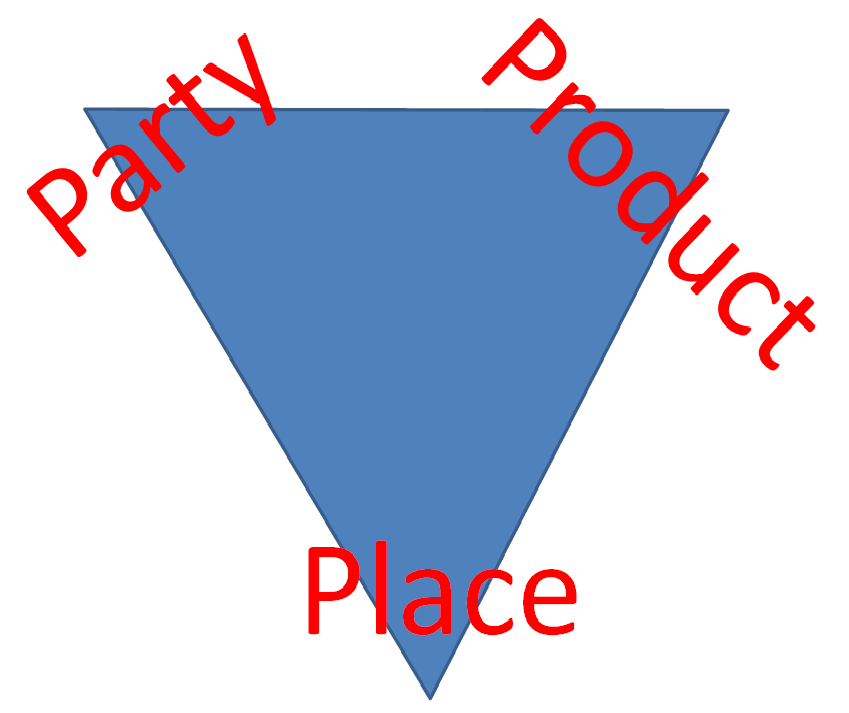
Sometimes I like to use the word places instead of locations as we then have a P-trinity of parties, products and places.

I’m not sure if places have a stronger semantic link to geography than locations have. Anyway, my thoughts on the location domain were merely connected to geography. The digital locations mentioned also in my eyes are more related to parties and not so much products. The same is true for another good old substitute for a location or address being a mailbox (like “Postbox 1234”), which is a valid notion for the destination of a letter or small package, and often seen in database columns else filled with geographic locations.

So, sticking to places being physical, geographic locations: How do we model parties, products and places?

First of all it’s important that we are able to model different concepts within each domain in one single way. A very common situation in many enterprise data landscapes is that different forms of parties exist with different models, like a model for customers, a model for suppliers, a model for employees and other models for other business partner roles.

The association between a party entity and a location entity is in most cases a time dependent relation like this consumer was billed on this address in this period. The relation between the party and the product is the good old basic data model, that we invoiced this and this product on that date. The product and place relation is very industry specific. One example will be that an on-site service contract applies to this address in this period.

Time, often handled as a period, will indeed add a fourth P to the P-trinity of party, product and place.

Bookmark and Share