Rapid Addressing, Structured or Unstructured Approach

Systems supporting faster and more accurate registration of addresses are becoming more and more common along with that they are becoming better and better.

I have noticed a structured and an unstructured approach to rapid addressing – and hybrids of course.

Structured Approach

The general concept is that you target in on the address like this:

  • First you choose a country from a country list (unless it’s always the same country).
  • Then you select a state or province if a state or province is a mandatory part of an address in that country like it is in the United States, Canada, Australia and India
  • Then you type a postal code if the country has a postal code system. It may be suggested as you write.
  • Then you type a street if the country has thoroughfare based addressing. It may be suggested as you write. For some countries, like the United Kingdom, or part of a country the street is unique by the postal code.
  • Then you type a building number. May be suggested if present in reference data.
  • Then you type a unit or other section of building where applicable. May be suggested if present in reference data.

Rapid AddressingUnstructured Approach

You type in the sequence in a single string as it suites you and the system figures out along the way what matches and makes suggestions.

This approach may better fit the way the address is known to you, but does on the other hand sometimes require you to start again and thereby the rapidness disappears a bit.

Hybrid Approach

A common hybrid solution as that you select the country before going unstructured. That cures the worst system glitches.

What’s Your Approach?

What are your experiences as a user? Maybe you are developing rapid addressing and have had your considerations. Where do you stand?

Bookmark and Share

Call me on Phone, Mobile or Skype

When calling people in order to have a long distance conversation there are three main ways today:

  • The landline phone, which have been around since the 19th century and penetrated most homes and businesses in the last century
  • The mobile phone, which came around in the 70’s and spread rapidly in the 90’s
  • Skype, a voice over internet service that grew in the 00’s

Using these services involves and identifier which may be stored in customer tables and other party master data repositories with some implications for data management and identity resolution:

TelephoneThe Landline Phone Number

The landline phone number is a very common attribute in databases around and is often used as the main identifier of a customer in ERP and CRM solutions around.

Using a landline phone number for identity resolution has some challenges, including:

  • As with most attributes they may change. Depending on the country in question they may change during relocation and most phone number systems gets and upgrade over the years.
  • In business-to-business (B2B) a company typically has more than one phone number.
  • In business-to-consumer (B2C) the landline phone number merely belongs to a household rather than a single individual. That may be good or not good depending on purpose of use.

The Mobile Phone Number

Mobile phone numbers also piles up in databases around. In relation to identity resolution there are issues with mobile phone numbers, namely:

  • They change a lot.
  • It’s not always clear to who a number actually belongs:
    • A company paid phone may be used for both business and pleasure and may be transferred to another individual
    • In a household a person may be registered for a range of mobile phones used by individual members of the household including children

The Skype ID

I seldom see databases with Skype ID’s. In my experience Skype ID aren’t used a lot in internal master data. They reside in Skype and social network profiles like for example LinkedIn.

A final rant

Today I hardly ever use a landline phone, I use my mobile once in a while and I use Skype a lot. Not because it’s convenient, but because the telecom companies has decided to charge international mobile calls in ways so greedy that it make Somali sea pirates look like honest business men.

Bookmark and Share

Shifts in Data Quality Tool Vendor Landscape

The Information Difference is an analyst firm that every year publishes a free online paper ranking the data quality tool vendors. The 2013 data quality tool landscape is out now.

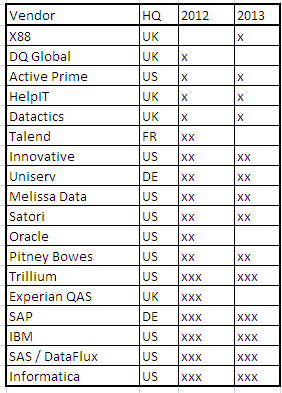
An interesting trend is the shifts in who is in the main picture. Here are the 2012 and 2013 participants:

The Information Difference 12 13

The number of x’s is a rough measure of market strength.

While X88 is a new vendor in the landscape there are four vendors that have dropped from the main picture to the list of other vendors.

I have earlier compared the Gartner Data Quality Tool Magic Quadrant and The Information Difference Landscape in the post The Data Quality Tool Vendor Difference and put the spot light on Experian QAS as a vendor appearing differently by not being in the Gartner Quadrant as reported here. This year Experian QAS also have dropped from The Information Difference Landscape main picture. Not the way to go I guess considering the many efforts of Experian QAS to be a leading data quality tool vendor.

Other vendors have dropped from their position in the picture. DQ Global is one. Oracle as well. And then Talend. Both Oracle and Talend are doing much more than data quality and probably some focus has shifted to other things. Talend for example has emphasized a lot on big data recently.

It’s going to be exciting to see what happens on another source of truth, being the Gartner Data Quality Tool Magic Quadrant, this year.

Bookmark and Share

Entrepreneurs within Social MDM

Some of the established vendors in the Master Data Management (MDM) realm may be working on integrating social data and some apparently don’t. Either way as with many other new technologies we will probably see the big movements coming from entrepreneurs.

I have noticed some new startups. Two is not surprisingly coming from the San Francisco Bay area and one is maybe surprisingly coming from the Saint Petersburg that is the original one in Russia.

Reltio is working with multi-channel, including the social channel, data integration. Their raison d’être is:

Reltio_Logo.“As a business user in Sales, Marketing or Compliance you always work with information from multiple sources of data, then why is it that most of your existing applications cannot handle data from multiple sources (internal, third party or social) or channels of interaction to provide you with the benefit of insights from this related information. Reltio is working to fill this gap….”.

Fliptop is doing the matching between your current party master data records and the same real world entities in the social sphere:

Fliptop_logo_white_small“Fliptop’s Customer Intelligence platform provides companies with an on-demand data scientist for their leads and contacts. Using publicly available information including social data to score and enrich leads, companies can prioritize their pipeline, better target their audience and know more about their customers.”

Actualog is into Social PIM (Product Information Management):

Actualog logo“Actualog is an innovative cloud-based social Product Information Management platform that brings together the expertise and knowledge of the manufacturers and most competent customers around the world. Actualog helps companies to share information about products, materials and technologies focusing on complex technical products using the ideas of social interaction.”

Have you noticed some Social MDM and related startups? – or are you actually one?

Bookmark and Share

Last Time Right

The ”First Time Right” principle is a good principle for data quality and indeed getting data right the first time is a fundamental concept in the instant Data Quality service I’m working with these days.

However, some blog posts in the data quality realm this week has pointed out that there is a life, and sometime an end of life, after data has hopefully been captured right the first time.

In the post From Cable to Grave by Guy Mucklow on the Postcode Anywhere blog the bad consequences of a case of chasing debt from a customer not among us anymore is examined.

Asset in, Garbage Out: Measuring data degradation is the title of a post by Rob Karel on Informatica Perspectives. Herein Rob goes through all the dangers data may encounter after being entered right the first time.

timingSome years ago I touched the subject in the post Ongoing Data Maintenance. As told here I’m convinced, after having seeing it work, that a good approach to also getting it right the last time is to capture data in a way that makes data maintainable.

Some techniques for doing this are:

  • Where possible collect external identifiers
  • Atomize data instead of squeezing several different elements into one attribute
  • Make the data model reflect the real world

And oh, it’s not the first time, neither the last time, I will touch this subject. It needs constant attention.

Bookmark and Share

How is Social MDM different?

In a recent interview with yours truly on the Fliptop blog I had the chance to answer a question about how Social MDM is different from traditional MDM (Master Data Management). Check out the interview here.

As said in the interview I think that:

“The main difference between MDM as it has been practiced until now and Social MDM is that traditional MDM has been around handling internal master data and Social MDM will be more around exploiting external reference data and sharing those data.”

This is in line with a take away from the MDM Summit Europe 2013 as reported in the post Adding 180 Degrees to MDM.

But, as asked by a member of the Social MDM group on LinkedIn:

What is the industry or analysts’ consensus on the meaning of Social MDM? Is it just gathering Master Data from social sources? Not really MDM – where is the Management part?”

Social MDM IconYou may follow the discussion here.

I definitely think that the management part is there, but it is different. Management is different in the social sphere in general. Data governance is different when it comes to social data (and other big data for that matter). Relying on social collaboration when maintaining master data is different from implementing “a data steward regime”.

In my eyes the management part is about balancing the use of internal master and the use of external reference data. Every organization should very carefully assess if they are good at maintaining different aspects of their internal master data (Hint: Many aren’t). Getting help from traditional data collectors and the new social sources and using social collaboration may very well be an important part of the solution.

Bookmark and Share

Fact Checking by Mashing Up

A recent blog post by Andrew Grill, CEO of Kred, is called Can you spot a social media faker? Fact checking on social media is now becoming even more important.

Besides methods within the social sphere for fact checking, as described in Andrew Grill’s post, I also believe that mashing up social network profiles and traditional external reference data is a great way of getting the full picture.

As explained in the post Sharing is the Future of MDM there are several available external options for checking the facts:

  • Public sector registries which are getting more and more open being that for example for the address part or even deeper in due respect of privacy considerations which may be different for business entities and individual entities.
  • Commercial directories often build on top of public registries.
  • Personal data lockers like Mydex
  • Social network profiles, including credibility (or influence) services

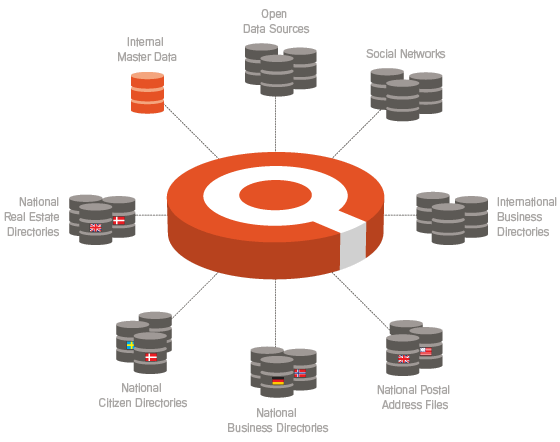
The challenge is of course that there are plenty of external reference data sources as many sources are national, making up 255 or so variants of each data source, as well as there are plenty of social networks and some credibility (or influence) services for that matter.

Making that easy for you is exactly the concept we are working on in the instant Data Quality, iDQ™, concept.

idq_framework

Bookmark and Share

The World of Measuring

A common data quality issue in data management is the use of different measuring systems. Let’s have a look at some of the issues.

Mile or Kilometer, Pound or Kilogram

There is the imperial system with units as a mile and a pound. And there is the metric system with units as meter and gram.

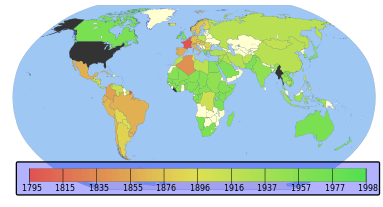
According to Wikipedia the metric system, though there are nuances in world-wide use, is used all over except in notably the United States.

Metric Penetratiion

Celsius or Fahrenheit

For temperature scale we have the Celsius scale used all over and the Fahrenheit scale in the United States.

Big-endian, Little-endian or Middle-endian

When expressing a date we have the ISO standard as a big-endian format like today is 2013-04-27. But all over the world a little-endian format like today is 27-04-2013 is used except in the United States (and all the social networks coming from there) where today is expressed in a middle-endian format being 04-27-2013.

Bookmark and Share