180 Degree Prospective Customer View isn’t Unusual

My eMail inbox is collecting received mails from several eMail accounts and therefore it’s not unusual to have duplicate messages in there.

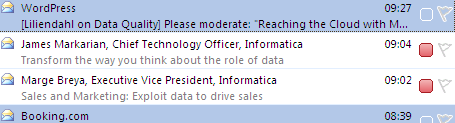
This morning I had two eMails coming in to two different eMail accounts probably part of the same campaign but with different messages:

180 degree

Apparently I have landed in two different segments with two different eMail accounts: One technology oriented and one sales and marketing oriented.

Record linking of sparse subscription profiles isn’t easy and even Informatica, a big player in Master Data Management and Data Quality solutions, have land to be covered in this game.

Bookmark and Share

Reaching the Cloud with MDM

As reported in the post The MDM Landscape is Slowly Changing a saying from the Information Difference MDM Landscape 2013 is:

  • “The market is starting to dabble in cloud-based implementations…”

I have spent some part of the last months with a cloud-based Master Data Management implementation in this case using the iDQ™ MDM Edition.

Well, actually it isn’t a full cloud implementation. There is a frontend taking care of user interaction in the cloud and there is a backend taking care of integration on-premise.

I guess many other MDM implementations embracing cloud technology will look like this solution being a hybrid, where some services are based in the cloud and some services are based on-premise.

What about your MDM implementation(s). Is it cloud-based, based on-premise or hybrid?

Hohenzollern Castle in Southern Germany

Bookmark and Share

On Washing Rental Cars and Shared Data

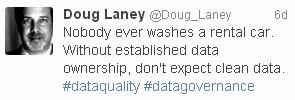
Recently a tweet from Doug Laney of Gartner has been retweeted a lot:

Rented Car

As most analogies it may fit or maybe not fit seen in different perspectives. Actually rental cars are probably some of the most washed cars as the rental company wash and clean the car between every rental.

In the same way as rental cars usually are quite clean I have also found that sharing data is a powerful way to have clean data as told on the page about Data Quality 3.0. This is also the grounding concept behind the instant Data Quality solution I’m working with, where we have just released our iDQ™ MDM Edition.

Bookmark and Share

Counting Citizens

A main story on BBC this morning is about how collection of UK migration figures is not fit for purpose as reported on the BBC website here.

UK boarderThe problem is that measuring who is going in and out of the country is designed on different purposes like measuring tourism and fighting terrorism.

Some different solutions have been mentioned:

  • The “oh no” solution: More data collection
  • The shiny new solution: Big Data
  • The unwanted solution: Master Data Management

The “oh no” solution: More data collection

Imagining you have to fill in endless forms with rigid checks when going in and out of the airports and ferry ports adding to the checks and security controls already in place. Oh no.

The shiny new solution: Big Data

A system of collecting data from passenger lists on ferries and airplanes called e-Borders is already being implemented and there are hopes that joining these new big data with the old system of record will improve accuracy. Oh, really.

The unwanted solution: Master Data Management

As said in an expert interview on TV the only sustainable solution is a central citizen registry – a solution not unknown for immigrants as me coming from Scandinavia. However, as reported here this solution is unwanted in the UK.

Bookmark and Share

Hear ye, hear ye, hear ye

royal-crier

A certain birth in London the other day was widely visualized by the announcement by a royal crier in front of St. Mary’s Hospital.

However, as reported by International Business Times here, the crier in fact just crashed the party, as he wasn’t invited by any Royal party. But the cries and included facts were true right enough.

So, this time everything was OK. But in general it’s amazing how we confuse great visualization and trustworthiness.

Bookmark and Share

The MDM Landscape is Slowly Changing

This year’s version of the MDM (Master Data Management) Landscape report from Information Difference is out.

The report confirms some trends in MDM offerings also mentioned here on the blog. Some sayings from the Information Difference report are:

  • “The market is starting to dabble in cloud-based implementations…”
  • “There continues to be a demand for MDM offerings to handle reference data….”
  • “ …still very much in their early stages, are support for Big Data…”

Categorizing the vendors into the traditional division of Customer Data Integration (CDI) versus Product Information Management (PIM) support is becoming less relevant as new Multi-Domain offerings are coming out and larger Product Master Data specialists as Hybris and Heiler has been snapped by megavendors. This leaves Stibo as the only remaining large PIM vendor, but Stibo has actually already rebranded themselves as a Multi-Domain player and have been working seriously on that for a couple of years.

MDM 2013You may view the full Information Difference MDM Landscape report here.

Bookmark and Share

Where the Streets have one Name but Two Spellings

Last week’s post called Where The Streets have Two Names caught a lot of comments both on this blog and in LinkedIn groups as here on Data Quality Professionals and on The Data Quality Association, with a lot of examples from around the world on how this challenge actually exist more or less everywhere.

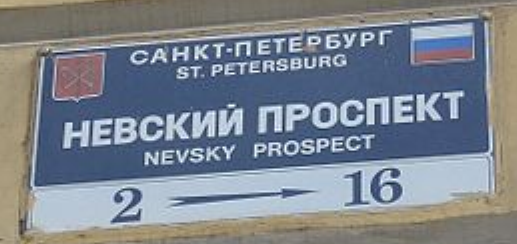
Recently I had the pleasure of experiencing a variant of the challenge when driving around in a rented car in the Saint Petersburg area in Russia. Here the streets usually only have one name but that may be presented in two different alphabets being the local Cyrillic or the Latin alphabet I’m used to which also was included in the reference data on the Sat Nav. So while it was nice for me to type destinations in Latin letters it was nice to have directions in Cyrillic in order to follow the progress on road signs.

So here standardization (or standardisation) to one preferred language, alphabet or script system isn’t the best solution. Best of breed solutions for handling addresses must be able to handle several right spellings for the same address.

Nevsky_Prospekt,_St_Petersburg,_street_sign
Street sign in Cyrillic with Latin subtitle

Bookmark and Share

Where the Streets have Two Names

As told in post The Art in Data Matching a common challenge in matching names and addresses is that in some parts of the world the streets have more than one name at the same time because more than one language is in use.

We have the same challenge when building functionality for rapid addressing, being functionality that facilitates fast and quality assured entry of addresses supported by reference data that knows about postal codes / cities and street names.

The below example is taken from the instant Data Quality tool address form:

Finish Swedish

The Finnish capital Helsinki also has an official name in Swedish being Helsingfors and the streets in Helsinki/Helsingfors have both Finnish and Swedish names. So when you start typing a letter suggestions could be in both Finnish and Swedish.

What challenges have you encountered with street names in multiple languages?

Bookmark and Share

A Blast from the Past

Many days I work in a so called day office, which is an office booked for a single day at a location convenient for where I am and is going to do on that day.

My day office today comes with a Rolodex.

rolodex

But I have trouble connecting it with Bluetooth 🙂

Fortunately means of keeping a contact list has improved over the years, not at least when it comes to connectivity:

  • The Personal Digital Assistant (PDA) usually could do Bluetooth or had other ways to connect to other devices and share data that way.
  • With the rise of Customer Relationship Management (CRM) systems your contact list was blended with the contact list of everyone else in your company.
  • Now with Social CRM (SCRM) your company’s contact list is (or will be) integrated with social networks.

Data Quality challenges and opportunities also have changed with the development in how to keep a contact list:

  • The Rolodex was totally dependent on you keeping the data up-to-date and it was your choice how it was indexed – by given name, surname or whatever.
  • The PDA data should be kept timely by you as well. When exchanging with other devices different ways of organizing data could be a pain somewhere.
  • With CRM systems updates from third party sources became relevant and you aren’t alone on making the updates – differently. Duplicates and data not fit for your purpose is a pain.
  • Now with SCRM your contacts themselves may make most of the updates. Now you have to figure out which ones to rely upon and how to link with your old recording. In other words: Social Master Data Management.

Well, perhaps I better have to forget about using the Rolodex and get on with today’s tweeting. Now, where is my pencil?

Papertweet

Bookmark and Share

Is Data Cleansing Bad for Data Matching?

Today I stumbled upon an article from Australia on BMC: Medical Informatics and Decision Making. The article is called The effect of data cleaning on record linkage quality.

The result of the described research is:

“Data cleaning made little difference to the overall linkage quality, with heavy cleaning leading to a decrease in quality. Further examination showed that decreases in linkage quality were due to cleaning techniques typically reducing the variability – although correct records were now more likely to match, incorrect records were also more likely to match, and these incorrect matches outweighed the correct matches, reducing quality overall.”

datamatchingThis resonates very well with my experience too. Usually I like to match with both original data and standardized (cleansed) data in order to exploit the best of both approaches.

What are your experiences?

Bookmark and Share