Time To Turn Your Customer Master Data Management Social?

The title of a post on the Nimble blog has this question: Time To Turn Your Sales Team Social?´ The post has a lot of evidence on why sales teams that embrace social selling are doing better than teams that doesn’t do that.

We do see new applications supporting social selling where Nimble is one example from the Customer Relationship  Management (CRM) sphere as explored in the post Sharing Social Master Data. Using social services and exploiting social data in sales related business processes will over time affect the way we are doing customer master data management.

Social MDM2Apart from having frontend applications being social aware we also need social aware data integration services and we do indeed need social aware Master Data Management (MDM) solutions for handling data quality issues and ensuring a Single Customer View (SCV) stretching from the old systems of record to the new systems of engagement.

One service capable of doing data integration between the old world and the new world is FlipTop and some months ago I was interviewed on the FlipTop blog about the links to Social MDM here. Currently I’m working with a social aware Master Data Management solution being the iDQ™ MDM Edition.

What about you? Are your Customer Master Data Management and related data quality activities becoming social aware?

Bookmark and Share

A Universal Challenge

Yesterday on The Postcode Anywhere blog Guy Mucklow wrote a nice piece called University Challenge. The blog post is about challenges with shared addresses and a remedy at least for addresses in the United Kingdom.

And sure, I also had my challenges with a shared address in the UK as reported in the post Multi-Occupancy.

But I guess the University Challenge is a universal challenge.

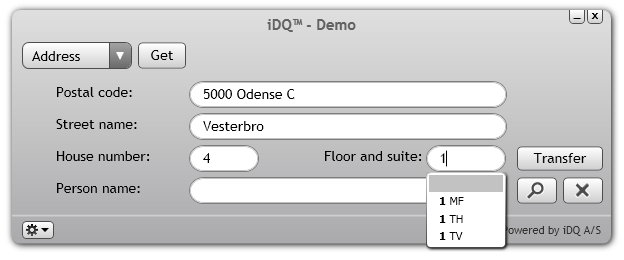
The postal formats and available reference data sources are of course very different around. Below is an example from the iDQ™ (instant Data Quality) tool when handling a Danish address with multiple flats. Here the tool continuously display what options is available to make the address unique:

iDQ(tm) multi occupancy

Bookmark and Share

What’s so Special About MDM?

In a blog post from yesterday one of my favorite bloggers Loraine Lawson writes:

“Take master data management, for instance. Oh sure, experts preach that it’s a discipline, not “just” a technology, but come on. Did anybody ever hear about MDM before MDM solutions were created?”

The post is called: Let’s Talk: Do You Really Need an Executive Sponsor for MDM?

And yes we do need an executive sponsor. Also we need a business case as we must avoid doing it big bang style and we need to establish metrics for measuring success and so on.

All wise things as it is wise sayings about data quality improvement initiatives, business intelligence (BI) implementations, customer relationship management (CRM) system roll-out and almost any other kind of technology enabled project.

shiny thingsI touched this subject some years ago in the post Universal Pearls of Wisdom.

So let’s talk:

  • Is an executive sponsor more important for Master Data Management (MDM) than for Business Intelligence (BI)?
  • Is a business case more important for Master Data Management (MDM) than for Supplier Chain Management (SCM)?
  • Is big bang style more dangerous for Master Data Management (MDM) than for Service Oriented Architecture (SOA)?

And oh, don’t just tell me that I can’t compare apples and pears.

Bookmark and Share

On Maps, Data Quality and MDM

Maps are great but sometimes you’ll have some trouble with data quality issues on maps as told in the post Troubled Bridge over Water.

When it comes to political borders on maps things may get really nasty as it happened lately for Huawei with a congratulation to Pakistan on the independence day showing a map with borders not in line with the Pakistani version of the truth. The story is told here.

Google EarthThere are plenty of disputes about borders in the world stretching from the serious situations in the Himalaya region to for example the close to comical case between Canada and Denmark/Greenland over Hans Island.

In these situations you can’t settle on a single version of the truth.

However, even if we don’t have disputes on what is right or wrong we may have very different views on how to look at various entities as examined in the post The Greenland Problem in MDM.

Bookmark and Share

Multi-Domain MDM Market Update

Multi-Domain MDMIn the recent post called The MDM Landscape is Slowly Changing I wrote about some findings in the latest MDM market research document by the Information Difference.

Recently Bloor published their view on the MDM Market including who is in or close to the bull’s eye. You may read the document called Master Data Management Market update by following the press release on the paper from Informatica here.

The two views are in agreement on a lot of things including how Multi-Domain MDM is becoming the norm.  The alignment of views is no surprise as I guess that there is only one Andy Hayler around in the MDM sphere and he is the man behind both documents.

And hey, if you agree with Andy about Multi-Domain MDM, why not join the LinkedIn Multi-Domain MDM group.

Bookmark and Share

Things we do with fresh master data in old packing

In a recent blog post called Understanding the sources of master data Prashanta Chandramohan writes:

“Often times, master data sources are legacy in nature, built and maintained over a long period of time, lack documentation and include procedures and terminologies which are no longer relevant in the current context.”

This saying resonates very well with my experiences.

puzzleImplementing Master Data Management (MDM) solutions doesn’t take place in a green field. Most of the hard work is not about how to build a perfect master data environment but is about how to work around what during the years has been done badly with master data for many good reasons.

Some of the maybe low practical but yet persistent challenges I have worked with are:

  • Quite a few old systems hold data as names, addresses, product descriptions and so on only in upper case. You may want to convert that to a more beautiful mix of upper and lower case (according to the culture in question) on an ongoing basis. When handling master data entities describing things outside the English alphabet, we may even want to optimize the use of national characters in strings that before only allowed characters from the English alphabet.
  • Fields are used for other things than the original purpose because there is no other way. While ongoing conversions including parsing may not be the best way around it often is the only way to go.
  • Due to limited search capabilities in old systems you may write personal names starting with the surname (in cultures where that’s not common), twist company name elements around and so on. This may not look nice when mashing up with other sources and limit the use for other purposes, so also here conversions may the only way to go.

Please find some more on the fun in doing those things in the post The Cases for UPPER CASE in Data Management.

Bookmark and Share

Hierarchical Data Matching

A year ago I wrote a blog post about data matching published on the Informatica Perspective blog. The post was called Five Future Data Matching Trends.

HierarchyOne of the trends mentioned is hierarchical data matching.

The reason we need what may be called hierarchical data matching is that more and more organizations are looking into master data management and then they realize that the classic name and address matching rules do not necessarily fit when party master data are going to be used for multiple purposes. What constitutes a duplicate in one context, like sending a direct mail, doesn’t necessary make a duplicate in another business function and vice versa. Duplicates come in hierarchies.

One example is a household. You probably don’t want to send two sets of the same material to a household, but you might want to engage in a 1-to-1 dialogue with the individual members. Another example is that you might do some very different kinds of business with the same legal entity. Financial risk management is the same, but different sales or purchase processes may require very different views.

I usually divide a data matching process into three main steps:

  • Candidate selection
  • Match scoring
  • Match destination

(More information on the page: The Art of Data Matching)

Hierarchical data matching is mostly about the last step where we apply survivorship rules and execute business rules on whether to purge, merge, split or link records.

In my experience there are a lot of data matching tools out there capable of handling candidate selection, match scoring, purging records and in some degree merging records. But solutions are sparse when it comes to more sophisticated things like spitting an original entity into two or more entities by for example Splitting Names or linking records in hierarchies in order to build a Hierarchical Single Source of Truth.

Bookmark and Share

Know Your (Foreign Luxury Bag) Customer

Gucci BagA story featured a lot in the media the last days is the incident where one of richest women on the planet, Oprah Winfrey, was told that she couldn’t afford the handbag she wanted to look at in a Zürich shop. Was it racism or a misunderstanding because Oprah isn’t good at speaking German?

Either way it was for sure an example of bad things happening when you don’t know your customer. This story also highlights the issues we have with foreign customers as Oprah may not be just as famous in Zürich as in New York.

We have these challenges in customer master data management all over as described in the post Know Your Foreign Customer.

And oh: Maybe it’s time to start a sister blog called Liliendahl on Fashion. This is my second post on luxury handbags. The first post was called Data Quality Luxury.

Bookmark and Share

On MDM, Data Models and Big Data

As described in the post Small Data with Big Impact my guess is that we will see Master Data Management solutions as a core element in having data architectures that are able to make sustainable results from dealing with big data.

If we look at party master data a serious problem with many ERP and CRM systems around is that the data model for party master data aren’t good enough for dealing with the many different forms and differences in which the parties we hold data about are represented in big data sources which makes the linking between traditional systems of record and big data very hard.

Having a Master Data Management (MDM) solution with a comprehensive data model for party master data is essential here.

Some of the capabilities we need are:

Storing multiple occurrences of attributes

People and companies have many phone numbers, they have many eMail addresses and they have many social identities and you will for sure meet these different occurrences in big data sources. Relating these different occurrences to the same real world entity is essential as reported in the post 180 Degree Prospective Customer View isn’t Unusual.

An MDM hub with a corresponding data model is the place to manage that challenge in one place.

Exploiting rich external reference data

As told in the post Where the Streets have Two Names and emphasized in the comments to the post the real world has plenty of examples of the same thing having many names. And this real world will be reflected in big data sources.

Your MDM solution should embrace external reference data solving these issues.

Handling the time dimension

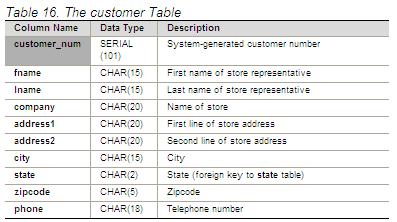
In the post A Place in Time the flaws of the usual customer table in ERP and CRM systems is examined. One common issue is handling when attributes changes. Change of address happens a lot. And this may be complicated by that we may operate several address types at the same time like visiting addresses, billing addresses and correspondence addresses. These different addresses will also pop up in big data sources. And the same goes for other attributes.

You must get that right in your MDM implementation.

Customer Table
The usual but very wrong customer table that wont work with big data.

Bookmark and Share

How can you have any pudding….

The social media sphere these days has a lot of good stuff around Data Quality and Big Data including this piece from Jim Harris called Big Data is Just Another Brick in the Wall.

the wallIn here Jim ponders how working with Big Data must be build on a lot of other disciplines including Data Quality and the title of the blog post is nicely composed from the title of the fantastic Pink Floyd song called Another Brick in the Wall.

In this song there is an unpleasant voice of an angry stupid old teacher yelling:

“If you don’t eat yer meat, you can’t have any pudding. How can you have any pudding if you don’t eat yer meat?”

I’m afraid I also have to raise an equally unpleasant voice of saying:

“If you don’t eat yer data quality, you can’t have any big data. How can you have any big data if you don’t eat yer data quality?”

And by the way: How can you work with big data if you don’t join the LinkedIn group called Big Data Quality?

Bookmark and Share