Dear fellow data governance practitioner. Unless you work in the United States, where today is a day off because of thanksgiving, you are supposed to create business value today.
Data governance is about creating business value. Like everything else going on at a workplace. It should be needless to say so. So therefore there is no reason to read a recent Jim Harris blog post called Data needs a Copernican Revolution.
Actually, I don’t think the problem for people working with data governance is understanding the need of creating business value. The problem is knowing how to prove business value. One way of doing this is requesting guidance for that. Actually, you can do that on Nicola Askham’s blog right here.
Over on the Informatica Perspectives blog Monica McDonnell of Informatica seems to be determined to separate Product Information Management (PIM) and Product Master Data Management (Product MDM) as we now have the second attempt in the post PIM is not Product MDM Part 2.
I can easily see the reason for this quest for Informatica, as Informatica will very much like to position the Heiler acquisition as an Informatica Multi-Domain MDM aware PIM solution as mentioned in the post MDM Aware MDM Solutions.
There will always be pros and cons for having capabilities delivered in smaller best of breed packages opposed to in larger integrated packages. On the MDM market the vendors pitch their offerings according to how they got there. SAP is using Hybris as an eCommerce focused PIM add-on to SAP. On the other hand Stibo Systems and Riversand have been adding MDM to PIM and now adds Multi-Domain to MDM as reported in the post The second part of the Multi-Domain MDM Magic Quadrant is out.
In the PIM / Product MDM realm we have several other considerations on how to address different disciplines with technology support. An important capability within PIM is Digital Asset Management (DAM) as described in the post Digital Assets and Product MDM. DAM can be a separate application or part of PIM / Product MDM. Technology support for Data Governance could also come separately as reported in the post Data governance tools: The new snake oil?
Now, back to PIM versus Product MDM. I’m not sure it is wise to divorce these two. It seems to be a kind of back looking exercise. I would like to marry them as part of looking forward in a multi-domain MDM world. To catch up on Monica’s arguments PIM has been much about the sell-side of things. I think we should be better at integrating the buy-side and the sell-side of Product MDM / PIM as examined in the post An Alternative Multi-Domain MDM Quadrant.
The term evergreen is known from botany as plants staying green all year and from music as songs not just being a hit for a few months but capable of generating royalties for years and years.
Data should also stay evergreen. I am a believer in the “first time right” principle as explained in the post instant Single Customer View. However, you must also keep your data quality fresh as examined in the post Ongoing Data Maintenance.
If we look at customer, or rather party, Master Data Management (MDM) it is much about real world alignment. In party master data management you describe entities as persons and legal entities in the real world and you should have descriptions that reflect the current state (and sometimes historical states) of these entities. Some reflections will be The Relocation Event. And as even evergreen trees go away, and “My Way” hopefully will go away someday, you also must be able to perform Undertaking in MDM.
A very common starting point for producing tangible outcomes in a data governance programme is setting up a business glossary. The alternatives, or next/previous steps, for a business glossary were discussed in the post Metadata Musings by a Nerd.
First, in my eyes a business glossary (or whatever you call such a thing) is indeed a useful deliverable in its own right. In order to support a data governance programme you will need to add things besides definition of terms. One important element is documenting business rules as reported by Nikki Rogers at The University of Bristol here.
A business glossary should ultimately morph into full-blown metadata management or meet data dictionary and/or metadata repository initiatives that also may grow in your organization. What full-blown metadata management means was touched recently by Brian Brewer in a blog post called Gartner Says More Metadata. This post cites a blog post by Darin Stewart of Gartner (the analyst firm). The Gartner post is called Big Content Needs More Metadata.
How did you develop your business glossary?
Did you start with a business glossary and then morphed into the data dictionary and metadata management discipline and lingo?
Did the business glossary grow from the metadata management work?
Is the business glossary just sitting there doing what it does?
When we talk about multi-domain Master Data Management (MDM) we usually recognize party (customer, supplier, employee) and product as the most predominant domains. The location domain is also widely understood as a separate domain. Further we can discus about assets as done in the post Where is the Asset.
Then there is the Calendar domain. In many industries calendar may just be seen as configuration data. However, in some industries calendar is a true master data domain.
Another example is public transit, an industry I have worked with in the last 16 years. Managing calendar data has many challenges in running a business or authority in public transit. Some tricky points are:
Keeping track of day types where different partners sees the week and public holidays differently, not at least when crossing borders.
Changing the day not necessarily at midnight, but at various times.
Assigning and monitoring services to a schedule under these circumstances.
In public transit managing calendar data has the same issues as the other more common master data domains, as calendar data may be represented differently in applications across the IT landscape stretching from back-office systems to mobile devices on-board vehicles, as examined in the post Going in the Wrong Direction.
Digital Asset Management (DAM) solutions are often seen working beside or within product Master Data Management (MDM) solutions.
I guess I might have been some of the first folks working with relating digital assets and enterprise software. That was in the early 90’s when I worked with Wang Laboratories that was a pioneer in handling digital images in the IT world.
Digital assets today are typically stored as files of well-known types as jpg, png and pdf. Within product MDM they are images of products, installation guides, safety handling sheets and so on.
The rise of the multi-channel theme has emphasized the importance of digital asset management capabilities.
Data quality is as ever an imperative. Related to well-known data quality dimensions that for example for product images means:
Uniqueness: You want to use the same image in your printed catalogue and on your web shop.
Accuracy: The image must show the described product and not something else.
Consistency: The images for similar products should have the same style.
A random product image
Many of the leading product MDM solutions were born in the printed catalogue era. Here the product image was the dominant digital asset. Adding eCommerce and mCommerce means that a lot more digital asset types must be handled.
Usually we see digital assets as unstructured, or sometimes semi-structured, data. Therefore we often relate structured keywords in order to control the digital assets.
Digital assets should flow and should be controlled in the eco system of manufacturers, distributors, retailers and end users of the products. Here we have the same issues as with the structured product attributes. Giving the foreseeable steep increase in the volume, velocity and variety of the digital assets used as part of product MDM, we must drastically improve our capability in Sharing Product Master Data.
Today I read a strange story about who discovered the Americas. It is about that Turkish President Recep Tayyip Erdogan said that Muslims, not Columbus, discovered Americas. The assumed discovery should have happened in the year 1178 in the Gregorian calendar.
2nd there is much speculation about that someone else crossed the oceans. Only archaeological evidence (so far) is that the Vikings were on Newfoundland of the coast of Canada at a place today called L’Anse aux Meadows. That happened around year 1000 in the Gregorian calendar. (By the way they came from Greenland, that geographically is a part of the Americas).
3rdChristopher Columbus and his crew arrived in the Americas in the year 1492 in the Gregorian calendar.
That is the data quality part of the story. The rest is information quality.
We all know the problem: We use the same term, but means two different things. Or: We use two different terms, but actually mean the same thing.
Within data management this is a huge challenge. The solution is ….. Well, there are different terms:
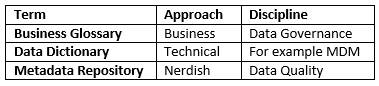
Business Glossary is one term. The term is explained in an artcle on B-eye-Network by Lowell Fryman here. Using the term business glossary implies that you have a business approach to the issue. Implementing a business glossary is often mentioned as a part of a data governance framework.
Data Dictionary is explained on Wikipedia here. Using the term data dictionary implies that you have a technical approach to the issue. Having a data dictionary is sometimes mentioned as a part of a Master Data Management (MDM) solution.
Metadata Repository is also explained on Wikipedia here. Using the term metadata repository implies that you have a somewhat nerdish approach to the subject as seen in the post Metadata Meatballs. Addressing metadata is often stated as an important subject within the data quality discipline as shown in the post Perfect Wrong Answer.
Gartner, the analyst firm, recently released their magic quadrant for Master Data Management (MDM) of customer data solutions 2014 as reported in the post Customer MDM Magic Wordles.
Now the quadrant for Master Data Management of product data solutions 2014 is out too, so we can overlay the two quadrants and see how multi-domain Master Data Management (MDM) solutions are doing in terms of who are performing well with product master data and who are performing well with customer master data.
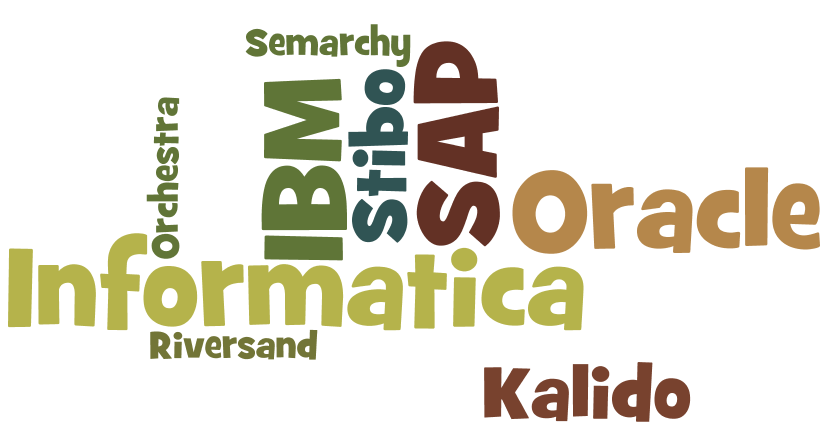
If we focus on leading vendors with differences in quadrant positioning, Informatica is better positioned with customer master data (leader) than with product master data (visionary and niche with two different products). Stibo Systems and Riversand are positioned very well within product master data (leaders) but not positioned at all with customer master data, though both vendors are naming themselves as multi-domain MDM solution providers and surely have such capabilities. I personally worked on the multi-domain roadmap with one of them some years ago.
This is not the quadrant. Just some vendor names.
As every year the vendors makes press releases about the quadrant.
Upen Varanasi, CEO of Riversand, has commented in this way: “In this new Digital world, accurate product and other master information is a foundation for our customers’ major business initiatives, which requires a comprehensive, highly scalable and flexible MDM solution with full multi-domain capabilities.” See the full press release from Riversand here.
Mikael Lyngsø, CEO of Stibo Systems says: “Every member of the Stibo Systems’ team remains committed to providing our customers and partners with cutting edge solutions that not only meet their most pressing business issues but also create the most lasting and demonstrable value.” The about the company section has this bold statement: “Stibo Systems is the global leader in multidomain Master Data Management (MDM) solutions.” Read the full press release here.
Rob Karel, vice president, Product Strategy and Product Marketing, MDM, Informatica says: “We continue to deliver a multidomain MDM solution that, in combination with Informatica PIM, delivers end-to-end customer, product and supplier information governance and stewardship. Delivering complete, reliable and consistent product information – across every channel – is the key to a great customer experience.” Informatica also kindly provides a free copy of the report. Get the Magic Quadrant for Master Data Management of Product Data Solutions 2014 here.
Yesterday this yuletide challenge was included in an eMail in my inbox:
Nice. Lapland is in Northern Scandinavia. Scandinavia belongs to that half of the world where comma is used as decimal mark as shown in the post Your Point, My Comma.
So while the UK born gym members will be near fainting doing several thousands of kilometers, I will claim the prize after easy 3 kilometers and 546 meters on the cross trainer.
 Data governance is about creating business value. Like everything else going on at a workplace. It should be needless to say so. So therefore there is no reason to read a recent Jim Harris blog post called Data needs a Copernican Revolution.
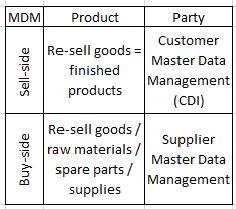 Now, back to PIM versus Product MDM. I’m not sure it is wise to divorce these two. It seems to be a kind of back looking exercise. I would like to marry them as part of looking forward in a multi-domain MDM world. To catch up on Monica’s arguments PIM has been much about the sell-side of things. I think we should be better at integrating the buy-side and the sell-side of Product MDM / PIM as examined in the post
  If we look at customer, or rather party, Master Data Management (MDM) it is much about real world alignment. In party master data management you describe entities as persons and legal entities in the real world and you should have descriptions that reflect the current state (and sometimes historical states) of these entities. Some reflections will be
 One example is in postal services as mentioned in the post


 Liliendahl on Data Quality