Social Commerce and Multi-Domain MDM

The term social commerce is said to be a subset of eCommerce where social media is used to ultimately drag prospects and returning customers to your website, where a purchase of products and services can be made.

In complex sales processes, typically for Business-to-Business (B2B) sales, the website may offer product information sheets, demo requests, contact forms and other pipeline steps.

This is the moment where your social media engaged (prospective) customer meets your master data as:

  • The (prospective) customer creates and maintains name, address and communication information by using registration functions
  • The (prospective) customer searches for and reads product information on web shops and information sites

One aspect of this transition is how master data is carried over, namely:

  • How the social network profile used in engagement is captured as part of (prospective) customer master data or if it should be part of master data at all?
  • How product information from the governed master data hub has been used as part of the social media engagement or if the data governance of product data should be extended to use in social media at all?

Any thoughts?

Bookmark and Share

Big Reference Data as a Service

This morning I read an article called The Rise of Big Data Apps and the Fall of SaaS by Raj De Datta on TechCrunch.

I think the first part of the title is right while the second part is misleading. Software as a Service (SaaS) will be a big part of Big Data Apps (BDA).

The article also includes a description of LinkedIn merely as a social recruitment service. While recruiters, as reported in the post Indulgent Moderator or Ruthless Terminator?, certainly are visible on this social network, LinkedIn is much more than that.

Among other things LinkedIn is a source of what I call big reference data as examined in the post Social MDM and Systems of Engagement.

Besides social network profiles big reference data also includes big directory services, being services with large amount of data about addresses, business entities and citizens/consumers as told in the post The Big ABC of Reference Data.

Right now I’m working with a Software as a Service solution embracing Big (Reference) Data as a Service thus being a Big Data App called instant Data Quality.

And hey, I have made a pin about that:

Bookmark and Share

Data Quality vs Big Data

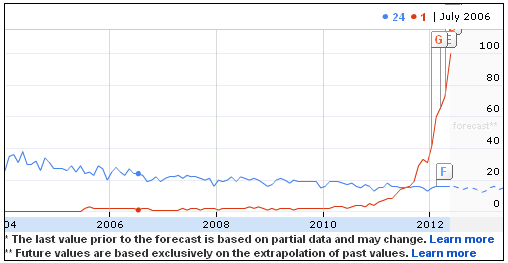
If you go to Google Insight and ask for how it goes with search interest for “data quality” versus how it is with “big data” you’ll get this graph:

“Data quality” (blue line) is a bear market. The interest is slowly but steadily decreasing. “Big data” (red line) is a bull market with a steep rising curve of interest starting in early 2011 and exploding in 2012.

So, what can you do if your blog is about data quality? For my part I’m writing a blog post on my data quality blog mentioning the term “big data” as many times as possible 🙂

I’m not saying “big data” is uninteresting. Not at all. I even use the term “big reference data” when describing how to exploit big directories and social network profiles in the quest for improving party master data quality.

In the short period of the “big data” hype it has often been said, that why should we start working with “big data” when we can’t manage small data yet?

While this makes some sense, it will in my eyes be a mistake not to try exploring what data quality techniques we can apply to “big data” and what data quality advantages we can harvest within “big data”.

We have known for years that the amount of data being available is drastically increasing. Now we just have a term to be used when searching for and talking about it. Like it or not; that term is “big data”.

Bookmark and Share

Social MDM and Systems of Engagement

Social Master Data Management has been an interest of mine the last couple of years and last week I have tried to reach out to others in exploring this new era of Master Data Management by creating a group on LinkedIn called Social MDM.

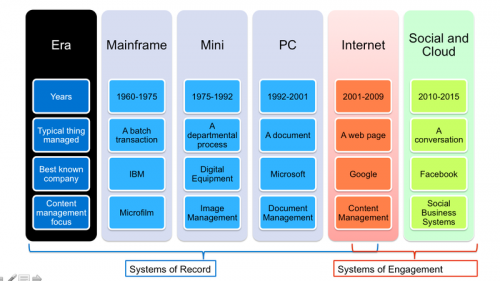
When reading a nice blog with the slogan ”Welcome to the Real (IT) World!” by Max J. Pucher I came across a good illustration by John Mancini showing the history of IT and how the term “Systems of Record” is being replaced (or at least supplemented) by the term “Systems of Engagement”:

Master Data Management (MDM) includes having a System of Record (SOR) describing the core entities that takes part in the transactional systems of record that supports the daily business in every organization. For example a golden MDM record is describing the party that acts as a customer on an order record while the products in the underlying order lines are described in golden MDM records for the things dealt with within the organization.

Social Master Data Management (Social MDM) will be about supplementing that System of Record so we are able to further describe the parties taking part in the new Systems of Engagement and link with the old Systems of Records. These parties are reflected as social network profiles that are owned by the same human beings who are our (prospective) customers, part of the same household or are a contact for a company being a (prospective) customer or any other business partner.

For a guy like me who started in IT in the mainframe era (just after it had ended according to the above illustration) and went on with mini computers, PC’s and the internet it’s very exciting to be moving on into the social and cloud era.

It will be good to be joined by even more data quality and MDM practitioners and anyone else in the LinkedIn Social MDM group.

Bookmark and Share

MDM Summit Europe 2012 Preview

I am looking forward to be at the Master Data Management Summit Europe 2012 next week in London. The conference runs in parallel with the Data Governance Conference Europe 2012.

Data Governance

As I am living within a short walking distance of the venue I won’t have so much time thinking as Jill Dyché had when she recently was on a conference within driving distance, as reported on her blog post After Gartner MDM in which Jill considers MDM and takes the road less traveled. In London Jill will be delivering a key note called: Data Governance, What Your CEO Needs to know.

On the Data Governance tracks there will be a panel discussion called Data Governance in a Regulatory Environment with some good folks: Nicola Askham, Dylan Jones, Ken O’Connor and Gwen Thomas.

Nicola is currently writing an excellent blog post series on the Six Characteristics Of A Successful Data Governance Practitioner. Dylan is the founder of DataQualityPro. Ken was the star on the OCDQblog radio show today discussing Solvency II and Data Quality.

Gwen, being the founder of The Data Governance Institute, is chairing the Data Governance Conference while Aaron Zornes, the founder of The MDM Institute, is chairing the MDM Summit.

Master Data, Social MDM and Reference Data Management

The MDM Institute lately had an “MDM Alert”  with Master Data Management & Data Governance Strategic Planning Assumptions for 2012-13 with the subtitle: Pervasive & Pandemic MDM is in Your Future.
Some of the predictions are about reference data and Social MDM.

Social master data management has been a favorite subject of mine the last couple of years, and I hope to catch up with fellow MDM practitioners and learning how far this has come outside my circles.

Reference Data is a term often used either instead of Master Data or as related to Master Data. Reference data is those data defined and initially maintained outside a single enterprise. Examples from the customer master data realm are a country list, a list of states in a given country or postal code tables for countries around the world.

The trend as I see it is that enterprises seek to benefit from having reference data in more depth than those often modest populated lists mentioned above. In the customer master data realm such big reference data may be core data about:

  • Addresses being every single valid address typically within a given country.
  • Business entities being every single business entity occupying an address in a given country.
  • Consumers (or Citizens) being every single person living on an address in a given country.

There is often no single source of truth for such data.

As I’m working with an international launch of a product called instant Data Quality (iDQ™) I look forward to explore how MDM analysts and practitioners are seeing this field developing.

Bookmark and Share

Updating a Social Business Directory

Business directories have been around for ages. In the old days it was paper based as in the yellow pages for a phone book. The yellow pages have since made it to be online searchable. We also know commercial business directories as the Dun & Bradstreet WorldBase as well as government operated national wide directories of companies and industry specific business directories.

Such business directories often takes a crucial role in master data quality work as sources for data enrichment in the quest for getting as close as possible to a single version of the truth when dealing with B2B customer master data, supplier master data and other business partner master data.

A classic core data model for Master Data in CRM systems, SCM solutions and Master Data hubs when doing B2B is that you have:

  • Accounts being the BUSINESS entities who are your customers, suppliers, prospects and all kind of other business partners
  • Contacts being the EMPLOYEEs working there and acting in the roles as decision makers, influencers, gate keepers, users and so on

Today we also have to think about social master data management, being exploiting reference data in social media as a supplementary source of external data.

As all social activity this exercise goes two ways:

  • Finding and monitoring your existing and wanted business partners in the social networks
  • Updating your own data

Most business entities in this world are actually one-man-bands. So are mine. Therefore I went to the LinkedIn company pages this morning and updated data about my company Liliendahl Limited: Unlimited Data Quality and Master Data Management consultancy for tool and service vendors.

Bookmark and Share

Sharing Social Master Data

If a company runs a Customer Relationship Management (CRM) system all employees are supposed to enter their interactions with customers and prospects including adding new accounts and contacts if it’s the first engagement.

With the rise of social networks first engagements are increasingly done in those networks. Furthermore new employees often bring old contacts from former employments with them thus utilizing an established relationship that probably is manifested in one or more already existing social network connections.

As explained in the post Social Master Data Management the term ”Social CRM” has been around for a while. We now see CRM solutions where the account and contact master data primarily is build on extracting those data from social networks.

I have just tried out such a solution called Nimble.

If you are more than a one-man-band company it’s interesting in what degree you are willing (or forced) to share your connections as master data entities for the CRM solution.

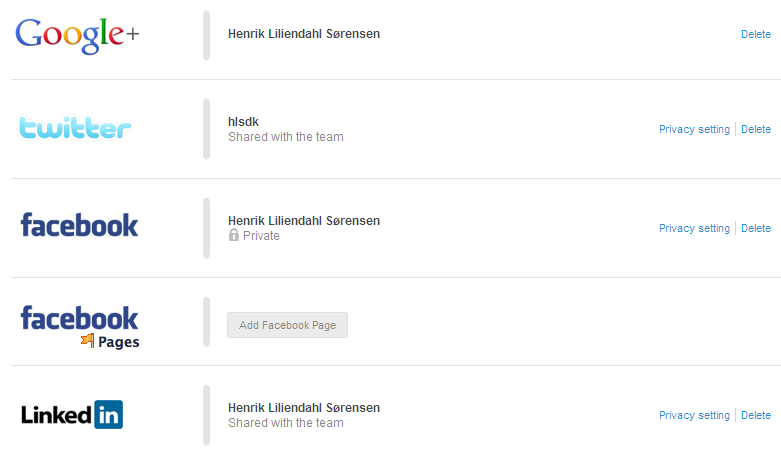
In Nimble you have the choice of differentiate for each network. I would probably freely choose a setup with Twitter and LinkedIn as shared with the team, but Facebook as private:

But that is just how I think based on my way of using social networks.

There is a fundamental data quality versus privacy issue around utilizing employee’s social network connections as master data for CRM and eventually enterprise wide Master Data Management (MDM).

All things equal data quality will be best if everyone contributes within reason. Not at least in sales, but also more or less in other functions, you are hired also because of your relations.

What do you think?

Bookmark and Share

Informatics for adding value to information

Recently the Global Agenda Council on Emerging Technologies within the World Economic Forum has made a list of the top 10 emerging technologies for 2012. According to this list the technology with the greatest potential to provide solutions to global challenges is informatics for adding value to information.

As said in the summary: “The quantity of information now available to individuals and organizations is unprecedented in human history, and the rate of information generation continues to grow exponentially. Yet, the sheer volume of information is in danger of creating more noise than value, and as a result limiting its effective use. Innovations in how information is organized, mined and processed hold the key to filtering out the noise and using the growing wealth of global information to address emerging challenges.”

Big data all over

Surely “big data” is the buzzword within data management these days and looking for extreme data quality will be paramount.

Filtering out the noise and using the growing wealth of global information will help a lot in our endurance to make a better world and to make better business.

In my focus area, being master data management, we also have to filtering out the noise and exploit the growing wealth of information related to what we may call Big Master Data.

Big external reference data

The growth of master data collections is also seen in collections of external reference data.

For example the Dun & Bradstreet Worldbase holding business entities from around the world has lately grown quickly from 100 million entities to over 200 millions entities. Most of the growth has been due to better coverage outside North America and Western Europe, with the BRIC countries coming in fast. A smaller world resulting in bigger data.

Also one of the BRICS, India, is on the way with a huge project for uniquely identifying and holding information about every citizen – that’s over a billion. The project is called Aadhaar.

When we extend such external registries also to social networking services by doing Social MDM, we are dealing with very fast growing number of profiles in Facebook, LinkedIn and other services.

Surely we need informatics for adding the value of big external reference data into our daily master data collections.

Bookmark and Share

What to do in 2012

The time between Christmas and New Year is a good time to think about if you are going to do the right things next year. In doing so, you will have to look back at the current year and see how you can develop from there.

In my professional life as a data quality and master data management practitioner my 2011 to do list included these three main activities:

  • Working with Multi-Domain Master Data Quality
  • Exploiting rich external reference data sources in the cloud
  • Doing downstream data cleansing

In a press release from May 2011 Gartner (the analyst firm) Highlights Three Trends That Will Shape the Master Data Management Market. These are:

  • Growing Demand for Multidomain MDM Software
  • Rising Adoption of MDM in the Cloud
  • Increasing Links Between MDM and Social Networks

It looks like I was working in the right space for the first two things but stayed in the past regarding the third activity being downstream data cleansing.

The third thing to embrace in the future, social MDM we may call it, has been an area of interest for me the last couple of years and actually some downstream data cleansing projects has touched making master data useful for including social media networks in the loop.  

I’m not sure if 2012 will be a breakthrough for social MDM, but I think there will be some exciting opportunities out there for paving the road for social MDM.

Bookmark and Share

Lean Social MDM

I have previously written some blog posts about “Social MDM” using the term “Social MDM” to describe the trend of having social media (master) data as a new complexity on top of the already known conundrum of mastering traditional master data.

Stephan Zoder of IBM Initiate discussed this topic in a recent post called CMM is Actually High-Frequency, Social MDM (where CMM is about Customer Motivation Management).

As I also briefly examined the term “Lean MDM” last week I wonder if it is possible to start embracing social media (master) data under a term as “Lean Social MDM”.

The lean MDM post included an actual real life project I have been involved in, which was about how the car rental giant Avis achieved lean MDM for the Scandinavian business.

An underlying business case for this project was that many decisions about car rental is made by individual persons who may act as an employee at (changing) employers and as private renters. Therefore the emphasis of the master data management was at the person in contact, user and private roles.

Having a “single person view” is in my eyes, if it wasn’t before, a good place to start your “Lean Social MDM” journey.

Bookmark and Share