Costs of a Single Citizen View

Recently Andrew Dean made a blog post called National Identity Numbers. The post generated some comments in the Data Matching group on LinkedIn.

Andrew’s post is based on the ongoing project in India called Aadhaar, where every citizen is assigned a unique identification number to be used for multiple purposes when interacting with the government and financial institutions.

As Andrew mentions the United Kingdom cancelled such a project a few years ago. This cancellation was, in some part, due to fear of excessive costs. The question Andrew, and comments in the LinkedIn group, poses, is if the (feared) costs will justify the benefits of getting a “single citizen view”.

Indeed large governmental projects have a bad name these days all over the world as I know it.

Back in the late 60’s the United States was able to put a man on the moon.

It was at the same time that the Scandinavian countries implemented their “single citizen view”.

Besides digitalizing the national identification number Sweden also, in 1967, managed to change from driving on the left side of the road to driving on the right side. I’m not sure if Sweden could afford turning to the right side today not to say the United Kingdom doing the same.

Bookmark and Share

Real World Identity

How far do you have to go when checking your customer’s identity?

This morning I read an article on the Danish Computerworld telling about a ferry line now dropping a solution for checking if the passenger using an access card is in fact the paying customer by using a lightweight fingerprint stored on the card. The reason for dropping was by the way due to the cost of upgrading the solution compared to future business value and not any renewed privacy concerns.

I have been involved in some balancing of real world alignment versus fitness for use and privacy in public transport as well as described in the post Real World Alignment. Here it was the question about using a national identification number when registering customers in public transportation.

As citizens of the world we are today used to sometimes having our iris scanned when flying as our passport holds our unique identification that way. Some of the considerations around using biometrics in general public registration were discussed in the post Citizen ID and Biometrics.

In my eyes, or should we say iris, there is no doubt that we will meet an increasing demand of confirming and registering our identification around. Doing that in the fight against terrorism has been there for long. Regulatory compliance will add to that trend as told in the post Know Your Foreign Customer, mentioning the consequences of the FATCA regulation and other regulations.

When talking about identity resolution in the data quality realm we usually deal with strings of text as names, addresses, phone numbers and national identification numbers. Things that reflect the real world, but isn’t the real world.

We will however probably adapt more facial recognition as examined in the post The New Face of Data Matching. We do have access to pictures in the cloud, as you may find your B2C customers picture on FaceBook and your B2B customer contacts picture on LinkedIn or other similar services. It’s still not the real world itself, but a bit closer than a text string. And of course the picture could be false or outdated and thus more suitable for traction on a dating site.

Fingerprint is maybe a bit old fashioned, but as said, more and more biometric passports are issued and the technology for iris and retinal scanning is used around for access control even on mobile devices.

In the story starting this post the business value for reinvesting in a biometric solution wasn’t deemed positive. But looking from the print on my fingers down to my hand lines I foresee some more identity resolution going beyond name and address strings into things closer to the real world as facial recognition and biometrics.

Bookmark and Share

Know Your Foreign Customer

I’m not saying that Customer Master Data Management is easy. But if we compare the capabilities within most companies with handling domestic customer records they are often stellar compared to the capabilities of handling foreign customer records.

It’s not that the knowledge, services and tools doesn’t exist. If you for example are headquartered in the USA, you will typically use best practice and services available there for domestic records. If you are headquartered in France, you will use best practice and services available there for domestic records. Using the best practices and services for foreign (seen from where you are) records is more seldom and if done, it is often done outside enterprise wide data management.

This situation can’t, and will not, continue to exist. With globalization running at full speed and more and more enterprise wide data management programs being launched, we will need best practices and services embracing worldwide customer records.

Also new regulatory compliance will add to this trend. Being effective next year the US Foreign Account Tax Compliance Act (FATCA) will urge both US Companies and Foreign Financial Institutions to better know your foreign customers and other business partners.

In doing that, you have to know about addresses, business directories and consumer/citizen hubs for an often large range of countries as described in the post The Big ABC of Reference Data.

It may seem a daunting task for each enterprise to be able to embrace big reference data for all the countries where you have customers and other business partners.

My guess, well, actually plan, is, that there will be services, based in the cloud, helping with that as indicated in the post Partnerships for the Cloud.

Bookmark and Share

Fit for repurposing

Reading a blog post by David Loshin called Data Governance and Quality: Data Reuse vs. Data Repurposing I was, perhaps a bit off topic, inspired to pose the question about if data are of high quality if they are:

  • Fit for the purpose of use
  • Fit for repurposing

The first definition has been around for many years and has been adapted by many data quality practitioners. I have however often encountered situations where the reuse of data for other purposes than the original purpose has raised data quality issues with else cleared data. One of my first pieces on my own blog discussed that challenge in a post called Fit for what purpose?

Not at least within master data management where data are maintained for multiple uses, this problem is very common.

Data in a master data hub may either:

  • Be entered directly into the hub where multiple uses is handled
  • Be loaded from other sources where data capture was done

In the latter case the data governance necessary to ensure fitness for multiple uses must stretch to the ingestion in these sources.

Now, if repurposing is seen as a future not yet discovered purpose of use, what can you then do to ensure that data today are fit for future repurposing?

The only answer is probably real world alignment as discussed here on a page called Data Quality 3.0. Make sure your data are reflecting the real world as close as we can when captured and make sure data can be maintained in order to keep that alignment. And make sure this is done and facilitated where data are entered.

Bookmark and Share

Sharing Social Master Data

If a company runs a Customer Relationship Management (CRM) system all employees are supposed to enter their interactions with customers and prospects including adding new accounts and contacts if it’s the first engagement.

With the rise of social networks first engagements are increasingly done in those networks. Furthermore new employees often bring old contacts from former employments with them thus utilizing an established relationship that probably is manifested in one or more already existing social network connections.

As explained in the post Social Master Data Management the term ”Social CRM” has been around for a while. We now see CRM solutions where the account and contact master data primarily is build on extracting those data from social networks.

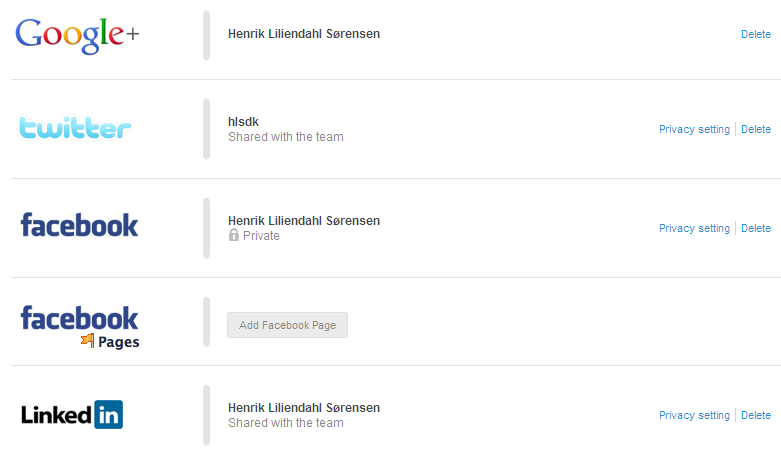
I have just tried out such a solution called Nimble.

If you are more than a one-man-band company it’s interesting in what degree you are willing (or forced) to share your connections as master data entities for the CRM solution.

In Nimble you have the choice of differentiate for each network. I would probably freely choose a setup with Twitter and LinkedIn as shared with the team, but Facebook as private:

But that is just how I think based on my way of using social networks.

There is a fundamental data quality versus privacy issue around utilizing employee’s social network connections as master data for CRM and eventually enterprise wide Master Data Management (MDM).

All things equal data quality will be best if everyone contributes within reason. Not at least in sales, but also more or less in other functions, you are hired also because of your relations.

What do you think?

Bookmark and Share

Informatics for adding value to information

Recently the Global Agenda Council on Emerging Technologies within the World Economic Forum has made a list of the top 10 emerging technologies for 2012. According to this list the technology with the greatest potential to provide solutions to global challenges is informatics for adding value to information.

As said in the summary: “The quantity of information now available to individuals and organizations is unprecedented in human history, and the rate of information generation continues to grow exponentially. Yet, the sheer volume of information is in danger of creating more noise than value, and as a result limiting its effective use. Innovations in how information is organized, mined and processed hold the key to filtering out the noise and using the growing wealth of global information to address emerging challenges.”

Big data all over

Surely “big data” is the buzzword within data management these days and looking for extreme data quality will be paramount.

Filtering out the noise and using the growing wealth of global information will help a lot in our endurance to make a better world and to make better business.

In my focus area, being master data management, we also have to filtering out the noise and exploit the growing wealth of information related to what we may call Big Master Data.

Big external reference data

The growth of master data collections is also seen in collections of external reference data.

For example the Dun & Bradstreet Worldbase holding business entities from around the world has lately grown quickly from 100 million entities to over 200 millions entities. Most of the growth has been due to better coverage outside North America and Western Europe, with the BRIC countries coming in fast. A smaller world resulting in bigger data.

Also one of the BRICS, India, is on the way with a huge project for uniquely identifying and holding information about every citizen – that’s over a billion. The project is called Aadhaar.

When we extend such external registries also to social networking services by doing Social MDM, we are dealing with very fast growing number of profiles in Facebook, LinkedIn and other services.

Surely we need informatics for adding the value of big external reference data into our daily master data collections.

Bookmark and Share

Five Moments of Truth in Subscriber Data Management

The term “Subscriber Data Management” with SDM as the TLA is the industry flavor in the telecommunication sector of the general term “Customer Data Management”.

Recently Teresa Cottam, research director of Telesperience, made a good introduction to the subject in an interview on DataQualityPro.com.

As we have a term as “Customer Master Data Management” we will then also have a term as “Subscriber Master Data Management”.

Based on my experience with phone companies “Subscriber Master Data Management” will be very much about (better) handling the subscriber’s life circle.

These are probably the five most important moments in a subscriber’s life circle(s):

  • A lead is born
  • Engaging a prospect
  • One more subscriber
  • Churn happens
  • Win-Back happiness

A lead is born

One of the most important things to do when capturing the data at this point is ensuring if you already have the person/business behind the subscriber somewhere in the life circle or maybe even in other party roles as examined in the post 360° Business Partner View.

Engaging a prospect

Much of the information prospects are asked about already exist somewhere in the cloud. Why not take advantage of these rich sources as described in Reference Data at Work in the Cloud. By doing that you will have fewer keystrokes and a much better chance of getting it right the first time.  

One more subscriber

After a successful sales process a new subscriber can be added to the subscriber list often with more data being captured as adding a billing address and stating credit risk as credit limit and terms of payment.

This is the point where many party entities are split into data silos. Maybe the current subscriber master data lives on in sales oriented systems while new subscriber data are reentered and enriched in an ERP system and other business applications.

Keeping these data silos aligned is the master data challenge as discussed in the post Boiling Data Silos.

Churn happens

A churn is often seen as the termination of a given subscription. But did the person/business behind the subscription really quit or is the service still covered by other subscriptions by the same person, by the household or within a company family tree?

Isn’t the person among us anymore or did a business dissolve?  

Such questions can be answered better if you are practicing Ongoing Data Maintenance

Win-Back happiness

If a person or business really did quit, but then comes back, then be sure to build on the data from the first engagement and not start from scratch again capturing master data and history. Avoiding this covers up for some of the 55 reasons to improve data quality related to party master data uniqueness.

Bookmark and Share

Wildcard Search versus Fuzzy Search

My last post about search functionality in Master Data Management (MDM) solutions was called Search and if you are lucky you will find.

In the comments the use of wildcards versus fuzzy search was touched.

The problem with wildcards

I have a company called “Liliendahl Limited” as this is the spelling of the name as it is registered with the Companies House for England and Wales.

But say someone is searching using one of the following strings:

  • “Liliendahl Ltd”,
  • “Liliendal Limited” or
  • “Liljendahl Limited”

Search functionality should in these situations return with the hit “Liliendahl Limited”.

Using wildcard characters could, depending on the specific syntax, produce a hit in all combinations of the spelling with a string like this: “lil?enda*l l*”.

The problem is however that most users don’t have the time, patience and skills to construct these search strings with wildcard characters. And maybe the registered name was something slightly else not meeting the wildcard characters used.  

Matching algorithms

Tools for batch matching of name strings have been around for many years. When doing a batch match you can’t practically use wildcard characters. Instead matching algorithms typically rely of one, or in best case a combination, of these techniques:

The same techniques can be used for interactive search thus reaching a hit in one fast search.

Fuzzy search

I have worked with the Omkron FACT algorithm for batch matching. This algorithm has morphed into being implemented as a fuzzy search algorithm as well.

One area of use for this is when webshop users are searching for a product or service within your online shop. This feature is, along with other eCommerce capabilities, branded as FACT-Finder.

The fuzzy search capabilities are also used in a tool I’m involved with called iDQ. Here external reference data sources, in combination with internal master data sources, are searched in an error tolerant way, thus making data available for the user despite heaps of spelling possibilities.

Bookmark and Share

Search and if you are lucky you will find

This morning I was following the tweet stream from the ongoing Gartner Master Data Management (MDM) conference here in London, when another tweet caught my eyes:

This reminded me about that (error tolerant) search is The Overlooked MDM Feature.

Good search functionality is essential for making the most out of your well managed master data.

Search functionality may be implemented in these main scenarios:

Inside Search

You should be able to quickly find what is inside your master data hub.

The business benefits from having fast error tolerant search as a capacity inside your master data management solution are plenty, including:

  • Better data quality by upstream prevention against duplicate entries as explained in this post.
  • More efficiency by bringing down the time users spends on searching for information about entities in the master data hub.
  • Higher employee satisfaction by eliminating a lot of frustration else coming from not finding what you know must be inside the hub already.

MDM inside search capabilities applies to multiple domains: Party, product and location master data.

Search the outside

You should be able to quickly find what you need to bring inside your master data hub.

Data entry may improve a lot by having fast error tolerant search that explores the cloud for relevant data related to the entry being done. Doing that has two main purposes:

  • Data entry becomes more effective with less cumbersome investigation and fewer keystrokes.
  • Data quality is safeguarded by better real world alignment.

Preferably the inside and the outside search should be the same mash-up.

Searching the outside is applies especially to location and party master data.

Search from the outside

Website search applies especially to product master data and in some cases also to related location master data as described in the post Product Placement.

Your website users should be able to quickly find what you publish from your master data hub be that description of physical products, services or research documents as in the case of Gartner, which is an analyst firm.

As said in the tweet on the top of this post, (good) search makes the life of your coming and current customers much easier. Do I need to emphasize the importance of good customer experience?

Bookmark and Share

Small Business Owners

A challenge I encounter over and over again within Data Matching and customer Master Data Management is what to do with small business owners.

Examples of small business owners are:

  • Farmers
  • Healthcare professionals with an own clinic
  • Small family driven shop owners
  • Modest membership organisation administrators
  • Local hospitality providers as Basil Fawlty of Fawlty Towers
  • Independent Data Quality consultants as myself

When handling customer master data we often like to divide those into Business-to-consumer (B2C) or Business-to-business (B2B). We may have different source systems, different data models and different data owners and data stewards for each of the two divisions.

But small business owners usually belong to both divisions. In some transactions they act as private persons (B2C) and in some other transactions they act as a business contact (B2B). If you like to know your customer, have a single customer view , engage in social media and all that jazz, you must have a unique view of the person, the business and the household.

In several industries small business owners, the business and the household is a special target group with unique product requirements. This is true for industries as banking, insurance, telco, real estate, law.

So here are plenty of business cases for multi-domain Master Data Management embracing customer master data and product master data.

The capability to handle a single customer view of small business owners is in my experience very poorly fulfilled in Data Quality and Master Data Management solutions around. Here is certainly room for improvement and entrepreneurship.

Bookmark and Share