Killing Keystrokes

Keystrokes are evil. Every keystroke represents a potential root cause of poor data quality by spelling things wrongly, putting the right thing in the wrong place, putting the wrong thing in the right place and so on. Besides that every keystroke is a cost of work summing up with all the other keystrokes to gigantic amounts of work costs.

In master data management (MDM) you will be able to getting things right, and reduce working costs, by killing keystrokes wherever possible.

Killing keystrokes in Product Information Management (PIM)

I have seen my share of current business processes where product master data are reentered or copied and pasted from different sources extracted from one product master data container and, often via spreadsheets, captured into another product master data container.

This happens inside organizations and it happens in the ecosystem of business partners in supply chains encompassing manufactures, distributors and retailers.

As touched in the post Social PIM there might be light at the end of the tunnel by the rise of tools, services and platforms setting up collaboration possibilities for sharing product master data and thus avoiding those evil keystrokes.

Killing keystrokes in Party Master Data Management

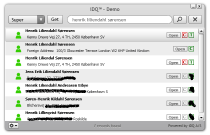
With party master data there are good possibilities of exploiting external data from big reference data sources and thus avoiding the evil keystrokes. The post instant Data Quality at Work tells about how a large utility company have gained better data quality, and reduced working costs, by using the iDQ™ service in that way within customer on-boarding and other business processes related to customer master data maintenance.

The next big thing in this area will be the customer data integration (CDI) part of what I call Social MDM, where you may avoid the evil keystrokes by utilizing the keystrokes already made in social networks by who the master data is about.


Bookmark and Share

Cross Border Data Quality

In data quality improvement you always have to find a balance between the almost impossible, and usually not sensible, vision of achieving zero percent defects and the good old 80-20 rule about aiming at the 80% most frequent issues and leaving the 20% not so frequent issues to a random fate.

One of the issues that usually falls into the 20% neglected issues is cross border challenges with contact master data.

In a recent blog post on the Postcode Anywhere blog Graham Rhind describes the data quality flaws arising from his relocation from Holland in the Netherlands to Germany. The post is called Validate … intelligently.

Personally I have had a lot of similar issues when moving from Denmark to England in the United Kingdom as for example described in the post Staying in Doggerland.

My guess is that we will see an increasing demand for cross border data quality services not at least as regulators are increasingly looking into cross border issues. The FATCA regulation from the United States tax authorities is an example as described in the post The Taxman: Data Quality’s Best Friend.

As globalization moves forward organizations will increasingly work cross border, people will move between countries and more frequently live in one country and work in another country and buy services in another country. In coping with this reality you can’t keep up with data quality by just using a National Change of Address service and other data quality services focused on and optimized for a single country.

Bookmark and Share

Business Entity Identifiers

The least cumbersome way of uniquely identifying a business partner being a company, government body or other form of organization is to use an externally provided number.

However, there are quite a lot of different numbers to choose from.

All-Purpose National Identification Numbers

In some counties, like in Scandinavia, the public sector assigns a unique number to every company to be used in every relation to the public sector and open to be used by the private sector as well for identification purposes.

As reported in the post Single Company View I worked with the early implementation of such a number in Denmark way back in time.

Single-Purpose National Identification Numbers

In most countries there are multiple systems of numbers for companies each with an original special purpose. Examples are registration numbers, VAT numbers and employer identification numbers.

My current UK company has both a registration number and a VAT number and very embarrassing for a data quality and master data geek these two numbers have different names and addresses attached.

Other Numbering Systems

The best known business entity numbering system around the world is probably the DUNS-number used by Dun & Bradstreet. As examined in the post Select Company_ID from External_Source Where Possible the use of DUNS-numbers and similar business directory id’s is a very common way of uniquely identifying business partners.

In the manufacturing and retail world legal entities may, as part of the Global Data Synchronization Network, be identified with a Global Location Number (GLN).

There has been a lot of talk in the financial sector lately around implementing yet a new numbering system for legal entities with an identifier usually abbreviated as LEI. Wikipedia has the details about a Legal Entity Identification for Financial Contracts.

These are only some of the most used numbering systems for business entities.

So, the trend doesn’t seem to be a single source of truth but multiple sources making up some kind of the truth.

Bookmark and Share

The Big MDM Trend

Back in 2011 Gartner (the analyst firm) released a document where Gartner Highlights Three Trends That Will shape the Master Data Management Market.

The three things were:

  • Multi-Domain MDM
  • MDM in the Cloud
  • MDM and Social Networks

MDM and Social Networks (also called Social MDM) was described as shown below:

Gartner 3 MDM things 2011

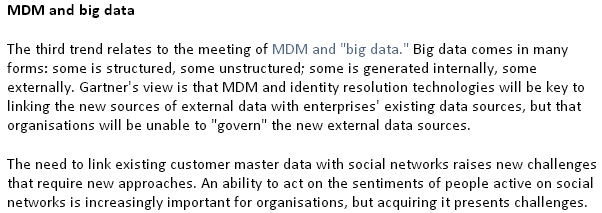
In a 2012 article on Computerweekly called Three trends that will shape the master data management market also by John Radcliffe of Gartner the three trends are repeated however with social MDM now described in the context of MDM and big data:

Gartner 3 MDM things 2012

The slightly different use of terms to describe the trends and what it entails used by Gartner follows the big trend of using the term “big data” by everyone else in the industry as discussed in the post Data Quality vs Big Data, where you see that the use of the term “big data” exploded just after the original Gartner piece on the three trends.

Bookmark and Share

Going in the Wrong Direction

When travelling with the London Underground I have several times noticed that the onboard passenger information system is set wrong, typically as if we are going in the opposite direction as what was announced on the station and where the train actually is heading.

People’s reactions

The reaction among the passengers to this data quality flaw varies. Most people who seem to be frequent commuters don’t seem to bother but keeps calm and carries on. Tourists on the other hand get confused and immediately try to appoint the culprit among them who apparently got them on the wrong train.

As the information system keeps on announcing the next station as the one we just left everyone not being new passengers keeps calm and carries on in the opposite direction of the data presented.

Big data quality issues

The problem with wrong journey settings in data collection within public transportation has actually been a challenge I have worked with a lot.

Besides confusing the passengers if presented on the onboard passenger information display and voicing, the data collection may also be corrupted leading to data quality issues when data is stored in a data warehouse or by other techniques in order to facilitate analysis of passenger travel patterns, how well the services applies to schedules and other reporting based on these big numbers of transaction data collected every day.

Aligning with master data

The challenge is to correctly join the transaction data with the right master data entities. A vehicle stop, and in some cases the passenger boarding and alighting, must be associated with the right product being a given journey on a given service according to a given time schedule.

Many other exploitations of big data shares the same basic data quality challenge. If we don’t get the transaction data joined correctly with the master data entities involved, any analysis and reporting may be going in the wrong direction.

Bookmark and Share

Social PIM

During the last couple of years I have been talking about social MDM (Social Master Data Management) on this blog.

MDM (Master Data Management) mainly consists of two disciplines: CDI (Customer Data Integration) and PIM (Product Information Management).

With social MDM most of the talk have been around CDI as the integration of social network profiles with traditional customer (or party) master data.

But there is also a PIM side of social MDM.

Making product data lively

The other day Kimmo Kontra had a blog post called With Tiger’s clubs, you’ll golf better – and what it means to Product Information Management. Herein Kimmo examines how stories around products help with selling products. Kimmo concludes that within master data management there is going to be a need for storing and managing stories.

I agree. And having stories related to your products and services is a must for social selling. Besides having the right hard facts about products consistent across multiple channels, and having the right images and other rich media consistent as well, you will also need to include the right and consistent stories when the multiple channels embraces social media.

Sharing product data

How do we ensure that we share the same product information, including the same stories, across the ecosystem of product manufacturers, distributors and retailers?

Recently I learned about a cloud service called Actualog aiming at doing exactly that with emphasis on the daunting task of sharing product data in an international environment with different measurement systems, languages, alphabets and script systems.

Actualog very much resembles the cloud service called iDQ™ I’m working with related to customer data integration.

Listening to big data

As discussed in the post Big Data and Multi Domain Master Data Management a prerequisite for getting sense out of analyzing social data (and other big data sources) is, that you not only have a consistent view of the product data related to products that you sell yourself, but also have a consistent view of competing products and how they relate to your products.

So, social PIM requires you to extend the volume of products handled by your product information management solution probably in alternate product hierarchies.

Bookmark and Share

Photo Finish in MDM Vendor Race

With the London Olympics going on we will probably see a lot of winners after a photo finish.

I noticed another photo finish in a recent analyst report called The MDM Landscape Q2 2012 by the Information Difference.

The MDM (Master Data Management) vendors are scored by technology and market strength. If we look at the technology axis – the vertical one, there is a close race.

Orchestra shared the victory on twitter:

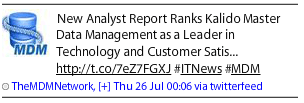
Kalido was also mentioned on twitter:

The linked press release from Kalido has a subtitle telling that Kalido was in front of the megavendors.

As mentioned in the report the vendors are actually not competing in the exact same discipline. Some vendors MDM offerings are part of a larger suite, some vendors focus on a single domain (like product) or industry and some vendors are generalists embracing multi-domain MDM.

This situation is also why another analyst firm, Gartner, have two magic quadrants for MDM vendors: One for customer MDM and one for product MDM.

However the trend is that more and more vendors are going towards multi-domain MDM. I know that for sure as I have been involved in one of the product MDM specialists journeys within multi-domain MDM.

So we could expect an even closer match in the Multi-Domain MDM race in the years to come.

Bookmark and Share

The Big Tower of Babel

3 years ago one of the first blog posts on this blog was called The Tower of Babel.

This post was the first of many posts about multi-cultural challenges in data quality improvement. These challenges includes not only language variations but also different character sets reflecting different alphabets and script systems, naming traditions, address formats, measure units, privacy norms, government registration practice to name some of the ones I have experienced.

When organizations are working internationally it may be tempting to build a new Tower of Babel imposing the same language for metadata (probably English) and the same standards for names, addresses and other master data (probably the ones of the country where the head quarter is).

However, building such a high tower may end up the same way as the Tower of Babel known from the old religious tales.

Alternatively a mapping approach may be technically a bit more complex but much easier when it comes to change management.

The mapping approach is used in the Universal Postal Unions’ (UPU) attempt to make a “standard” for worldwide addresses. The UPU S42 standard is mentioned in the post Down the Street. The S42 standard does not impose the same way of writing on envelopes all over the world, but facilitates mapping the existing ways into a common tagging mapped to a common structure.

Building such a mapping based “standard” for addresses, and other master data with international diversity, in your organization may be a very good way to cope with balancing the need for standardization and the risks in change management including having trusted and actionable master data.

The principle of embracing and mapping international diversity is a core element in the service I’m currently working with. It’s not that the instant Data Quality service doesn’t stretch into the clouds. Certainly it is a cloud service pulling data quality from the cloud. It’s not that that it isn’t big. Certainly it is based on big reference data.

Bookmark and Share

Beyond Address Validation

The quality of contact master data is the number one data quality issue around.

Lately there has been a lot of momentum among data quality tool providers in offering services for getting at least the postal address in contact data right. The new services are improved by:

  • Being cloud based offering validation services that are implemented at data entry and based on fresh reference data.
  • Being international and thus providing address validation for customer and other party data embracing a globalized world.

Capturing an address that is aligned with the real world may have a significant effect on business outcomes as reported by the tool vendor WorldAddresses in a recent blog post.

However, a valid address based on address reference data only tells you if the address is valid, not if the addressee is (still) on the address, and you are not sure if the name and other master data elements are accurate and complete. Therefore you often need to combine address reference data with other big reference data sources as business directories and consumer/citizen reference sources.

Using business directories is not new at all. Big reference sources as the D&B WorldBase and many other directories have been around for many years and been a core element in many data quality initiatives with customer data in business-to-business (B2B) environments and with supplier master data.

Combining address reference data and business entity reference data makes things even better, also because business directories doesn’t always come with a valid address.

Using public available reference data when registering private consumers, employees and other citizen roles has until now been practiced in some industries and for special reasons. Therefore the big reference data and the services are out there and being used today in some business processes.

Mashing up address reference data, business entity reference data and consumer/citizen reference data is a big opportunity for many organizations in the quest for high quality contact master data, as most organizations actually interact with both companies and private persons if we look at the total mix of business processes.

The next big source is going to be exploiting social network profiles as well. As told in the post Social Master Data Management social media will be an additional source of knowledge about our business partners. Again, you won’t find the full truth here either. You have to mashup all the sources.

Bookmark and Share

Mashing Up Big Reference Data and Internal Master Data

Right now I’m working on a cloud service called instant Data Quality (iDQ™).

It is basically a very advanced search engine capable of being integrated into business processes in order to get data quality right the first time and at the same time reducing the time needed for looking up and entering contact data.

With iDQ™ you are able to look up what is known about a given address, company and individual person in external sources (I call these big reference data) and what is already known in internal master data.

From a data quality point of view this mashup helps with solving some of the core data quality issues almost every organization has to deal with, being:

  • Avoiding duplicates
  • Getting data as complete as possible
  • Ensuring maximal accuracy

The mashup is also a very good foundation for taking real-time decisions about master data survivorship.

The iDQ™ service helps with getting data quality right the first time. However, you also need Ongoing Data Maintenance in order to keep data at a high quality. Therefore iDQ™ is build for trigging into subscription services for external reference data.

At iDQ we are looking for partners world-wide who see the benefit of having such a cloud based master data service connected to providing business-to-business (B2B) and/or business-to-consumer (B2C) data services, data quality services and master data management solutions.

Here’s the contact data: http://instantdq.com/contact/

Bookmark and Share