Multi-domain Master Data Management is usually perceived as the union of Customer MDM, Supplier MDM and Product MDM. It is. And it is much more than that.
Customer MDM is typically about federating the accounts receivable in the ERP system(s) and the direct and prospective accounts in the CRM system(s). Golden records are formed through deduplication of multiple representations of the same real-world entity.
Supplier (or vendor) MDM is typically about federating the accounts payable in the ERP system(s) and the existing and prospective accounts in the SRM system(s). A main focus is on the golden records and the company family tree they are in.
Product MDM has a buy-side and a sell-side.
On the buy-side MDM is taking care of trading data for products to resell, in manufacturing environments also the trading data for raw materials and in some cases also for parts to be used in Maintenance, Repair and Operation (MRO). The additional long tail of product specifications may in resell scenarios be onboarded in an embedded/supplementary Product Information Management (PIM) solution.
On the sell-side the trading data are handled for resell products and in manufacturing environments the finished products. The additional long tail of product specifications may be handled in an embedded/supplementary Product Information Management (PIM) solution.

Multidomain MDM does this in a single solution / suite of solutions. And much more as for example:
- Supplier contacts can be handled in a generic party master data structure.
- Customer contacts can be handled in a generic party master data structure
- Besides the direct accounts in CRM the indirect accounts and contacts can in the party master data structure too. Examples of such parties are:
- Influencers in the form of heath care professionals in life science.
- Influencers in the form of architects and other construction professionals in building material manufacturing.
- End consumers in many supply chain B2B2C scenarios.
- Employee records can be handled in a generic party master data structure. The roles of sales representatives and their relation to customers, influencers, product hierarchies and location hierarchies can be handled as well as purchase responsibles and their relation to suppliers, influencers, product hierarchies and location hierarchies can be handled.
- The relation between suppliers and product hierarchies and location hierarchies cand be handled.
- The relation between customers and end consumers and the product hierarchies and location hierarchies can be handled.
- Inbound product information feeds from suppliers can be organized and optimized through Product Data Syndication (PDS) solutions.
- The relation between customer preferences and product information can be handled in Product eXperience Management (PXM).
- Outbound product information feeds to resellers can be organized and optimized through Product Data Syndication (PDS) solutions.
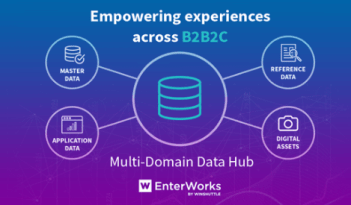 The EnterWorks solution has during the latest years, as a small crowd of other solutions on the market, grown from being a PIM solution to be a Multi-domain MDM solution. But they have not stopped there. EnterWorks is also a Multi-enterprise MDM solution and is thus covering the needs of sharing master d
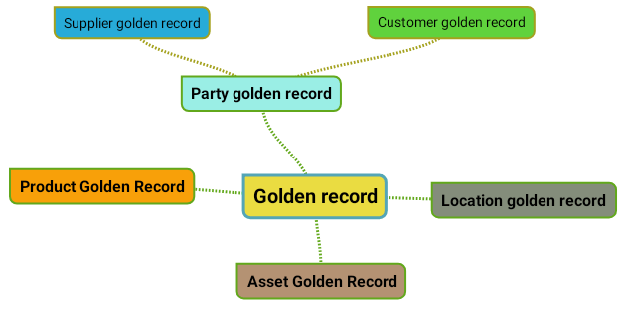 Product Golden Record

 Bigger picture
 Two of the most addressed data management topics on this blog is data matching and multidomain Master Data Management (MDM). In addition, I have also founded two LinkedIn Groups for people interested in one of or both topics.
 The Multi-Domain MDM Group has close to 2,500 members. In here we exchange knowledge on how to encompass more than a single master data domain in an MDM initiative. In that way the group also covers the evolution of MDM as the discipline – and solutions – has emerged from Customer Data Integration (CDI) and Product Information Management (PIM).
 Liliendahl on Data Quality