Multi-Domain MDM Market Update

Multi-Domain MDMIn the recent post called The MDM Landscape is Slowly Changing I wrote about some findings in the latest MDM market research document by the Information Difference.

Recently Bloor published their view on the MDM Market including who is in or close to the bull’s eye. You may read the document called Master Data Management Market update by following the press release on the paper from Informatica here.

The two views are in agreement on a lot of things including how Multi-Domain MDM is becoming the norm.  The alignment of views is no surprise as I guess that there is only one Andy Hayler around in the MDM sphere and he is the man behind both documents.

And hey, if you agree with Andy about Multi-Domain MDM, why not join the LinkedIn Multi-Domain MDM group.

Bookmark and Share

Is Managing Master Data a Differentiating Capability?

If you are a Master Data Management (MDM) fanatic seeing the MDM solution as the centre of the universe and you plan to attend the MDM Summit Europe 2013 then you might as well start to work on your consistency in booing and your accuracy in throwing rotten tomatoes.

In the session called Multi-Entity MDM for the Enterprise Bert Hooyman will shock you by telling that managing master data is not considered a differentiating capability at Royal Philips Electronics.

The solution at Philips is based on the information factory idea and built upon data warehouse technology. Master data and transactional data are treated equally.

saving bulb MDMWhere others may struggle with Multi-Entity / Multidomain MDM the path chosen by Philips already serves multiple business cases for combining party master data and product master data.

I guess the term “a Philips light bulb moment” could have been used too much, so let me just say that I look forward to be enlightened on how to do MDM in an energy saving way.

Bookmark and Share

The Real Estate Domain

In the comments on the recent blog post about multidomain MDM (Master Data Management) it was discussed in what degree multidomain MDM is much more than CDI (Customer Data Integration) and PIM (Product Information Management).

While customer (or rather party) and product are important master entity types, there are of course a lot of other master entity types. The location domain is often mentioned as the third domain in MDM, and then there are some entity types most relevant for specific industries like an insurance policy or a vehicle in public transit, and in public transit we also have the calendar as an important master entity type.

Real estateOne of the entity types that doesn’t belong to party and in many ways is a different thing than a product is real estate (or real property or just property if you like).

For a realtor a real estate looks like a product of course. And it’s all about location, location, location.

Right now I’m working with the instant Data Quality framework. Here we are embracing the party domain by having access to external reference sources about individuals and companies, we are embracing the location domain by having access to external reference sources about addresses and then we are also embracing the real estate domain by having access to external reference sources about properties.

Real properties have addresses in many cases and are therefore close to the location domain. For some business processes it is a product with a product key like mentioned for realtors. For some business processes it is a security often identified by other keys than the postal address. It is related to different party roles like an occupier (or several) and an owner (or several) that may or may not be the same party (or parties).

What about you. Do you feel at home with the real estate entity type?

Bookmark and Share

Multi-Entity MDM vs Multidomain MDM

puzzleOn the upcoming MDM Summit Europe 2013 in London this April you will be able to learn about Multi-Entity MDM as well as Multi-Domain MDM.

So, what is the difference between Multi-Entity MDM and Multi-Domain MDM?

To my knowledge it is two terms having the same meaning. It is doing the two main preceding disciplines for MDM being Customer Data Integration (CDI) and Product Information Management (PIM) at the same time presumably using the same software brand.

Multi-Entity MDM was probably the first term used and still used by The MDM Institute while Multidomain MDM is used by Gartner (the analyst firm) and most tool vendors today. For example Stibo Systems is focusing on mutidomain recently in this press release about latest achievements.

Talking about Gartner and the vendor crowd Gartner analyst Andrew White wrote a blog post the other day: Round-Up of Master Data Management (MDM) 2012, and looking forward to 2013.

Herein White bashes the vendors by saying:

“Vendor hype related to multidomain …. continued to be far in excess of reality”.

What do you think? Is Andrew White right about that? And what about Multi-Entity MDM, is that any better?

Bookmark and Share

The Big MDM Trend

Back in 2011 Gartner (the analyst firm) released a document where Gartner Highlights Three Trends That Will shape the Master Data Management Market.

The three things were:

  • Multi-Domain MDM
  • MDM in the Cloud
  • MDM and Social Networks

MDM and Social Networks (also called Social MDM) was described as shown below:

Gartner 3 MDM things 2011

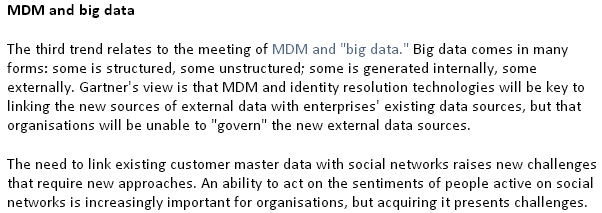
In a 2012 article on Computerweekly called Three trends that will shape the master data management market also by John Radcliffe of Gartner the three trends are repeated however with social MDM now described in the context of MDM and big data:

Gartner 3 MDM things 2012

The slightly different use of terms to describe the trends and what it entails used by Gartner follows the big trend of using the term “big data” by everyone else in the industry as discussed in the post Data Quality vs Big Data, where you see that the use of the term “big data” exploded just after the original Gartner piece on the three trends.

Bookmark and Share

Photo Finish in MDM Vendor Race

With the London Olympics going on we will probably see a lot of winners after a photo finish.

I noticed another photo finish in a recent analyst report called The MDM Landscape Q2 2012 by the Information Difference.

The MDM (Master Data Management) vendors are scored by technology and market strength. If we look at the technology axis – the vertical one, there is a close race.

Orchestra shared the victory on twitter:

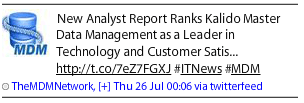
Kalido was also mentioned on twitter:

The linked press release from Kalido has a subtitle telling that Kalido was in front of the megavendors.

As mentioned in the report the vendors are actually not competing in the exact same discipline. Some vendors MDM offerings are part of a larger suite, some vendors focus on a single domain (like product) or industry and some vendors are generalists embracing multi-domain MDM.

This situation is also why another analyst firm, Gartner, have two magic quadrants for MDM vendors: One for customer MDM and one for product MDM.

However the trend is that more and more vendors are going towards multi-domain MDM. I know that for sure as I have been involved in one of the product MDM specialists journeys within multi-domain MDM.

So we could expect an even closer match in the Multi-Domain MDM race in the years to come.

Bookmark and Share

Big Data and Multi-Domain Master Data Management

The possible connection between the hot buzz within IT today being “big data” and the good old topic of master data management has been discussed a lot lately. An example from CIO UK today is this article called Big data without master data management is a problem.

As said in the article there is a connection through big master data (and big reference data) to big transaction data. Big transaction data is what we usually would call big data, because these are the really big ones.

The two most mentioned kind of big transaction data are:

  • Social data and
  • Sensor data

I also have seen a lot of connections between these big data and master data in multiple domains.

Social Data

Connecting social data to Master Data Management (MDM) is an ongoing discussion I have been involved in for the last three years lately through the new LinkedIn group called Social MDM.

The customer master data domain is in focus here, as the immediate connection here is how to relate traditional systems of record holding customer master data and the systems of engagement where the big social data are waiting to be analyzed and eventually be a part of day-to-day customer centric business processes.

However being able to analyze, monitor and take action on what is being said about specific products in social data is another option and eventually that has to be linked to product master data. In product master data management the focus has traditionally been on your own (resell) products. Effectively listening to social data will mean that you also have to manage data about competing products.

Attaching location to social data has been around for long. Connecting social data to your master data will also require that your location master data are well aligned with the real world.

Sensor Data   

During the past many years I have been involved in data management within public transportation where we have big data coming in from sensors of different kind.

The big problem has for sure being able to connect these transactions correctly to master data. The challenges here are described in the post Multi-Entity Master Data Quality.

The biggest problem is that all the different equipment generating the sensor data in practice can’t be at the same stage at the same time and this will eventually create data that if related without care will show very wrong information about who was the passenger(s), what kind of trip it were, where the journey happened and under which timetable.

Bookmark and Share

Social Commerce and Multi-Domain MDM

The term social commerce is said to be a subset of eCommerce where social media is used to ultimately drag prospects and returning customers to your website, where a purchase of products and services can be made.

In complex sales processes, typically for Business-to-Business (B2B) sales, the website may offer product information sheets, demo requests, contact forms and other pipeline steps.

This is the moment where your social media engaged (prospective) customer meets your master data as:

  • The (prospective) customer creates and maintains name, address and communication information by using registration functions
  • The (prospective) customer searches for and reads product information on web shops and information sites

One aspect of this transition is how master data is carried over, namely:

  • How the social network profile used in engagement is captured as part of (prospective) customer master data or if it should be part of master data at all?
  • How product information from the governed master data hub has been used as part of the social media engagement or if the data governance of product data should be extended to use in social media at all?

Any thoughts?

Bookmark and Share

Small Business Owners

A challenge I encounter over and over again within Data Matching and customer Master Data Management is what to do with small business owners.

Examples of small business owners are:

  • Farmers
  • Healthcare professionals with an own clinic
  • Small family driven shop owners
  • Modest membership organisation administrators
  • Local hospitality providers as Basil Fawlty of Fawlty Towers
  • Independent Data Quality consultants as myself

When handling customer master data we often like to divide those into Business-to-consumer (B2C) or Business-to-business (B2B). We may have different source systems, different data models and different data owners and data stewards for each of the two divisions.

But small business owners usually belong to both divisions. In some transactions they act as private persons (B2C) and in some other transactions they act as a business contact (B2B). If you like to know your customer, have a single customer view , engage in social media and all that jazz, you must have a unique view of the person, the business and the household.

In several industries small business owners, the business and the household is a special target group with unique product requirements. This is true for industries as banking, insurance, telco, real estate, law.

So here are plenty of business cases for multi-domain Master Data Management embracing customer master data and product master data.

The capability to handle a single customer view of small business owners is in my experience very poorly fulfilled in Data Quality and Master Data Management solutions around. Here is certainly room for improvement and entrepreneurship.

Bookmark and Share

Indulgent Moderator or Ruthless Terminator?

I am the founder/moderator of two small niche LinkedIn groups in the data quality and Master Data Management (MDM) realm:

As a moderator I feel responsible for keeping the discussions in the group on target.

I guess my challenges in doing so resemble what nearly every other moderator on LinkedIn groups are faced with.

The postings that keep creating trouble are related to:

  • Jobs
  • Promotions

LinkedIn does have a facility to place entries into these two alternative tabs. But people seldom do that voluntary.

Jobs

In fact I’m pleased when a job is posted in one of the groups. But I also know that many people don’t like job postings coming up among the “normal” discussions in the groups.

I’m not so naive that I think recruiters forget to post as a job or don’t know how to do it. Many recruiters don’t respect the rules even if reminded. And some recruiters keep on entering the same job over and over again.

Therefore I have to mark recruiters, who twice “forget”, as subject to indulgent moderation. As said, I like job postings, so until now I haven’t practiced ruthless termination apart from deleting double entries – but that is also a destination of data matching anyway.

Promotions

With the relative small number of members in the groups in question, and recognising that most participants are tool vendors and service providers, I find it refreshing and informative with entries with promotional content, however most pleased when it’s done with limited marketing triviality.     

My indulgence may be explained by that I’m interconnected with tool makers and service providers myself. So these promotions are great ready-made competitor monitoring.

However, my indulgence has its limits when it comes to off topic promotion.

A special case here is outsourcing promotions. I find it peculiar that those people practicing this trade don’t target the message for the group where posted. It shouldn’t be too hard to make an angle with data matching or Multi-Domain MDM for your services. But I find that most out-sourcing people copy-paste their usual stuff.

So, in this area I mostly am the ruthless terminator. And there is seldom any hasta la vista, baby.

Bookmark and Share